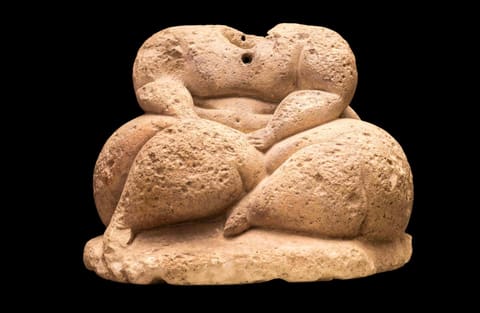
A corpulent seated limestone figure from the megalithic temple of Ħaġar Qim, featured in the museum's carousel of prehistoric highlights.
“Ħaġar Qim Statue” In the museum’s words — heritagemalta.mt ↗ · quotation verified against the live page
The Atlas·MT
Seen from Valletta, history is above all sculpture, then writing & invention — a collection split between its own tradition and other worlds (4 of 8 works are from other civilisations).

A corpulent seated limestone figure from the megalithic temple of Ħaġar Qim, featured in the museum's carousel of prehistoric highlights.
“Ħaġar Qim Statue” In the museum’s words — heritagemalta.mt ↗ · quotation verified against the live page

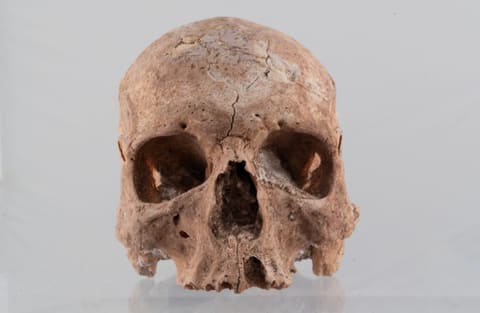
A Neolithic human skull from the collection of skulls excavated at the Ħal Saflieni Hypogeum, displayed on the museum's upper floor; the remains were recovered under Fr Emmanuel Magri and later Sir Themistocles Zammit.
“On the upper floor, one can see the collection of skulls from the Ħal Saflieni Hypogeum, dating to the Neolithic period.” In the museum’s words — heritagemalta.mt ↗ · quotation verified against the live page
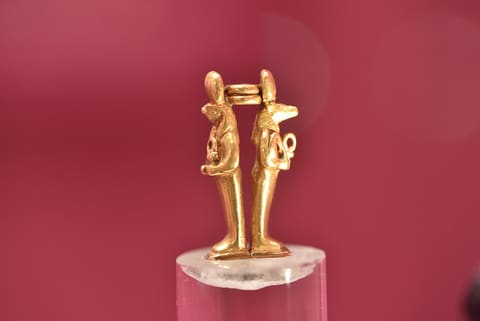
A small Phoenician gold pendant modelled as two standing figures with the heads of the Egyptian gods Horus (falcon) and Anubis (jackal), from the museum's Phoenician-period collection of glass and gold artefacts.
“Horus & Anubis pendant” In the museum’s words — heritagemalta.mt ↗ · quotation verified against the live page
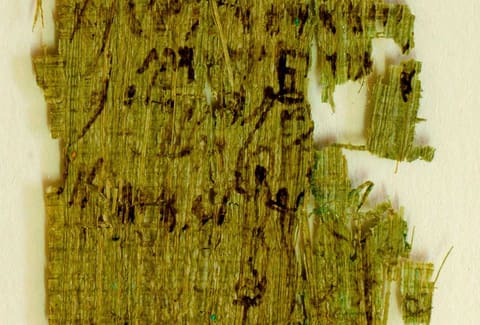
A fragment of papyrus bearing a Phoenician inscription in ink, preserved in the museum's Phoenician section (found rolled inside an amulet case).
“Papyrus with Phoenician inscription” In the museum’s words — heritagemalta.mt ↗ · quotation verified against the live page
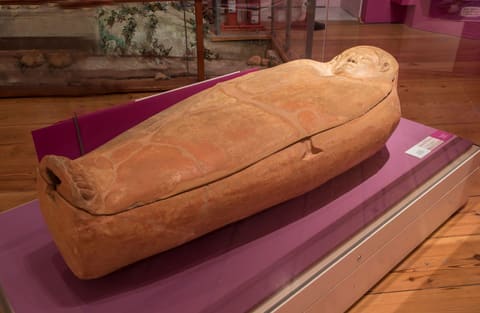
A large terracotta anthropoid sarcophagus with a sculpted human face at the head end, given pride of place in the museum's Phoenician section alongside Phoenician glass and gold.
“Phoenician glass and gold artefacts alongside an impressively large terracotta sarcophagus enjoy the pride of place in this section.” In the museum’s words — heritagemalta.mt ↗ · quotation verified against the live page
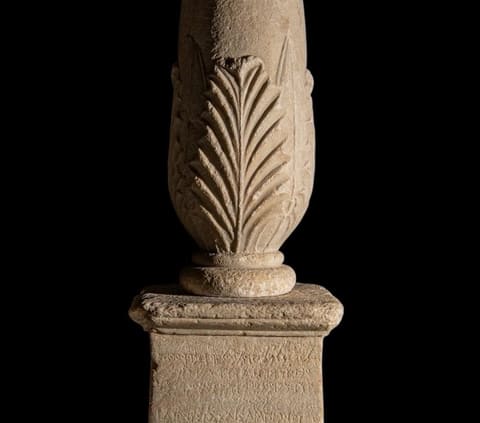
A marble cippus (votive candelabrum on an inscribed base) whose Phoenician inscription played a key role in the decipherment of the Phoenician alphabet. It is exhibited on the museum's second floor beside a copy of its twin, the Louvre Cippus.
“Another important artefact is the Cippus, which played a key role in the decipherment of the Phoenician alphabet.” In the museum’s words — heritagemalta.mt ↗ · quotation verified against the live page
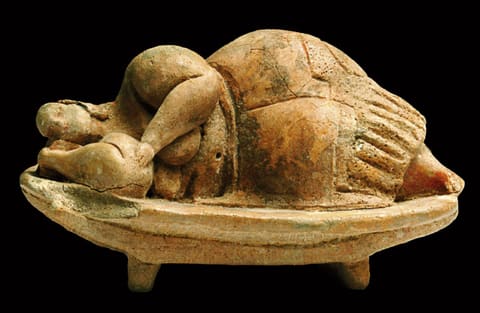
A small terracotta figure of a woman lying asleep on her side on a couch, recovered from the underground burial complex of the Ħal Saflieni Hypogeum. The museum presents it as a highlight of its Neolithic ground floor.
“Excavated from the renowned Maltese UNESCO World Heritage Sites, the megalithic structures and the Ħal Saflieni Hypogeum, these include highlights such as The Sleeping Lady, The Venus of Malta and the colossal statue from the Ħal Tarxien Prehistoric Complex.” In the museum’s words — heritagemalta.mt ↗ · quotation verified against the live page

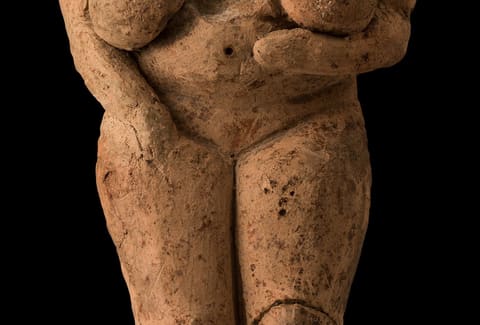
A small nude standing female figure modelled in terracotta with naturalistic detail, from the megalithic site of Ħaġar Qim. The museum lists it among the highlights of its Neolithic collection.
“these include highlights such as The Sleeping Lady, The Venus of Malta and the colossal statue from the Ħal Tarxien Prehistoric Complex.” In the museum’s words — heritagemalta.mt ↗ · quotation verified against the live page