The Atlas·FJ

FJ

Fiji Museum, Suva — 5 works · museum site ↗ · 1100 BCE – 1867 60000 BCE2020

Seen from Suva, history is above all craft & design, then stories & histories — a collection opened wide onto other worlds — a window more than a mirror (5 of 5 works are from other civilisations).

Craft 3 Stories 2
Lapita Pottery
N° 126·I · The First Makers
Lapita Pottery
Unknown (Lapita culture)
Lapita culture, c. 1100–900 BCE (Fiji settled over 3,000 years ago) · earthenware (fired clay)
Lapita

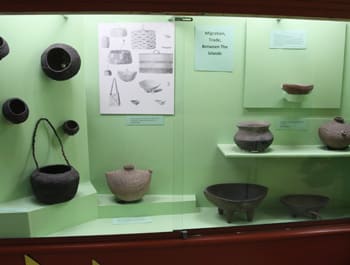
Lapita pottery in the Fiji Museum’s archaeology collection. “Lapita” is the name given to the ancient Pacific culture that colonised much of the Pacific over 3,000 years ago — believed to be the ancestors of modern Pacific Islanders and the first people to settle across much of the region. Much of what is known about them comes from their pottery, decorated in highly distinctive ways, which is central to the museum’s archaeological holdings and to the study of Pacific prehistory.

“Lapita is the name given to an ancient Pacific culture that colonised much of the Pacific over 3000 years ago. They are believed to be the ancestors of modern Pacific Islanders and were the first people to settle across much of the region. Much of what we know about them comes from their pottery, which was decorated in highly distinctive ways and provides insights into where and how they lived.” In the museum’s words — virtual.fijimuseum.org.fj ↗

Meanwhile — Mumienbrett und Innerer Sarg des Nes-pauti-taui Egypt & Nubia · 21st Dynasty, before 969 BC
HMS Bounty Relics
N° 839·VII · The Age of Reason
HMS Bounty Relics
Unknown
HMS Bounty, mutiny of 1789

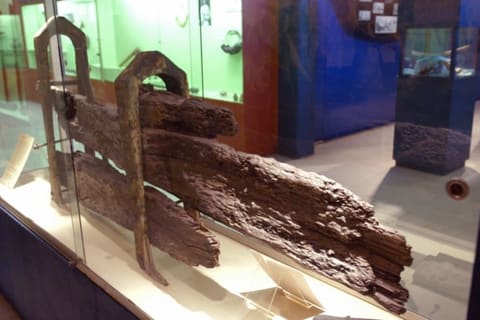
Relics of HMS Bounty held by the Fiji Museum. The museum recounts that one of the earliest sources of contact between Fiji and the Western world came about in 1789, when — following the mutiny aboard the British transport ship HMS Bounty — the ship’s captain (William Bligh) and eighteen other men, cast adrift in a small boat, sailed through the heart of the Fiji archipelago and brought the extent and complexity of the island group to European awareness. The display groups the museum’s Bounty relics, including a rudder, a copper nail, lead deck sheeting and a bronze pin.

“One of the earliest sources of contact between Fiji and the Western world came about in 1789 because of a mutiny aboard the British transport ship, the HMS Bounty . Cast adrift in a small boat, the ship’s captain, along with 18 other men, sailed through the heart of the Fiji archipelago and brought the extent and complexity of the island group to European awareness.” In the museum’s words — virtual.fijimuseum.org.fj ↗

Meanwhile — Self-portrait Europe · 1790

Reverend Thomas Baker Relics
N° 910·VIII · The Restless Century
Reverend Thomas Baker Relics
Unknown
1867

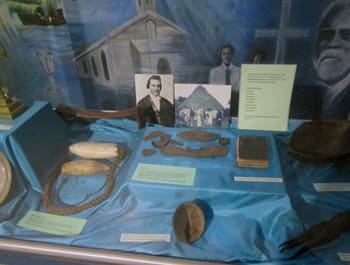
Relics associated with the Reverend Thomas Baker, a Methodist missionary who in 1867 — together with the Fijian minister Setareki Seileka and six of eight Fijian student teachers from Davuilevu — was hacked to death and eaten at Nubutautau in central Viti Levu, the only Methodist missionary killed by followers of the Fijian old religion. The killing followed a chief’s acceptance of a tabua (whale tooth) sent into the mountains to request the murder. The museum’s display brings together objects connected with Baker, including his ordination Bible, his spare boots, an iCula ni bokola (cannibal fork), a tabua, a dish and a bilo.

“In 1867, Reverend Thomas Baker, along with Setareki Seileka (a Fijian minister) and six out of eight Fijian student teachers from Davuilevu were hacked to death and eaten at Nubutautau in central Viti Levu.” In the museum’s words — virtual.fijimuseum.org.fj ↗

Meanwhile — Jo, the Beautiful Irish Girl Europe · signed 1866

Masi (Barkcloth)
N° 1178·Undated
Masi (Barkcloth)
Unknown (Fijian)
Fijian barkcloth (masi) · barkcloth (beaten inner bark of the paper mulberry)
Fijian

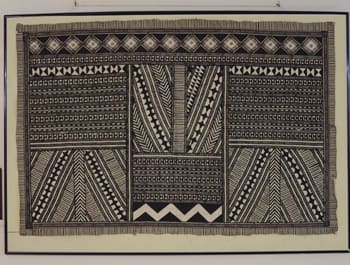
Masi (also called tapa) is Fijian barkcloth — a non-woven cloth made by beating the inner bark of the paper mulberry tree into a compacted web of fibres. Fijian masi has a very distinctive style, with heavy patterning in brown and black, and has been an integral part of life in Fiji for a very long time: used for everyday clothing and wall hangings and for ceremonial and religious purposes such as the installation of chiefs, as costume and props in meke (dance), as chiefly battle flags, and to wrap and store valuables. The Fiji Museum devotes a dedicated gallery to masi.

“Masi (or tapa) is a non-woven cloth produced by beating the inner bark of the paper mulberry tree to form a compacted web of fibers. Similar barkcloths are found throughout the world including the Americas, South-East Asia, Africa and across the Pacific region. Fijian masi has a very distinctive style, with heavy patterning in brown and black and has been an integral part of life in Fiji for a very long time.” In the museum’s words — virtual.fijimuseum.org.fj ↗
Ratu Finau (Drua)
N° 1196·Undated
Ratu Finau (Drua)
Unknown (Fijian)
Fijian drua (double-hulled sailing canoe) · wood
Fijian

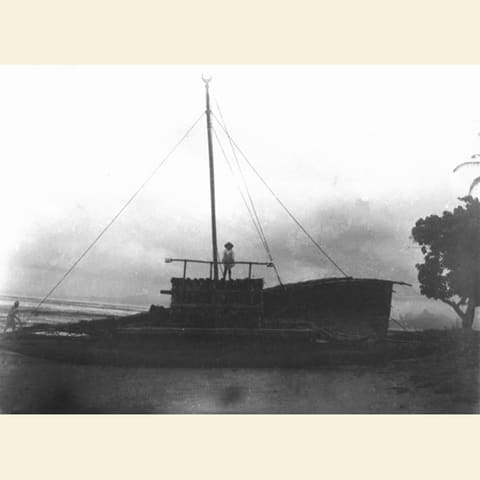
Ratu Finau is a drua, a large Fijian double-hulled sailing canoe, held by the Fiji Museum in Suva, which describes it as its “magnificent national cultural heritage icon.” Recently conserved, it will occupy a prominent position in the museum’s exhibition Voyages: Stories of an Ocean People, the museum states, serving as a platform for stories of Fijian tradition, bravery, discovery, innovation, knowledge and adventure.

“Ratu Finau, our magnificent national cultural heritage icon, has recently undergone crucial conservation and will occupy a prominent position in the gallery” In the museum’s words — fijimuseum.org.fj ↗ · quotation verified against the live page