The Atlas·IT

Italy

Uffizi Gallery, Florence — 14 works · museum site ↗ · 120 BCE – 1790 60000 BCE2020

Seen from Florence, history is above all sacred images, then faces & portraits — a collection kept mostly in its own tradition, with a few glances abroad (1 of 14 works are from other civilisations).

Sacred 6 Portraits 3 Stories 3 Sculpture 2
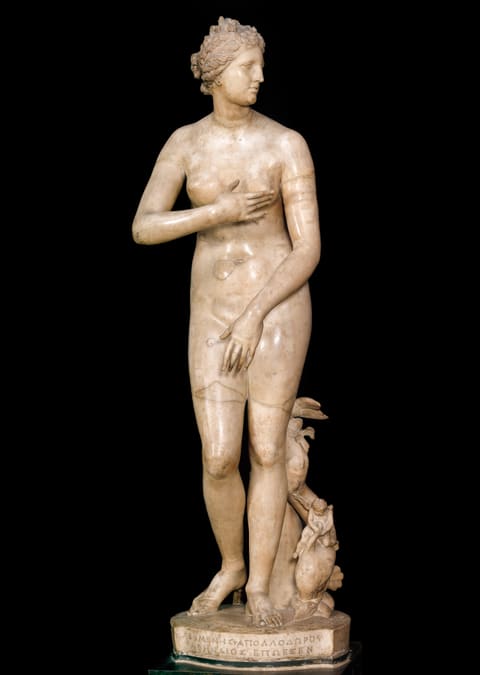
Medici Venus
N° 236·II · The Classical World
Medici Venus
Unknown
Late 2nd century BC – early 1st century BC · Parian marble (lychnite variant), Pentelic marble base
Hellenistic Greek · Hellenistic period

A Hellenistic marble Venus of the 'pudica' type descended from Praxiteles' Aphrodite of Knidos, excavated in Rome in the 16th century, later restored and so prized by Grand Tour visitors that Napoleon had it carried off to Paris before its return to Florence in 1816.

“Venus, the Greek Aphrodite, is depicted according to the iconographic type known as 'pudica’ (chaste). The goddess is caught in the act of instinctively covering her breasts and pubis, as if she was feeling observed by an indiscreet gaze.” In the museum’s words — uffizi.it ↗

Meanwhile — Silver braided torc Europe · 2nd–1st century BC
Wrestlers
N° 254·II · The Classical World
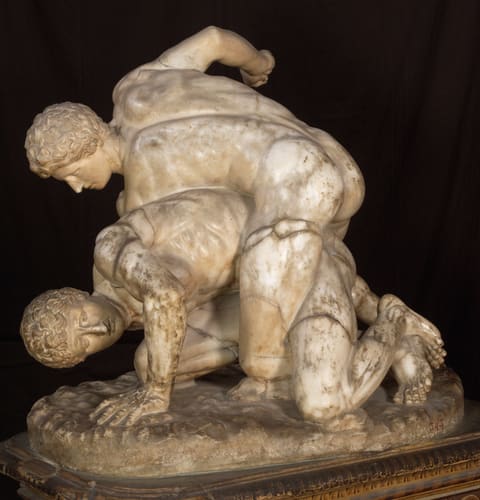
Wrestlers
After Lysippus (Roman copy after a lost bronze original) (c. 390 – c. 300 BC)
1st century AD · Parian marble, lychnite variant
Roman · Imperial Rome

A Roman marble copy after a lost bronze original attributed to Lysippus, unearthed in 1583 alongside the Niobid sculptures in the gardens of the ancient Horti Lamiani in Rome, showing two wrestlers locked in a balanced, unresolved bout.

“The group depicts two men with pronounced muscular structure, engaged in a wrestling bout, rendered particularly realistic by the firm anatomies and good proportions of the subjects.” In the museum’s words — uffizi.it ↗

Meanwhile — Whistling bottle: feline and mouse (Vicús) Americas & Oceania · 400 BCE – 500 CE

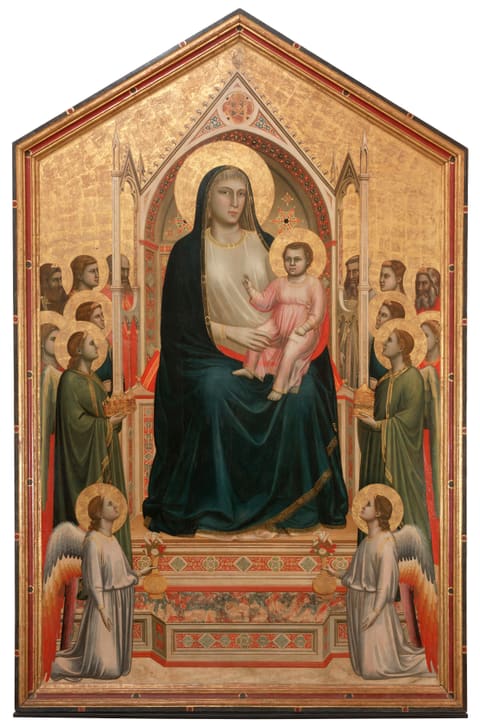
Virgin and Child enthroned, surrounded by angels and saints (Ognissanti Maestà)
N° 524·IV · Toward the Renaissance
Virgin and Child enthroned, surrounded by angels and saints (Ognissanti Maestà)
Giotto (1267–1337)
c. 1300–1305 · Tempera on wood, gold background
Italian · Proto-Renaissance

Giotto's monumental altarpiece for the church of Ognissanti shows the enthroned Virgin and Child surrounded by saints and angels bearing lilies and roses, rendered with a naturalism and plasticity that made it a model for Florentine painters for more than a century.

“Mary, holding Jesus in her arms, is seated on a throne, like a queen. This is the iconography that gives rise to the title “Maestà” or “Majesty”, used to refer to this and other paintings with similar subjects.” In the museum’s words — uffizi.it ↗

Meanwhile — Cup East Asia · 13th or 14th century

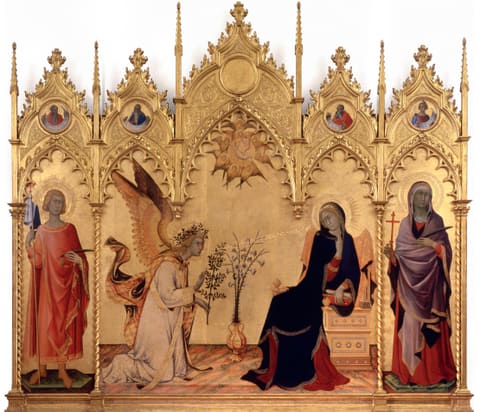
Annunciation with St. Maxima and St. Ansanus
N° 539·IV · Toward the Renaissance
Annunciation with St. Maxima and St. Ansanus
Simone Martini and Lippo Memmi
1333 · Tempera on wood, gold background
Italian · Gothic

Simone Martini and Lippo Memmi's signed and dated 1333 altarpiece for Siena Cathedral shows the Archangel Gabriel's sudden appearance to a startled Virgin Mary against a gold background, flanked by Siena's patron saints.

“The angel's appearance is sudden, as suggested by the fluttering cloak and spread wings. Mary is distressed, drawing back and wrapping herself in her cloak.” In the museum’s words — uffizi.it ↗

Meanwhile — Marinid Alms Measure (Mudd) of Abu al-Hasan Islamic world · 731–749 AH / 1331–1348 CE

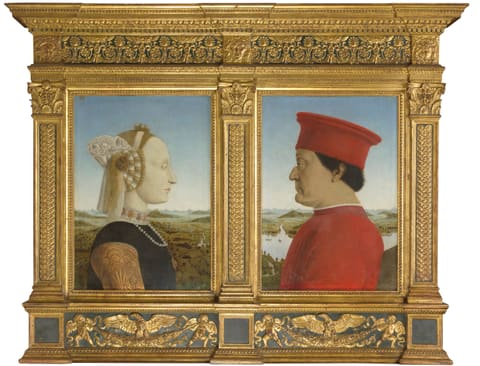
The Duke and Duchess of Urbino Federico da Montefeltro and Battista Sforza
N° 594·IV · Toward the Renaissance
The Duke and Duchess of Urbino Federico da Montefeltro and Battista Sforza
Piero della Francesca (1416/17–1492)
c. 1473–1475 · Oil on wood
Italian · Italian Renaissance

Piero della Francesca's profile diptych of Federico da Montefeltro and his wife Battista Sforza, set against the rolling landscape of their duchy, is among the most celebrated portrait pairs of the early Italian Renaissance; the reverse sides depict the couple riding in triumphal cars.

“One of the most celebrated portraits of the Italian Renaissance, the diptych features the Duke of Urbino, Federico da Montefeltro (1422-1482) and his wife Battista Sforza (1446-1472).” In the museum’s words — uffizi.it ↗

Meanwhile — Blue-and-White Vase with Swan Design South Asia · Mid-to-late 15th century, Lê sơ dynasty

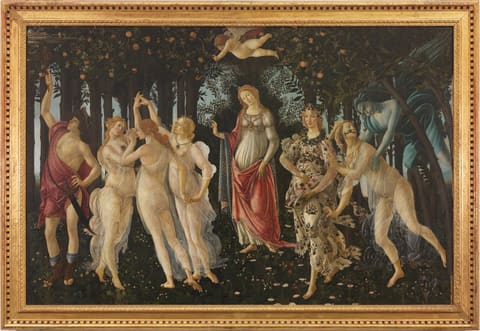
Spring
N° 598·IV · Toward the Renaissance
Spring
Sandro Botticelli (1445–1510)
c. 1480 · Tempera grassa on wood
Italian · Italian Renaissance

Botticelli's allegory of love, peace and springtime abundance gathers nine mythological figures - Zephyr and Chloris, Flora, Venus, the three Graces, Cupid and Mercury - amid an orange grove painted with more than forty identifiable plant species.

“This painting, usually known as the Primavera [or ‘Spring’] shows nine figures from classic mythology advancing over a flowery lawn in a grove of orange and laurel trees.” In the museum’s words — uffizi.it ↗

Meanwhile — Miniature gold llama figurine (Inka) Americas & Oceania · 1430–1532 CE

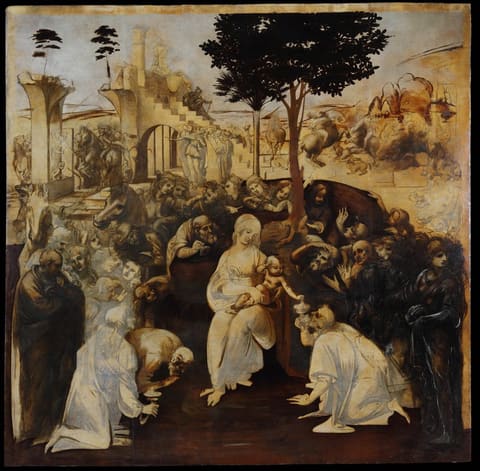
Adoration of the Magi (San Donato in Scopeto)
N° 600·IV · Toward the Renaissance
Adoration of the Magi (San Donato in Scopeto)
Leonardo da Vinci (1452–1519)
c. 1482 · Drawing in charcoal, watercolour ink and oil on wood
Italian · Italian Renaissance

Commissioned in 1481 for the church of San Donato in Scopeto and left unfinished when Leonardo departed for Milan the following year, this large, densely populated composition survives only as an underdrawing in charcoal, ink wash and oil.

“A document from July 1481 states that Leonardo da Vinci had received a commission from the Augustinian monks to paint a panel for the high altar in the church of San Donato in Scopeto, outside Florence’s city walls.” In the museum’s words — uffizi.it ↗

Meanwhile — Miniature gold llama figurine (Inka) Americas & Oceania · 1430–1532 CE

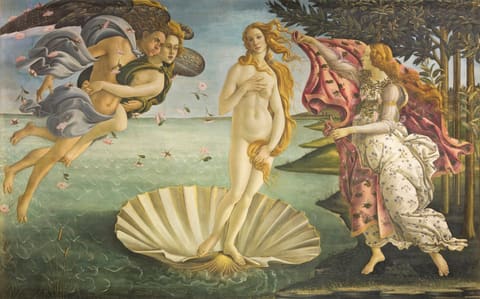
Birth of Venus
N° 601·IV · Toward the Renaissance
Birth of Venus
Sandro Botticelli (1445–1510)
c. 1485 · Tempera on canvas
Italian · Italian Renaissance

Venus arrives on the shore of Cyprus standing on a scallop shell, blown in by the wind gods Zephyr and Aura and met by a nymph offering her a flowered cloak; probably commissioned by the Medici family and inspired by classical statuary for Venus's modest pose.

“Known as the “Birth of Venus”, the composition actually shows the goddess of love and beauty arriving on land, on the island of Cyprus, born of the sea spray and blown there by the winds, Zephyr and, perhaps, Aura.” In the museum’s words — uffizi.it ↗

Meanwhile — Miniature gold llama figurine (Inka) Americas & Oceania · 1430–1532 CE

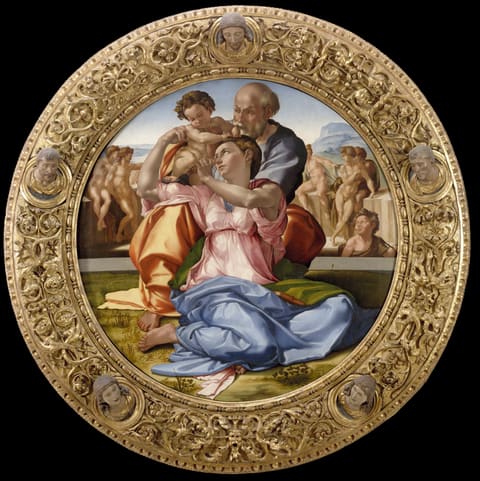
Holy Family, known as the “Doni Tondo”
N° 633·V · The Renaissance
Holy Family, known as the “Doni Tondo”
Michelangelo Buonarroti (1475–1564)
1505–1506 · Tempera grassa on wood
Italian · Italian Renaissance

Michelangelo's only surviving finished panel painting, made for the marriage of Florentine merchant Agnolo Doni, arranges the Holy Family in a sculptural, pyramidal composition inspired by ancient Hellenistic marbles including the newly excavated Laocoön.

“Michelangelo painted this Holy Family for a Florentine merchant, Agnolo Doni, whose prestigious marriage to Maddalena Strozzi in 1504 took place in a period that was crucial for early 16th-century Florentine art.” In the museum’s words — uffizi.it ↗

Meanwhile — Gold ewer with dragon and phoenix design East Asia · Ming Dynasty (1368–1644)

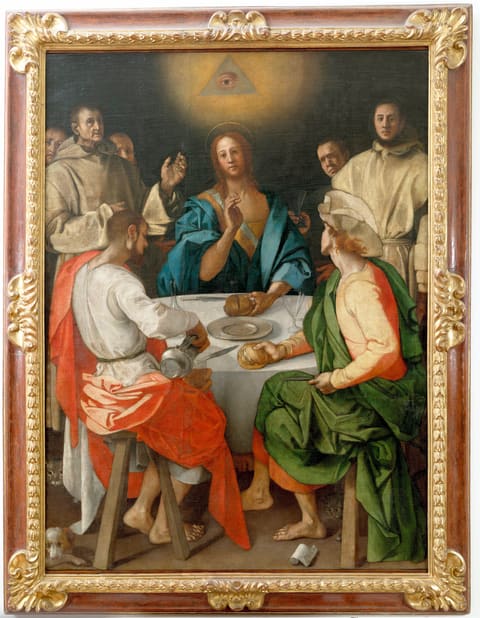
Supper at Emmaus
N° 655·V · The Renaissance
Supper at Emmaus
Jacopo Carucci, known as Pontormo (1494–1557)
1525 · Oil on canvas
Italian · Mannerism

Painted by Pontormo for the guest quarters of the Certosa del Galluzzo while he sheltered there from Florence's 1523 plague, the painting captures the moment the risen Christ is recognized by two disciples as he breaks bread at Emmaus.

“The painting depicts the apparition of Christ to the Apostles as related in the Gospel of Luke (24:13-35).” In the museum’s words — uffizi.it ↗

Meanwhile — Dragon and Phoenix Carpet Islamic world · 1450–1600

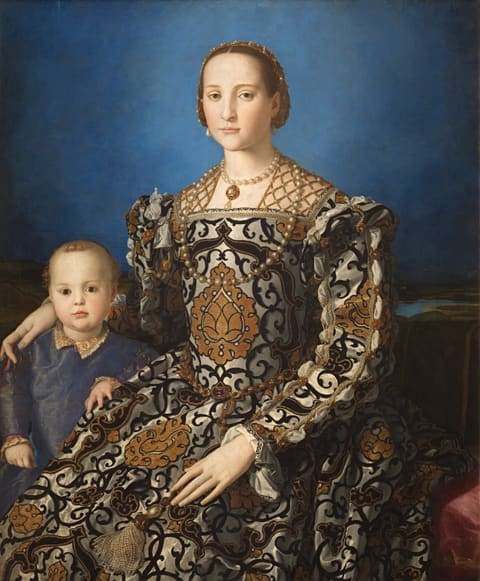
Portrait of Eleonora di Toledo with her son Giovanni
N° 670·V · The Renaissance
Portrait of Eleonora di Toledo with her son Giovanni
Agnolo Bronzino (1503–1572)
c. 1545 · Oil on wood
Italian · Mannerism

Bronzino's portrait of Cosimo I de' Medici's duchess with her son Giovanni, set against a luminous lapis-lazuli-blue background, was designed to project both her sacred, dynastic role as mother of the Medici line and her real political authority as a stateswoman.

“The magnificent portrait of Eleonora di Toledo together with her second son Giovanni is one of Bronzino's greatest masterpieces, and is the work that contributed to transmitting the splendour of Cosimo I de' Medici’s bride to the collective imaginary.” In the museum’s words — uffizi.it ↗

Meanwhile — Haikata Arabic Well (Kisima cha Asili cha Haikataa) Africa · attributed to Arab settlers, 1545

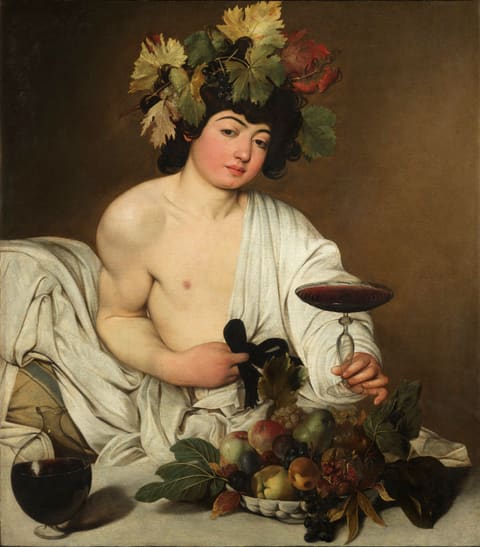
Bacchus
N° 709·V · The Renaissance
Bacchus
Michelangelo Merisi, known as Caravaggio (1571–1610)
c. 1598 · Oil on canvas
Italian · Baroque

An early Caravaggio, painted in Rome under Cardinal Francesco Maria del Monte's patronage, showing the wine god with a flushed, inebriated expression amid a masterfully rendered still life of fruit and wine; rediscovered in the Uffizi's storerooms in 1913 and attributed to Caravaggio by Roberto Longhi.

“The sculpted figure of Bacchus, who has a stunned expression due to his state of inebriation, reproduces some models of classical art, in particular the portraits of Antinous, and is instilled with a languid sensuality.” In the museum’s words — uffizi.it ↗

Meanwhile — Tachi Sword East Asia · Japan, Momoyama period, dated 1598 (Keichō 3)

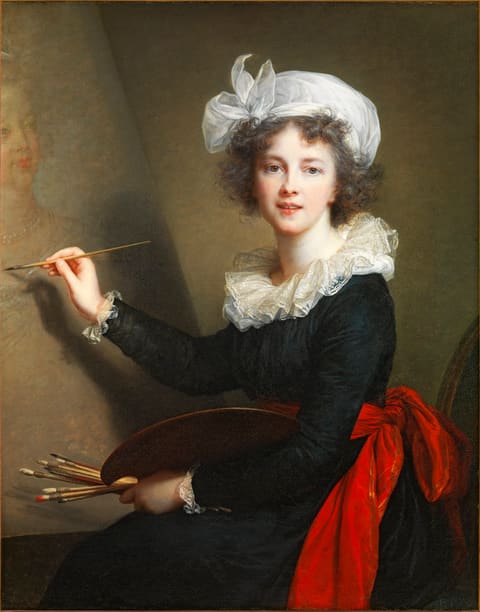
Self-portrait
N° 841·VII · The Age of Reason
Self-portrait
Elisabeth Louise Vigée Le Brun (1755–1842)
1790 · Oil on canvas
French · Neoclassicism

Painted in Rome in 1790 and sent to Florence to join the Uffizi's Medici-founded collection of painters' self-portraits, this shows Vigée Le Brun holding her palette before a canvas on which she is sketching her patron and former queen, Marie Antoinette.

“She stopped in Florence during her trip to Rome, and visited the Pitti Palace and the Uffizi where she admired the collection of self-portraits that Prince Leopoldo de’ Medici had inaugurated in the 17th century.” In the museum’s words — uffizi.it ↗

Meanwhile — Cocks and Hens East Asia · Japan, Edo period, dated 1790

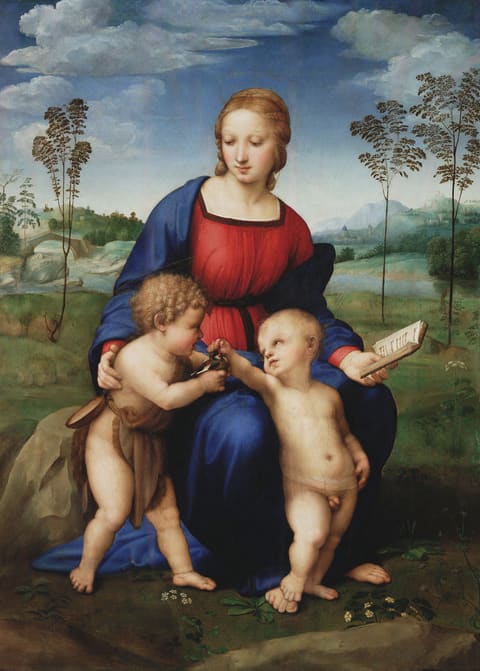
Mary, Christ and the young John the Baptist, known as the “Madonna of the Goldfinch”
N° 1177·Undated
Mary, Christ and the young John the Baptist, known as the “Madonna of the Goldfinch”
Raffaello Sanzio (1483–1520)
Before February 1506 · Oil on wood
Italian · Italian Renaissance

Raphael's pyramidal grouping of the Virgin, the infant Christ and the young John the Baptist, painted during his Florentine period for a merchant's wedding, was shattered into seventeen pieces in a 1547 landslide and later reassembled.

“In his biography of the artist, Giorgio Vasari says that the painting was commissioned for the marriage of Lorenzo Nasi with Sandra di Matteo Canigiani, celebrated on 23 February 1506.” In the museum’s words — uffizi.it ↗