Museo Chileno de Arte Precolombino, Santiago — 16 works · museum site ↗ · 500 BCE – 2000
Seen from Santiago, history is above all craft & design, then sculpture — a collection opened wide onto other worlds — a window more than a mirror (16 of 16 works are from other civilisations).
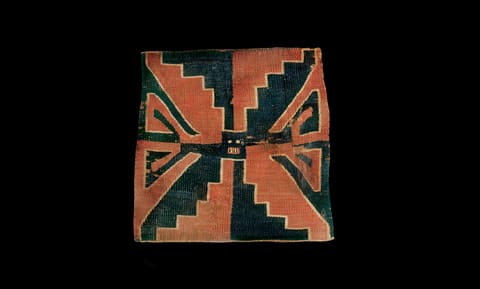
Translated from Spanish: This textile came from the funerary offering of an individual buried more than two thousand years ago in an archaeological cemetery in the city of Calama, Región de Antofagasta. It is a square, four-selvage cloth, loom-woven in tapestry technique with camelid fiber in the weft and plant fiber in the warp, decorated with a human face of feline features (its pronounced teeth) from which radiate stepped triangular appendages. Similar imagery is frequent on the ceramics and stone stelae of the Pucara and Chiripa cultures around Lake Titicaca, suggesting an altiplanic origin, and the textile probably reached the Río Loa through exchange or as a prestige gift.
“Este textil perteneció al ajuar funerario de un individuo que fue sepultado hace más de dos mil años en un cementerio arqueológico de la ciudad de Calama, Región de Antofagasta.”
In the museum’s words — museo.precolombino.cl ↗ · quotation verified against the live page
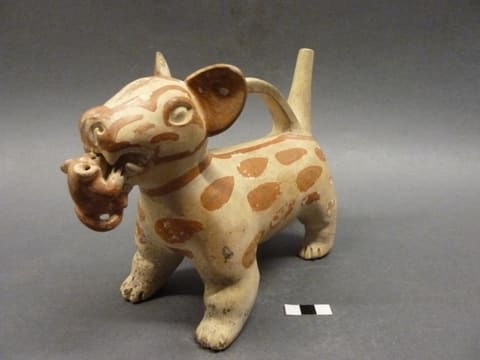
Translated from Spanish: An intriguing clay bottle by the Vicús culture representing a feline — perhaps a jaguar or an ocelot, recognizable by the spots on its skin — with a mouse hanging from its snout. Inside the feline's head is a small air chamber and a whistle: when the bottle is filled with liquid and rocked, the moving air activates the whistle, producing a sweet, strong sound.
“Esta intrigante botella de arcilla, creada por la cultura Vicús, representa a un felino, quizás un jaguar o un ocelote, reconocible por las manchas en su piel. En su hocico, lleva colgado un ratón.”
In the museum’s words — museo.precolombino.cl ↗ · quotation verified against the live page
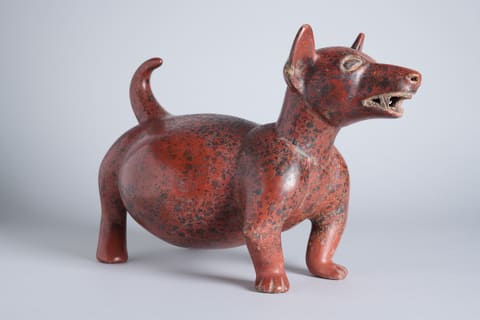
Translated from Spanish: A ceramic effigy of a native male dog known as tlalchichi ('floor dog' in Nahuatl, for its short legs), shown standing on all four legs with head and tail raised. The hollow figure was carefully modelled in clay, painted with a red colorant and polished to a fine finish. Such dogs were commonly placed in the tombs of prominent Colima people, believed to accompany and protect the deceased on the journey to the afterlife.
“Esta escultura representa a un perro de pie en sus cuatro patas, con su cabeza y cola elevadas, mostrando un porte majestuoso. La escultura es hueca y ha sido cuidadosamente modelada en arcilla, luego pintada con un colorante rojo y pulida para darle un acabado perfecto.”
In the museum’s words — museo.precolombino.cl ↗ · quotation verified against the live page
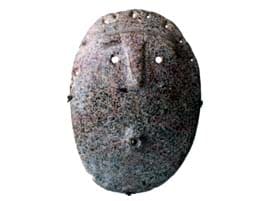
Translated from Spanish: A distinctive stone sculpture of the northwest Argentine region, carved from a single block of grey stone with black crystals and dating to around 500 CE. It represents an oval human face, with brows in relief joined to a long nose forming a 'T' and a circular relief mouth pierced through the piece; perforations at the top of the head probably once held an ornament such as a radiant crown. Such simple-lined stone faces were common in the area and often expressed a mix of wonder and sadness.
“Esta escultura es una expresión artística distintiva de la región del noroeste de Argentina, tallada en un solo bloque de piedra de color gris con cristales negros.”
In the museum’s words — museo.precolombino.cl ↗ · quotation verified against the live page
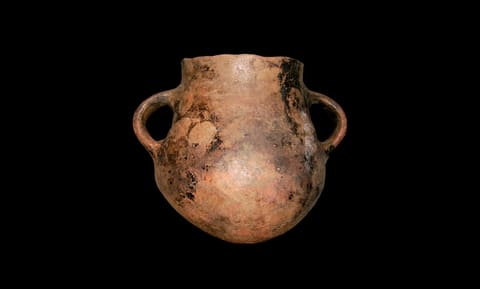
Translated from Spanish: 'Challa' is the Mapudungun word for this type of vessel — wide-mouthed, with a broad ovoid body and two lateral vertical handles — used as a pot for cooking and preparing food. Its surface finish is diagnostic of the ceramics of the Pitrén culture: the exterior is decorated with plant- and tree-leaf motifs produced by a negative or resist technique, applied after firing by adhering leaves (probably lingue or ñire) and placing the pot in a smoke-saturated reducing atmosphere, so the leaves leave their negative in the vessel's original color, with the veins in a darker tone.
“de boca ancha, cuerpo amplio y ovoide, con dos asas verticales laterales, que sirve como olla para el cocimiento y preparación de alimentos.”
In the museum’s words — museo.precolombino.cl ↗ · quotation verified against the live page
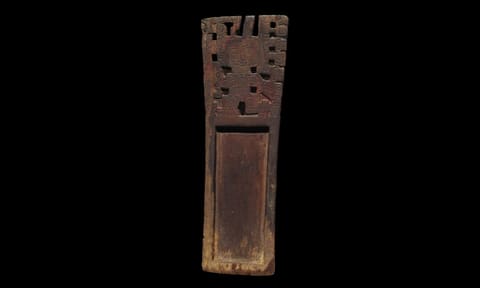
Translated from Spanish: The figure carved on this wooden snuff tablet (a tray for hallucinogens) closely resembles the one on the great stone sculptures of Tiwanaku at Lake Titicaca, particularly the lintels of Kantatayita and Linares; the same image appears on dozens of wooden tablets and textiles across that culture's sphere of influence. It shows a person bending with one knee on the ground and the head turned upward — the pose characteristic of individuals in a trance under psychoactive substances — and may represent a shaman, or one of the spirits that aid him in his shamanic flight. Interlocking fangs mark his transformation into a feline, and his long nasal appendage stresses the route by which the hallucinogen is inhaled.
“La figura tallada en esta tableta para alucinógenos es muy similar a la que aparece en las grandes esculturas de piedra de Tiwanaku, en el Lago Titicaca, particularmente en los dinteles de Kantatayita y Linares.”
In the museum’s words — museo.precolombino.cl ↗ · quotation verified against the live page
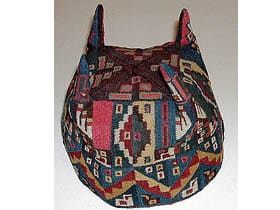
Four-pointed hat (gorro de cuatro puntas), Tiwanaku
Unknown
700–1000 CE · camelid fiber (knotted textile)
Tiwanaku
Translated from Spanish: A four-pointed hat made of dyed camelid fiber knotted in intricate designs and colors (more than ten different colors), a notable expression of the Tiwanaku culture and tradition of Bolivia, whose cultural influence reached northern Chile and southern Peru. It was probably worn only by people of the ruling class or of high social and political status; the points at the top of its crown are thought to allude to the ears of a feline, a powerful animal in Tiwanaku belief.
“Este gorro, confeccionado con fibra de camélido teñido y tejido con nudos en intrincados diseños y colores, es una representación notable de la cultura y la tradición de Tiwanaku de Bolivia, cuyas influencias culturales alcanzaron al norte de Chile y el sur de Perú.”
In the museum’s words — museo.precolombino.cl ↗ · quotation verified against the live page
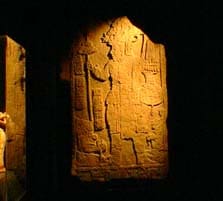
Translated from Spanish: A carved stone stela — a commemorative architectural monument of great importance in Maya history — honoring Tan Te' K'inich, the fifth ruler of Petexbatún, originally set in the ceremonial center of Aguateca in the Maya region of the Petén, Guatemala. One face is carved with a scene of three figures and hieroglyphic texts whose glyphs give its date as the year 790 in our calendar. The central figure, the ruler, is shown in warrior dress holding a dart and a shield, with two bound captives seated at his side.
“La estela está esculpida en una de sus caras, mostrando una escena con tres personajes y una serie de textos jeroglíficos.”
In the museum’s words — museo.precolombino.cl ↗ · quotation verified against the live page
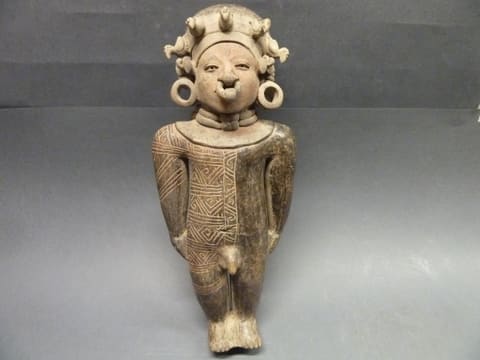
Translated from Spanish: A standing clay figure of a man belonging to the Manta culture, which flourished on the coast of Ecuador between 800 and 1534 CE. The figure displays a 'clothed nakedness': though it wears no garments, one half of the body is decorated while the other is bare, evoking the body paintings, tattoos and scarifications with which the Manta marked their bodies to express identity, feelings, experiences and personal history.
“Esta figura humana de arcilla de sexo masculino, pertenece a la cultura Manta, que floreció en la costa del Ecuador, entre 800 y 1534 DC.”
In the museum’s words — museo.precolombino.cl ↗ · quotation verified against the live page
Meanwhile — JarSouth Asia · Angkor period, 12th century
N° 417·III · Faith and Empire
Wall tapestry with pelicans and fish (Chimú)
Unknown
900–1470 CE · camelid fiber and cotton
Chimú
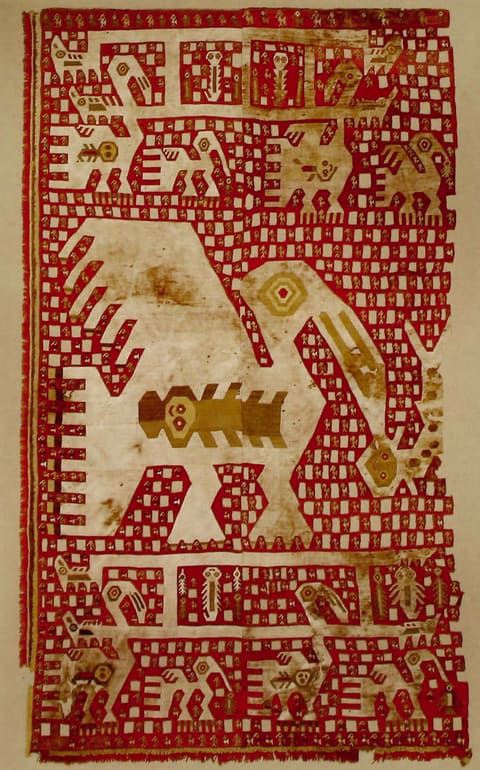
Translated from Spanish: A textile showing a unique scene — a large pelican carried on a litter by smaller pelicans, with fish hanging from their beaks and bellies. Woven in camelid fiber and cotton using a slotted-tapestry technique, it is thought to have functioned as a kind of latticework screen in an important building, probably occupied by a Chimú lord — both decorative and practical, letting one see through it while separating spaces and people.
“Este textil muestra una escena única: un gran pelícano, llevado en andas por pelícanos más pequeños, con peces colgando de sus picos y en sus vientres.”
In the museum’s words — museo.precolombino.cl ↗ · quotation verified against the live page
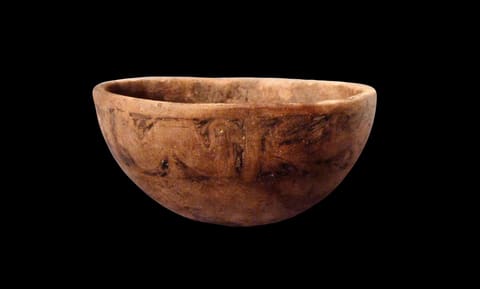
Translated from Spanish: A bowl made by cutting in half a gourd of the species Lagenaria siceraria, a fruit widely used across pre-Columbian America to make vessels and musical instruments. It bears a band decorated by pyro-engraving — pressing a sharp, fire-heated implement onto the gourd's surface — divided into five fields depicting bird-like (ornithomorphic) and lizard-like (sauriform) figures. According to the study by Cristián Olivares, in northern Chile such figures also appear on other ritual containers such as qero cups, and given their iconography and use as liquid vessels he proposes they were used in fertility rites associated with water and earth.
“La calabaza presenta una banda decorada mediante la técnica del pirograbado, es decir, aplicando a la superficie de la calabaza un objeto punzante calentado al fuego. La parte decorada consta de cinco campos, donde se representan figuras ornitomorfas y sauriformes.”
In the museum’s words — museo.precolombino.cl ↗ · quotation verified against the live page
Meanwhile — Buddhist TriadSouth Asia · Late 12th - early 13th century
N° 454·III · Faith and Empire
Seated figure of a sukíe (shaman-healer), Costa Rica
Unknown
1000–1550 CE · volcanic stone
Atlantic Watershed (Línea Vieja), Costa Rica
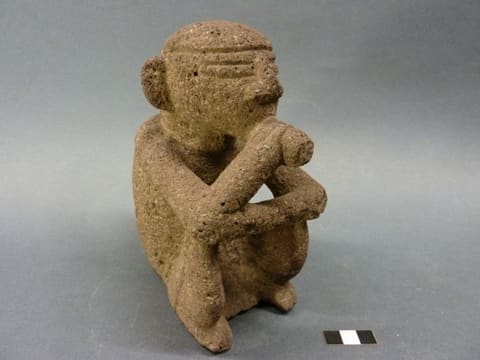
Translated from Spanish: A human figure carved from a single block of volcanic stone, seated with the knees drawn up to the chest in a relaxed, meditative pose and holding an object that may be a flute. It is interpreted as a shaman, or sukíe — the term used among the native peoples of Costa Rica for healers. Through specific postures, the use of tobacco or visionary plants and music, shamans made ecstatic journeys to reach other worlds and communicate with the spirits.
“Esta escultura humana está tallada en un solo bloque de piedra volcánica, representando a una figura sentada, con las rodillas dobladas hacia el pecho, en una pose relajada y meditativa.”
In the museum’s words — museo.precolombino.cl ↗ · quotation verified against the live page
Translated from Spanish: One of the largest quipus discovered to date, an impressive expression of Andean mathematics. This particular quipu consists of 586 cords made of camelid fiber, organized in 13 hierarchical levels of information, with a combination of twisted cords, simple and complex knots and variations in the natural color of the fiber; in all it could store up to 15,024 pieces of data, though its exact meaning remains a mystery. It was found in 1940 at Mollepampa, in the Lluta river valley near Arica.
“586 cuerdas hechas de fibra de camélido, organizadas en 13 niveles de jerarquía de información. Cuenta con una combinación de cuerdas torcidas, nudos simples y complejos, y variaciones en el color natural de la fibra textil.”
In the museum’s words — museo.precolombino.cl ↗ · quotation verified against the live page
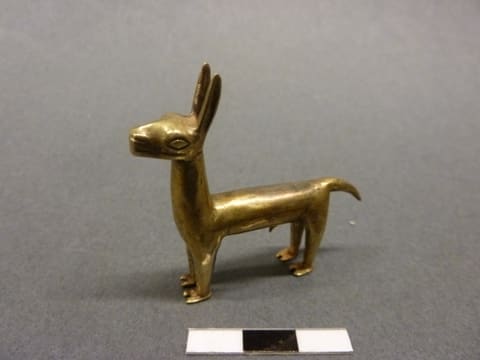
Translated from Spanish: A small, naturalistic figurine of a male llama made from sheets of a copper, gold and silver alloy. In Inka culture, miniatures of humans and camelids were commonly made and offered at the many shrines and places of worship across the vast imperial territory, especially on the summits of the Andes. Golden llamas such as this were considered gifts to the mountain deities, in a symbolic act of reciprocity meant to ensure the health and prosperity of the herd.
“En la cultura Inka, era común la fabricación de miniaturas de humanos y camélidos, elaboradas con láminas de una aleación de cobre, oro y plata, tal como esta figurilla naturalista de una llama de sexo masculino que se describe aquí.”
In the museum’s words — museo.precolombino.cl ↗ · quotation verified against the live page
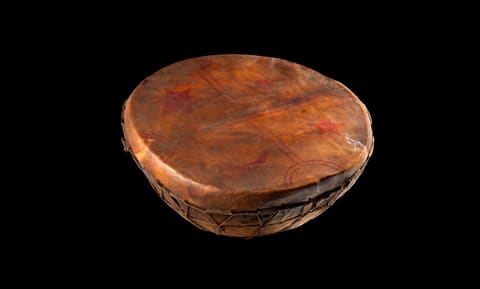
Translated from Spanish: The kultrún is the musical instrument par excellence of Mapuche shamanism. It is a wooden kettledrum made from a large bowl carved from the trunk of a 'tree of power' that represents the earth. Each machi decorates it to a general scheme but with her own design and plays it in her own way; the lines furrowing the hide surface divide the world into four parts, with the machi at the center surrounded by the astral powers that assist her. Its interior holds various magical objects and the machi's own voice, placed there when the instrument is built; it is played close to the ear so its rich sonority saturates perception and eases the trance.
“Se trata de un timbal de madera hecho de un gran cuenco, elaborado a partir del tronco de un árbol de poder que representa a la tierra.”
In the museum’s words — museo.precolombino.cl ↗ · quotation verified against the live page
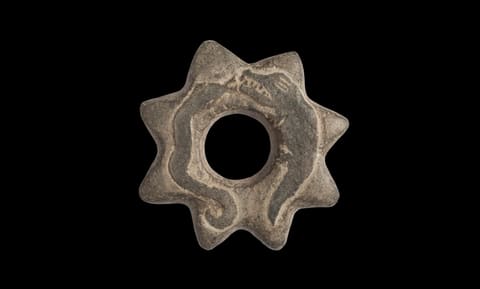
Star-shaped mace head: serpent and lizard (Cabezal de maza estrellada)
Unknown
Pre-Hispanic period · stone
Translated from Spanish: A star-shaped stone mace head decorated with a serpent and a lizard (111 mm diameter, MChAP 0215), from Centre-South Chile in the South Andean area, donated by Sergio Larraín García-Moreno. The museum presents it in its essay on Caicai and Trentren, the two serpents of Mapuche narrative whose titanic struggle is said to have shaped Chile's landscape, and asks — as an open question — whether this mace head might be an ancient representation of those legendary reptiles. On permanent exhibition in 'Chile antes de Chile'.
“Cabezal de maza estrellada: serpiente y lagarto Piedra Periodo prehispánico Centro-Sur de Chile, Área Sur Andina Donación Sergio Larraín García-Moreno MChAP 0215, 111 mm (Diám.)”
In the museum’s words — museo.precolombino.cl ↗ · quotation verified against the live page