The Atlas·ZA

ZA

Iziko Museums of South Africa, Cape Town — 18 works · museum site ↗ · 1620–1991 60000 BCE2020

Seen from Cape Town, history is above all the world observed, then stories & histories — a collection opened wide onto other worlds — a window more than a mirror (14 of 18 works are from other civilisations).

Observation 7 Stories 5 Sculpture 2 New vision 2 Craft 1 Sacred 1
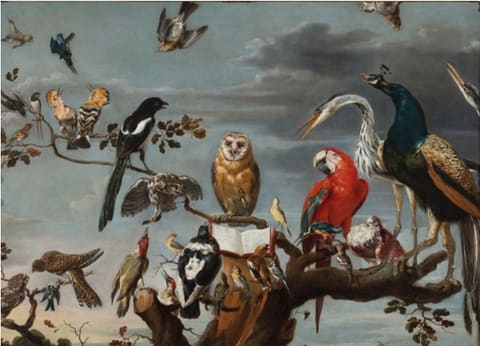
Concert of Birds
N° 743·VI · The Baroque Age
Concert of Birds
Frans Snyders (1579–1657)
1620–1630 · Oil on canvas

A large allegorical bird piece (135 x 175 cm) by the Antwerp painter Frans Snyders — an owl 'conducting' a treetop concert of a peacock, herons, a parrot, doves and other birds gathered around an open songbook, the diverse species singing together as an image of harmony out of diversity. Snyders painted several versions (others are in the Hermitage, the Prado and Petworth House). This is one of the few Flemish works in the Michaelis Collection of Dutch and Flemish 17th-century paintings, which the businessman Max Michaelis gave to South Africa in 1916; it is housed in the Iziko Old Town House, Cape Town, and administered by the Iziko South African National Gallery. Featured in the gallery's "Masterpiece of the Month" essay series by Anna Tietze.

“Its central character is an owl. To its right and left is a variety of other birds, exotic or familiar: a peacock, herons, a parrot, doves, wood-peckers, sparrowhawks” In the museum’s words — iziko.org.za ↗ · quotation verified against the live page

Meanwhile — Water Fowl in the Lotus Pond East Asia · Japan, Edo period, early 17th century
Classical Composition: Bacchanal
N° 852·VIII · The Restless Century
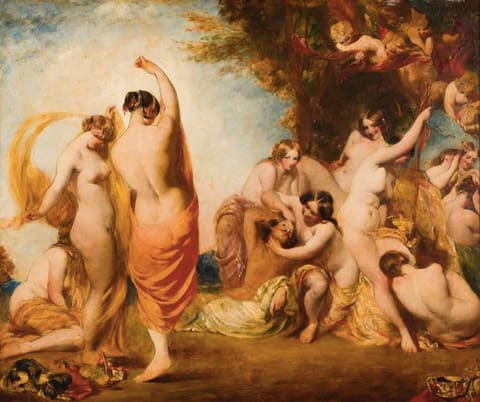
Classical Composition: Bacchanal
William Etty (1787–1849)
Undated (early 19th century) · Oil on panel

An undated early-19th-century bacchanal (oil on panel, 60 x 71 cm) by William Etty, one of the few British artists of his day painting the nude. Unclothed and partially-draped female bodies dance across the picture, with Bacchus himself slumped at the centre and putti hovering among the trees; the warm reddish-brown tonality and soft painterliness are borrowed from the Venetian Renaissance masters Etty admired. The earliest of forty-eight works given to the gallery by the mining magnate Sir Edmund Davis between 1935 and 1938. Part of the Iziko South African National Gallery; featured in its "Masterpiece of the Month" essay series by Anna Tietze.

“unclothed or partially-draped female bodies carry the eye across the front plane of this picture, from the three at the left to the complicated interwoven mass of bodies at right” In the museum’s words — iziko.org.za ↗ · quotation verified against the live page

Meanwhile — Australia's first bank note Americas & Oceania · Issued 8 April 1817

Dusk Scene
N° 879·VIII · The Restless Century
Dusk Scene
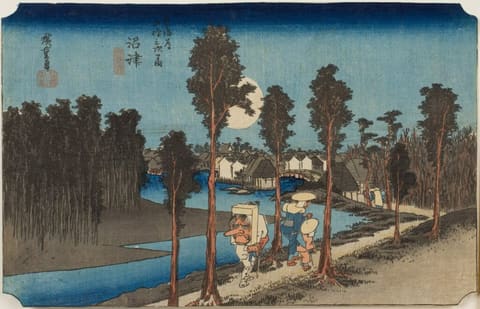
Ando Hiroshige (1797–1858)
1833–1834 · Colour woodcut (ukiyo-e print)

A colour woodcut (22.5 x 35.5 cm) from Hiroshige's 1833–4 series Fifty-three Stages on the Tōkaidō, depicting three pilgrims on the road near Numazu — the rearmost carrying a large red-faced, long-nosed tengu mask on his back — beneath a great moon glimpsed among the pines. One of fifteen Japanese woodcuts the benefactor Alfred de Pass gave to the gallery; the six Hiroshige prints among them were presented in 1930, with further Japanese woodcuts following in 1948. Part of the Iziko South African National Gallery; featured in its "Masterpiece of the Month" essay series by Anna Tietze.

“In this image, three figures make their way along the route between tall trees. All three are bound in the same direction, but the figure behind carries on his back a large mask which gives the illusion that he faces us” In the museum’s words — iziko.org.za ↗ · quotation verified against the live page

Meanwhile — Cristo abençoador (Christ Blessing) Europe · 1834

Peace and War (copy after Rubens)
N° 912·VIII · The Restless Century
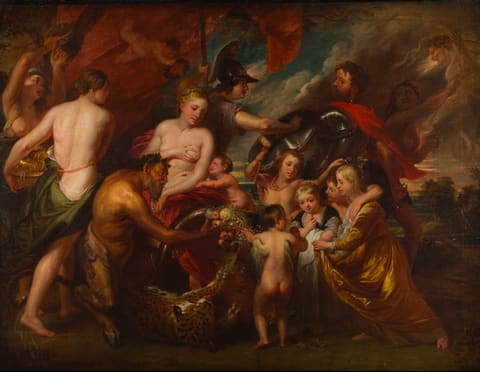
Peace and War (copy after Rubens)
Charles Gow (c. 1809–1886)
c. 1870 · Oil on canvas

A 19th-century copy (70.5 x 93.5 cm) by the little-known Royal Academician Charles Gow after Rubens's allegory Peace and War (1629–30, now in the National Gallery, London). Peace offers her breast to the child Plutus while a satyr brings fruit and, behind, Minerva pushes away the armoured Mars — a plea for the wisdom and plenty of peace over war. Submitted to the 1875 South African Fine Arts Association exhibition, it became one of the first works in the gallery's permanent collection. Part of the Iziko South African National Gallery; featured in its "Masterpiece of the Month" essay series by Anna Tietze.

“Contrasting with it, behind, are the figures of Minerva and Mars, in dark costume and in shadow” In the museum’s words — iziko.org.za ↗ · quotation verified against the live page

Meanwhile — Old Bulawayo Africa · royal town of King Lobengula; established 1870

Lopokova in her Dressing-room
N° 1022·IX · Into Our Time
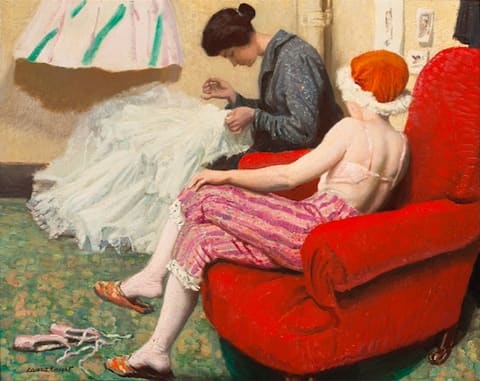
Lopokova in her Dressing-room
Laura Knight (1877–1970)
c. 1919 · Oil on canvas

A backstage study (505 x 610 mm) by Laura Knight of the Ballets Russes ballerina Lydia Lopokova, seated in a red armchair in her undergarments and a fur-trimmed hat while a seamstress adjusts a tutu, ballet pumps cast off at her feet. In the spirit of Degas, the dancer is turned away and faceless, the picture built on rich, tactile colour. One of the first of nearly 250 gifts the benefactor Alfred de Pass made to the gallery. Part of the Iziko South African National Gallery; featured in its "Masterpiece of the Month" essay series by Anna Tietze.

“The dancer herself is seated in an armchair in the foreground, dressed only in undergarments and wearing slippers and a soft, fur-trimmed hat” In the museum’s words — iziko.org.za ↗ · quotation verified against the live page

Meanwhile — Partido de fútbol (Football Match) Americas & Oceania · c. 1919

N'tabeni
N° 1043·IX · Into Our Time
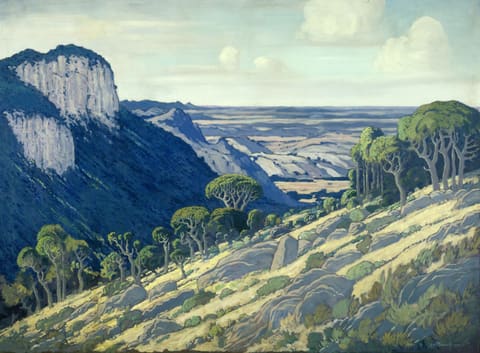
N'tabeni
Jacob Hendrik Pierneef (1886–1957)
1930 · Oil on canvas

A large Highveld landscape (89 x 122 cm) in Pierneef's mature style: a shadowed rockface at left plunges into a valley crossed by a strongly-lit slope, with simplified decorative trees, striated bands of light and shade and a low horizon, all rendered in a bleached palette of blues, greens and warm greys, and quite devoid of figures. Princess Alice bought the recently-completed work from Pierneef's studio and gifted it to the gallery for its official 1930 opening. Part of the Iziko South African National Gallery; featured in its "Masterpiece of the Month" essay series by Anna Tietze.

“A shadowed rockface at left plunges down into a valley and is intersected by a strongly lit sweep of land, sloping dramatically down from the right” In the museum’s words — iziko.org.za ↗ · quotation verified against the live page

Meanwhile — Cinco moças de Guaratinguetá (Five Girls from Guaratinguetá) Americas & Oceania · 1930

Still Life
N° 1047·IX · Into Our Time
Still Life
Wolf Kibel (1903–1938)
1934–1935 · Watercolour on paper

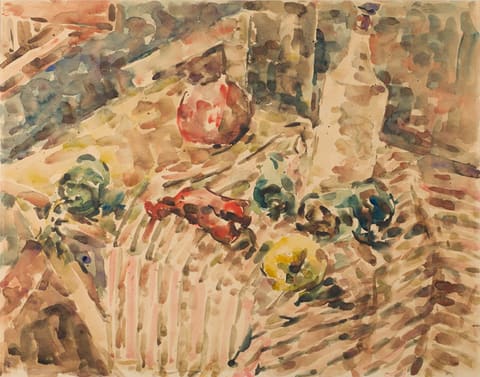
A comparatively large watercolour (465 x 600 mm) by the Polish-born, Cape Town-based Wolf Kibel, who died of tuberculosis at 35 and won his reputation posthumously. A cross-legged table under a striped cloth holds a bottle, fruit and vegetables, seen from a high viewpoint in watery, translucent dabs; the tilting objects and blurred boundaries turn a plain still life into something airy, melancholy and animate. Bought by the gallery in 1991 from the Cape Town dealer Joe Wolpe. Part of the Iziko South African National Gallery; featured in its "Masterpiece of the Month" essay series by Anna Tietze.

“The work features a simple cross-legged table draped with a striped cloth which spills off the table to the right. On the table is a bottle, some fruit, and some vegetables” In the museum’s words — iziko.org.za ↗ · quotation verified against the live page

Meanwhile — O lavrador de café (The Coffee Farmer) Americas & Oceania · 1934

Street Scene
N° 1058·IX · Into Our Time
Street Scene
Gerard Sekoto (1913–1993)
1945 · Oil on board

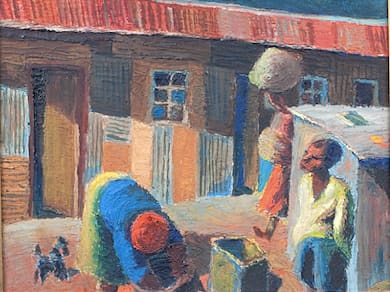
A small oil on board (30.5 x 40.5 cm) showing three generic, solidly-modelled figures before corrugated-metal buildings, built up in thick paint and strong oranges, blues and yellows so that the everyday township view becomes a highly abstracted play of pattern. Bought by the gallery in 1964, it was the Iziko South African National Gallery's first acquisition by a black South African artist. Featured in the gallery's "Masterpiece of the Month" essay series by Anna Tietze.

“They are generic figures rather than individuals: only one face is sketchily indicated, the other two obscured” In the museum’s words — iziko.org.za ↗ · quotation verified against the live page

Meanwhile — Tutusoma, Arhuaco hat (Tutusoma, sombrero arhuaco) Americas & Oceania · c. 1945

Lake Kivu, Congo
N° 1062·IX · Into Our Time
Lake Kivu, Congo
Irma Stern
1946 · Oil on canvas

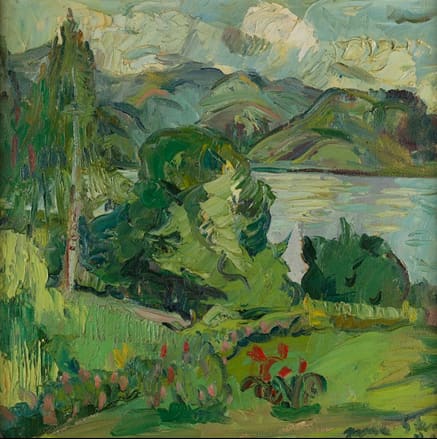
A small square oil (56 x 56 cm) that Irma Stern painted following her 1946 visit to the Congo (today the DRC). Viewed from above and close-up, verdant growth fills three-quarters of the picture, giving way to a glimpse of Lake Kivu and rolling hills; the muted greens, yellows and blues are relieved only by red and pink flowers in the foreground. There are no human figures, the drama carried entirely by Stern's dense, energetic impasto. Part of the Iziko South African National Gallery in Cape Town, presented by the benefactor Alfred de Pass in 1949. Featured in the gallery's monthly "Masterpiece of the Month" essay series by art historian Anna Tietze.

“green growth fills three-quarters of the picture space, giving way to a glimpse of the lake itself and then rolling hills and sky” In the museum’s words — iziko.org.za ↗ · quotation verified against the live page

Meanwhile — Handwritten Draft of President Ho Chi Minh's "Appeal to National Resistance" South Asia · 19 December 1946

Landscape in the Nude
N° 1067·IX · Into Our Time
Landscape in the Nude
Lippy (Israel-Isaac) Lipshitz (1903–1980)
1953 · Carved teak

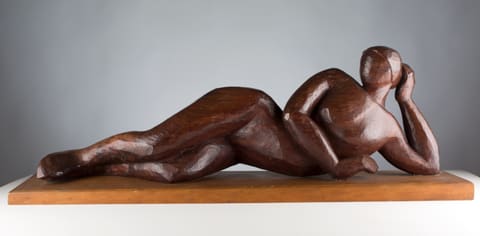
A reclining female nude (76.5 cm) carved from a horizontal block of teak, designed to be seen in the round. The title likens the body — with its rises and falls, thrust hip and narrow waist — to a landscape; Lipshitz plays smooth polished passages against vigorous faceting and open 'absences' of space, in a deliberately faceless, humanist form. One of five Lipshitz works the gallery bought in 1968, the year it also held its first retrospective of a living artist for him. Part of the Iziko South African National Gallery; featured in its "Masterpiece of the Month" essay series by Anna Tietze.

“The body gives the impression of being simultaneously at rest and alert. It lies, full stretched” In the museum’s words — iziko.org.za ↗ · quotation verified against the live page

Meanwhile — Porto I (Port I) Americas & Oceania · 1953

The Revelation of St John
N° 1079·IX · Into Our Time
The Revelation of St John
Azaria Mbatha (1941–2018)
1965 · Linocut print on paper

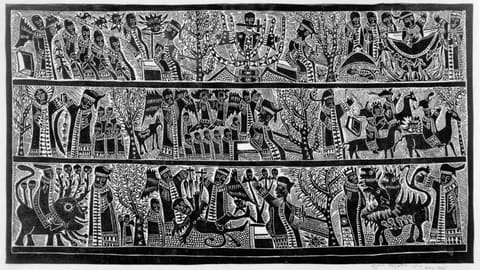
A linocut (376 x 680 mm) by Azaria Mbatha, one of the artists associated with the Rorke's Drift art centre in KwaZulu-Natal, who mastered the medium while convalescing at Ceza Hospital. The Book of Revelation is retold in horizontal 'comic-strip' bands divided by decorative trees and figures — massed angels, hydra-headed beasts and, in the lowest band, dark monsters and a prostrate devil — in a densely-patterned style the museum's essay compares to Romanesque manuscript illumination, while Mbatha Africanised the biblical narrative. It won the printmaking prize at the 1965 Art South Africa Today exhibition and was bought that year for the gallery. Part of the Iziko South African National Gallery; featured in its "Masterpiece of the Month" essay series by Anna Tietze.

“In the lowest band of the work, dark monster animals and a prostrate devil provide a subtle weight which grounds the work as a whole” In the museum’s words — iziko.org.za ↗ · quotation verified against the live page

Meanwhile — Great Dialogue Europe · 1966

Untitled
N° 1080·IX · Into Our Time
Untitled
Ernest Mancoba (1904–2002)
1965 · Oil on canvas

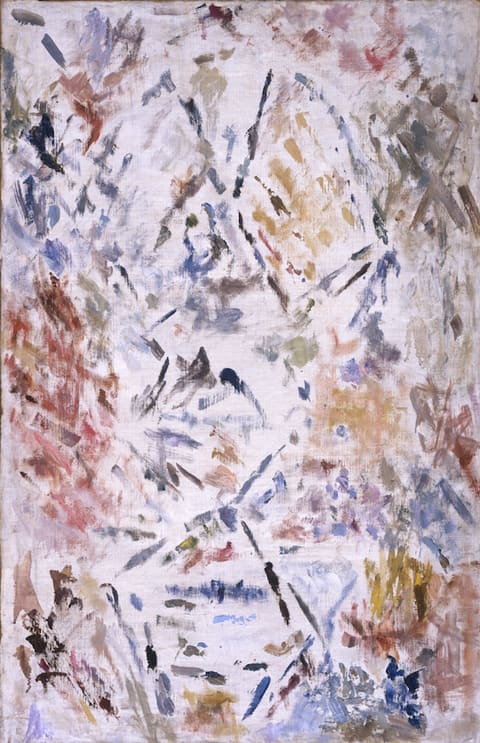
A vertical painterly abstraction (92.3 x 60.3 cm) made in Paris, where the Johannesburg-born Mancoba spent most of his life. A vestigial human figure — head split into two flag-like wedges, torso and bent legs — forms the central scaffolding, the delicate bleached reds, yellows and soft blues laid drily over a luminous, textured canvas. Purchased by the Iziko South African National Gallery in 2005, shortly after the artist's death. Featured in the gallery's "Masterpiece of the Month" essay series by Anna Tietze.

“the vestigial figure serves as the central scaffolding of the work, establishing its dominantly vertical format. The head has split laterally to become two flag-like wedges” In the museum’s words — iziko.org.za ↗ · quotation verified against the live page

Meanwhile — Great Dialogue Europe · 1966

Giant squid model (Architeuthis)
N° 1092·IX · Into Our Time
Giant squid model (Architeuthis)
Unknown
Modelled from a 1991 specimen

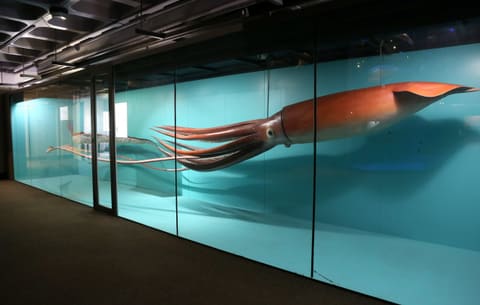
A full-sized model of a giant squid (Architeuthis) — the largest of all animals without backbones and one of the last great mysteries of the sea, never yet seen alive. Built by the Iziko South African Museum's taxidermy section to be as accurate as possible, it was based on a mature female with a 1.85-metre mantle that had stranded at Soetwater, near the Slangkop Lighthouse at Kommetjie, after a storm in March 1991; because none of the local specimens had intact tentacles, these were reconstructed from Architeuthis examined in museums in Denmark and Norway. The finished model has a total length of 9.3 metres. On display at the Iziko South African Museum, Cape Town.

“It was decided that a model would be built based on a mature female, with a mantle (body) length of 1.85 metres, which had been stranded at Soetwater, near the Slangkop Lighthouse at Kommetjie, after a storm in March 1991.” In the museum’s words — iziko.org.za ↗ · quotation verified against the live page

Meanwhile — Britten V1000 motorcycle Americas & Oceania · 1992

Blue whale skeleton
N° 1119·Undated
Blue whale skeleton
Unknown
Undated · Bone

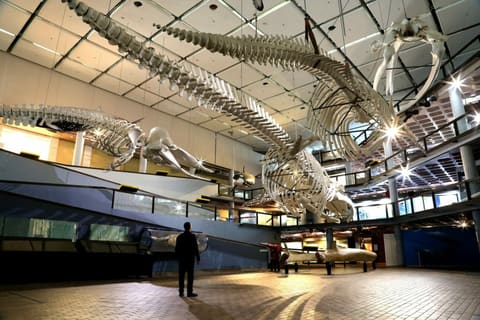
A 20.5-metre blue whale skeleton, part of the Iziko South African Museum's Whale Well — a unique collection of whale casts and skeletons hung so that they can be seen from all floors. Held at the Iziko South African Museum, Cape Town.

“A unique collection of whale casts and skeletons, to be seen from all floors. Includes a 20.5-metre blue whale skeleton.” In the museum’s words — iziko.org.za ↗ · quotation verified against the live page
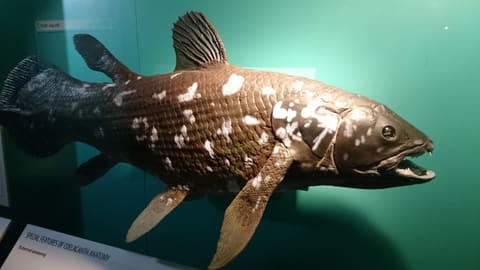
Cast of the first coelacanth
N° 1131·Undated
Cast of the first coelacanth
Unknown
Undated

A cast of the first living coelacanth ever discovered, which the Iziko South African Museum describes as beautiful and now iconic. It forms the centrepiece of a display on the coelacanth's evolutionary history and its biology, including the fish's special features, with audiovisual footage of live coelacanths; fossilised remains of these fish also form part of the exhibition. Held at the Iziko South African Museum, Cape Town.

“The Iziko South African Museum has a beautiful, now iconic, cast of the first living coelacanth discovered. This cast forms the centrepiece of a new display” In the museum’s words — iziko.org.za ↗ · quotation verified against the live page
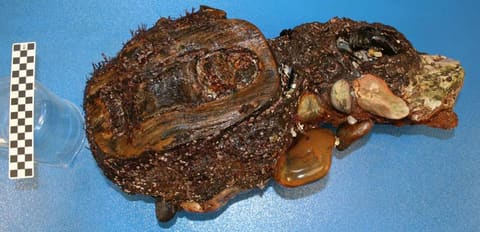
Pulley from the São José slave ship
N° 1194·Undated
Pulley from the São José slave ship
Unknown
São José wreck 1794 (recovered and conserved for display) · Lignum vitae (wood) with iron fittings

A wooden pulley block from the wreck of the São José-Paquete de Africa, the slave ship lost near Cape Town in 1794. Lying visible on the sea floor in the area of the wreck, it was a priority to excavate and retrieve, and came up concreted to a nearby rock. Because the waterlogged wood would shrink and deform if allowed to dry, it was kept wet through successive fresh-water baths; X-rays revealed a housing, wheel and iron dowel and strapping inside the concretion, and the pulley wheel was identified as lignum vitae, the very hard wood traditionally used for pulley wheels. It was conserved by combined electrolysis and sugar-bulking followed by freeze-drying. Held by Iziko Museums with the São José material associated with the Iziko Slave Lodge, Cape Town.

“Visible on the sea floor in the area of the Sao Jose wreck the pulley was a priority to excavate and retrieve.” In the museum’s words — slavery.iziko.org.za ↗ · quotation verified against the live page
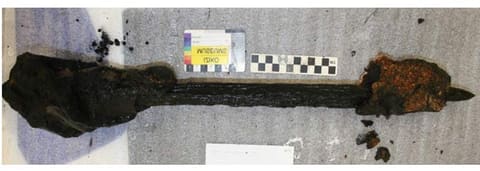
Shackles from the São José slave ship
N° 1208·Undated
Shackles from the São José slave ship
Unknown
São José wreck 1794 (shackles recovered November 2014) · Iron

Iron shackles recovered in November 2014 from the wreck of the São José-Paquete de Africa, a slave ship that wrecked on the Clifton shoreline near Cape Town in December 1794 while carrying 553 enslaved people, 212 of whom perished. After more than two hundred years on the sea floor the shackles were heavily concreted and extremely fragile; Iziko's conservators removed them carefully from the site and stabilised them through fresh-water desalination baths and electrolysis. Held by Iziko Museums with the São José material associated with the Iziko Slave Lodge, Cape Town.

“The shackles were recovered in November 2014.” In the museum’s words — slavery.iziko.org.za ↗ · quotation verified against the live page
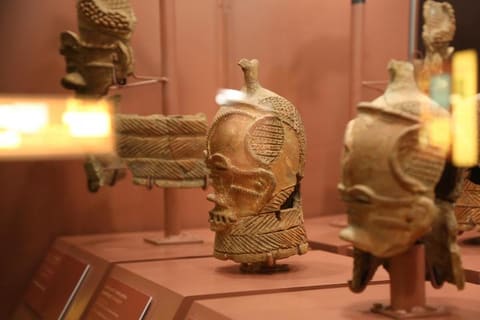
The Lydenburg Heads
N° 1219·Undated
The Lydenburg Heads
Unknown
Discovered 1962–1964, Lydenburg, Mpumalanga · Clay

Seven clay heads reconstructed from pottery fragments that a young boy found eroding out of a gully at Lydenburg, Mpumalanga, between 1962 and 1964. The fragments were not formally excavated, but the majority of the pieces were recovered and reconstructed into the seven heads collectively known as the Lydenburg Heads, which the museum presents as African treasures notable for the interesting symbols that adorn them. Iziko Museums of South Africa is the custodian of the Lydenburg Heads, held at the Iziko South African Museum in Cape Town.

“Between 1962 and 1964, a young boy discovered strange pieces of pottery eroding out of a gully in Lydenburg, Mpumalanga, South Africa” In the museum’s words — iziko.org.za ↗ · quotation verified against the live page