The Atlas·CO

CO

Museo Nacional de Colombia, Bogotá — 19 works · museum site ↗ · 200 BCE – 1970 60000 BCE2020

Seen from Bogotá, history is above all craft & design, then faces & portraits — a collection opened wide onto other worlds — a window more than a mirror (18 of 19 works are from other civilisations).

Craft 6 Portraits 4 Power 3 Stories 2 Invention 1 Sculpture 1 Sacred 1 Observation 1
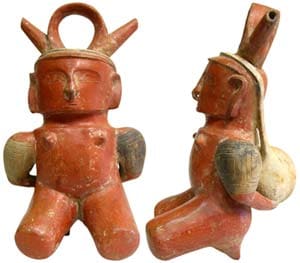
Female-form flask from Malagana (Alcarraza con forma femenina)
N° 227·II · The Classical World
Female-form flask from Malagana (Alcarraza con forma femenina)
Unknown
200 BCE - 200 CE (relative chronology) · modelled ceramic with applied and incised decoration
Malagana

Translated from Spanish: A modelled ceramic flask in the form of a seated woman (27 x 16.5 cm, Reg. 43) from the Malagana archaeological zone (Palmira, Valle del Cauca), dated to 200 BCE-200 CE, decorated in light ochre and red with two parallel cream bands on the arms. It is one of many objects recovered from illegal trafficking in archaeological heritage.

“La alcarraza en forma de mujer es uno de los tantos objetos recuperados de las manos de profesionales dedicados al tráfico ilegal del patrimonio arqueológico.” In the museum’s words — museonacional.gov.co ↗ · quotation verified against the live page

Meanwhile — Sarcophagus and Cartonnage of the Priest Hor-Djehuti and the Mummy of an Unknown Woman Egypt & Nubia · 2nd half of the 1st century BC – 1st half of the 1st century AD (Roman Period)
Muisca cup with serpent figures (Copa Muisca con representaciones de serpientes)
N° 319·II · The Classical World
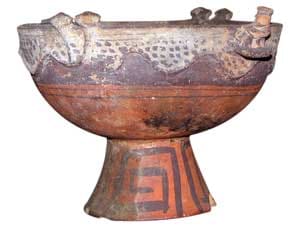
Muisca cup with serpent figures (Copa Muisca con representaciones de serpientes)
Unknown
400-1800 CE (relative chronology) · ceramic with appliqué and negative painting
Muisca

Translated from Spanish: A Muisca ceramic pedestal cup (código 189) decorated with appliqué and negative painting, in which two undulating serpents intertwine around the rim. Such representations are frequent in the pottery and goldwork of the Muisca who inhabited the Cundiboyacense highlands; researchers connect the serpents with the origin myth of Bachué. Part of the ICANH archaeological collection.

“Dos serpientes ondulantes se entrecruzan y decoran el borde de la copa Muisca.” In the museum’s words — museonacional.gov.co ↗ · quotation verified against the live page

Meanwhile — Antler-Reinforced Composite Bow East Asia · 11th–12th century

Muisca diadem with three bird figures (Diadema o corona muisca)
N° 320·II · The Classical World
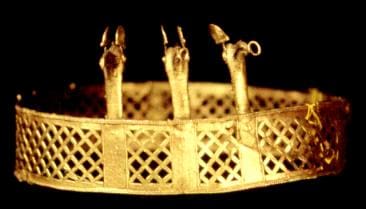
Muisca diadem with three bird figures (Diadema o corona muisca)
Unknown
400-1800 CE (relative chronology) · laminated openwork gold with solid lost-wax cast figures
Muisca

Translated from Spanish: A Muisca gold diadem or crown made of laminated openwork gold topped with three solid lost-wax-cast bird figures (Código 38-I-930), from the Cundiboyacense highlands. The bird motif, common on pectorals and ornaments, marked the lineage of the wearer in the hierarchical Muisca society. It belongs to the ICANH archaeological collection exhibited at the Museo Nacional in its goldwork vault (Bóveda de Orfebrería).

“Esta diadema con varias cabezas muestra una manera de representar el tema generalizado del ave, frecuente en pectorales y ornamentos para uso de un determinado linaje en sociedades jerarquizadas como la muisca.” In the museum’s words — museonacional.gov.co ↗ · quotation verified against the live page

Meanwhile — Antler-Reinforced Composite Bow East Asia · 11th–12th century

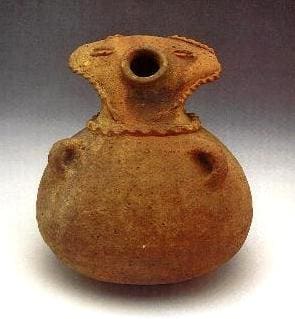
Calima anthropomorphic vessel ('gritón') (Vasija antropomorfa Calima)
N° 378·III · Faith and Empire
Calima anthropomorphic vessel ('gritón') (Vasija antropomorfa Calima)
Unknown
700-1500 CE (relative chronology), Sonso period · ceramic with appliqué
Calima (Sonso period) · Sonso

Translated from Spanish: An anthropomorphic ceramic vessel (19.8 x 19.5 cm, código CA99) of the Calima area of Valle del Cauca, known as the 'gritón' (shouter). Calima ceramics distinguish three periods of occupation — Ilama, Yotoco and Sonso; this piece belongs to the Sonso period. It is part of the ICANH archaeological collection.

“A través de la cerámica procedente del área Calima se identifican tres periodos de ocupación conocidos como Ilama, Yotoco y Sonso.” In the museum’s words — museonacional.gov.co ↗ · quotation verified against the live page

Meanwhile — Antler-Reinforced Composite Bow East Asia · 11th–12th century

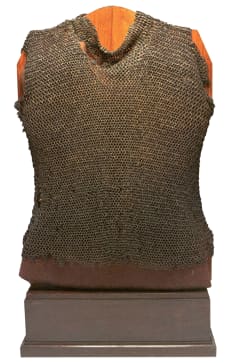
Chain mail of Gonzalo Jiménez de Quesada (Cota de malla de Gonzalo Jiménez de Quesada)
N° 659·V · The Renaissance
Chain mail of Gonzalo Jiménez de Quesada (Cota de malla de Gonzalo Jiménez de Quesada)
Unknown
c. 1530 · mild steel rings (mail)
Spanish

Translated from Spanish: A mail shirt (c. 1530, 66.5 x 45 cm, registration number 1) made in Toledo, Spain, of interlinked steel rings forming a kind of vest. It belonged to Gonzalo Jiménez de Quesada, the Spanish conquistador who founded the city of Bogotá in 1538.

“Esta cota de malla fabricada en Toledo (España) hace más de cuatro siglos y compuesta de argollas de acero entrelazadas que forman una especie de chaleco, perteneció a Gonzalo Jiménez de Quesada” In the museum’s words — museonacional.gov.co ↗ · quotation verified against the live page

Meanwhile — Manuscript Page from the Golestan of Sa’di Islamic world · 1526–1530

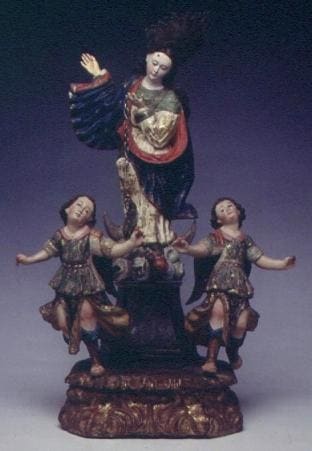
Virgin of the Apocalypse with angels (Virgen del Apocalipsis y ángeles)
N° 800·VII · The Age of Reason
Virgin of the Apocalypse with angels (Virgen del Apocalipsis y ángeles)
Unknown
18th century · carved and polychromed wood
Quito school (Spanish colonial)

Translated from Spanish: A carved and polychromed wooden sculpture (Reg. 3747) of the apocalyptic Virgin flanked by angels, belonging to the Quito-school style that developed in the 17th and 18th centuries and was marked by religious emotion, rich polychromy and gilding.

“Esta representación de la virgen apocalíptica pertenece al estilo escultórico conocido con el nombre de la escuela quiteña” In the museum’s words — museonacional.gov.co ↗ · quotation verified against the live page

Meanwhile — Samurai armour East Asia · Edo period (18th century)

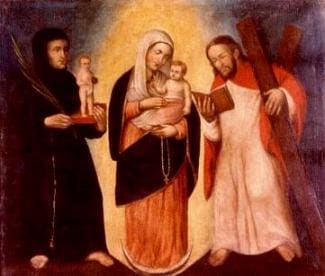
Virgin of the Rosary of Chiquinquirá (Virgen del Rosario de Chiquinquirá)
N° 801·VII · The Age of Reason
Virgin of the Rosary of Chiquinquirá (Virgen del Rosario de Chiquinquirá)
Unknown
18th century · oil on canvas
Spanish colonial (Viceroyalty of New Granada)

Translated from Spanish: The most important sacred image created in the New Kingdom of Granada during the colonial period. Its distinctive feature is the depiction of three figures in one painting: the Virgin of the Rosary, Saint Anthony of Padua and the apostle Saint Andrew. The original was painted in Tunja in the 16th century by Alonso de Narváez; the Museo Nacional's anonymous version keeps the same iconographic composition and appears to have been made in the 18th century (Reg. 3801).

“La Virgen del Rosario de Chiquinquirá fue la imagen más importante que se creó en la Nueva Granada, durante el período colonial.” In the museum’s words — museonacional.gov.co ↗ · quotation verified against the live page

Meanwhile — Samurai armour East Asia · Edo period (18th century)

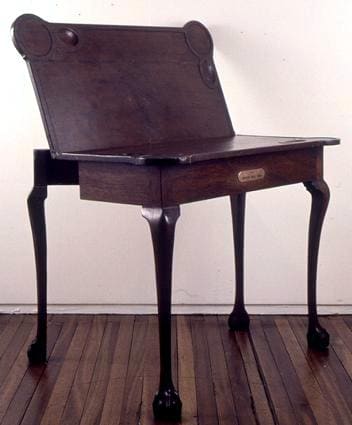
Card table used by Francisco de Paula Santander (Mesa de tresillo de Santander)
N° 836·VII · The Age of Reason
Card table used by Francisco de Paula Santander (Mesa de tresillo de Santander)
Unknown
18th century (c. 1780) · walnut (nogal)
Colombian / English-influenced

Translated from Spanish: A wooden gaming (tresillo) table (c. 1780, 81.3 x 103.5 x 56.8 cm, Reg. 671) used by General Francisco de Paula Santander. Its design is close to the work of the English furniture designer Thomas Chippendale, whose 18th-century English styles strongly shaped decorative arts. Tresillo, a card game that appeared in Spain around 1600, was played by Bolívar, Nariño and Santander.

“El diseño de la mesa es próximo a los trabajos de Thomas Chippendale, reconocido diseñador de muebles de origen inglés.” In the museum’s words — museonacional.gov.co ↗ · quotation verified against the live page

Meanwhile — Melancholia Europe · c. 1770–1790

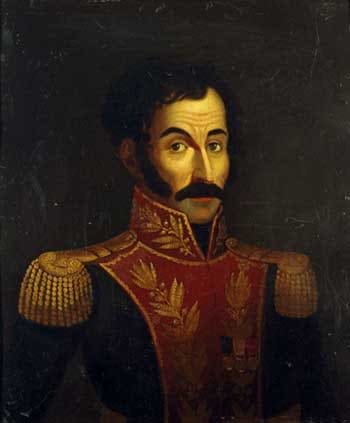
Simón Bolívar
N° 873·VIII · The Restless Century
Simón Bolívar
Antonio Salas Pérez
c. 1822 · oil on metal
Colombian / Quito school

Translated from Spanish: A portrait of the Liberator Simón Bolívar painted around 1822 in oil on metal (27 x 24 cm) by the Quito painter Antonio Salas Pérez (Quito, 1795-1860). It was donated to the Museo Nacional de Colombia by the collector and former president Eduardo Santos in 1959 (Reg. 1855).

“Antonio Salas Pérez [Quito, 1795 - 1860] Simón Bolívar Ca. 1822 Óleo sobre metal 27 x 24 cm. Reg. 1855” In the museum’s words — museonacional.gov.co ↗ · quotation verified against the live page

Meanwhile — Saturn Europe · 1820–1823

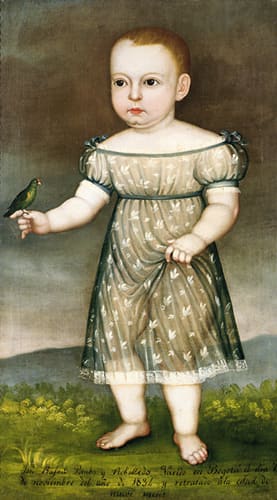
Rafael Pombo as a child (Rafael Pombo)
N° 881·VIII · The Restless Century
Rafael Pombo as a child (Rafael Pombo)
Unknown
c. 1835 · oil on canvas
Colombian (Republican)

Translated from Spanish: A portrait (oil on canvas, 75 x 43.8 cm, Reg. 3845) showing the future poet and fabulist Rafael Pombo — born in Bogotá on 7 November 1834 — at the age of nine months, in a transparent lace dress and holding a bird. It reflects a 19th-century shift away from depicting children as small adults. The work relates to the tradition of Pedro José Figueroa's workshop; it was donated by the Fundación para la Conservación del Patrimonio del Banco de la República in 1998.

“Esta imagen nos muestra cómo en el siglo XIX se deja de ver a los niños como pequeños adultos” In the museum’s words — museonacional.gov.co ↗ · quotation verified against the live page

Meanwhile — Morning View of Østerbro Europe · 1836

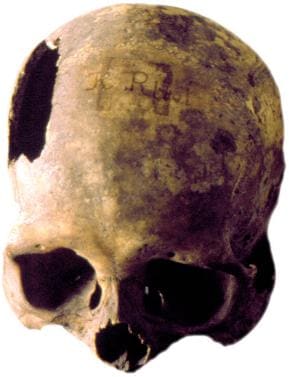
Skull attributed to the criminal 'Doctor Russi' (Cráneo del 'Doctor Russi')
N° 899·VIII · The Restless Century
Skull attributed to the criminal 'Doctor Russi' (Cráneo del 'Doctor Russi')
Unknown
1851 · bone

Translated from Spanish: A human skull (Reg. 942) with several alterations, including a missing mandible and bone loss, and two ink inscriptions reading 'R Russi' in an old hand. It is believed to have belonged to José Raimundo Russi, a lawyer executed by firing squad in Bogotá in 1851 after being accused of leading a band of thieves. The skull entered the Museo Nacional de Colombia during the 20th century and has since remained in its reserve collection.

“Cráneo de un hombre que presenta diversas alteraciones como ausencia de mandíbula y múltiples pérdidas de sustancia ósea, la mayor de ellas ubicada en la región frontoparietal derecha.” In the museum’s words — museonacional.gov.co ↗ · quotation verified against the live page

Meanwhile — At a Window in the Artist's Studio Europe · 1852

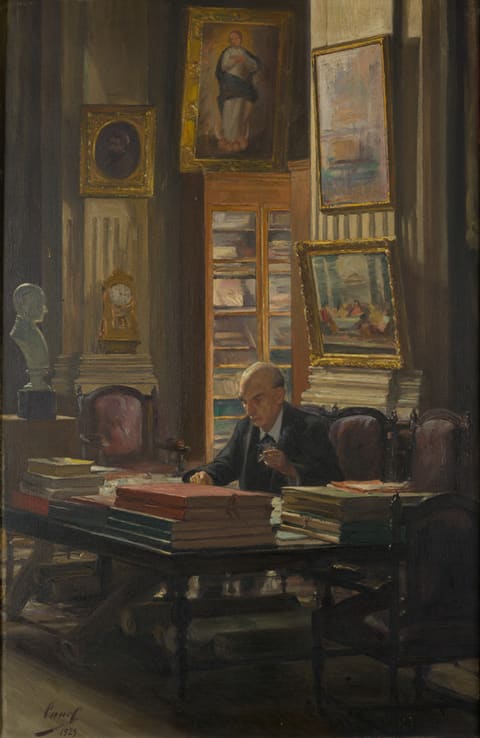
Eugenio Peña (portrait)
N° 1038·IX · Into Our Time
Eugenio Peña (portrait)
Francisco Antonio Cano Cardona
1929 · oil on canvas
Colombian (Republican)

Translated from Spanish: An oil-on-canvas portrait (81 x 52.5 cm, Reg. 3111) painted in 1929 by Francisco Antonio Cano Cardona (1865-1935), the artist and director of Colombia's Escuela de Bellas Artes. It shows the sitter, Eugenio Peña (1860-1944), in his study, following the early-20th-century convention of portraying a person within their surroundings to characterise them.

“El óleo en que se representa a Eugenio Peña (1860-1944), además de responder a una de las maneras en que se asume el retrato en los primeros años del siglo XX” In the museum’s words — museonacional.gov.co ↗ · quotation verified against the live page

Meanwhile — "Celestial Globe" Europe · manufactured 1929-1930

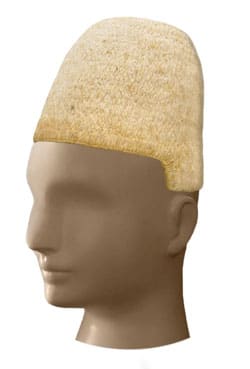
Tutusoma, Arhuaco hat (Tutusoma, sombrero arhuaco)
N° 1059·IX · Into Our Time
Tutusoma, Arhuaco hat (Tutusoma, sombrero arhuaco)
Unknown (Arhuaco community)
c. 1945 · woven fibre
Arhuaco

Translated from Spanish: A woven Arhuaco hat, or tutusoma (c. 1945, 18 x 16 cm, Reg. E-90-XII-123), from the Sierra Nevada de Santa Marta. When a young Arhuaco man wears his tutusoma for the first time he commits to safeguarding the balance and harmony of the mountain. Part of the ICANH ethnographic collection.

“Cuando un joven arhuaco utiliza por primera vez su tutusoma se compromete a resguardar el equilibrio y la armonía de la montaña.” In the museum’s words — museonacional.gov.co ↗ · quotation verified against the live page

Meanwhile — Street Scene Africa · 1945

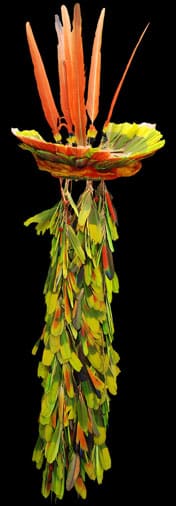
Kofán feather crown (Corona de plumas)
N° 1061·IX · Into Our Time
Kofán feather crown (Corona de plumas)
Unknown (Kofán community)
1946 · bark and feathers
Kofán (Cofán)

Translated from Spanish: A feather crown (1946, 120 x 35 cm, Reg. 46-V-6624) from the Kofán people of Putumayo. Such crowns are part of the attire worn by members of Kofán communities for ceremonial occasions such as the taking of yagé (ayahuasca); they are made from a ring of bark to which feathers are attached. Part of the ICANH ethnographic collection.

“Las coronas de plumas hacen parte de la indumentaria que los miembros de las comunidades Kofán utilizan para momentos ceremoniales como la toma del yagé” In the museum’s words — museonacional.gov.co ↗ · quotation verified against the live page

Meanwhile — Handwritten Draft of President Ho Chi Minh's "Appeal to National Resistance" South Asia · 19 December 1946

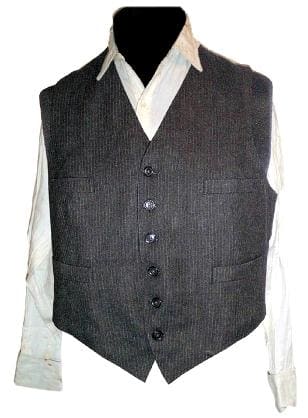
Clothing worn by Jorge Eliécer Gaitán on the day of his death (Prendas de Jorge Eliécer Gaitán)
N° 1063·IX · Into Our Time
Clothing worn by Jorge Eliécer Gaitán on the day of his death (Prendas de Jorge Eliécer Gaitán)
Camisería Francesa / Egos
c. 1948 · wool, silk, cotton and linen (machine-sewn)
Colombian

Translated from Spanish: The garments (vest, undershirt, braces, handkerchief; Reg. 5647) worn by the liberal leader Jorge Eliécer Gaitán when he was assassinated in Bogotá on 9 April 1948. His follower Pedro Antonio Vaca Torres, who stayed with Gaitán until his death, kept the objects; after the death of Vaca's widow in 2005, their children donated them to the Museo Nacional.

“Al morir su esposa Milena Murcia de Vaca el 31 de enero de 2005, sus hijos decidieron donar los objetos al Museo Nacional” In the museum’s words — museonacional.gov.co ↗ · quotation verified against the live page

Meanwhile — Handwritten Draft of President Ho Chi Minh's "Appeal to National Resistance" South Asia · 19 December 1946

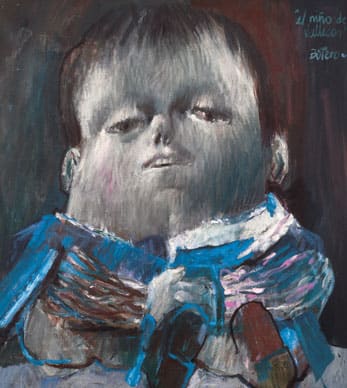
El niño de Vallecas (Fernando Botero)
N° 1074·IX · Into Our Time
El niño de Vallecas (Fernando Botero)
Fernando Botero Angulo
1959 · oil on canvas
Colombian

Translated from Spanish: An oil on canvas (150.5 x 136.5 cm, Reg. 3194) painted in 1959 by Fernando Botero Angulo (b. Medellín, 1932) and donated to the museum by the artist himself in 1984. One of Botero's eleven versions of Velázquez's El niño de Vallecas — the museum notes that reinterpreting the history of art is a constant in his production, made, in his own words, 'only to learn from universal painting', and that these versions show the creation of a pictorial figure of his own from the theme. Displayed in the Sala Ideologías, arte e industria (1910-1948), third floor.

“Fernando Botero Angulo [Medellín, 19.4.1932] El niño de Vallecas 1959 Pintura (Óleo/tela) 150,5 x 136,5 cm Reg. 3194 Donada por el autor (14.2.1984)” In the museum’s words — museonacional.gov.co ↗ · quotation verified against the live page

Meanwhile — Chair, "The Drop" Europe · designed 1958

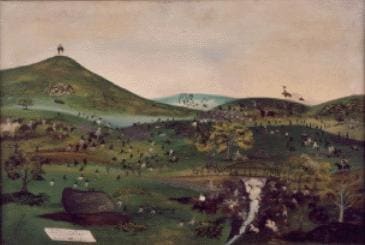
Battle of Boyacá (Batalla de Boyacá)
N° 1085·IX · Into Our Time
Battle of Boyacá (Batalla de Boyacá)
Marco Tulio Villalobos
c. 1970 · oil on canvas
Colombian (naïve painting)

Translated from Spanish: A naïve oil-on-canvas painting (c. 1970, Reg. 3168) depicting the patriots' victory over the Spanish army commanded by Barreiro at the Battle of Boyacá (7 August 1819), the decisive engagement of the independence of New Granada. An inscription in the lower left corner, signed 'Marco Tulio Villalobos (obrero)', reads: 'Así terminó la esclavitud y nació la libertad. En el puente de Boyacá el 7 de agosto de 1819.'

“Este cuadro representa el triunfo de los patriotas sobre el ejército español, comandado por Barreiro.” In the museum’s words — museonacional.gov.co ↗ · quotation verified against the live page

Meanwhile — THE HEARTH (Feuerstätte) Europe · 1968–1974

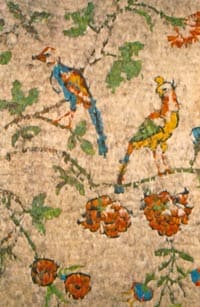
Feather tapestry (Tapiz de plumas)
N° 1146·Undated
Feather tapestry (Tapiz de plumas)
Unknown
undated (Peru; recorded 1881) · featherwork (cotton cloth and feathers)
Peruvian (featherwork)

Translated from Spanish: A large featherwork tapestry (254 x 215 cm, código 44-VII-5341) of cotton cloth and feathers, whose principal theme is the tree, a symbolic element present in many cultures and religions. Of Peruvian origin, it belongs to the ICANH collection, was a 19th-century gift of the Government of Peru, and was first recorded in the Breve Guía del Museo Nacional de Colombia of 1881.

“El árbol ha sido un elemento simbólico presente en diversas culturas y religiones, y es el tema principal de esta pieza de arte plumario” In the museum’s words — museonacional.gov.co ↗ · quotation verified against the live page
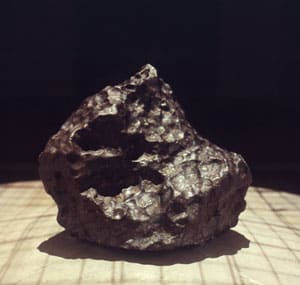
Santa Rosa de Viterbo Meteorite (Aerolito de Santa Rosa de Viterbo)
N° 1203·Undated
Santa Rosa de Viterbo Meteorite (Aerolito de Santa Rosa de Viterbo)
Unknown
Acquired 1823 · mineral with metallic appearance (density 7.70), 411 kg

Translated from Spanish: An irregular metallic-looking mass, black with reddish tints (51 x 54 x 54 cm, 411 kg, Reg. 874), showing wind erosion over its surface and a flat cut where a sample was taken for analysis. This meteorite was found by Cecilia Corredor near Santa Rosa de Viterbo, Boyacá, and was purchased from her for the museum's collection in 1823.

“Mineral de forma irregular con apariencia metálica, de color negro y visos rojos.” In the museum’s words — museonacional.gov.co ↗ · quotation verified against the live page