The Atlas·CH

Switzerland

Kunstmuseum Basel, Basel — 13 works · museum site ↗ · 1521–1974 60000 BCE2020

Seen from Basel, history is above all sculpture, then new ways of seeing — a collection kept mostly in its own tradition, with a few glances abroad (2 of 13 works are from other civilisations).

Sculpture 3 New vision 3 Portraits 2 Stories 2 Observation 2 Sacred 1
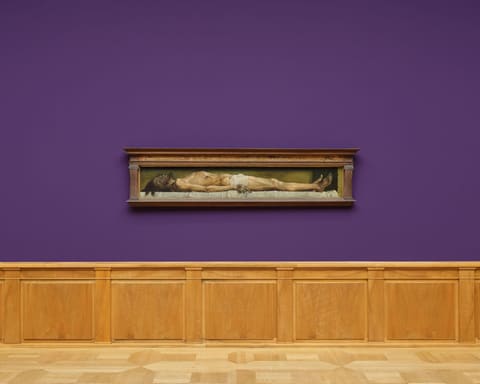
The Dead Christ in the Tomb
N° 653·V · The Renaissance
The Dead Christ in the Tomb
Hans Holbein the Younger (c. 1497/98–1543)
1521–1522 · oil on limewood panel
German · Northern Renaissance

Painted on a long, narrow panel, Holbein's life-size, unsparingly realistic depiction of Christ's corpse - shown alone, without mourners, in the first hours of decomposition - has no real precedent in Western art. Fyodor Dostoevsky viewed the painting in Basel in 1867 and later wrote it into The Idiot, where a character fears the image could make a viewer lose their faith.

“The German painter Hans Holbein the Younger depicts the dead Christ with an unsparingness that is unprecedented, reducing the scene to its essential object: the tortured corpse in a sepulchral niche. The writer Fyodor Dostoevsky is said to have been so distressed when he saw it in 1867 that he almost had an epileptic seizure. The picture appears in his famous novel The Idiot, written after his visit to Basel.” In the museum’s words — cdn.kunstmuseumbasel.ch ↗

Meanwhile — Padrão of Sunda Kalapa South Asia · 16th century (treaty dated 21 August 1522)
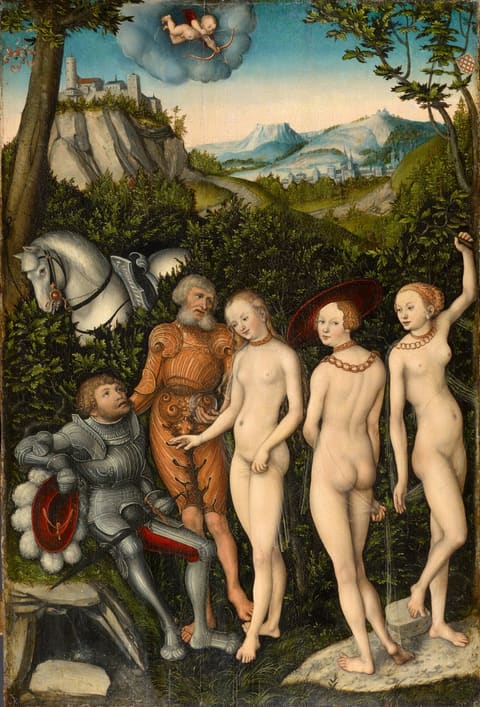
The Judgement of Paris
N° 658·V · The Renaissance
The Judgement of Paris
Lucas Cranach the Elder (1472–1553)
1528 · mixed media on beech panel
German · Northern Renaissance

Lucas Cranach the Elder depicts the Trojan prince Paris, dressed as a medieval knight, being shown the three nude goddesses Juno, Minerva, and Venus in a dream by the messenger god Mercury, moments before awarding Venus the golden apple as the fairest. Cranach's workshop produced roughly a dozen surviving variants of the theme between about 1513 and 1540; this one is signed and dated 1528.

“The painting depicts a famous episode from Greek legend. Prince Paris of Troy is asked to judge which of three goddesses—Hera, Athena, or Aphrodite—is the most beautiful. The German painter Lucas Cranach transformed the ancient source into a scene of erotic nudity.” In the museum’s words — cdn.kunstmuseumbasel.ch ↗

Meanwhile — Manuscript Page from the Golestan of Sa’di Islamic world · 1526–1530

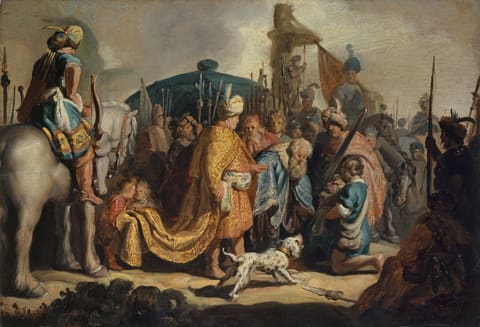
David with the Head of Goliath before Saul
N° 745·VI · The Baroque Age
David with the Head of Goliath before Saul
Rembrandt van Rijn (1606–1669)
1627 · oil on oak panel
Dutch · Dutch Golden Age

This small panel, signed and dated 1627, is the earliest known oil sketch by Rembrandt, painted when he was just twenty-one. It shows the young shepherd David presenting the severed head of the giant Goliath to King Saul, with the biblical figures dressed in the imagined "oriental" costume Dutch artists used to signal a distant biblical past.

“This panel is the earliest known oil sketch by the Netherlandish master's hand. It depicts a scene from the story of David and Goliath in the Old Testament. The turbans and the striking "Orientalizing" attire of the biblical personages are a far cry from the austere fashions worn by the Dutch in the seventeenth century. They are meant to convey what was, in the perspective of the time, a realistic vision of an action set far away and in a distant past.” In the museum’s words — cdn.kunstmuseumbasel.ch ↗

Meanwhile — Water Fowl in the Lotus Pond East Asia · Japan, Edo period, early 17th century

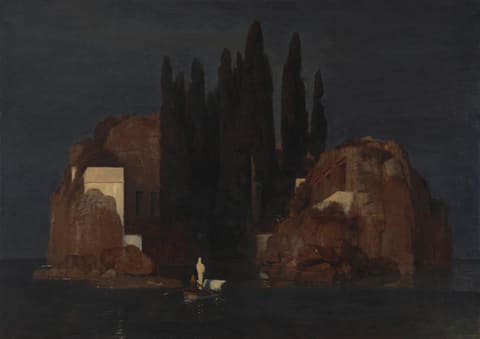
Island of the Dead
N° 922·VIII · The Restless Century
Island of the Dead
Arnold Böcklin (1827–1901)
1880 · oil on canvas
Swiss · Symbolism

Böcklin, who was born in Basel, painted this haunting image of a shrouded figure being ferried toward a rocky, cypress-covered island - the first of five versions he made of the composition, completed in spring 1880 in his studio in Florence for his patron Alexander Günther. Reproduced endlessly in the decades after, it became one of the most widely known images in European art.

“The Basel-born painter Arnold Böcklin's Island of the Dead was a blockbuster in the late nineteenth century. Prints after the painting adorned many a bourgeois living room. The mysterious scene inspired composers, while writers, comic artists, and filmmakers gave it cameos in their works.” In the museum’s words — cdn.kunstmuseumbasel.ch ↗

Meanwhile — Madame X (Virginie Amélie Avegno Gautreau) Americas & Oceania · 1883–84

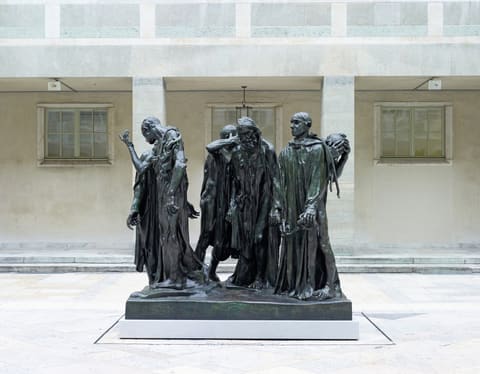
The Burghers of Calais
N° 934·VIII · The Restless Century
The Burghers of Calais
Auguste Rodin (1840–1917)
1884–1889 · bronze
French

Rodin's bronze group depicts six leading citizens of Calais who, according to the medieval chronicler Jean Froissart, offered themselves as hostages to the besieging English king in 1347 to spare their city from destruction. Rather than idealized heroes, Rodin portrayed them at eye level in postures of anguish and resignation, radically reinterpreting the traditional heroic monument. The Kunstmuseum Basel's cast (the 7th of twelve) was made in 1942/43 and has stood in the museum's courtyard since 1948.

“The Burghers of Calais recalls an episode from the Hundred Years' War between France and England. In one of his most imposing works of sculpture, Rodin also created a new kind of monument. The French artist's figures are heroic in defeat, their faces and hand gestures haunting expressions of resignation and despair.” In the museum’s words — cdn.kunstmuseumbasel.ch ↗

Meanwhile — A Poem on the Anatomy of the Eye (Qasida fi Tashrih al-Ayn) Islamic world · 1305 AH / 1887 CE (copy)

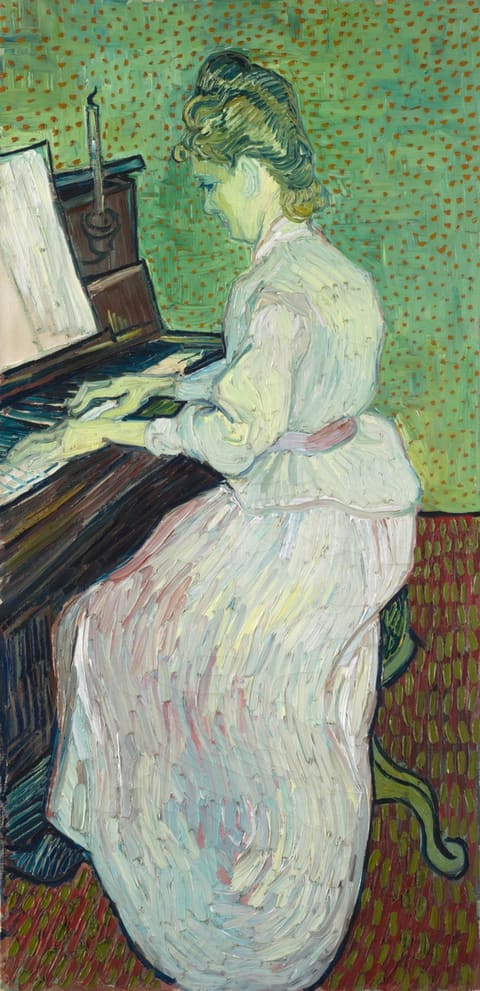
Marguerite Gachet at the Piano
N° 956·VIII · The Restless Century
Marguerite Gachet at the Piano
Vincent van Gogh (1853–1890)
1890 · oil on canvas
Dutch · Post-Impressionism

Van Gogh painted this portrait of Marguerite Gachet, the daughter of Dr. Paul Gachet - the physician treating him at Auvers-sur-Oise - over two days in late June 1890, only weeks before his death. The composition was apparently inspired by an etching Dr. Gachet had made years earlier of his late wife at the piano; van Gogh gave the finished painting directly to Marguerite.

“The Dutch painter Vincent van Gogh created this picture shortly before he took his own life in July 1890. It shows the nineteen-year-old Marguerite Gachet, the daughter of a physician. The mentally ailing artist had traveled to see her father in Auvers. Van Gogh gave the portrait to the young woman, with whom he had presumably fallen in love.” In the museum’s words — cdn.kunstmuseumbasel.ch ↗

Meanwhile — Mangaaka Power Figure (Nkisi N’Kondi) Africa · ca. 1880–1900

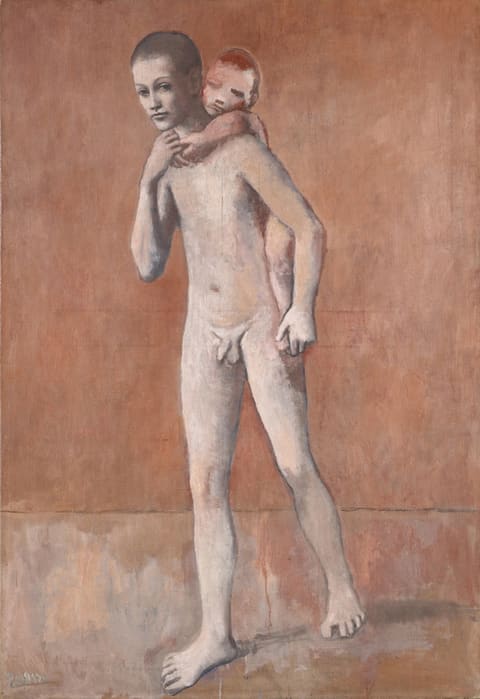
The Two Brothers
N° 998·IX · Into Our Time
The Two Brothers
Pablo Picasso (1881–1973)
1906 · oil on canvas
Spanish · Rose Period

Painted in the Catalan village of Gósol in the early summer of 1906, at the close of Picasso's Rose Period, this canvas shows two boys - one gently supporting the other - rendered in the warm, earthen palette and simplified, almost sculptural forms Picasso was developing just before his breakthrough into Cubism.

“Motifs from the world of harlequins, clowns, and acrobats appear frequently in the early works of Picasso, a native of Spain and arguably the most famous artist of his century. The older child tenderly touches the hands and foot of his young brother, whose figure almost blends in with the shallow pictorial space. Only a single line and the shadow on the floor lend the painting some depth.” In the museum’s words — cdn.kunstmuseumbasel.ch ↗

Meanwhile — The Hanging Place of the Maji Maji War Heroes (Eneo la manyongeo, Songea) Africa · site of the executions of 27 February 1906

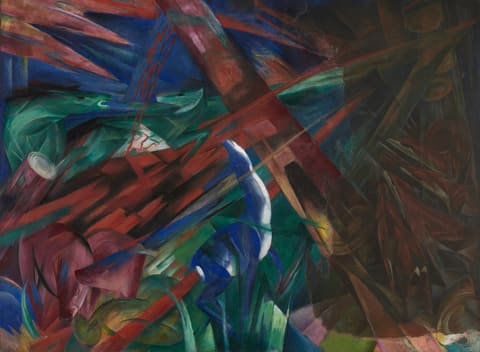
Animal Destinies
N° 1006·IX · Into Our Time
Animal Destinies
Franz Marc (1880–1916)
1913 · oil on canvas
German · Der Blaue Reiter

A co-founder of Der Blaue Reiter, Franz Marc filled this large canvas with fleeing, terrified animals amid a shattering, crystalline forest, foreboding the catastrophe of the First World War that would kill Marc himself three years later. Damaged by fire in 1917 and restored under Paul Klee's supervision, the painting was seized by the Nazis as "degenerate art" before Kunstmuseum Basel acquired it in 1939 - the first of 21 such "degenerate" works the museum went on to purchase.

“This masterpiece by the German painter Franz Marc was created less than a year before the outbreak of the First World War and seems filled with foreboding of the looming cataclysm. The picture's own history has been eventful, too: after it caught fire in 1917, it was restored by the artist Paul Klee. The Nazis rejected it as "degenerate"; it was among the many works they pulled from German museums and sold abroad. The Kunstmuseum Basel bought it in 1939, the first of altogether twenty-one such acquisitions.” In the museum’s words — cdn.kunstmuseumbasel.ch ↗

Meanwhile — Mawson's sledge Americas & Oceania · Used on the Australasian Antarctic Expedition, 1911–1914

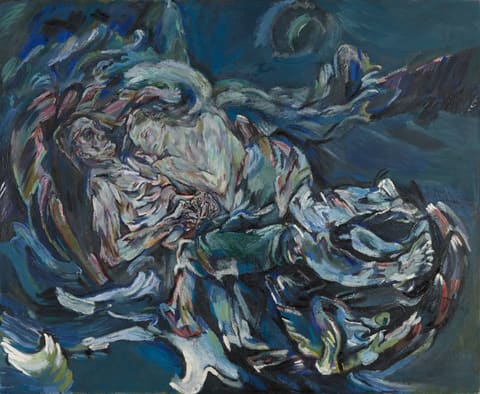
The Bride of the Wind
N° 1007·IX · Into Our Time
The Bride of the Wind
Oskar Kokoschka (1886–1980)
1913 · oil on canvas
Austrian · Expressionism

Kokoschka painted himself and his lover Alma Mahler (widow of composer Gustav Mahler) adrift in a swirling, storm-tossed sea, with her sleeping peacefully while he stares out tensely - widely read as a premonition of both the coming World War and the collapse of their turbulent relationship. Confiscated by the Nazi regime from the Hamburger Kunsthalle in 1937 as "degenerate art," the painting later returned to public view at Kunstmuseum Basel.

“This painting, created on the eve of the First World War, shows the Austrian artist Oskar Kokoschka with his lover, Alma Mahler. The couple is engulfed in a storm. She is fast asleep, without a care in the world, but he lies rigid and tense. The work may be read as alluding to the explosive political tensions of the time, but also as an expression of a fraught love affair that fell apart shortly after the picture was painted.” In the museum’s words — cdn.kunstmuseumbasel.ch ↗

Meanwhile — Mawson's sledge Americas & Oceania · Used on the Australasian Antarctic Expedition, 1911–1914

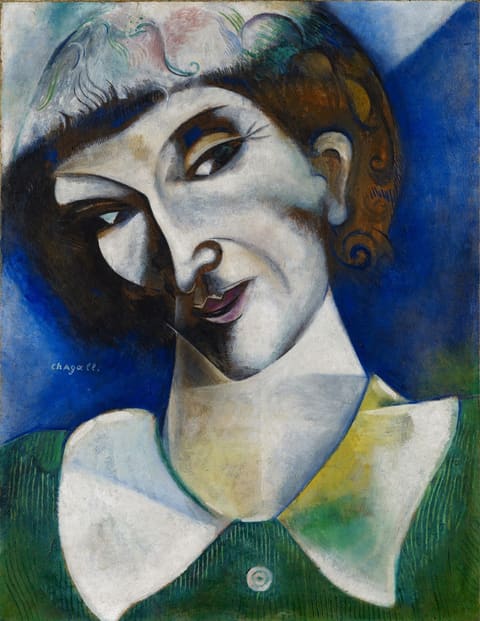
Self-Portrait
N° 1008·IX · Into Our Time
Self-Portrait
Marc Chagall (1887–1985)
1914 · oil on cardboard, mounted on canvas
Russian · School of Paris

One of a series of close-cropped self-portraits Chagall painted in 1914, shortly before the outbreak of war stranded him in Russia for the following eight years, this small oil on cardboard shows the artist positioned so near the mirror that only his head and shoulders appear, his gaze both skeptical and inscrutable. On loan from the Im Obersteg Foundation.

“In 1914, the Russian-French painter Marc Chagall created a series of self-portraits. To make this one, he stood so close to the mirror that only his head and shoulders fit into the frame. The resulting picture creates the impression that the artist is skeptically eyeing the beholder, while his own expression is rather inscrutable. With his clownish features, Chagall has the aura of an enigmatic visionary.” In the museum’s words — cdn.kunstmuseumbasel.ch ↗

Meanwhile — Gelang Aceh (Aceh Bracelet) South Asia · Early 20th century

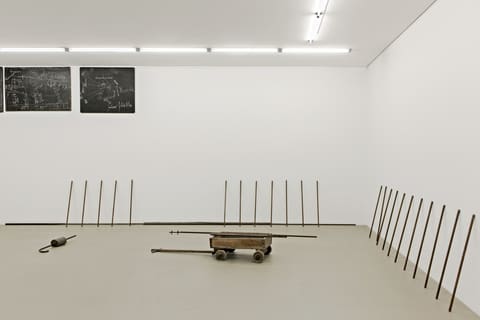
THE HEARTH (Feuerstätte)
N° 1084·IX · Into Our Time
THE HEARTH (Feuerstätte)
Joseph Beuys (1921–1986)
1968–1974 · mixed-media installation with copper, iron, felt, wood, and chalk
German · Fluxus

Beuys assembled this installation - a wooden cart, copper and iron rods (some wrapped in felt), and blackboards salvaged from one of his own public lectures - as what he called a "social sculpture," extending art beyond the museum into conversation and collective action; a slight electrical warmth generated where the copper and iron rods meet was a favorite Beuys metaphor for human warmth.

“The German artist Joseph Beuys is regarded as one of the great innovators in the art of the twentieth century. Works in a museum, he thought, were only one manifestation of art; so were events, conversations, and intellectual processes. In installations like this one, Beuys compellingly articulated his complex artistic and political ideas through materials in three-dimensional situations.” In the museum’s words — cdn.kunstmuseumbasel.ch ↗

Meanwhile — The original Uhuru Torch (Mwenge halisi wa Uhuru) Africa · Union Torch relayed 1964–1979; received by the museum 9 December 1979

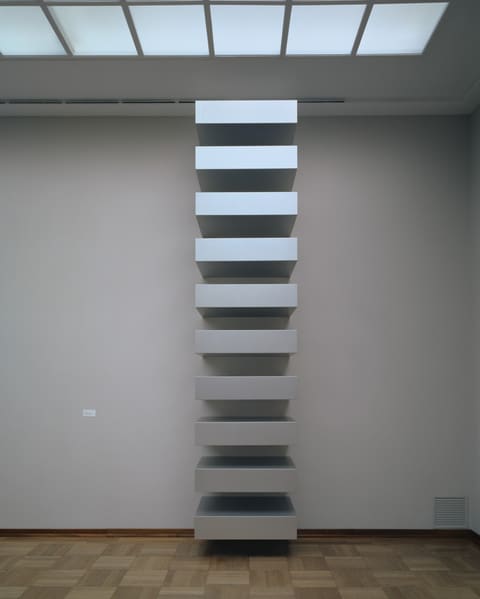
Untitled
N° 1086·IX · Into Our Time
Untitled
Donald Judd (1928–1994)
1970 · clear anodized aluminum
American · Minimalism

A leading figure of American Minimalism, Judd rejected traditional sculpture in favor of what he called "specific objects" - industrially fabricated geometric forms. This ten-part anodized aluminum "stack," mounted on the wall with gaps between units equal to the height of the units themselves, alternates solid and open volumes of identical dimensions.

“The American artist has been hailed as a leading exponent of minimalism, a tendency in visual art characterized by lucid basic structures, repetition in series, and industrial production methods. Rather than sculptures in the traditional sense of the word, Judd created specific objects: geometric bodies based on a small set of forms manufactured out of industrial materials. This work, a precise arrangement of uniform aluminum cubes, reflects his interest in the interplay between open and closed volumes in space.” In the museum’s words — cdn.kunstmuseumbasel.ch ↗

Meanwhile — THE HEARTH (Feuerstätte) Europe · 1968–1974

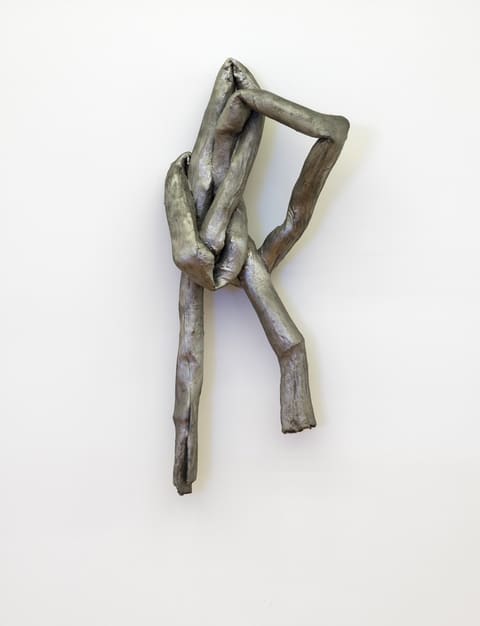
Foxtrot
N° 1087·IX · Into Our Time
Foxtrot
Lynda Benglis (b. 1941)
1974 · aluminum screen, cotton bunting, plaster, sprayed tin and zinc
American · Post-Minimalism

Part of Benglis's "Knots" series, this sculpture is built from aluminum screen, cotton bunting, plaster, and sprayed metal, formed into tubes sized to the circumference of her own arm and knotted by hand, with a title borrowed, half-ironically, from the NATO phonetic alphabet.

“The American artist Lynda Benglis is a pioneer of feminist art. This work is one in her series of Knots: sculptures made of metal and plaster tubes whose circumference matches that of her own arm. Benglis knotted them by hand; titles like Sierra or Foxtrot ironically quote the letters of the NATO phonetic alphabet. Benglis's oeuvre is distinguished by her use of industrial materials, which she handles with raw physical force. Sensitive to the qualities of her materials and forms, her art also registers her own movements.” In the museum’s words — cdn.kunstmuseumbasel.ch ↗

Meanwhile — The original Uhuru Torch (Mwenge halisi wa Uhuru) Africa · Union Torch relayed 1964–1979; received by the museum 9 December 1979