Pergamon Museum, Berlin — 16 works · museum site ↗ · 2600 BCE – 1603
Seen from Berlin, history is above all architecture & ornament, then faith & ritual objects — a collection opened wide onto other worlds — a window more than a mirror (16 of 16 works are from other civilisations).
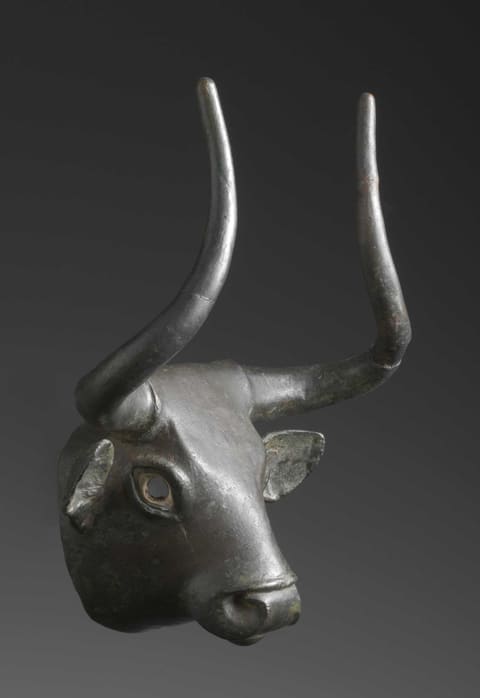
A bull's head with inlaid eyes, dated to around the 26th century BC, among the oldest objects in the Vorderasiatisches Museum's collection and a striking example of early Mesopotamian animal imagery. The museum's own caption does not give a specific material or findspot, and none is asserted here.
“Bull's head with inlaid eyes, ca. 26th century BC”
In the museum’s words — smb.museum ↗
Mesopotamian · Early Dynastic period (Mesopotamia)
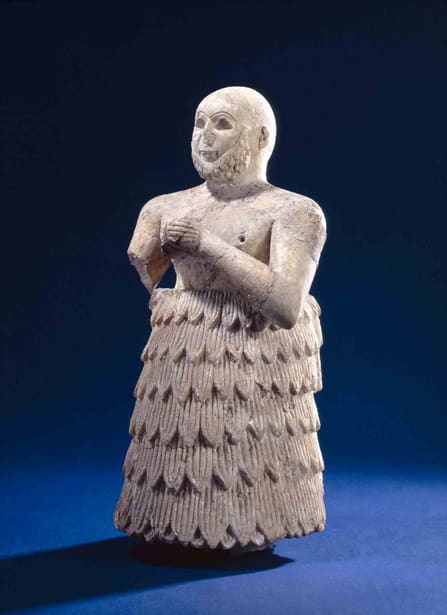
A small statuette of a worshipper in the traditional 'praying figure' pose, made at Assur around 2400 BC and typical of the votive statues Mesopotamians dedicated in temples on their own behalf. The museum's own caption does not specify a material, and none is asserted here.
“Statuette of a praying figure, Assur, ca. 2400 BC”
In the museum’s words — smb.museum ↗
Old Babylonian · Old Babylonian period (First Dynasty of Babylon)
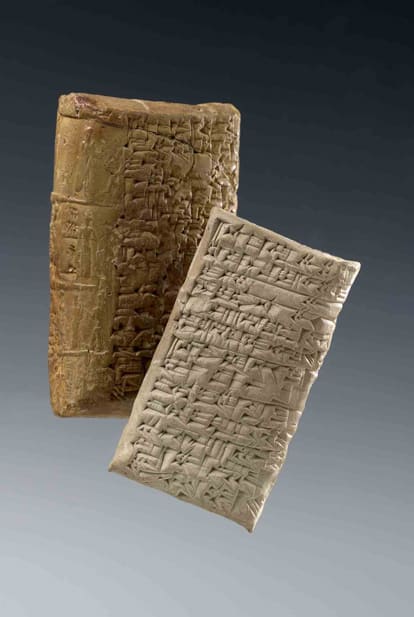
A cuneiform clay tablet recording the waiver of a legal action, together with its own clay envelope or 'case' used to seal and authenticate the document, dated to the reign of the Babylonian king Apil-Sin in the 19th century BC.
“Clay tablet with case, muniment about a waiver of an action, Apil-Sin period/19th century BC”
In the museum’s words — smb.museum ↗
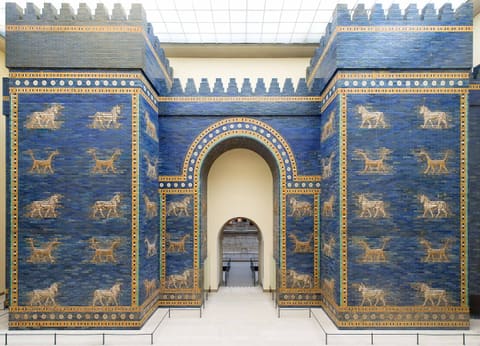
The reconstructed Ishtar Gate of Babylon, built of glazed and moulded brick in its third construction stage, decorated with rows of bulls and dragons sacred to the gods Adad and Marduk. This construction stage is generally dated to the reign of Nebuchadnezzar II (604-562 BC), within the broader 7th-6th century BC range the museum's own caption gives; it is one of the ancient world's most celebrated monumental gateways.
“Ishtar Gate (III construction stage), 7th-6th century BC, Babylon”
In the museum’s words — smb.museum ↗
604–562 BC (reign of Nebuchadnezzar II) · glazed brick
Neo-Babylonian · Neo-Babylonian Empire
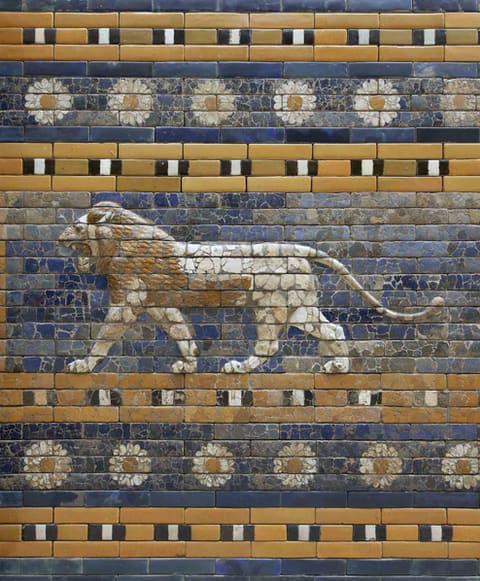
A striding lion in glazed brick relief from the Processional Way of Babylon, the ceremonial avenue leading to the Ishtar Gate, built under King Nebuchadnezzar II (604-562 BC); the lion was sacred to the goddess Ishtar and lined the route in a long repeating frieze.
“Walking lion from the Processional Way, Babylon, Reign of King Nebuchadnezzar II (604–562 v. Chr.)”
In the museum’s words — smb.museum ↗
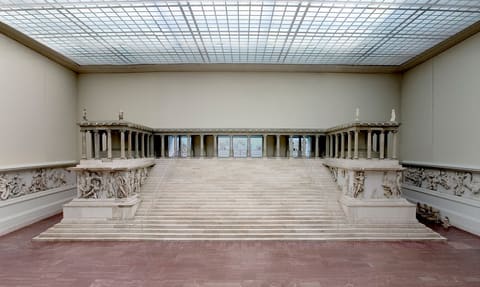
A monumental Hellenistic altar built at Pergamon around 170 BC, reconstructed at full scale around its surviving original architectural elements; the long relief frieze running around its base depicts the Gigantomachy, the mythical battle between the Olympian gods and the Giants, and is widely regarded as one of the masterpieces of Hellenistic sculpture. Its own hall has been the museum's single most famous space.
“The main Pergamon altar, reconstruction of the western façade, with frieze panels of the Gigantomachy and original architectural elements, Hellenistic, Pergamon, ca. 170 BC”
In the museum’s words — smb.museum ↗
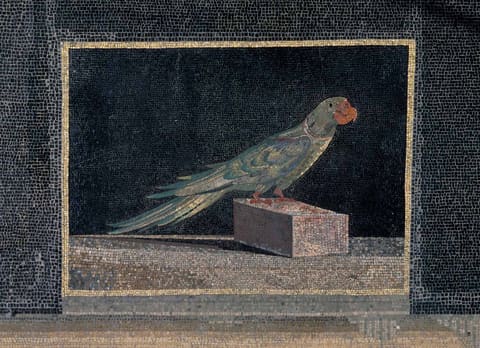
A Hellenistic floor mosaic from an 'altar chamber' in Palace V, the royal palace at Pergamon, dated 160-150 BC and depicting an Alexandrine parakeet; a fine example of the refined tessera mosaic work produced for the Pergamene royal court.
“Mosaic with Alexandrine parakeet, the 'altar chamber' in palace V, Hellenistic, Pergamon, 160–150 BC”
In the museum’s words — smb.museum ↗
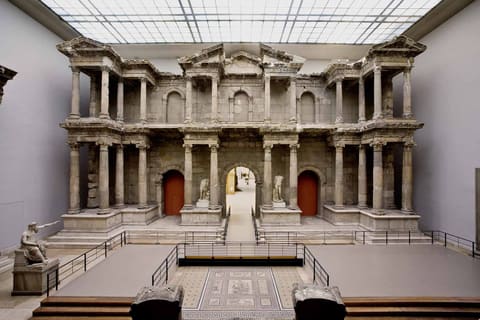
A monumental two-storey marble gateway built at Miletus in Roman Asia Minor around 100 AD, in the reign of Trajan, and reconstructed at full scale in the museum's Miletus Hall (with some modern additions) as one of the Antikensammlung's great architectural ensembles.
“The Market Gate of Miletus, reconstruction with modern additions, Roman, Trajan era, Miletus, ca. 100 AD”
In the museum’s words — smb.museum ↗
2nd century AD · stone and glass tesserae (mosaic)
Roman · Roman Empire
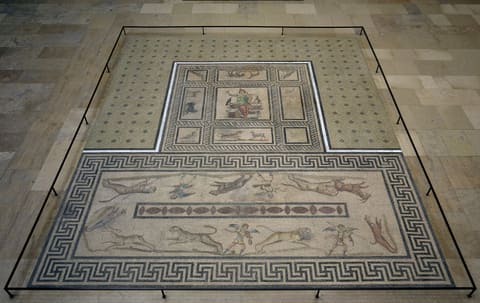
A Roman floor mosaic from Miletus, dated to the 2nd century AD, depicting the mythical musician Orpheus playing to the animals. The Antikensammlung's own highlights page (which spans its holdings across several Museum Island buildings, not only the Pergamon Museum) groups it with the department's Miletus material; its exact gallery was not independently confirmed beyond that page, which is disclosed here rather than assumed.
“Orpheus mosaic, Roman, Miletus, 2nd C. AD”
In the museum’s words — smb.museum ↗
Meanwhile — Seated KuberaSouth Asia · 2nd Century AD
N° 383·III · Faith and Empire
Mshatta Facade
Unknown
743–744 AD · limestone
Umayyad · Umayyad Caliphate
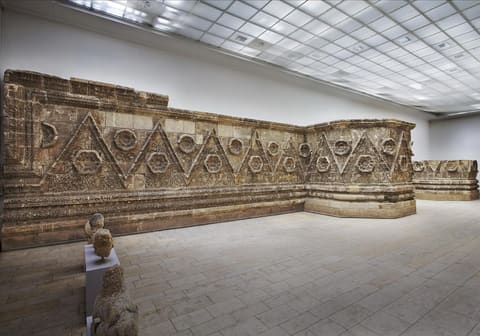
A richly carved limestone façade from the unfinished 8th-century desert palace of the Caliph's residence at Mshatta, near Amman in Jordan, built around 743-744 under the Umayyad caliphate; its dense vine-scroll and rosette ornament is among the finest surviving examples of early Islamic architectural decoration.
“Façade of the Caliph's Palace of Mshatta, near Amman, Jordan, 743-4 (Inv. No. 6163)”
In the museum’s words — smb.museum ↗
13th century · stonepaste (fritware) with glazed tile mosaic
Anatolian Seljuk · Seljuk Sultanate of Rum
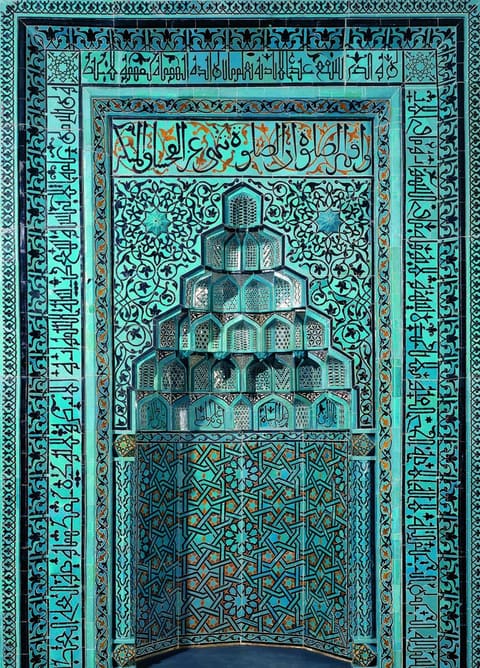
A glazed-tile prayer niche (mihrab) from the Beyhekim Mosque in Konya, Turkey, made in the 13th century under the Seljuk Sultanate of Rum; Seljuk Konya was a major centre of turquoise- and cobalt-glazed tile production for mosque interiors.
“Prayer niche (mihrab) from the Beyhekim Mosque in Konya, Turkey, 13th century (Inv. No. I. 7193)”
In the museum’s words — smb.museum ↗
Meanwhile — Great ZimbabweAfrica · flourished 11th-15th century CE
N° 511·III · Faith and Empire
Mihrab from Kashan
Unknown
1226 · stonepaste (fritware) with lustre glaze
Persian · Seljuk period (Iran)
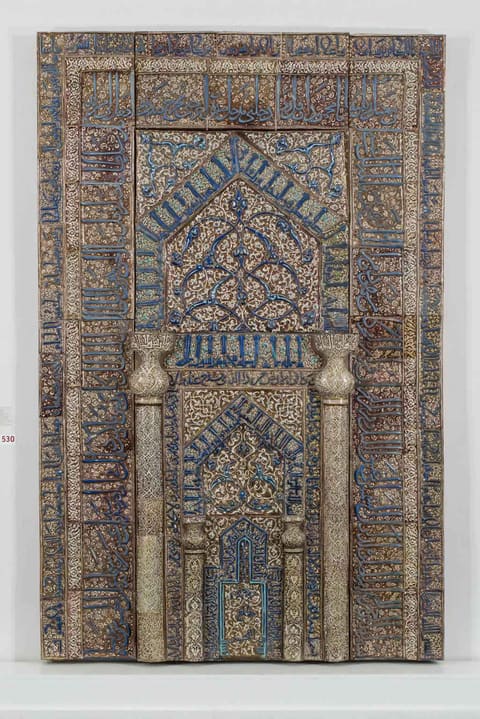
A lustre-glazed ceramic prayer niche (mihrab) made in Kashan, Iran, dated 1226; Kashan was the leading centre of Persian lustreware production, and its tiled mihrabs are among the most admired achievements of medieval Islamic ceramic art.
“Prayer niche (mihrab), Kashan, Iran, 1226 (Inv. No. 5366)”
In the museum’s words — smb.museum ↗
Nasrid (Moorish Spain) · Nasrid Emirate of Granada
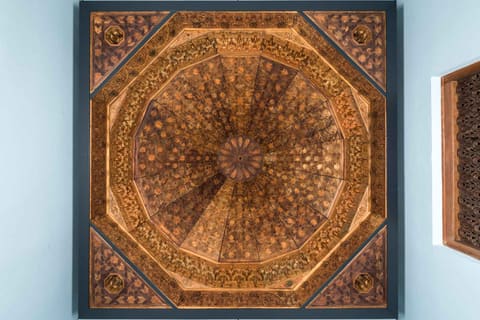
A carved and painted wooden dome ceiling from a Nasrid palace building in Granada, Spain, dated around 1320, one of the outstanding surviving examples of Nasrid woodwork associated with the Alhambra.
“Alhambra dome, Granada, Spain, c. 1320 (Inv. No. 5/78)”
In the museum’s words — smb.museum ↗
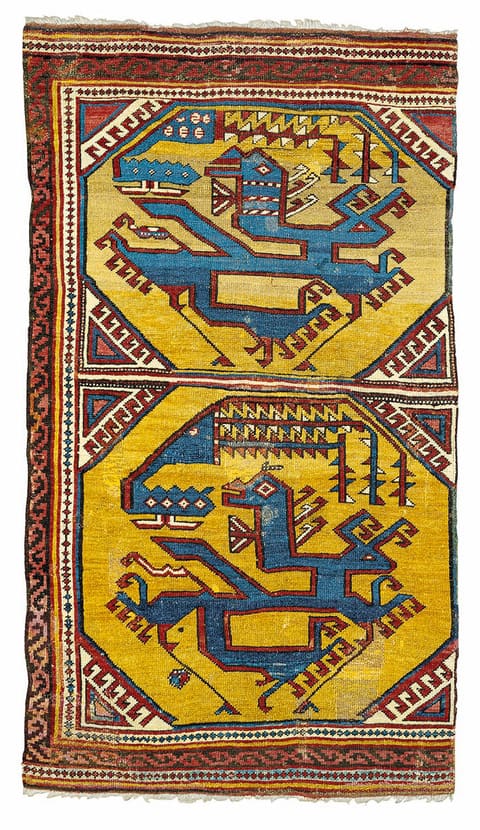
A large knotted wool carpet from Anatolia, Turkey, dated broadly to 1450-1600 and depicting a combat between a dragon and a phoenix; one of the oldest surviving Anatolian carpets and a key reference piece in the history of Turkish carpet weaving.
“Dragon Phoenix Carpet, Turkey, 1450-1600 (Inv. No. I.4)”
In the museum’s words — smb.museum ↗
1526–1530 · ink, opaque watercolour, and gold on paper
Safavid Persian · Safavid dynasty
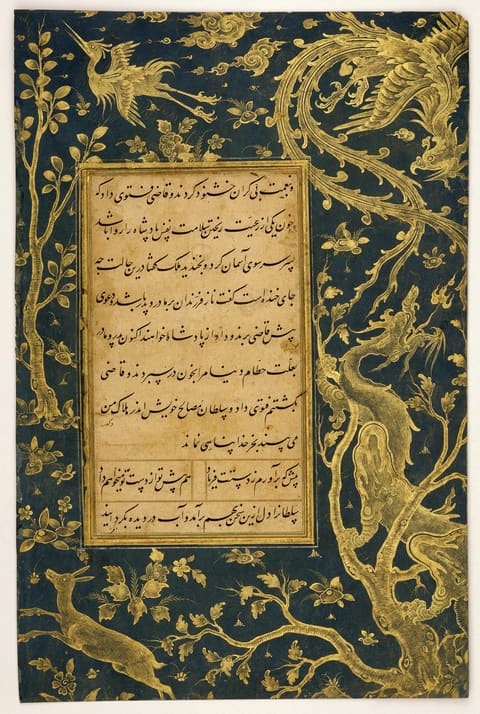
An illustrated page from a 16th-century manuscript copy of the Golestan ('Rose Garden'), the classic 13th-century Persian poetry collection by the poet Sa'di of Shiraz, produced in Shiraz, Iran, between 1526 and 1530.
“Single page from the Golestan of Saʿdī, Shiraz, Iran, 1526-1530 (Inv. No. 1986.104)”
In the museum’s words — smb.museum ↗
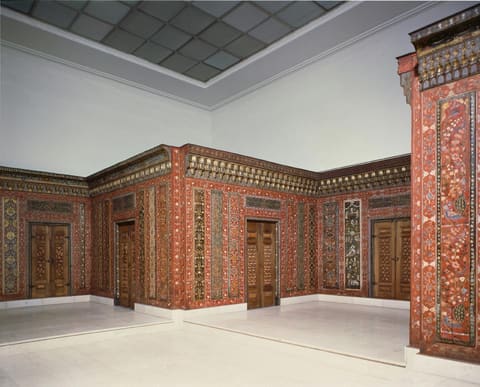
A complete painted wood-panelled reception room from the house of a Christian merchant in Ottoman Aleppo, Syria, dated 1600-01 and 1603; its brightly painted panels combine Islamic, Christian, and Jewish imagery, reflecting the mixed culture of the merchant elite of Ottoman-era Aleppo.
“Aleppo Room, painted wood panelling from the reception room of a Christian merchant from Aleppo, Syria, dated 1600-01 and 1603 (Inv. No. 2862)”
In the museum’s words — smb.museum ↗