The Atlas·PE

PE

Museo Larco, Lima — 18 works · museum site ↗ · 1250 BCE – 1532 60000 BCE2020

Seen from Lima, history is above all craft & design, then treasure & power — a collection opened wide onto other worlds — a window more than a mirror (18 of 18 works are from other civilisations).

Craft 9 Power 4 Ritual 3 Sculpture 2
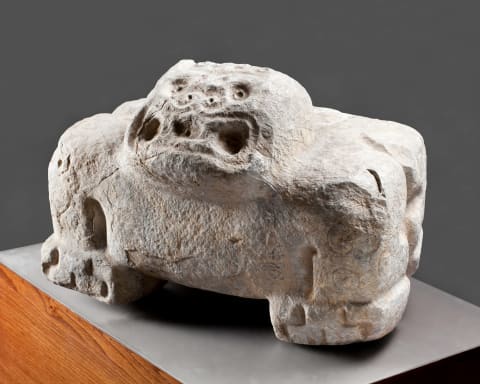
Pacopampa stone feline sculpture (Felino Pacopampa)
N° 119·I · The First Makers
Pacopampa stone feline sculpture (Felino Pacopampa)
Unknown
Pacopampa, Formative Era (1250 BCE – 1 CE) · Stone
Pacopampa · Época Formativa (Formative Era)

Translated from Spanish: A stone sculpture representing a feline standing on all four legs with its mouth open and its fangs prominent, its tail coiled at the rear; incised circles cover the whole body, so the feline represented is probably a jaguar. Pacopampa culture (Formative period), from the Larco collection.

“Escultura de piedra que representa un felino parado en sus cuatro patas con la boca abierta, destacando sus colmillos.” In the museum’s words — coleccion.museolarco.org ↗ · quotation verified against the live page

Meanwhile — Ishtar Gate Near East · 7th–6th century BC
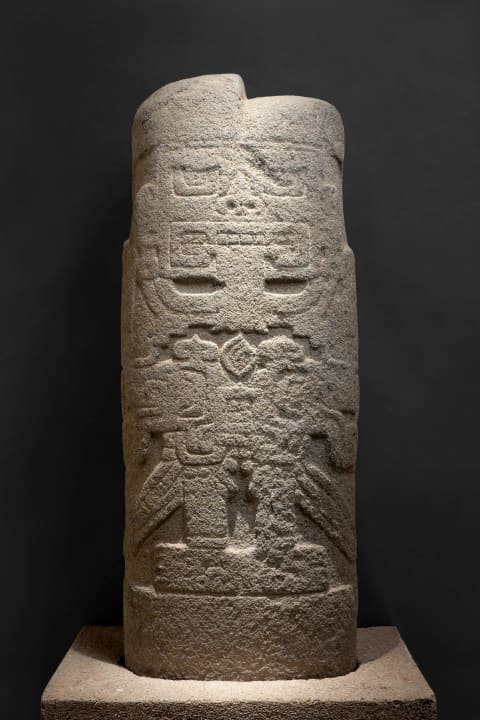
Pacopampa stone stela of a supernatural woman (Estela Pacopampa)
N° 120·I · The First Makers
Pacopampa stone stela of a supernatural woman (Estela Pacopampa)
Unknown
Pacopampa, Formative Era (1250 BCE – 1 CE) · Stone
Pacopampa · Época Formativa (Formative Era)

Translated from Spanish: A stone stela representing a supernatural woman who carries a snail at the centre of her body, with appendages issuing from her mouth and a head divided into two unequal halves. At the genitals is a face with feline attributes, the genital area shown as a fanged 'vagina dentata'. Pacopampa culture (Formative period), part of the permanent exhibition's Cultures of Ancient Peru gallery.

“Estela de piedra que representa a una mujer sobrenatural. La mujer lleva un caracol al centro de su cuerpo.” In the museum’s words — coleccion.museolarco.org ↗ · quotation verified against the live page

Meanwhile — Ishtar Gate Near East · 7th–6th century BC
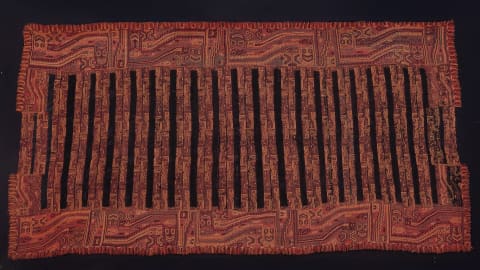
Paracas embroidered funerary mantle (Manto Paracas)
N° 121·I · The First Makers
Paracas embroidered funerary mantle (Manto Paracas)
Unknown
Paracas, Formative Era (1250 BCE – 1 CE) · Textile (cotton and camelid fibre)
Paracas · Época Formativa (Formative Era)

Translated from Spanish: A Paracas funerary mantle on a black cotton ground with designs embroidered in camelid wool, repeated cyclically across the textile and forming quadrants around the border. The motif is a hybrid being with the head of a feline (Andean cat), a serpentine body and bird's feet, repeated three times nested within itself and alternating yellow, green and black thread against a red embroidery ground. On permanent display in the museum's Textiles of Ancient Peru gallery.

“Manto funerario Paracas en base de algodón de color negro con diseños bordados en lana de camélido que se repiten de forma cíclica en toda la estructura del tejido, formando cuadrantes en todo el borde del manto.” In the museum’s words — coleccion.museolarco.org ↗ · quotation verified against the live page

Meanwhile — Ishtar Gate Near East · 7th–6th century BC
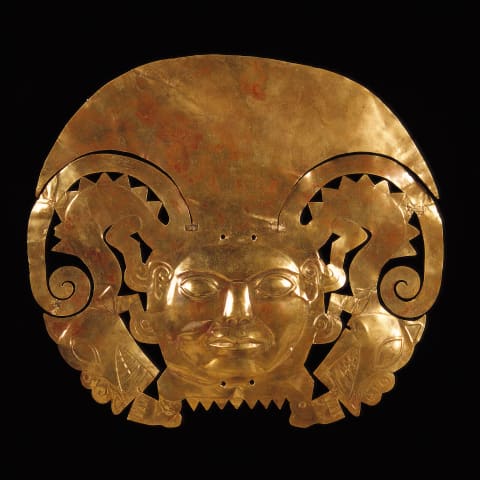
Moche 14-karat gold headdress frontal ornament with dragons (Adorno Frontal de Oro Mochica)
N° 258·II · The Classical World
Moche 14-karat gold headdress frontal ornament with dragons (Adorno Frontal de Oro Mochica)
Unknown
Moche (Mochica), Florescent Era (1 – 800 CE) · Gold alloy (14-karat gold-copper-silver)
Moche (Mochica) · Época Auge (Florescent Era)

Translated from Spanish: A frontal headdress ornament of 14-karat gold representing a human head with a crescent headdress and zoomorphic figures (dragons) with feline heads. Moche goldwork, part of the permanent exhibition's Gold and Jewellery gallery (Sala Oro y joyas).

“Adorno frontal del tocado de aleación oro de 14 quilates representando cabeza humana con tocado de media luna y personajes zoomorfos (dragones) con cabeza de felino con apéndices en el hocico y cuerpo aserrado (animal lunar).” In the museum’s words — coleccion.museolarco.org ↗ · quotation verified against the live page

Meanwhile — Bronze drum (mahoratuek) South Asia · Late prehistoric period (c. 1,000–2,200 years ago)

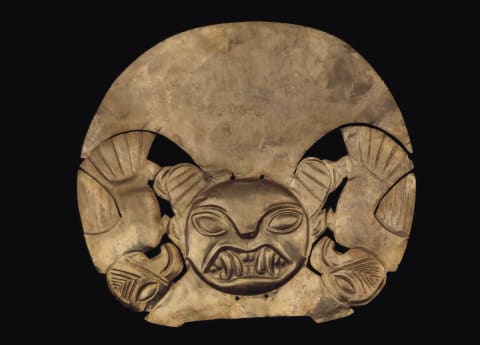
Moche 18-karat gold headdress frontal ornament with feline head (Adorno Frontal de Oro Mochica)
N° 259·II · The Classical World
Moche 18-karat gold headdress frontal ornament with feline head (Adorno Frontal de Oro Mochica)
Unknown
Moche (Mochica), Florescent Era (1 – 800 CE) · Gold alloy (18-karat gold-copper-silver)
Moche (Mochica) · Época Auge (Florescent Era)

Translated from Spanish: A frontal headdress ornament of 18-karat gold representing a feline head with a crescent headdress and two birds; the gold is a ternary gold-copper-silver alloy with a chemical composition of 78.5% gold. Moche goldwork, part of the permanent exhibition's Gold and Jewellery gallery (Sala Oro y joyas).

“Adorno frontal del tocado de oro de 18 quilates representando cabeza de felino con tocado de media luna y dos aves.” In the museum’s words — coleccion.museolarco.org ↗ · quotation verified against the live page

Meanwhile — Bronze drum (mahoratuek) South Asia · Late prehistoric period (c. 1,000–2,200 years ago)

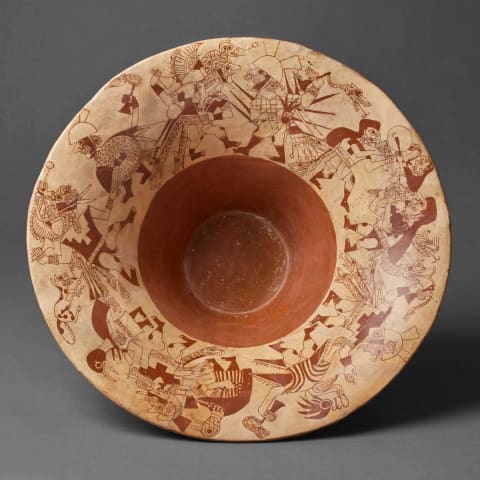
Moche flaring vase of the mythical journeys of Ai Apaec (Viajes de Ai Apaec)
N° 260·II · The Classical World
Moche flaring vase of the mythical journeys of Ai Apaec (Viajes de Ai Apaec)
Unknown
Moche (Mochica), Florescent Era (1 – 800 CE) · Ceramic
Moche (Mochica) · Época Auge (Florescent Era)

Translated from Spanish: A bell-shaped, everted-wall vase with pictorial decoration of mythical scenes, including the combat between the supernatural hero Ai Apaec and the sea urchin and other adversaries. Moche ceramic, part of the permanent exhibition's Cultures of Ancient Peru gallery.

“Vaso acampanulado o vaso con paredes evertidas, con decoración pictórica con representación de las siguientes escenas míticas: 1) Combate entre personaje antropomorfo con rasgos sobrenaturales (héroe” In the museum’s words — coleccion.museolarco.org ↗ · quotation verified against the live page

Meanwhile — Bronze drum (mahoratuek) South Asia · Late prehistoric period (c. 1,000–2,200 years ago)

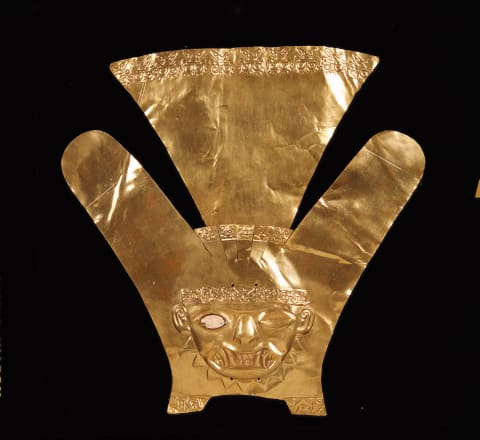
Moche gold headdress frontal ornament with fanged human head (Adorno Frontal de Oro Mochica)
N° 261·II · The Classical World
Moche gold headdress frontal ornament with fanged human head (Adorno Frontal de Oro Mochica)
Unknown
Moche (Mochica), Florescent Era (1 – 800 CE) · Gold alloy (copper-gold-silver) and shell
Moche (Mochica) · Época Auge (Florescent Era)

Translated from Spanish: A frontal headdress ornament of copper-gold-silver alloy and shell representing a human head with feline fangs, a band with serpent-head designs and a triangle collar, together with clawed serpent heads, serpent-headed felines and zoomorphic figures. Its gilded surface was probably achieved with the pre-Columbian technique of depletion gilding. Moche goldwork, part of the permanent exhibition's Gold and Jewellery gallery (Sala Oro y joyas).

“Adorno frontal del tocado de aleación cobre-oro-plata y concha representando cabeza humana con colmillos de felino, banda con diseños de cabezas de serpientes y collar de triángulos.” In the museum’s words — coleccion.museolarco.org ↗ · quotation verified against the live page

Meanwhile — Bronze drum (mahoratuek) South Asia · Late prehistoric period (c. 1,000–2,200 years ago)

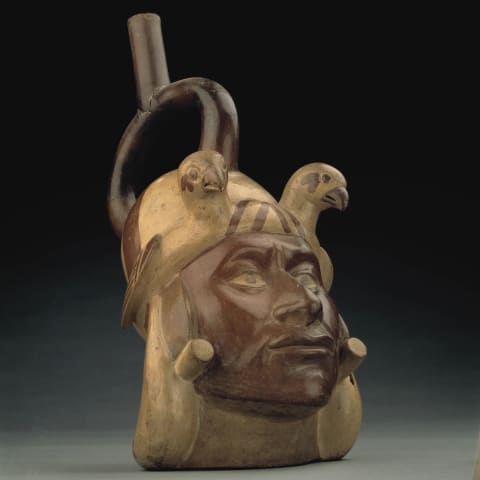
Moche portrait vessel of a priest (Huaco Retrato Sacerdote Mochica)
N° 262·II · The Classical World
Moche portrait vessel of a priest (Huaco Retrato Sacerdote Mochica)
Unknown
Moche (Mochica), Florescent Era (1 – 800 CE) · Ceramic
Moche (Mochica) · Época Auge (Florescent Era)

Translated from Spanish: A sculptural stirrup-spout bottle — a portrait vessel (huaco retrato) — of a figure wearing a headdress of birds and tubular ear ornaments. Moche ceramic, on permanent display in the museum's Cultures of Ancient Peru gallery.

“Botella gollete asa estribo escultórica huaco retrato de personaje con tocado de aves y orejeras tubulares.” In the museum’s words — coleccion.museolarco.org ↗ · quotation verified against the live page

Meanwhile — Bronze drum (mahoratuek) South Asia · Late prehistoric period (c. 1,000–2,200 years ago)

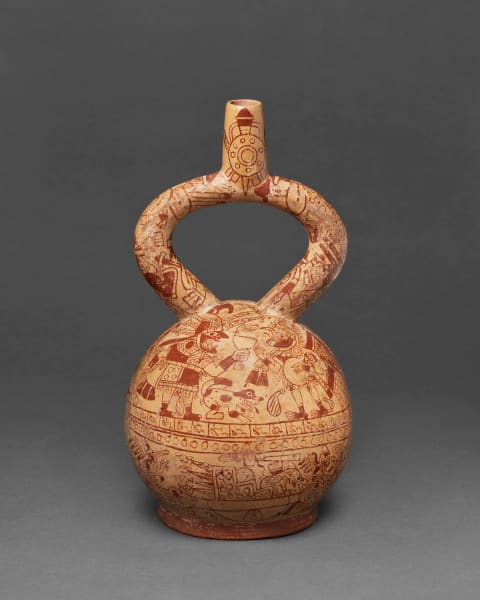
Moche Sacrifice Ceremony bottle (Ceremonia del Sacrificio Mochica)
N° 263·II · The Classical World
Moche Sacrifice Ceremony bottle (Ceremonia del Sacrificio Mochica)
Unknown
Moche (Mochica), Florescent Era (1 – 800 CE) · Ceramic
Moche (Mochica) · Época Auge (Florescent Era)

Translated from Spanish: A pictorial stirrup-spout bottle depicting the Sacrifice Ceremony and the presentation of the cup holding the sacrificial blood (a Larco piece). On the lower body two naked figures with bound hands have their throats cut by anthropomorphic and zoomorphic beings who collect the blood in bowls, to be offered to the gods of the upper world; the Radiant God appears with his warrior helmet and its crescent-shaped frontal tumi. Moche ceramic, part of the permanent exhibition's Sacrifice Ceremony gallery.

“Botella gollete asa estribo pictórica con representación de escena de Ceremonia del Sacrificio y de Presentación de la copa con la sangre del Sacrificio.” In the museum’s words — coleccion.museolarco.org ↗ · quotation verified against the live page

Meanwhile — Bronze drum (mahoratuek) South Asia · Late prehistoric period (c. 1,000–2,200 years ago)

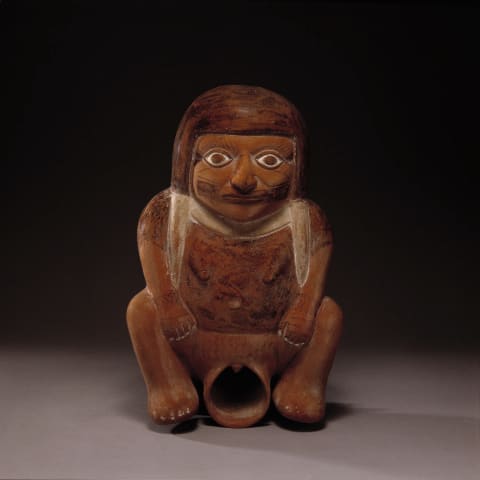
Moche sculptural vessel of a reclining woman (Mujer Receptora Mochica)
N° 264·II · The Classical World
Moche sculptural vessel of a reclining woman (Mujer Receptora Mochica)
Unknown
Moche (Mochica), Florescent Era (1 – 800 CE) · Ceramic
Moche (Mochica) · Época Auge (Florescent Era)

Translated from Spanish: A sculptural vessel representing a reclining woman showing an enlarged vulva with open labia and a visible clitoris; she wears braids, facial and body paint, a pectoral and painted nails. The piece is a sculptural bowl used for drinking liquids in rituals, with the liquid to be drunk through the woman's vulva. Moche ceramic, shown in the museum's Erotic Gallery.

“Vaso escultórico que representa a una mujer echada mostrando vulva con los labios abiertos, de gran tamaño, y clítoris visible.” In the museum’s words — coleccion.museolarco.org ↗ · quotation verified against the live page

Meanwhile — Bronze drum (mahoratuek) South Asia · Late prehistoric period (c. 1,000–2,200 years ago)

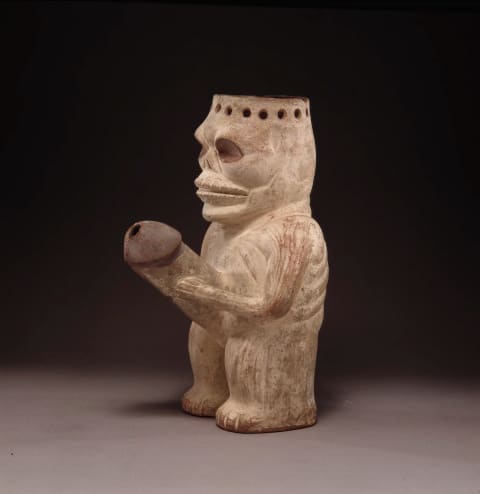
Moche sculptural vessel of an ancestor (Ancestro Mochica)
N° 265·II · The Classical World
Moche sculptural vessel of an ancestor (Ancestro Mochica)
Unknown
Moche (Mochica), Florescent Era (1 – 800 CE) · Ceramic
Moche (Mochica) · Época Auge (Florescent Era)

Translated from Spanish: A sculptural vessel representing a cadaverous figure with a large erect penis, masturbating. The rim of the vessel is perforated so that if one drinks from the upper edge the liquid spills through the holes, obliging the user to drink from the figure's penis. Moche ceramic, shown in the museum's Erotic Gallery.

“Vaso escultórico que representa a un personaje cadavérico con pene erecto de gran tamaño masturbándose.” In the museum’s words — coleccion.museolarco.org ↗ · quotation verified against the live page

Meanwhile — Bronze drum (mahoratuek) South Asia · Late prehistoric period (c. 1,000–2,200 years ago)

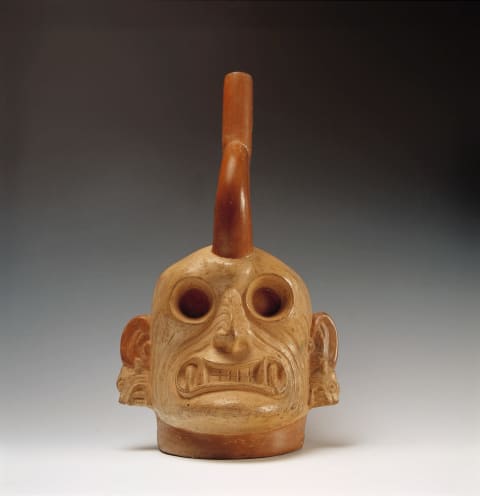
Moche stirrup-spout bottle of Ai Apaec, Lord of the Underworld (Ai Apaec Mundo de Abajo)
N° 266·II · The Classical World
Moche stirrup-spout bottle of Ai Apaec, Lord of the Underworld (Ai Apaec Mundo de Abajo)
Unknown
Moche (Mochica), Florescent Era (1 – 800 CE) · Ceramic
Moche (Mochica) · Época Auge (Florescent Era)

Translated from Spanish: A sculptural stirrup-spout bottle of the head of a supernatural anthropomorphic figure — the hero Ai Apaec — with a wrinkled face, feline fangs, empty eye sockets and serpent ear ornaments. Moche ceramic, part of the permanent exhibition's Cultures of Ancient Peru gallery.

“Botella gollete asa estribo escultórica de cabeza de personaje antropomorfo sobrenatural (héroe Ai Apaec) con la cara arrugada, colmillos de felino, cuencas oculares vacías y orejeras o pendientes de cabeza de serpiente.” In the museum’s words — coleccion.museolarco.org ↗ · quotation verified against the live page

Meanwhile — Bronze drum (mahoratuek) South Asia · Late prehistoric period (c. 1,000–2,200 years ago)

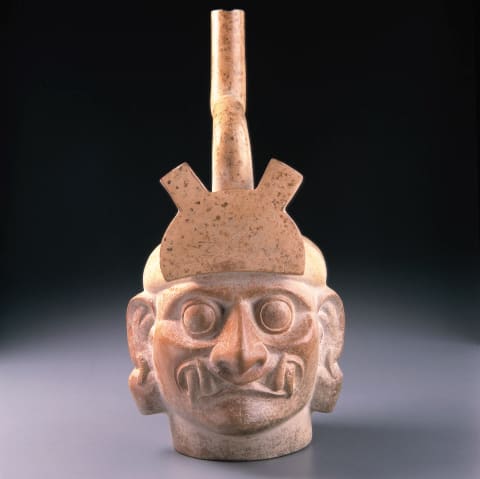
Moche stirrup-spout bottle of the hero Ai Apaec (Ai Apaec - Botella Mochica)
N° 267·II · The Classical World
Moche stirrup-spout bottle of the hero Ai Apaec (Ai Apaec - Botella Mochica)
Unknown
Moche (Mochica), Florescent Era (1 – 800 CE) · Ceramic
Moche (Mochica) · Época Auge (Florescent Era)

Translated from Spanish: A sculptural stirrup-spout bottle representing the head of an anthropomorphic figure with supernatural features — the hero Ai Apaec — with feline fangs and a crescent (or owl) headdress. Moche ceramic from the Larco collection, part of the permanent exhibition's Cultures of Ancient Peru gallery.

“Botella gollete asa estribo escultórica que representa la cabeza de personaje antropomorfo con rasgos sobrenaturales (héroe Ai Apaec) con colmillos de felino, tocado de media luna (o tocado de búho), y pendientes con cabezas de serpiente.” In the museum’s words — coleccion.museolarco.org ↗ · quotation verified against the live page

Meanwhile — Bronze drum (mahoratuek) South Asia · Late prehistoric period (c. 1,000–2,200 years ago)

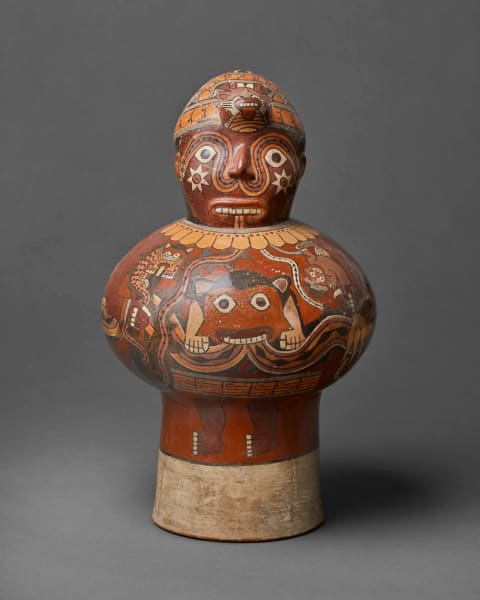
Nasca ceramic drum (Tambor Nasca)
N° 268·II · The Classical World
Nasca ceramic drum (Tambor Nasca)
Unknown
Nasca, Florescent Era (1 – 800 CE) · Ceramic
Nasca · Época Auge (Florescent Era)

Translated from Spanish: A musical instrument (drum) representing a supernatural anthropomorphic figure with a feline headdress, serpent hair, facial paint, collar, wristlets and tunic, holding a zoomorphic and phytomorphic 'yuca man' who in turn carries a trophy head. The drum represents a shaman or ancestor linked to regeneration. Nasca ceramic, part of the permanent exhibition's Cultures of Ancient Peru gallery.

“Instrumento musical (tambor) que representa a un personaje antropomorfo sobrenatural con tocado de felino, cabellos de serpientes, pintura facial (con diseños de serpientes y diseños geométricos de es” In the museum’s words — coleccion.museolarco.org ↗ · quotation verified against the live page

Meanwhile — Bronze drum (mahoratuek) South Asia · Late prehistoric period (c. 1,000–2,200 years ago)

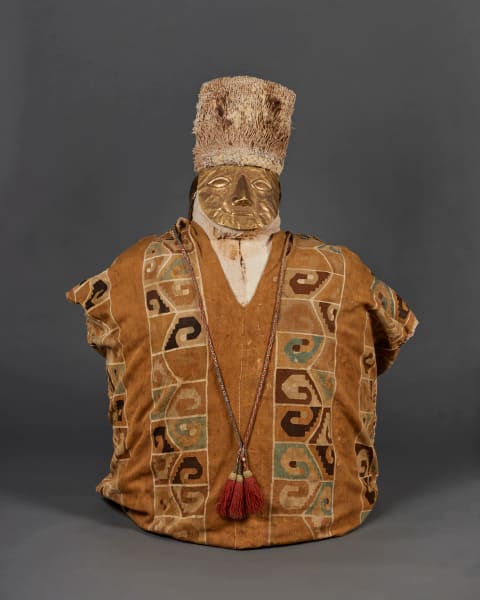
Wari funerary bundle with gold mask (Fardo Huari)
N° 392·III · Faith and Empire
Wari funerary bundle with gold mask (Fardo Huari)
Unknown
Wari (Huari), Fusional Era (800 – 1300 CE) · Textile, gold and feathers (funerary bundle)
Wari (Huari) · Época Fusional (Fusional Era)

Translated from Spanish: A funerary bundle with a gold mask, a feather headdress and a tunic (uncu) with geometric scroll designs (the uncu measures 1006 mm wide by 1002 mm high). Wari culture, on permanent display in the museum's Death in Ancient Peru gallery.

“Fardo Funerario con máscara de oro, tocado de plumas y túnica con diseños geométricos de volutas. Las medidas del uncu son 1006mm de ancho, 1002mm de alto.” In the museum’s words — coleccion.museolarco.org ↗ · quotation verified against the live page

Meanwhile — Standing Parvati South Asia · 11th Century CE

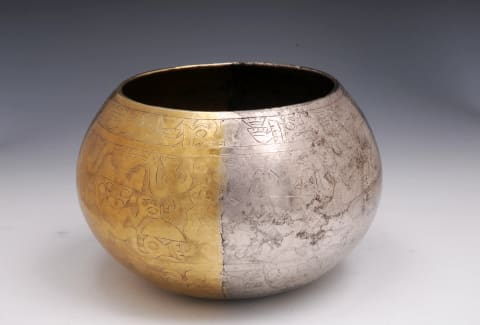
Chimú bimetallic ceremonial bowl (Cuenco Bimetálico Chimú)
N° 528·IV · Toward the Renaissance
Chimú bimetallic ceremonial bowl (Cuenco Bimetálico Chimú)
Unknown
Chimú, Imperial Era (1300 – 1532 CE) · Gold and silver (bimetallic)
Chimú · Época Imperial (Imperial Era)

Translated from Spanish: A ceremonial bowl formed of two pieces perfectly joined by soldering — one a binary silver-copper alloy, the other a ternary gold-silver-copper alloy — its final gold-and-silver appearance achieved by surface enrichment. Its base depicts an anthropomorphic figure with circular ear ornaments, a stepped headdress, feathers and serpent-head appendages with crescent headdresses and dragons emerging from the mouth. Chimú metalwork, part of the permanent exhibition's Ceremonial Vessels gallery.

“Cuenco ceremonial formado por dos piezas perfectamente unidas por soldadura. Una pieza es una aleación binaria (plata-cobre) y la otra es una aleación ternaria (oro-plata-cobre).” In the museum’s words — coleccion.museolarco.org ↗ · quotation verified against the live page

Meanwhile — Sword from the Ljubljanica Europe · Beginning of the 15th century

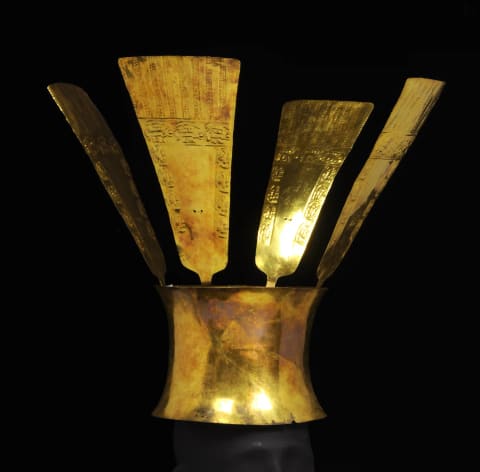
Chimú gold crown (Corona de Oro Chimú)
N° 529·IV · Toward the Renaissance
Chimú gold crown (Corona de Oro Chimú)
Unknown
Chimú, Imperial Era (1300 – 1532 CE) · Gold alloy (gold-silver-copper)
Chimú · Época Imperial (Imperial Era)

Translated from Spanish: A crown of gold-silver-copper alloy with four feathers, depicting anthropomorphic figures with crescent-and-feather headdresses and feline-head tails holding a spherical object. Chimú goldwork, part of the permanent exhibition's Gold and Jewellery gallery (Sala Oro y joyas).

“Corona de aleación oro-plata-cobre con cuatro plumas. Representación de personajes antropomorfos con tocado de media luna y plumas, cola de cabeza de felino, sosteniendo objeto esférico.” In the museum’s words — coleccion.museolarco.org ↗ · quotation verified against the live page

Meanwhile — Sword from the Ljubljanica Europe · Beginning of the 15th century

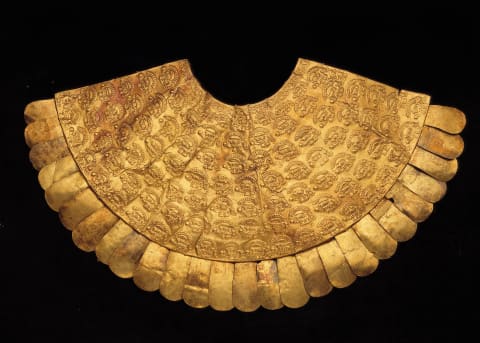
Chimú gold pectoral (Pectoral de Oro Chimú)
N° 530·IV · Toward the Renaissance
Chimú gold pectoral (Pectoral de Oro Chimú)
Unknown
Chimú, Imperial Era (1300 – 1532 CE) · Gold alloy (gold-silver-copper)
Chimú · Época Imperial (Imperial Era)

Translated from Spanish: A pectoral of gold-silver-copper alloy depicting anthropomorphic figures with crescent-and-feather headdresses and feline-head tails, holding a spherical object. Chimú goldwork, part of the permanent exhibition's Gold and Jewellery gallery (Sala Oro y joyas).

“Pectoral de aleación oro-plata-cobre con representación de personajes antropomorfos con tocado de media luna y plumas y cola de cabeza de felino, sosteniendo objeto esférico.” In the museum’s words — coleccion.museolarco.org ↗ · quotation verified against the live page

Meanwhile — Sword from the Ljubljanica Europe · Beginning of the 15th century