The National Museum, Sultanate of Oman, Muscat — 17 works · museum site ↗ · 5000 BCE – 2020
Seen from Muscat, history is above all writing & invention, then craft & design — a collection opened wide onto other worlds — a window more than a mirror (16 of 17 works are from other civilisations).
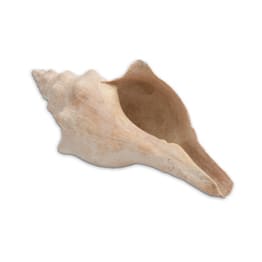
A large marine shell (jam/yam) from the Late Stone Age site of Ra's al-Hamra in Muscat, perforated on its spiral to serve as a horn or trumpet; the museum presents it as the earliest musical instrument found in Oman, blown at funerary ceremonies and left on the grave.
“a few of them were carefully perforated on the spiral zone in order to be used as a horn or trumpet. They were blown on occasion of funeral ceremonies and then abandoned on the grave afterwards.”
In the museum’s words — nm.gov.om ↗ · quotation verified against the live page
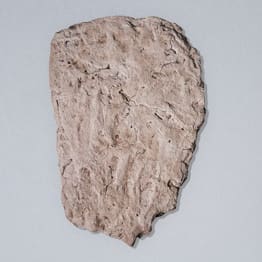
Brick Bearing the Handprint of its Original Builder
Unknown
c. 3000 BCE (Early Bronze Age) · mud brick
Early Bronze Age Oman · Early Bronze Age
A mud brick from the Mattariyya tower at Bat - a Early Bronze Age site of monumental circular towers - preserving the handprint of the builder who made it around 3000 BCE.
“There are seven enigmatic monuments or towers at Bat, four of which have been excavated. Like most Bronze Age towers in Oman, they are circular.”
In the museum’s words — nm.gov.om ↗ · quotation verified against the live page
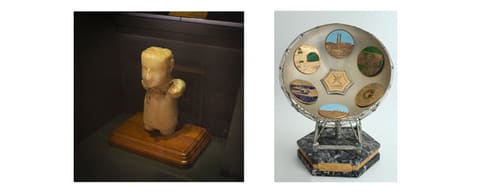
Meanwhile — Wooden godEurope · Neolithic Stone Age, c. 4000–2000 BCE
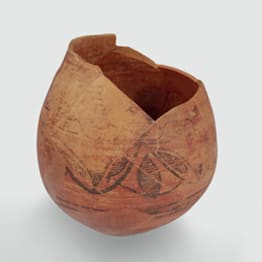
A black-on-red painted Harappan jar excavated at Ra's al-Jinz, made in the Indus Valley (Gujarat) in the 3rd millennium BCE; its peacock, tree and sun motifs and its findspot in Oman attest the Bronze Age maritime trade between Magan and the Indus Valley.
“The black-on-red painted decoration on this jar is typical of the Harappan pottery production of the Indus Valley Civilisation in the 3rd millennium BCE. It includes alternating peacocks and trees, sun motifs and intersecting circles.”
In the museum’s words — nm.gov.om ↗ · quotation verified against the live page
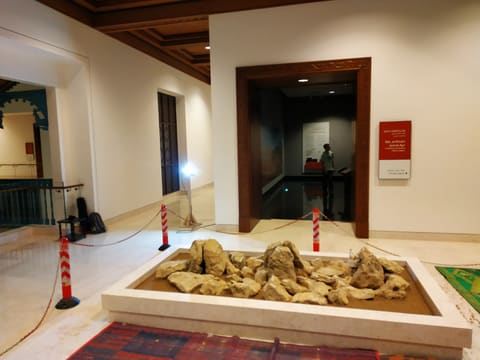
A group of triliths - three upright flat stones angled inward into a small pyramid - from a class of enigmatic 2,000-year-old monuments found along the coastal highlands of southern Arabia; the museum dates the type to the Late Iron Age and records that this group was relocated in December 2018 from Wadi Hayy in Duqm by an Italian-Czech expedition.
“They consist of three upright flat stones forming a triangular pyramid and are often arranged in rows alongside dry watercourses and possible ancient trade routes.”
In the museum’s words — nm.gov.om ↗ · quotation verified against the live page
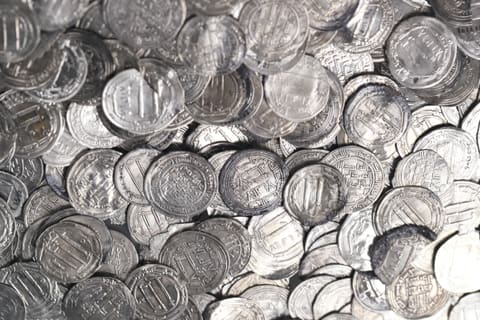
coins of 589-841 CE; buried and found 1979 · silver (dirhams)
Sassanid and Islamic · Sassanid to Abbasid
The Sinaw Hoard, described by the museum as the largest coin treasure yet found in Oman: 962 silver dirhams of the late Sassanid and Islamic periods, unearthed in a glazed turquoise pottery jar at Sinaw in 1979, ranging from a coin of Hormuzd IV / Khosrow II (589-623 CE) to an Abbasid dirham of al-Mu'tasim (226 AH / 840-841 CE).
“completed the restoration of the Sinaw Hoard, the largest currency treasure unearthed in Oman to date. The treasure was found inside a pottery vessel in Shawwal 1399 AH/ September 1979 CE in Sinaw area in the Wilayat of al-Mudhaibi”
In the museum’s words — nm.gov.om ↗ · quotation verified against the live page
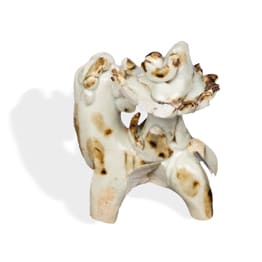
A small glazed Chinese porcelain lion excavated at the great medieval trading port of Sohar, which the museum dates to about the late 10th century CE - a token of Oman's far-reaching maritime trade with China.
“LION OF SOHAR Sohar (al-Batinah North Governorate) Origin: China (Yuan Dynasty) Glazed porcelain”
In the museum’s words — nm.gov.om ↗ · quotation verified against the live page
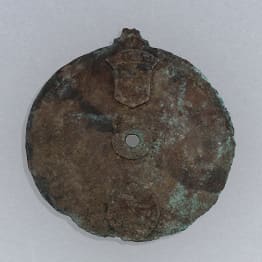
The Sodre Astrolabe, which the museum records as the oldest known marine astrolabe in the world: a bronze disc bearing the Portuguese royal arms and the armillary sphere of King Manuel I, recovered in 2014 from the wreck of the Esmeralda - a ship of Vasco da Gama's 1502-03 fleet - off al-Hallaniyyah Island in Dhofar.
“This is the oldest known marine astrolabe in the world. Discovered on 8 May 2014 CE, the astrolabe was one of the 2,800 artifacts excavated by archaeologists from the wreck site of a Portuguese ship (nau), identified as the Esmeralda”
In the museum’s words — nm.gov.om ↗ · quotation verified against the live page
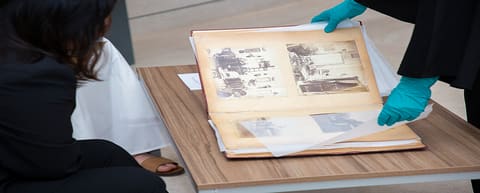
A photograph album of Oman, Iraq and India given in 1885 by Louis Maguire, US Consul at Muscat, to Colonel S. B. Miles, British Political Agent in the Gulf; conserved by the museum, it contains the second-oldest known photograph of Muscat and the oldest known photograph of Mattrah.
“The National Museum had recently finished restoring an album of photographs of Oman, Iraq and India that Louis Maguire presented, the United States Consul in Muscat, to Lit. Colonel S. B. Miles, the British Political Agent in the Gulf, on 6 September 1885 CE.”
In the museum’s words — nm.gov.om ↗ · quotation verified against the live page
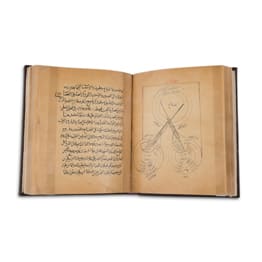
A Poem on the Anatomy of the Eye (Qasida fi Tashrih al-Ayn)
Rashid bin Umayra al-Hashmi ar-Rustaqi
1305 AH / 1887 CE (copy) · ink on paper
Omani · Al Bu Said dynasty
An 1887 Omani manuscript copy of the Qasida fi Tashrih al-Ayn, a versified treatise on the anatomy of the eye by the Rustaq physician-poet Rashid bin Umayra al-Hashmi (15th-16th century), which the museum praises for its scientific accuracy.
“In this masterful work, lauded for its accuracy and scientific methodology, al-Hashmi describes the anatomy of the eye in poetic form”
In the museum’s words — nm.gov.om ↗ · quotation verified against the live page
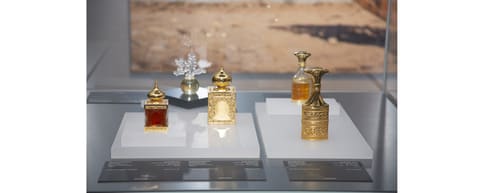
A set of Amouage 'Gold' perfume flasks (1983) in crystal, 24-carat gold and silver, shown in the museum's Land of Frankincense Gallery; the museum records them as the first creation of the Omani perfume house Amouage, with the men's flask modelled on the Omani dagger, presented by Sultan Qaboos bin Said to his guests.
“Embodying the historical value of the frankincense tree, the National Museum displays in the Land of Frankincense Gallery a collection of perfume bottles dating back to 1983 CE made of crystal, gold (24 carat) and silver.”
In the museum’s words — nm.gov.om ↗ · quotation verified against the live page
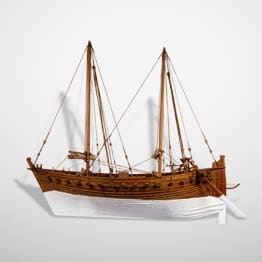
1433-34 AH / 2012 CE (model of a 9th-century ship) · cherry wood
Omani
A 1:15 model of the Jewel of Muscat, the full-size reconstruction of a 9th-century sewn-plank ship built at Qantab near Muscat - its planks sewn with over 130 km of cordage through more than 37,000 holes - which sailed 6,000 km to Singapore in 2010.
“Jewel of Muscat is a reconstruction of a 3rd century AH/9th century CE sewn-plank ship based on a shipwreck discovered off the coast of Indonesia. She was built in the small fishing village of Qantab, in Muscat. More than 130 km of cordage, passed through over 37,000 holes, were required to sew the planks and lash the frames.”
In the museum’s words — nm.gov.om ↗ · quotation verified against the live page
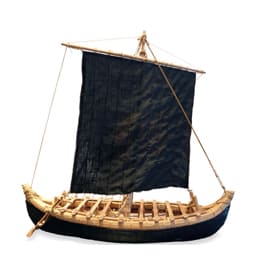
1433 AH / 2012 CE (model of an Early Bronze Age boat) · cherry wood and straw bundles
Omani
A 1:15 model of the Magan boat - a reed-and-wood vessel of the type that carried Omani cargo across the Oman Sea and Arabian Gulf in the Early Bronze Age; it reconstructs the 12-metre Magan built at Sur in 2005 to test ancient boatbuilding on the Magan trade route to Mesopotamia and the Indus.
“During the early Bronze Age boats made of wood, reeds, rope and bitumen sailed the waters of the Oman Sea and Arabian Gulf, carrying large cargoes to possibly as far as Mesopotamia and the Indus Valley.”
In the museum’s words — nm.gov.om ↗ · quotation verified against the live page
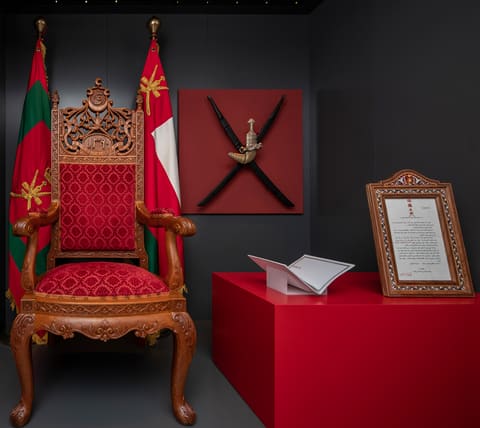
The original handwritten will of Sultan Qaboos bin Said, addressed to the Royal Family Council through the Defence Council, in which he named Sayyid Haitham bin Tarik as his successor; displayed in the Renaissance Gallery.
“We are excited to have the honour to display the original will letter of the late Sultan Qaboos bin Said addressed to the Royal Family Council through the Defence Council, recommending, in the handwriting of the late Sultan: "Sayyid Haitham bin Tarik", as the new sovereign of Oman.”
In the museum’s words — nm.gov.om ↗ · quotation verified against the live page
Al-Busaidi Family Endowment: Three Qur'ans and a Metal Vessel
Unknown
acquired 2019 (objects 20th century) · Qur'an manuscripts and a metal vessel
Omani
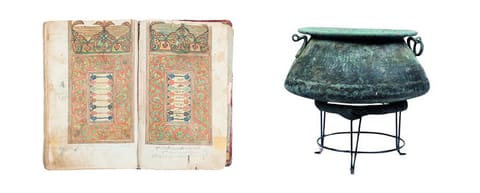
Three Qur'ans and a metal vessel from the family of Hamoud bin Nasr al-Busaidi, acquired by the museum in 2019; the largest Qur'an belonged to his mother Alia bint Muhammad al-Busaidiyah (d. 1984), and the vessel is a household boiler from the 1960s.
“which are three Koranic and a metal vessel. The largest was owned by the mother of Mr. Hamoud Alia Bint Mohammed Bin Hamad Al Busaidia, who died in 1984.”
In the museum’s words — nm.gov.om ↗ · quotation verified against the live page
N° 1165·Undated
Kiswat al-Ka'ba Textile Panels
Unknown
20th century · pure silk, gold and silver threads, natural gum and cotton
Saudi Arabian (Islamic)
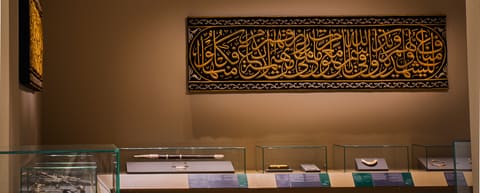
Embroidered textile panels from the kiswa of the Ka'ba, bearing verses 28-29 of Surat al-Hajj and woven of pure silk with gold and silver thread at the Kiswa factory in Mecca; a gift from King Fahd of Saudi Arabia to Sultan Qaboos bin Said, shown in the Splendours of Islam gallery.
“The National Museum is displaying at the splendours of Islam gallery, textile panels (kiswat al-ka’bah) bearing the verses (28) and (29) of Surat Al Hajj.”
In the museum’s words — nm.gov.om ↗ · quotation verified against the live page
N° 1176·Undated
Marble Statue of a South Arabian Dignitary
Unknown
Iron Age (South Arabian kingdoms) · marble
South Arabian (ancient Yemen) · Iron Age
A marble statue thought to represent a senior official - administrative, religious or military - which the museum dates to the Iron Age kingdoms of southern Arabia (Yemen), around Qataban, Marib or al-Jawf, and displays in its Oman and the World gallery among the royal possessions of Sultan Qaboos bin Said.
“The National Museum displays a statue likely to be a senior administrative official, religious official, or military commander in the Oman and the World gallery”
In the museum’s words — nm.gov.om ↗ · quotation verified against the live page
N° 1201·Undated
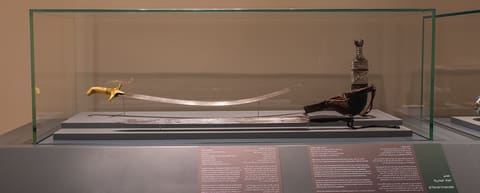
Saber and al-Haswah Dagger attributed to Imam Saif bin Sultan al-Ya'rubi
Unknown
attributed to Imam Saif bin Sultan al-Ya'rubi I (r. late 17th - early 18th c.)
Omani · Ya'rubid dynasty
A shamshir saber and an al-Haswah khanjar dagger which the museum attributes to the Ya'rubid imam Saif bin Sultan I ('Qaid al-Ard'), from the collection of Sultan Qaboos bin Said and displayed in the Splendours of Islam gallery.
“The National Museum is displaying in the splendors of Islam gallery the Saber(shamshir)and the al-Haswah dagger(khanjar), which are attributed to Imam Saif bin Sultan Al Yarubi I”
In the museum’s words — nm.gov.om ↗ · quotation verified against the live page