The Atlas·QA

QA

National Museum of Qatar, Doha — 19 works · museum site ↗ · 6500 BCE – 1999 60000 BCE2020

Seen from Doha, history is above all craft & design, then treasure & power — a collection opened wide onto other worlds — a window more than a mirror (19 of 19 works are from other civilisations).

Craft 12 Power 4 Observation 2 Sculpture 1
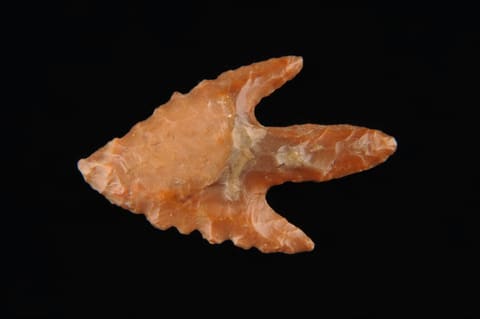
Neolithic Arrowhead
N° 008·I · The First Makers
Neolithic Arrowhead
Unknown
6500–3200 BCE · Flint
Kapel Group D, Arabian Bifacial Tradition (ABT) · Neolithic

A finely worked Neolithic flint arrowhead of the Arabian Bifacial Tradition, used for hunting and warfare. It has a tang for hafting to a wooden shaft and two pointed barbs designed to keep it lodged in a wound once it had struck.

“This small flint stone arrowhead would have been used for hunting and warfare. It is very finely worked and has a tang, or central stalk, used to attach it to a wooden shaft. Once the arrowhead had struck its victim, the two, pointed barbs on each side would have served to prevent it from falling out of the wound.” In the museum’s words — collections.qm.org.qa ↗ · quotation verified against the live page

Meanwhile — Ornamented stone vessel of the Surska culture Europe · Late 6th – early 5th millennium BCE
Bowl (funerary, Umm al-Ma‘a)
N° 241·II · The Classical World
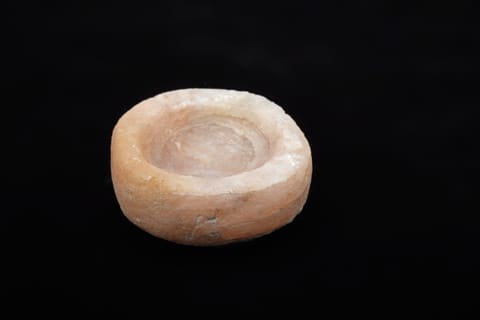
Bowl (funerary, Umm al-Ma‘a)
Unknown
c. 100 BCE – 100 CE · Alabaster (stone)
Hellenistic Period

A very small straight-sided bowl carved from a whitish friable stone (possibly onyx), the kind of vessel often used as a cosmetic container. It was found at Umm Al Ma‘a in northwest Qatar, placed as a funerary offering in a circular burial mound dated by the museum to between 100 BCE and 100 CE.

“This very small, straight-sided bowl was carved from a whitish, friable stone (possibly onyx). Small bowls such as this were often used as cosmetic containers. It was found at Umm Al Ma‘a, northwest Qatar, in a burial mound consisting of a circular tomb.” In the museum’s words — collections.qm.org.qa ↗ · quotation verified against the live page

Meanwhile — Sarcophagus and Cartonnage of the Priest Hor-Djehuti and the Mummy of an Unknown Woman Egypt & Nubia · 2nd half of the 1st century BC – 1st half of the 1st century AD (Roman Period)

Sword with scabbard, Umm al-Ma‘a
N° 271·II · The Classical World
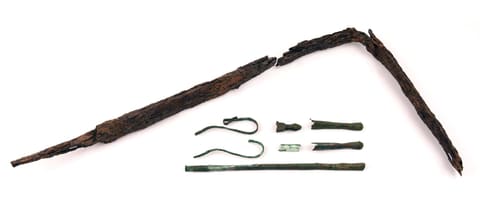
Sword with scabbard, Umm al-Ma‘a
Unknown
50–100 CE (Roman period) · Iron, copper alloy, lead alloy
Roman

A heavily corroded iron sword with a bronze-fitted scabbard, recovered from a warrior's grave at Umm al-Ma‘a; following the custom of the time it had been deliberately broken to prevent reuse, a ritual tribute laid with the fragmentary remains of the dead man.

“This heavily corroded iron sword, with bronze on its scabbard, was found in a grave. It was an offering to a dead warrior, from whom only fragmentary human bones were found.” In the museum’s words — collections.qm.org.qa ↗ · quotation verified against the live page

Meanwhile — Whistling bottle: feline and mouse (Vicús) Americas & Oceania · 400 BCE – 500 CE

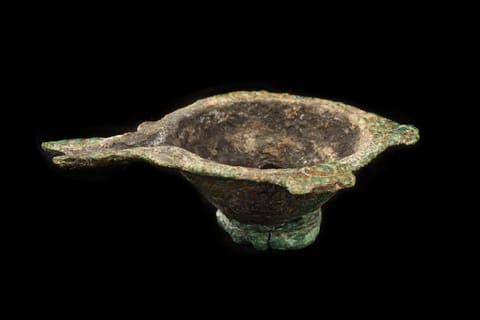
Bronze Oil Lamp
N° 396·III · Faith and Empire
Bronze Oil Lamp
Unknown
805–885 CE (9th century) · Copper alloy
Early Abbasid period · 9th century CE

An 'open tank' type of cast copper-alloy oil lamp of the early Abbasid period, with a globular body, flat triangular handle and a spout with a curved hollow. Its decoration — stylised rosettes with double circles on the rim and zigzags moulded onto the handle — was formed in the mould.

“This ‘open tank’ type of oil lamp has a globular body with a flat, horizontal, triangular handle. The spout has a curved hollow and the foot has been joined after casting.” In the museum’s words — collections.qm.org.qa ↗ · quotation verified against the live page

Meanwhile — Four-pointed hat (gorro de cuatro puntas), Tiwanaku Americas & Oceania · 700–1000 CE

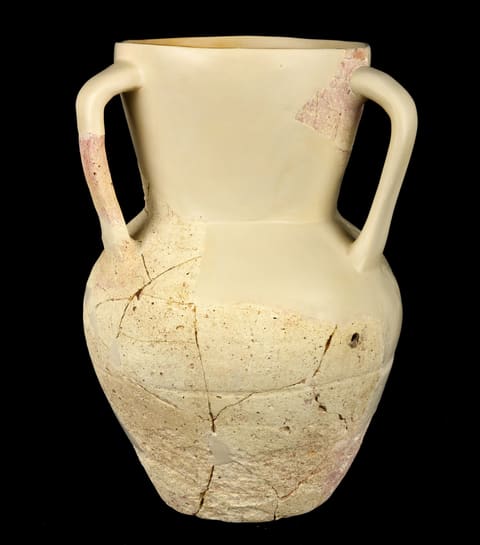
Earthenware jar with three handles, Murwab
N° 397·III · Faith and Empire
Earthenware jar with three handles, Murwab
Unknown
805–885 CE (9th century) · Earthenware (ceramic), bitumen
Early Abbasid period · 9th century CE

A medium-sized three-handled earthenware jar of the early Abbasid period, associated with the archaeological settlement of Murwab in northern Qatar. Made of a light porous clay with a five-pronged incised comb pattern on its high neck, it was cooking-ware that would have held liquids such as water or milk.

“This medium-sized earthenware jar has three handles that rest on the upper part of the body. The neck is very high and the wall slightly flared. The neck is decorated with a five-pronged incised comb pattern, creating alternating vertical lines that frame a wave.” In the museum’s words — collections.qm.org.qa ↗ · quotation verified against the live page

Meanwhile — Four-pointed hat (gorro de cuatro puntas), Tiwanaku Americas & Oceania · 700–1000 CE

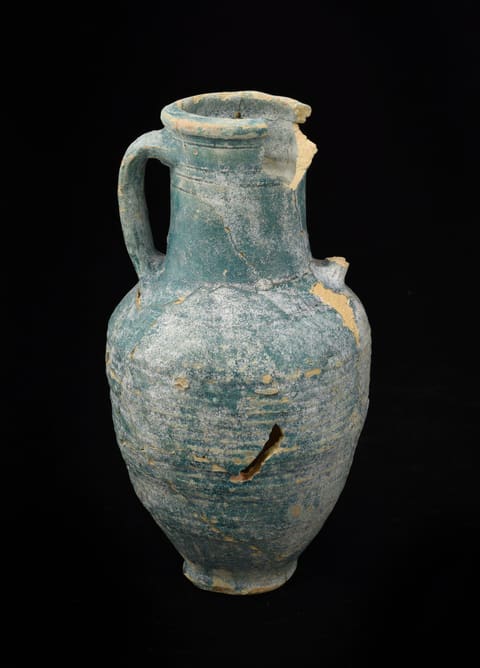
Glazed Ceramic Jar
N° 398·III · Faith and Empire
Glazed Ceramic Jar
Unknown
805–885 CE (9th century) · Glazed ceramic
Early Abbasid · 9th century CE

A small turquoise-blue glazed jar of the early Abbasid period, produced in the Basra region. Glazed inside and out, it could transport and store liquids such as water, vinegar or oil; its short neck and wide flat rim took a lid, and two small handles allowed it to be carried or suspended.

“This small ceramic jar is decorated in a turquoise-blue glaze. As the glaze covers the outside as well as the inside, liquids such as water, vinegar, oil and so on could be transported and conserved in the vessel. The jar has a short neck with a wide flat rim, allowing for a lid or flexible cover of fabric or leather to be fastened to it.” In the museum’s words — collections.qm.org.qa ↗ · quotation verified against the live page

Meanwhile — Four-pointed hat (gorro de cuatro puntas), Tiwanaku Americas & Oceania · 700–1000 CE

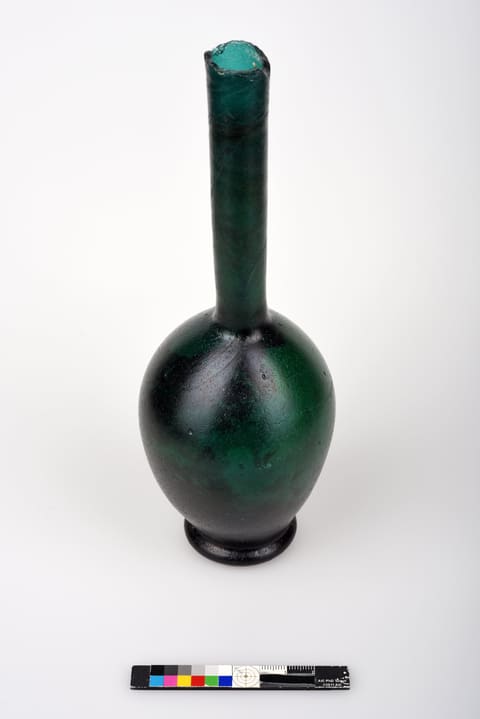
Rosewater Sprinkler
N° 437·III · Faith and Empire
Rosewater Sprinkler
Unknown
c. 970 CE (10th century) · Glass
Early Abbasid period · 10th century CE

An elegant long-necked glass sprinkler recovered from the 10th-century Cirebon shipwreck off the coast of Indonesia. Its bottle form is characteristic of early Abbasid glass, most of it made in Persian workshops, and several similar fine vessels came from the same wreck — testimony to the Indian Ocean trade in luxury glass.

“This elegant, long-necked glass vessel was found in the Cirebon shipwreck off the coast of Indonesia. The bottle shape is characteristic of wares from the early Abbasid period (9th-10th century), the majority of which manufactured in Persian workshops.” In the museum’s words — collections.qm.org.qa ↗ · quotation verified against the live page

Meanwhile — Lion of Sohar East Asia · late 10th century CE

Decorated glazed dish
N° 562·IV · Toward the Renaissance
Decorated glazed dish
Unknown
1400–1599 CE · Glazed ceramic
14th century CE

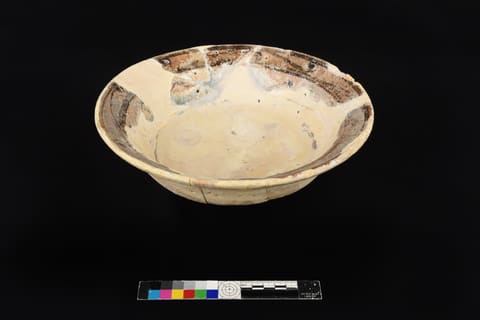
A glazed dish of Persian manufacture with stylised vegetal motifs painted in black along the rim, set between black bands against a turquoise ground under a pale-blue transparent glaze. Though its walls and base are badly damaged, a zigzag pattern around a central vegetal motif survives in the interior.

“This dish features stylised vegetal motifs along its rim. Painted black and set between two black bands, the motifs sit against a turquoise background and under a pale blue transparent glaze.” In the museum’s words — collections.qm.org.qa ↗ · quotation verified against the live page

Meanwhile — White Porcelain Jar with Cloud and Dragon Design in Underglaze Iron East Asia · Early Joseon period, 15th–16th century

Lārīn (Ṭawīla) coin
N° 563·IV · Toward the Renaissance
Lārīn (Ṭawīla) coin
Unknown
1400–1599 CE · Copper alloy
15th century CE

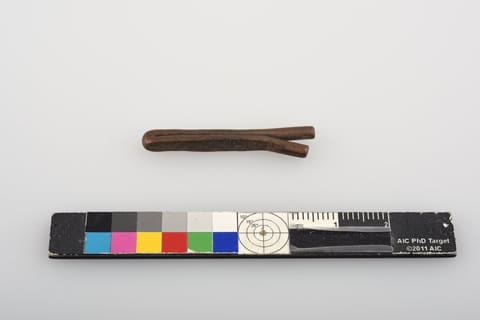
A lārīn or ṭawīla coin — a length of copper-alloy wire bent and flattened into a hooked, tweezer-like shape. Its name derives from the Iranian city of Lār, while ṭawīla ('long' in Arabic) refers to the folded form; such coins circulated widely across the Indian Ocean and Arab/Ottoman worlds.

“This lārīn/ ṭawīla coin is made of a bent and flattened copper alloy wire that resembles tweezers or a fishhook. The term lārīn derives from the Iranian city of Lār. Ṭawīla refers to the elongated shape of the folded coin, as ‘tawil’ means ‘long’ in Arabic.” In the museum’s words — collections.qm.org.qa ↗ · quotation verified against the live page

Meanwhile — White Porcelain Jar with Cloud and Dragon Design in Underglaze Iron East Asia · Early Joseon period, 15th–16th century

Glass bracelets, Al Huailah
N° 798·VII · The Age of Reason
Glass bracelets, Al Huailah
Unknown
1700–1800 CE (18th century) · Glass
18th century CE

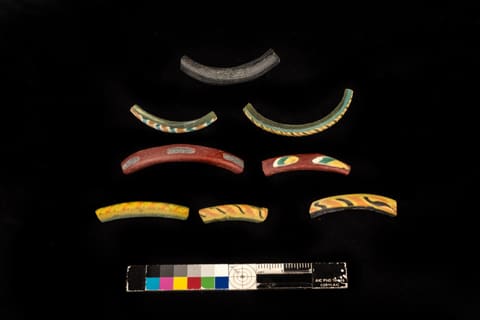
Fragments of coloured glass bracelets found on the surface at Al Huwailah, a historic coastal trading and pearl-fishing settlement in northern Qatar. Likely of Indian manufacture, the bracelets probably date to the 18th or early 19th century.

“Fragments of coloured glass bracelets found on the surface at the site of Al Huwailah in northern Qatar, a historic coastal settlement known for trade and pearl fishing. The bracelets likely date to the 18th century or early 19th century.” In the museum’s words — collections.qm.org.qa ↗ · quotation verified against the live page

Meanwhile — Samurai armour East Asia · Edo period (18th century)

Pearl diver's weight
N° 803·VII · The Age of Reason
Pearl diver's weight
Unknown
1700–1899 CE (18th century) · Haematite
18th century CE

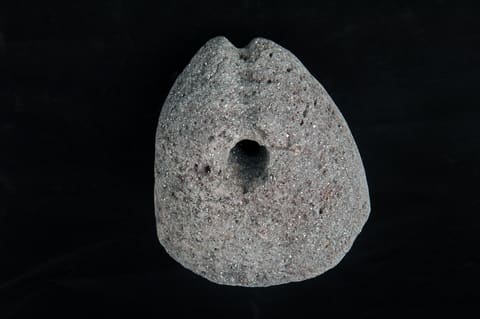
An oval pearl diver's weight from the 18th-century pearling town of Al Zubara, pierced at one end and grooved where the rope wore into the stone through repeated use. It is made of a heavy glittering stone, probably haematite (locally called lasif), thought to have been sourced from the island of Kish in the Gulf.

“This oval pearl diver's weight was found at the 18th-century site of Al Zubara. It has a hole at one end and a groove where the rope has rubbed away the stone during repeated use. It is made from a particular kind of heavy, glittering stone, probably haematite which is known as lasif.” In the museum’s words — collections.qm.org.qa ↗ · quotation verified against the live page

Meanwhile — The Buddhist Protector Mahakala East Asia · 18th–19th century

Oryx Figurine
N° 857·VIII · The Restless Century
Oryx Figurine
Unknown
1800–1900 CE (19th century) · Bone
19th century CE

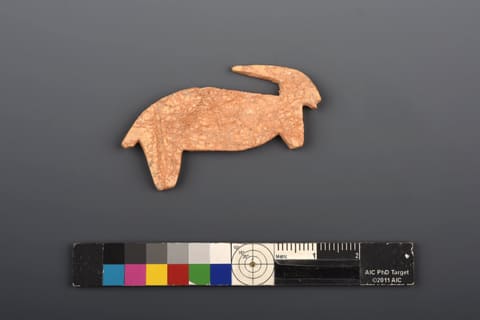
A small figurine carved in the shape of an oryx — the arid-adapted antelope emblematic of Arabia — probably from camel bone. Excavated alongside bone inlay and copper-alloy mounts still attached to cloth, it is thought to have decorated a larger inlaid object such as a box or piece of furniture.

“This piece of bone is carved in the shape of an oryx. It is probably a camel bone, although has not been scientifically tested. A small triangular piece of worked bone inlay and some copper alloy mounts or clasps, attached to remnants of cloth, were also found in the same level of the archaeological excavation.” In the museum’s words — collections.qm.org.qa ↗ · quotation verified against the live page

Meanwhile — Haida House Pole Americas & Oceania · c. 1850

Basket (Shelbadan)
N° 858·VIII · The Restless Century
Basket (Shelbadan)
Unknown
1800–1999 CE · Palm fibre, leather, textile, iron
19th century CE

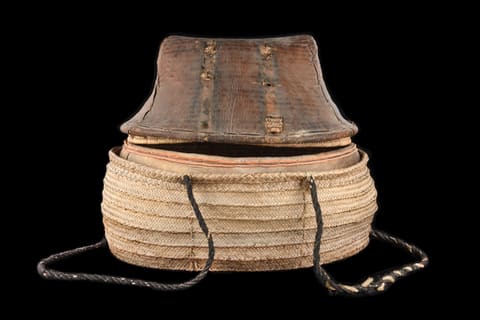
A round coiled basket of palm-leaf-stitched plant stems with a conical leather lid and a wire-hook fastening, its base and sides sheathed in tanned goat or sheep skin. Thought to have been made in Al-Hasa (eastern Saudi Arabia), such baskets were used by tribes moving between the eastern peninsula and Qatar to store and transport kitchen items.

“This round open basket with a leather conical lid is made from coiled plant stems. The stems are wound and stitched with strips of palm leaf, with one coil joined to the next. A loop and wire hook serve as a closing mechanism and are knotted to the inside of the lid and basket.” In the museum’s words — collections.qm.org.qa ↗ · quotation verified against the live page

Meanwhile — Boys Bathing at Skagen. Summer Evening Europe · 1899

Milk churn (Isga)
N° 859·VIII · The Restless Century
Milk churn (Isga)
Unknown
1800–1999 CE · Wood, leather, cord
19th century CE

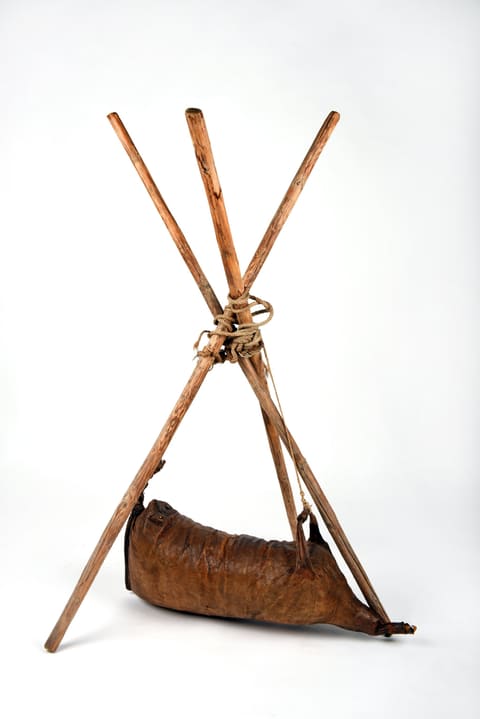
A skin milk-churn of the kind stitched from goatskin and hung by a waxed cord from a tripod or tree branch, rocked back and forth by two women each morning to churn milk. When people were on the move the bags hung from the sides of camels; similar containers carried water and goat or camel milk.

“Containers such as this milk churn were typically made from goatskin and stitched shut at the bottom with a thick strip of, often embroidered, leather. A long, waxed cord would suspend the bag from a tripod or a tree branch, which would allow the bag to be rocked backwards and forwards during the churning process. This was performed in the morning together by two women.” In the museum’s words — collections.qm.org.qa ↗ · quotation verified against the live page

Meanwhile — Boys Bathing at Skagen. Summer Evening Europe · 1899

Plate (Suhfa)
N° 860·VIII · The Restless Century
Plate (Suhfa)
Unknown
1800–1999 CE · Wood, copper alloy, leather
19th century CE

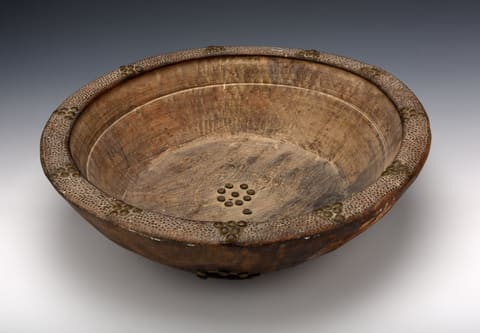
A handmade wooden serving bowl (suhfa) incised with two lines inside the rim, used for preparing, serving and eating water, milk and food. Such bowls were made in a range of sizes according to their intended use.

“This handmade wooden bowl is decorated with two incised lines inside the rim. It would have been used for the serving, preparation and consumption of water, milk and food.” In the museum’s words — collections.qm.org.qa ↗ · quotation verified against the live page

Meanwhile — Boys Bathing at Skagen. Summer Evening Europe · 1899

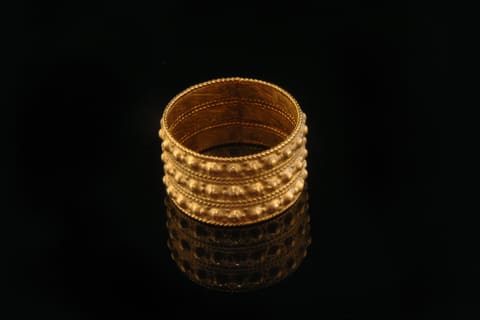
Marmi (gold ring)
N° 1065·IX · Into Our Time
Marmi (gold ring)
Unknown
1950–1973 CE · Gold
20th century CE

A wide gold finger ring known as al marami, built from three narrow bands brazed together and separated by twisted wire. Each band carries a row of welded decorative knobs with flattened tops and granules between them; the ring is typically worn on the middle finger.

“This wide gold finger ring is known as al marami. It is made up of three narrow bands which have been brazed together to make one wide ring. Each band is separated by twisted wire and decorated with a row of projecting decorative knobs with smooth, flattened tops.” In the museum’s words — collections.qm.org.qa ↗ · quotation verified against the live page

Meanwhile — The Abduction of Sabines Europe · 1962

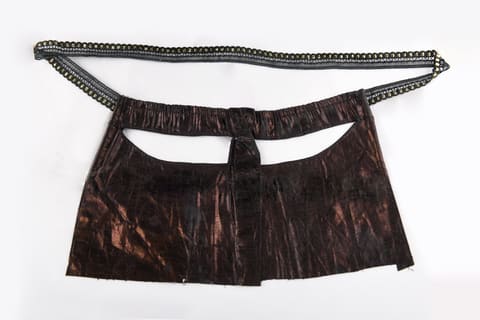
Battoola (face veil)
N° 1116·Undated
Battoola (face veil)
Unknown
Cotton, metallic thread

A batoolah, the stiff face-covering worn by women in Qatar, typically rectangular (about 16 by 8 cm). This example is made of woven cotton (calico) dyed with indigo and polished to a golden shine.

“The batoolah is a cover for a woman’s face and is made from a thick shiny material, or sometimes leather. This one is made from a type of woven cotton (calico) covered in blue dye (indigo), which was then polished to a golden shine.” In the museum’s words — collections.qm.org.qa ↗ · quotation verified against the live page
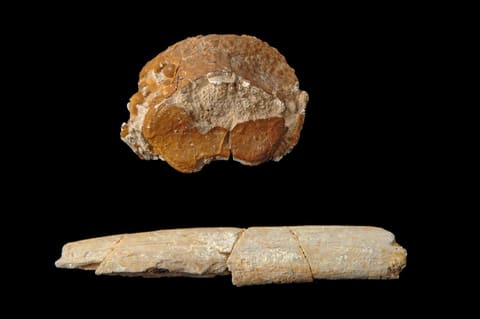
Fossilised Dugong
N° 1149·Undated
Fossilised Dugong
Unknown
c. 40 million years old (Eocene epoch) · Fossil bone (vertebra and rib)
Eocene epoch

Two fossilised fragments — a vertebra and a rib — of a prehistoric sea cow (Sirenia), discovered in Qatar's Dammam Formation and estimated at around 40 million years old (Eocene epoch); the museum presents them as the earliest known evidence of sea cows in the region, whose living relatives still inhabit Qatari waters today.

“This object features two fossilized fragments of a vertebra and a rib from a prehistoric marine animal belonging to the sea cow family (Sirenia). The fossils were discovered in the Dammam Formation in Qatar and are estimated to be around 40 million years old, dating back to the Eocene epoch.” In the museum’s words — collections.qm.org.qa ↗ · quotation verified against the live page
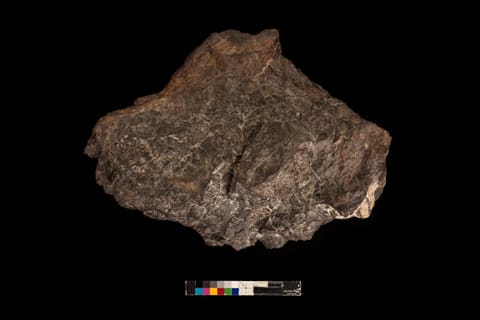
The Khatiyah Meteorite
N° 1218·Undated
The Khatiyah Meteorite
Unknown
c. 4.56 billion years old (found 2000) · Stony meteorite (ordinary chondrite, H5 type)

The first meteorite recovered in Qatar: a 1.5-kilogram stony meteorite of the ordinary chondrite H5 type, formed at the origins of the solar system some 4.56 billion years ago and found in May 2000 near wellhead DK60 in the Khatiyah sector of the Dukhan Oil Field. It was officially recorded in Meteoritical Bulletin No. 87 in 2003.

“The Khatiyah meteorite is the first meteorite found in Qatar. It is a stony meteorite of the ordinary chondrite H5 type, dating back about 4.56 billion years to the origins of the solar system.” In the museum’s words — collections.qm.org.qa ↗ · quotation verified against the live page