The Atlas·PL

Poland

National Museum in Warsaw, Warsaw — 20 works · museum site ↗ · 2345 BCE – 1965 60000 BCE2020

Seen from Warsaw, history is above all sacred images, then stories & histories — a collection split between its own tradition and other worlds (7 of 20 works are from other civilisations).

Sacred 6 Stories 3 Ritual 2 Sculpture 2 Craft 2 Portraits 2 Observation 2 Invention 1
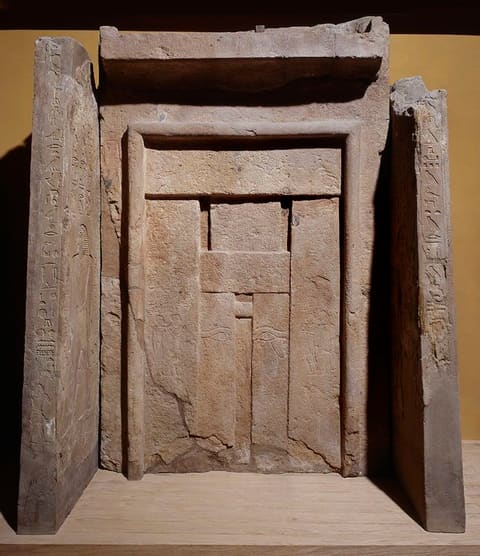
False Door of the Mastaba of Izi
N° 070·I · The First Makers
False Door of the Mastaba of Izi
Unknown
c. 2345–2323 BC (Old Kingdom, early 6th Dynasty) · limestone
Ancient Egyptian (Old Kingdom) · Old Kingdom, 6th Dynasty

The false door from the tomb of the Old Kingdom official Izi, discovered at Edfu in 1933 and re-excavated by a Polish-French mission in 1938 - described in the Museum's own digital collection record (translated from Polish) as the largest and most valuable ancient artifact in the gallery. Beyond the usual titles and names of the deceased, it carries an inscribed autobiography of Izi, one of the earliest such autobiographical texts known, recounting his rise through royal offices under Kings Izezi, Unas and Teti.

“Największy i najcenniejszy zabytek na Galerii odkryty został w Edfu przez Francuzów w 1933, a ponownie odkopała go misja polsko-francuska w 1938. Prócz normalnie spotykanych na Ślepych Wrotach imion i tytułów zmarłego, do wyjątkowych należy inskrypcja zawierająca autobiografię dostojnika, jedną z najwcześniejszych jakie są znane.” In the museum’s words — cyfrowe-api.mnw.art.pl ↗

Meanwhile — Statuette of a Praying Figure Near East · ca. 2400 BC
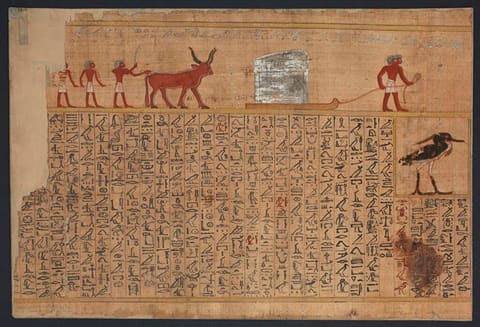
Book of the Dead of Bakai
N° 108·I · The First Makers
Book of the Dead of Bakai
Unknown
c. 1479–1400 BC (New Kingdom, 18th Dynasty) · papyrus, ink and pigment
Ancient Egyptian (New Kingdom) · New Kingdom, 18th Dynasty

A papyrus Book of the Dead made for a woman named Bakai, mounted on six sheets of card and illustrated with vignettes including the funerary procession, the Benu and Ba birds, the golden falcon and gate-guardians, and the weighing of the heart. The museum's own gallery text (translated from Polish) highlights its Book of the Dead papyrus, nearly 10 metres long, as one of the ancient-art collection's pearls.

“1 - orszak pogrzebowy, ptak Benu i strażnicy bram 2 - czapla, ptak Ba 3 - przedstawienie złotego sokoła, strażnicy bram” In the museum’s words — cyfrowe-api.mnw.art.pl ↗

Meanwhile — The Vapheio Cups Greek world · 1st half of the 15th century BC

Protoma in the Shape of a Bull's Head
N° 110·I · The First Makers
Protoma in the Shape of a Bull's Head
Unknown
c. 1450–1100 BC (Middle Elamite period) · gold (repoussé and filigree)
Elamite · Middle Elamite period

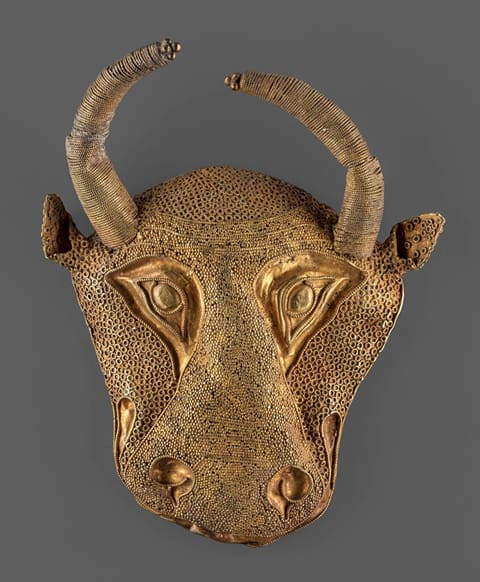
A small gold mask in the shape of a bull's head, worked in repoussé relief with granulation and filigree detail concentrated around the nostrils and cheeks. The museum's own gallery text (translated from Polish) describes a golden bull-head protoma from Iran as one of the ancient-art collection's most valuable objects.

“Głowa byka opracowana w formie reliefowej maski wykonanej techniką repusowania. Poszczególne partie głowy wyróżniono poprzez zróżnicowanie technik złotnicznych. W części centralnej z nozdrzami zastosowano granulację i filigran, natomiast na policzkach i czubku łba tylko filigran.” In the museum’s words — cyfrowe-api.mnw.art.pl ↗

Meanwhile — Hoard of bronze objects of the Stanivska culture Europe · 14th–12th centuries BCE

Panathenaic Amphora
N° 182·II · The Classical World
Panathenaic Amphora
Attributed to Berlin Painter
c. 470 BC · terracotta (black-figure)
Ancient Greek (Attic, black-figure)

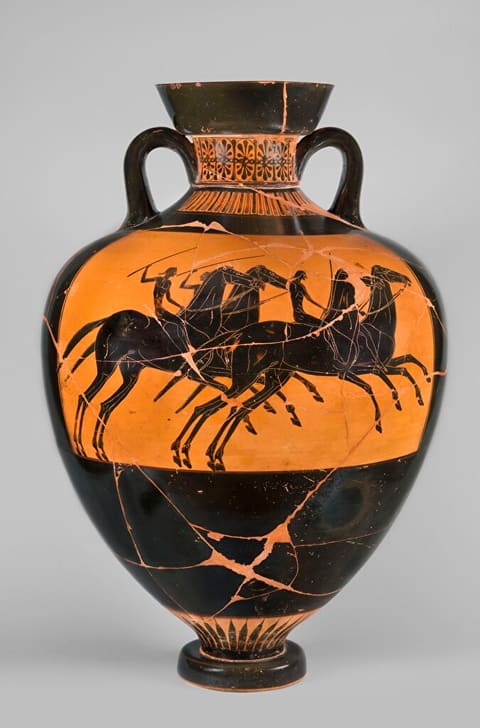
A black-figure Panathenaic prize amphora, described in the museum's own digital collection record (translated from Polish) as one side decorated with Athena Promachos striding between two Doric columns topped with cocks, the other with four nude riders galloping bareback in a horse race. Vessels of this standard shape, filled with olive oil, were awarded to victors at the Panathenaic Games in ancient Athens. Attributed to the Berlin Painter, one of the most celebrated hands in Attic vase painting.

“Amfora panatenajska zdobiona sceną z wyścigów konnych oraz przedstawieniem bogini Ateny Promachos. Glina czerwonawa, powierzchnia wypalona - pomarańczowa.” In the museum’s words — cyfrowe-api.mnw.art.pl ↗

Meanwhile — Bronze He (pouring vessel) of King Fuchai of Wu East Asia · Spring and Autumn period (late), reign of King Fuchai of Wu (r. 495–473 BCE)

Sarcophagus and Cartonnage of the Priest Hor-Djehuti and the Mummy of an Unknown Woman
N° 244·II · The Classical World
Sarcophagus and Cartonnage of the Priest Hor-Djehuti and the Mummy of an Unknown Woman
Unknown
2nd half of the 1st century BC – 1st half of the 1st century AD (Roman Period) · painted wood, cartonnage and pigment
Ancient Egyptian (Roman Period) · Roman Period

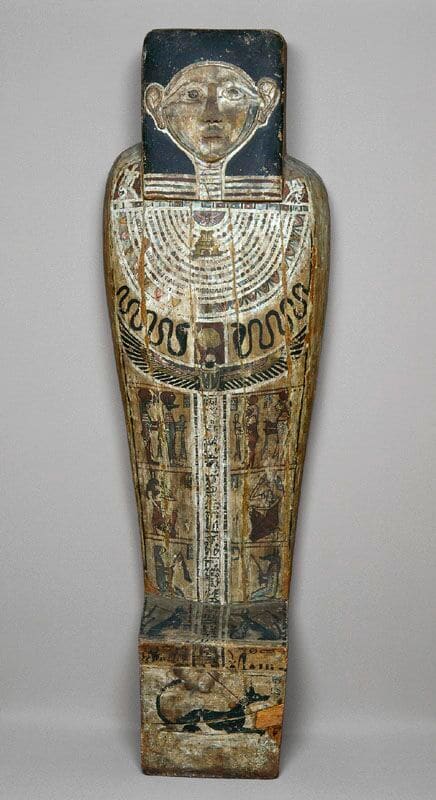
A richly painted wooden sarcophagus and cartonnage casing for the mummy of an unknown woman, from a burial associated with the priest Hor-Djehuti. The cartonnage's gold-painted face is a careful portrait of the deceased in a striped wig, with a broad wesekh collar and bands of hieroglyphic text and funerary scenes running the length of the case. The museum's own Gallery of Ancient Art text names this sarcophagus among the gallery's most interesting pieces (translated from the Museum's Polish-language digital collection record).

“Kartonaż bogato malowany. Twarz, pokryta złotą farbą, jest starannie wykonanym portretem zmarłego w prążkowanej peruce. Na piersiach bardzo szeroki naszyjnik usech.” In the museum’s words — cyfrowe-api.mnw.art.pl ↗

Meanwhile — Female-form flask from Malagana (Alcarraza con forma femenina) Americas & Oceania · 200 BCE - 200 CE (relative chronology)

Wall Painting: St Anne
N° 372·III · Faith and Empire
Wall Painting: St Anne
Workshop of Nubian workshop (Faras Cathedral)
8th century AD · tempera on plaster
Medieval Nubian (Christian) · Kingdom of Makuria

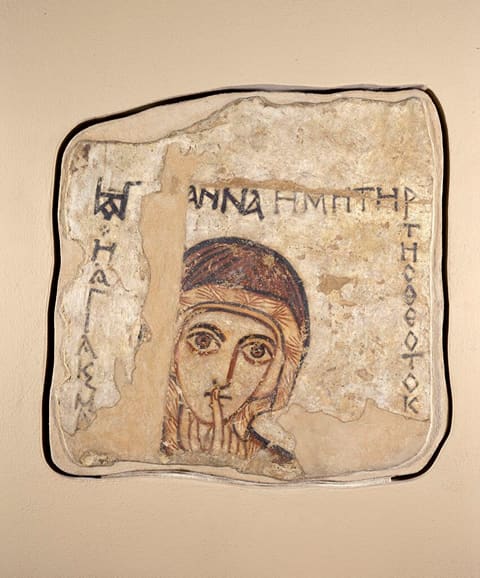
A fragmentary wall painting from Faras Cathedral's north nave showing the head and part of the left shoulder of St Anne, depicted frontally as a young woman raising the index finger of her right hand to her lips. The museum's own English-language gallery overview singles this out by name as an 'exquisite image' among the Faras wall paintings.

“The north nave reveals its exquisite image of St. Anne.” In the museum’s words — mnw.art.pl ↗

Meanwhile — Gilt-bronze Standing Bhaisajyaguru Buddha East Asia · Unified Silla period, 8th century

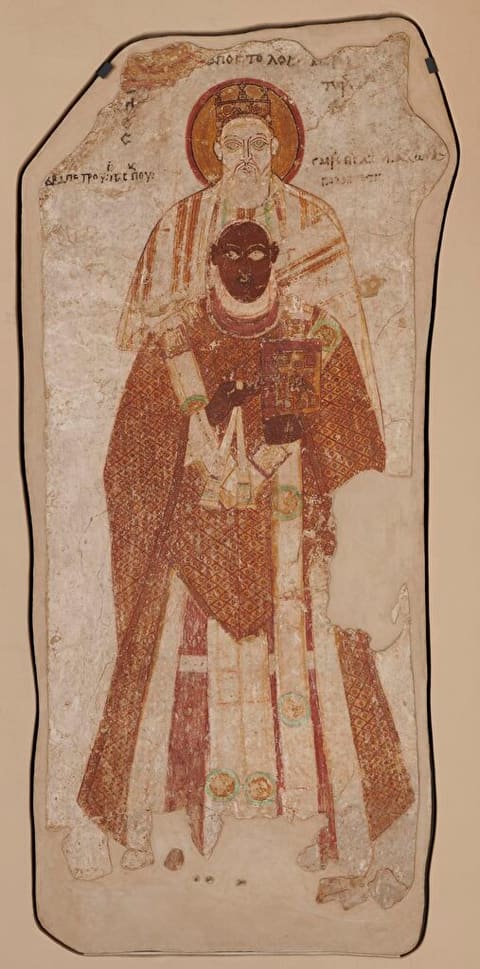
Wall Painting: Bishop Petros under the Protection of St Peter the Apostle
N° 438·III · Faith and Empire
Wall Painting: Bishop Petros under the Protection of St Peter the Apostle
Workshop of Nubian workshop (Faras Cathedral)
974–997 AD (last quarter of the 10th century) · tempera on plaster
Medieval Nubian (Christian) · Kingdom of Makuria

A wall painting from Faras Cathedral that the museum's own digital collection record (translated from Polish) describes as showing Bishop Petros standing frontally with a jewelled gospel book, Saint Peter the Apostle standing behind him with both hands resting on the bishop's shoulders. An accompanying inscription identifies him as Petros II, who held the Faras episcopal office from 974-997. One of the wall paintings excavated by the Polish Nubia Campaign mission and installed in the Museum's own Faras Gallery.

“Malowidło przedstawia stojącego frontalnie ciemnoskórego biskupa, za którego plecami stoi święty Piotr kładąc obie dłonie na ramionach kapłana. Biskup trzyma w lewej ręce dużą księgę ewangelii w żółtej oprawie zdobionej czerwonymi i zielonymi klejnotami, spiętą klamrami widocznymi na tle czerwonych kart.” In the museum’s words — cyfrowe-api.mnw.art.pl ↗

Meanwhile — Lion of Sohar East Asia · late 10th century CE

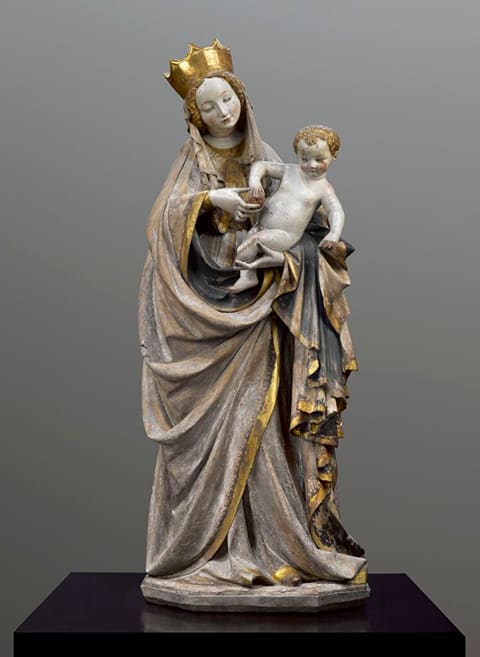
Beautiful Madonna from Wrocław
N° 549·IV · Toward the Renaissance
Beautiful Madonna from Wrocław
Master of the Beautiful Madonna of Wrocław
c. 1390 · stone, with traces of polychromy and gilding
Central European (International Gothic / 'Beautiful Style') · Late Middle Ages

A Gothic Madonna and Child carved around 1390 in the 'Beautiful Style' (Schöne Stil), her body swayed into an S-curve with her weight on her right leg and her head tilted toward her right shoulder and slightly downward, her gaze directed toward the Christ Child on her left arm. The museum's own digital collection record (translated from Polish) calls it a key work among the international group of 'Beautiful Madonnas', related to the Beautiful Madonna of Toruń. Its original provenance is undocumented: the sculpture is traditionally associated with a Wrocław church, most often identified as St Elizabeth's, though the museum's own records describe this link as unconfirmed. The association reportedly arose from a mistaken swap of an identification card, with St Mary Magdalene's church named as an equally plausible alternative, and the museum's curatorial commentary states plainly that 'the place for which this figure was made is unknown.'

“W postaci Madonny silnie zarysowuje się kontrapost: ciężar ciała przerzucony na prawą nogę, figura wygięta w kształt odwróconej litery "S". Głowa przechylona na prawe ramię i lekko ku dołowi.” In the museum’s words — cyfrowe-api.mnw.art.pl ↗

Meanwhile — Kaibu no Mo(Women's Formal Pantaloon-Skirt with Seashore Motif) East Asia · Japan, Nanboku-chō period, dated 1390

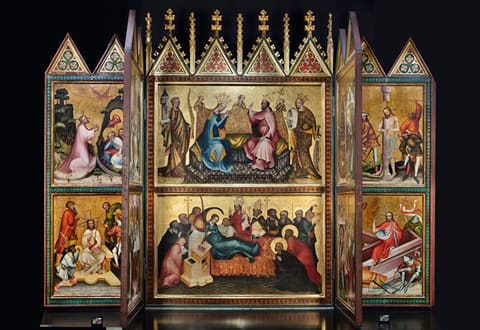
Grudziądz Polyptych
N° 550·IV · Toward the Renaissance
Grudziądz Polyptych
Unknown
c. 1390 · tempera on panel
Polish / Teutonic Order (Late Gothic) · Late Middle Ages

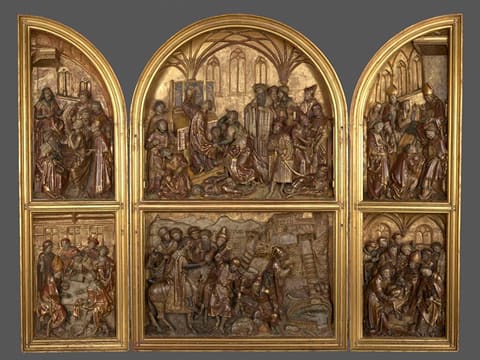
A large winged altarpiece from the castle chapel of the Teutonic Order's Grudziądz commandery, first documented serving as the high altar of the castle church in a 1669 church-visitation record. The museum's own Gallery of Medieval Art names it among its famous works (translated from Polish), and its modern mounting lets visitors see the reverse of the wings for the first time.

“Zamek komturii grudziądzkiej zakonu krzyżackiego; w kaplicy zamkowej, ukończonej w 1299 r. (pierwsza wzmianka o jego miejscu przechowywania - w wizytacji kościelnej komtura chełmińskiego Ludwiga Strech z 1669 r. - wtedy służył jako ołtarz główny w kościele zamkowym).” In the museum’s words — cyfrowe-api.mnw.art.pl ↗

Meanwhile — Kaibu no Mo(Women's Formal Pantaloon-Skirt with Seashore Motif) East Asia · Japan, Nanboku-chō period, dated 1390

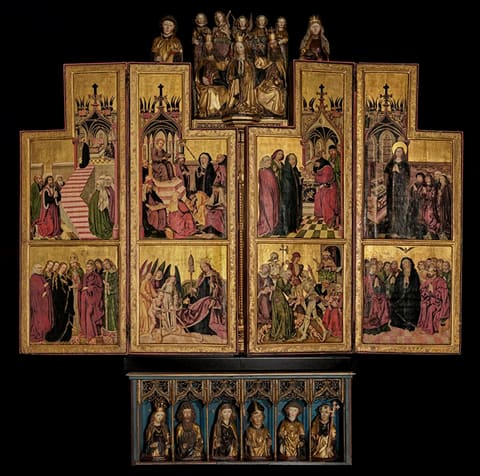
Annunciation Polyptych with the Unicorn
N° 597·IV · Toward the Renaissance
Annunciation Polyptych with the Unicorn
Master of the Annunciation Polyptych with the Unicorn
c. 1480 · tempera on panel
Silesian (Late Gothic) · Late Middle Ages

A winged altarpiece painted around 1480 for a side altar of St Elizabeth's church in Wrocław, most likely originally positioned at the fourth north pillar of the nave's triumphal arch. Named specifically among the Gallery of Medieval Art's famous works in the museum's own gallery text (translated from Polish).

“Ołtarz był pierwotnie przeznaczony do ołtarza bocznego w kościele św. Elżbiety - najpewniej stał przy czwartym północnym filarze (łuku triumfalnego) nawy głównej.” In the museum’s words — cyfrowe-api.mnw.art.pl ↗

Meanwhile — Miniature gold llama figurine (Inka) Americas & Oceania · 1430–1532 CE

Madonna and Child with St John the Baptist and an Angel
N° 604·IV · Toward the Renaissance
Madonna and Child with St John the Baptist and an Angel
Sandro Botticelli (workshop) (1444/1445–1510)
late 15th–early 16th century · tempera on panel (tondo)
Italian Renaissance (Florentine)

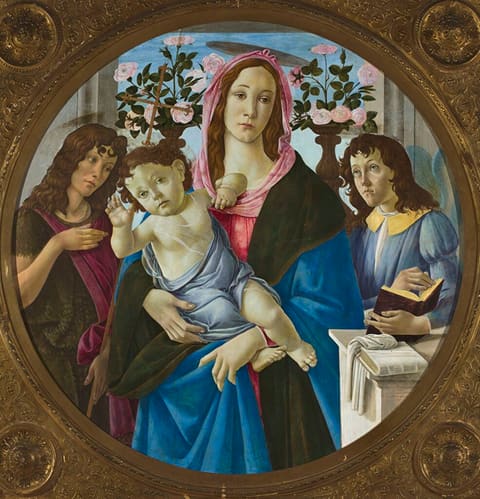
A tondo of the Madonna and Child with the young St John the Baptist and an angel, from Sandro Botticelli's Florentine workshop. Per the museum's own digital collection record (translated from Polish), it was acquired in Italy in the 1810s-20s by Gustav Adolf von Ingenheim, later damaged by fire at the Ingenheim family's Silesian palace, passed through the Wrocław decorative-arts museum and several international dealers (including the Duveen Brothers) without finding a buyer, and was evacuated for safekeeping in 1942 before eventually entering the National Museum in Warsaw's own collection.

“Nabyty w drugiej dekadzie XIX wieku został przez Gustava Adolfa von Ingenheim podczas podróży po Włoszech. Przed 1870 rokiem trafił z częścią kolekcji do pałacu w Rysiowicach, gdzie został uszkodzony przez pożar.” In the museum’s words — cyfrowe-api.mnw.art.pl ↗

Meanwhile — Adorned Buddha South Asia · 15th - 16th century

Triptych with the Legend of St Stanislaus the Bishop
N° 645·V · The Renaissance
Triptych with the Legend of St Stanislaus the Bishop
Hans von Kulmbach (c. 1485–1522)
1510–1520 · tempera on panel, with carved and gilded elements
Polish / German (Northern Renaissance)

A triptych depicting the legend of St Stanislaus, the martyred medieval Bishop of Kraków, with painted panels attributed to the German Renaissance painter Hans von Kulmbach and carved elements by an unidentified sculptor, made around 1510-1520. One of the five works the Gallery of Medieval Art names specifically as famous pieces in its own collection.

“Famous works such as the Beautiful Madonna from Wrocław, the Grudziądz Polyptych, the Annunciation with the Unicorn Polyptych, the Triptych with the Legend of Saint Stanislaus the Bishop and the monumental altarpiece from Pruszcz Gdański will be presented in a modern arrangement specifically designed to resonate with the modern viewer.” In the museum’s words — mnw.art.pl ↗

Meanwhile — Salt Cellar Africa · first quarter of the 16th century

View of Warsaw from the Terrace of the Royal Castle
N° 832·VII · The Age of Reason
View of Warsaw from the Terrace of the Royal Castle
Bernardo Bellotto (1722–1780)
1773 · oil on canvas
Polish royal court painting (Italian-born painter)

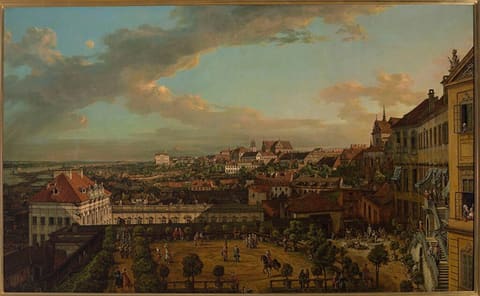
A 1773 view of Warsaw seen from the terrace of the Royal Castle. Per the museum's own digital collection record (translated from Polish), it was painted for King Stanisław August Poniatowski and recorded in his own collection before he gave it to Ludwik Tyszkiewicz around 1775. Bellotto's precisely detailed Warsaw cityscapes are so architecturally accurate that they served as key reference images when Warsaw's Old Town was rebuilt after its near-total destruction in the Second World War (this reconstruction fact is well-established general history, not itself part of the cited excerpt).

“Malowany dla Stanisława Augusta, w jego zbiorach pod numerem 463, podarowany przez króla ok. 1775 Ludwikowi Tyszkiewiczowi, następnie (przez przez córkę Annę) w zbiorach Potockich w Jabłonnej.” In the museum’s words — cyfrowe-api.mnw.art.pl ↗

Meanwhile — Hei tiki (pendant in human form) Americas & Oceania · Māori, 1700–1847

Insurgent Patrol (Insurgent Picket)
N° 916·VIII · The Restless Century
Insurgent Patrol (Insurgent Picket)
Maksymilian Gierymski (1846–1874)
1873 · oil on canvas
Polish

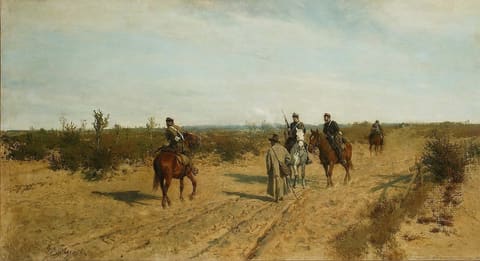
A somber winter scene of a mounted patrol from the 1863 January Uprising against Russian rule, painted a decade after the failed insurgency by Maksymilian Gierymski, who died the following year at the age of 28.

“Maksymilian Gierymski, Insurgent Patrol (Insurgent Picket), 1873, oil on canvas” In the museum’s words — mnw.art.pl ↗

Meanwhile — Maori girl Americas & Oceania · circa 1874

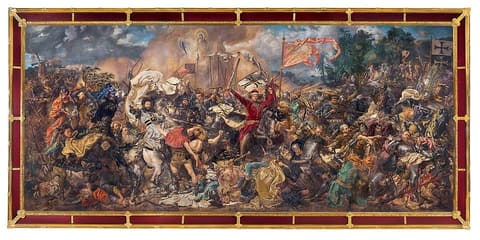
The Battle of Grunwald
N° 919·VIII · The Restless Century
The Battle of Grunwald
Jan Matejko (1838–1893)
1878 · oil on canvas
Polish

Matejko's monumental 1878 canvas depicting the Polish-Lithuanian victory over the Teutonic Knights at the Battle of Grunwald (Tannenberg) in 1410 - at nearly 10 by 4.3 metres, the largest painting in Polish art, and the single work most identified with the National Museum in Warsaw.

“Jan Matejko, The Battle of Grunwald [Tannenberg], 1878, oil on canvas” In the museum’s words — mnw.art.pl ↗

Meanwhile — Kahu kiwi (kiwi feather cloak) Americas & Oceania · Māori, 1850–1900

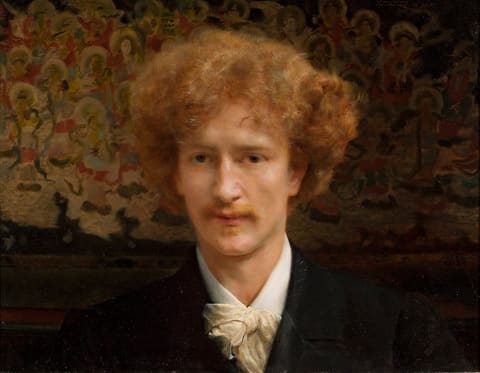
Portrait of Ignacy Jan Paderewski
N° 958·VIII · The Restless Century
Portrait of Ignacy Jan Paderewski
Lawrence Alma-Tadema (1836–1912)
1890 · oil on canvas
Anglo-Dutch academic painting

A portrait of the celebrated Polish pianist, composer and future statesman Ignacy Jan Paderewski, painted in 1890 by the Dutch-born British academic painter Lawrence Alma-Tadema - one of the international works the gallery displays alongside its Polish paintings.

“Lawrence Alma-Tadema, Portrait of Ignacy Jan Paderewski, 1890, oil on canvas” In the museum’s words — mnw.art.pl ↗

Meanwhile — Mangaaka Power Figure (Nkisi N’Kondi) Africa · ca. 1880–1900

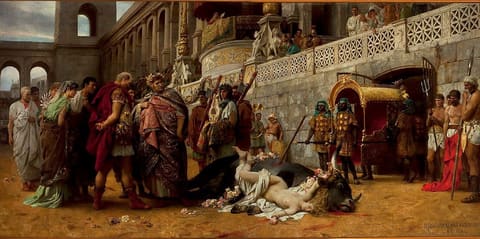
The Christian Dirce
N° 972·VIII · The Restless Century
The Christian Dirce
Henryk Siemiradzki (1843–1902)
1897 · oil on canvas
Polish

A large history painting imagining the martyrdom of an early Christian woman in Nero's Rome, staged as a re-enactment of the myth of Dirce - one of Siemiradzki's grand academic canvases on the persecution of the early Christians.

“Henryk Siemiradzki, The Christian Dirce, 1897, oil on canvas” In the museum’s words — mnw.art.pl ↗

Meanwhile — Sleigh by the McLaughlin Carriage Company Americas & Oceania · Around 1896

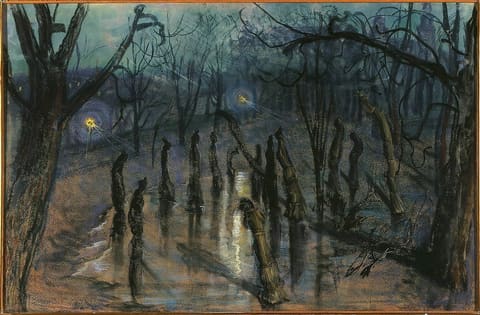
Capsheaves
N° 976·VIII · The Restless Century
Capsheaves
Stanisław Wyspiański (1869–1907)
1898–1899 · pastel on paper
Polish

A pastel by the Young Poland polymath Stanisław Wyspiański - better known as a playwright and stage designer - showing stooked sheaves of grain in a harvested field, part of his sustained pastel studies of the rural landscape around Kraków.

“Stanisław Wyspiański, Capsheaves, 1898-1899, pastel, paper” In the museum’s words — mnw.art.pl ↗

Meanwhile — Retrato del Sr. Juan Carlos Muñoz Americas & Oceania · 1899

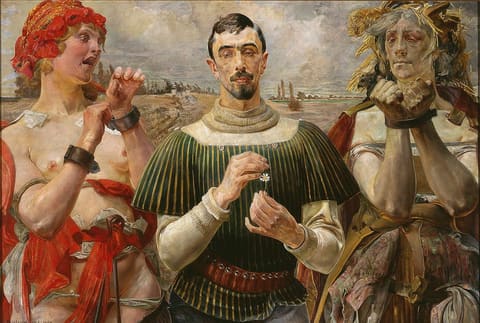
Polish Hamlet – Portrait of Aleksander Wielopolski
N° 991·IX · Into Our Time
Polish Hamlet – Portrait of Aleksander Wielopolski
Jacek Malczewski (1854–1929)
1903 · oil on canvas
Polish

A symbolist portrait by Jacek Malczewski, casting the 19th-century Polish statesman Aleksander Wielopolski as a 'Polish Hamlet' torn between conflicting loyalties under partition-era Russian rule over Poland.

“Jacek Malczewski, Polish Hamlet – Portrait of Aleksander Wielopolski, 1903, oil on canvas” In the museum’s words — mnw.art.pl ↗

Meanwhile — Darby and Joan [Ina Te Papatahi, Ngāpuhi] Americas & Oceania · 1903

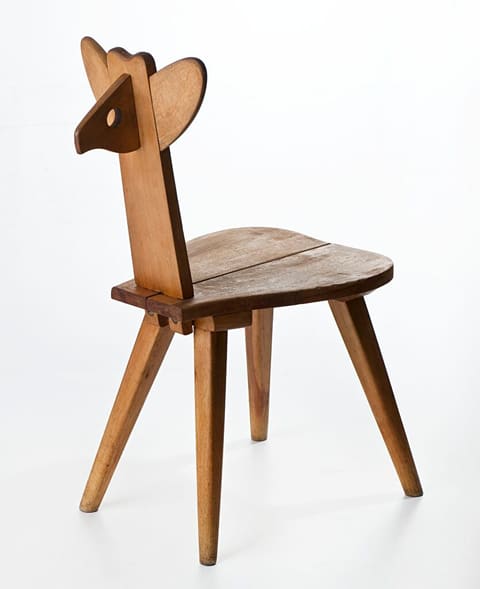
Sarenka (Fawn) Children’s Stool
N° 1055·IX · Into Our Time
Sarenka (Fawn) Children’s Stool
Władysław Wincze and Olgierd Szlekys (Ład Artists’ Cooperative)
designed 1942–1943, produced c. 1946–1965 · solid wood
Polish design (Ład Cooperative)

A children's stool of solid wood, its backrest shaped like a fawn's head above a rounded, heart-shaped two-part seat - designed by Władysław Wincze and Olgierd Szlekys for the Ład Artists' Cooperative, the Warsaw workshop whose furniture anchors the Museum's own Gallery of Polish Design. Per the object's own display history (translated from Polish), it was shown at Ład's 30th-anniversary exhibition at the Zachęta gallery in Warsaw, winter 1956-57.

“Krzesełko - zydelek dla dzieci z oparciem zakończonym formą przypominającą głowę sarenki. Siedzisko złozone z dwóch części zaokrąglone, w kształcie sercowatym. Wykonany z masywu.” In the museum’s words — cyfrowe-api.mnw.art.pl ↗

Meanwhile — Landscape in the Nude Africa · 1953