The Atlas·KH

KH

National Museum of Cambodia, Phnom Penh — 16 works · museum site ↗ · 500 CE–2000 60000 BCE2020

Seen from Phnom Penh, history is above all sculpture, then craft & design — a collection opened wide onto other worlds — a window more than a mirror (16 of 16 works are from other civilisations).

Sculpture 10 Craft 6
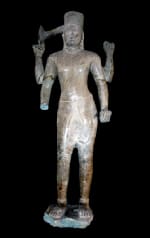
Visnu
N° 329·III · Faith and Empire
Visnu
Unknown
6th century · Sandstone
Khmer · Pre-Angkorian (Phnom Da / Funan style)

A tall sandstone image of Vishnu, Preserver of the World, from Tuol Dai Buon in Prey Veng, dated to the 6th-century Funan (Phnom Da) style of the pre-Angkorian 'Nokor Phnom' period. Identified by its attributes, it is one of the museum's several representations of Vishnu and his incarnations.

“According to his attributes, this figure is Visnu (Preserver of the World).” In the museum’s words — cambodiamuseum.info ↗ · quotation verified against the live page

Meanwhile — Prestige of the Germanic world – Jewellery and ornaments Europe · 6th century AD
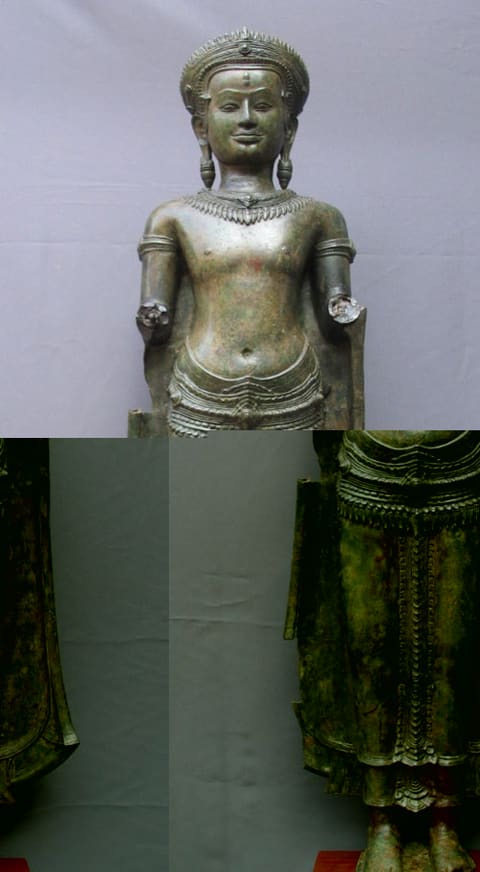
Standing Buddha
N° 332·III · Faith and Empire
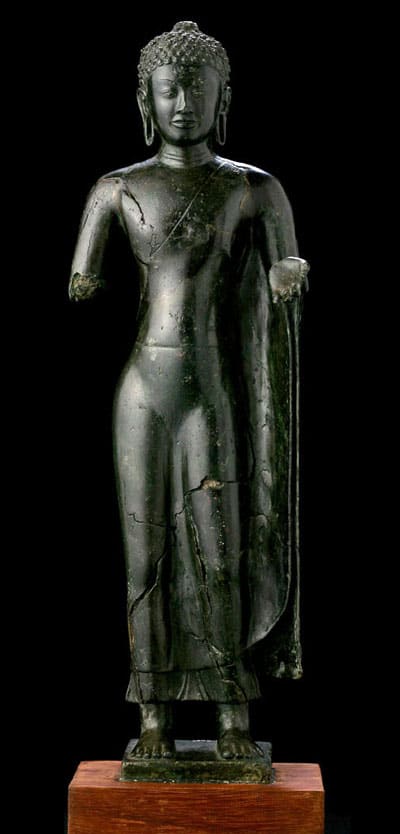
Standing Buddha
Unknown
6th - 7th century · Bronze
Khmer · Pre-Angkorian

A pre-Angkorian bronze Buddha of the unadorned type, wearing simple monastic robes with the left hand in vitarka mudra, the gesture of reflection or teaching. The museum highlights its naturalistic modelling - squared shoulders, semi-closed eyes and a semi-smiling face - and thin robes that reveal the body beneath.

“There are two types of Buddha statues in Khmer art: the unadorned and the adorned Buddha. This figure is an unadorned Buddha (with simple monastic robes).” In the museum’s words — cambodiamuseum.info ↗ · quotation verified against the live page

Meanwhile — Pensive Bodhisattva East Asia · Three Kingdoms period, 6th–7th century

Oval Vessel
N° 336·III · Faith and Empire
Oval Vessel
Unknown
Pre-Angkorian period · Earthenware
Khmer · Pre-Angkorian

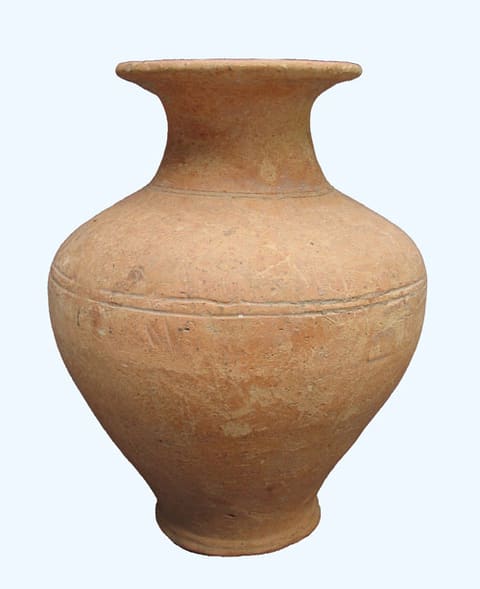
A pre-Angkorian earthenware vessel of the type used to carry drinking water, its long neck and body decorated with incised horizontal and concentric lines. The museum observes that its uneven, asymmetrical form and low firing temperature point to hand production, and that Cambodians name a vessel's parts - mouth, neck, body, foot - after the human body.

“Usually these vessels were used for carrying potable water.” In the museum’s words — cambodiamuseum.info ↗ · quotation verified against the live page

Meanwhile — Gold Crown (Altan Titem) East Asia · 6th–8th century

Devi
N° 347·III · Faith and Empire
Devi
Unknown
First half of the 7th century · Sandstone
Khmer · Pre-Angkorian (Sambor Prei Kuk style)

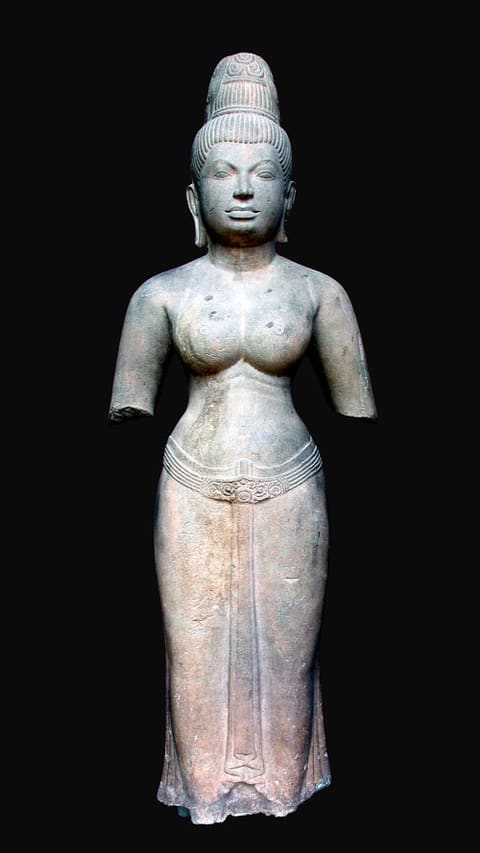
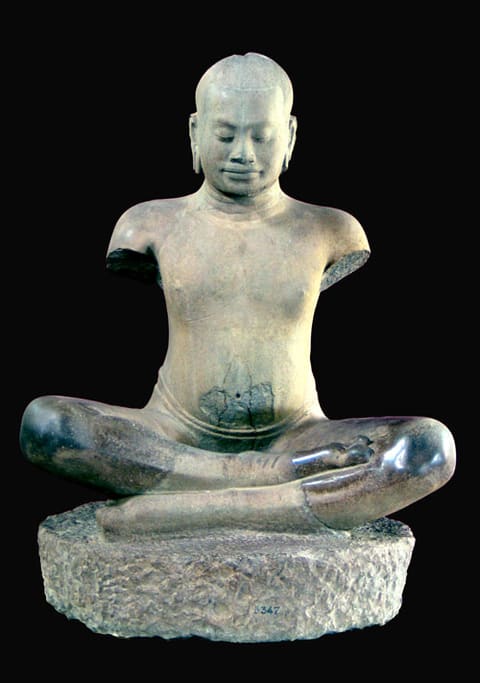
A sandstone image of a goddess (Devi) from Koh Krieng, dated by Professor Jean Boisselier to the mid-7th-century Sambor Prei Kuk style. Lacking identifying attributes, she cannot be firmly linked to the consort of either Vishnu or Shiva; the museum admires the naturalism of her modelling, likening it to the beauty of Cambodian women, and details her sampot skirt and jata coiffure.

“According to Professor Jean Boisselier, this female statue is dated to the middle of the 7th century in the Sambor Prei Kuk style.” In the museum’s words — cambodiamuseum.info ↗ · quotation verified against the live page

Meanwhile — The Sutton Hoo Helmet Europe · c. AD 610-635

Elephant Vessel
N° 395·III · Faith and Empire
Elephant Vessel
Unknown
Angkor period (uncertain) · Tan earthenware with brown glaze
Khmer · Angkor period

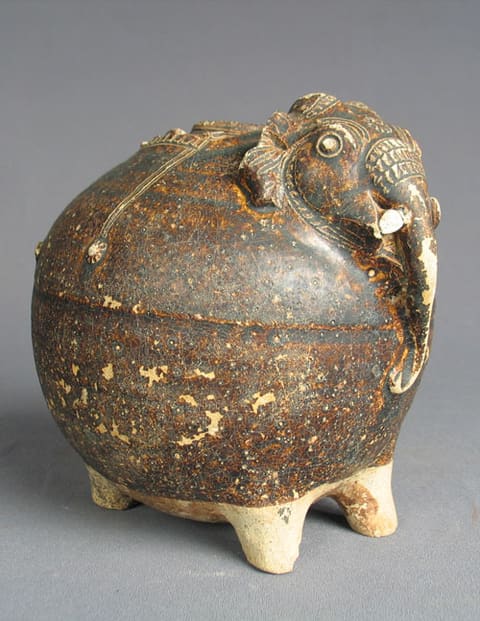
A small wheel-thrown earthenware lime pot modelled with a high-relief elephant's head, four feet and a tail. Such containers, the museum notes, were commonly shaped as animals - birds, frogs, dogs, rabbits, tortoises - with an opening in the top to store the lime chewed with betel.

“Most lime pots were shaped in the form of animals such as birds, frogs, dogs, rabbits and tortoises.” In the museum’s words — cambodiamuseum.info ↗ · quotation verified against the live page

Meanwhile — Cross of Cong Europe · AD 1123

Lintel
N° 429·III · Faith and Empire
Lintel
Unknown
3rd quarter of the 10th century · Pink Sandstone
Khmer · Angkor period (Banteay Srei style)

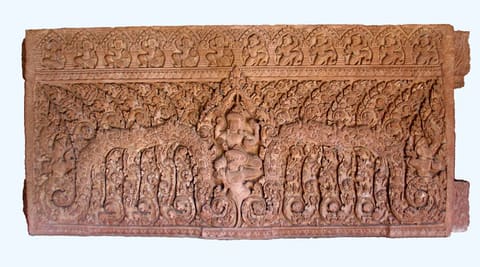
A pink sandstone temple lintel in the refined Banteay Srei style (3rd quarter of the 10th century), which the museum calls a masterpiece. Its central motif shows Vishnu mounted on Garuda, framed by symmetrical foliage formed of two naga bodies with small three-headed naga heads, and a frieze of dancing figures above; from the central sanctuary of Sralao temple.

“This lintel is a masterpiece dated to the Banteay Srei style.” In the museum’s words — cambodiamuseum.info ↗ · quotation verified against the live page

Meanwhile — Tombstone of the ichirgou-boyla Mostich Europe · Middle - third quarter of the 10th c.

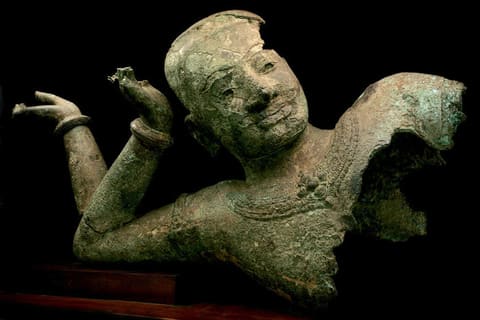
Reclining Visnu
N° 459·III · Faith and Empire
Reclining Visnu
Unknown
Second half of the 11th century · Bronze
Khmer · Angkor period (Baphuon style)

A colossal bronze image of the god Vishnu reclining on the cosmic ocean, its fragments recovered in 1936 during excavations at the Western Mebon temple at Angkor and brought to the museum in 1950. The museum presents it as evidence of Khmer artists' mastery of monumental bronze casting in the Baphuon style; the four-armed figure has inlaid hollows at the eyes and lips.

“This reclining Visnu is testimony to the talent of Khmer artists in the production of monumental bronze statues.” In the museum’s words — cambodiamuseum.info ↗ · quotation verified against the live page

Meanwhile — Early Spring East Asia · 1072, Northern Song dynasty

Standing Adorned Buddha
N° 461·III · Faith and Empire
Standing Adorned Buddha
Unknown
Late 11th - early 12th century · Bronze
Khmer · Angkor period

A bronze standing Buddha crowned and adorned with royal attributes, from the North Library of the third enclosure of Angkor Wat. The museum notes that from the Angkor period Khmer artists dressed both Buddhist and Brahmanist divinities in such regalia; its monastic robe is draped in the 'khlum' style covering both shoulders.

“Since the Angkor period, ancient Khmer artists decorated both Buddhist and Brahmanist divinities in stone with royal attributes.” In the museum’s words — cambodiamuseum.info ↗ · quotation verified against the live page

Meanwhile — Hoa Hakananai'a Americas & Oceania · c. 1000–1200 AD

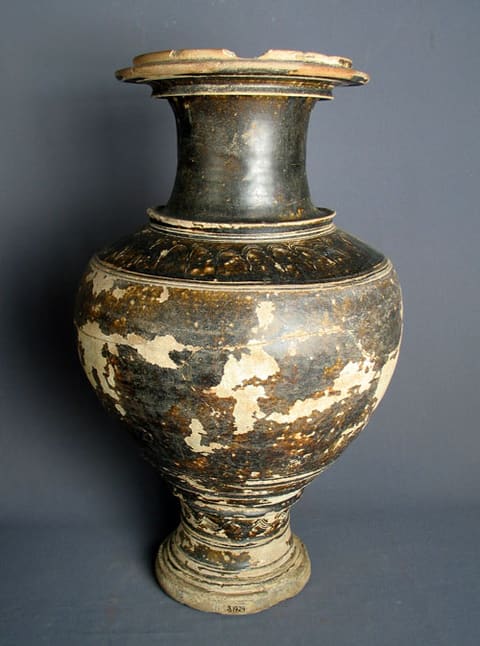
Jar
N° 469·III · Faith and Empire
Jar
Unknown
Angkor period, 12th century · Tan stoneware and "temmoku" brown glaze with amber tones
Khmer · Angkor period

A tall Angkor-period stoneware jar with a 'temmoku' brown glaze, decorated with rings around the lip, neck and foot and incised festoons at the shoulder. The museum notes that Angkorian narrow-necked vessels have been found at burial sites, sometimes holding human remains.

“A rounded bottom, flared lip, long neck and colour are typical of Angkor period ceramic production.” In the museum’s words — cambodiamuseum.info ↗ · quotation verified against the live page

Meanwhile — Male human figure (Manta culture) Americas & Oceania · 800–1500 CE

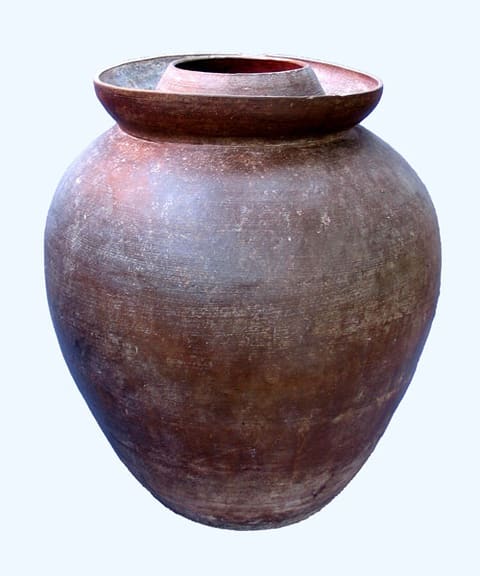
Vessel for prahok
N° 472·III · Faith and Empire
Vessel for prahok
Unknown
Angkor period, 12th century · Stoneware (ash glaze)
Khmer · Angkor period

An Angkor-period ash-glazed stoneware jar used to store prahok, the salted fermented-fish paste central to Khmer cuisine. Its wide mouth - which the museum notes must be wider than a forearm - allowed the paste to be packed in by hand, and a water-sealed bowl inverted over the top kept out insects and air.

“Prahok is a staple for Khmer cuisine. It is made from salted, fermented fish and has a strong odour.” In the museum’s words — cambodiamuseum.info ↗ · quotation verified against the live page

Meanwhile — Male human figure (Manta culture) Americas & Oceania · 800–1500 CE

Buddhist Triad
N° 491·III · Faith and Empire
Buddhist Triad
Unknown
Late 12th - early 13th century · Bronze
Khmer · Angkor period (Bayon style)

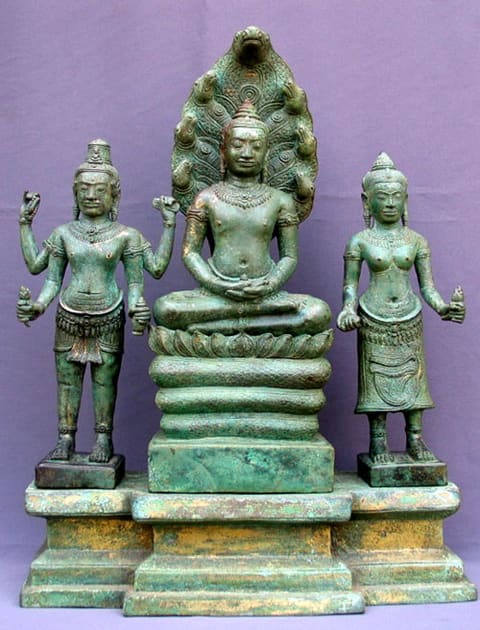
A bronze group of three adorned divinities in the Bayon style: the Buddha sheltered by the naga king Mucilinda at the centre, with Lokesvara to his right and Prajnaparamita to his left. The museum retells the story of the naga king coiling his body into a throne and placing his head above the Buddha to shelter him from the storm provoked by Mara; the piece was found at Prei Monti, Roluos.

“This piece is composed of three adorned divinities: Buddha shelled by the Naga in the middle, Lokesvara to the right of the Buddha and Prajnaparamita to the left.” In the museum’s words — cambodiamuseum.info ↗ · quotation verified against the live page

Meanwhile — Pyro-engraved gourd bowl Americas & Oceania · 1000–1400 CE

Jayavarman VII
N° 492·III · Faith and Empire
Jayavarman VII
Unknown
Late 12th - early 13th century · Sandstone
Khmer · Angkor period (Bayon style)

A sandstone portrait presumed to depict King Jayavarman VII in the Bayon style, its serene, lightly smiling face with semi-closed eyes typical of the period's portraiture. Found at Krol Romeas in Angkor Thom and conserved by the museum, which recounts his reign as one of the most energetic in Cambodian history; two statues with identical faces are held in Bangkok and at the Musee Guimet, Paris.

“The National Museum recently conserved a statue, which was found in the Angkor region that is presumed to be a likeness of Jayavarman VII.” In the museum’s words — cambodiamuseum.info ↗ · quotation verified against the live page

Meanwhile — Pyro-engraved gourd bowl Americas & Oceania · 1000–1400 CE

Adorned Buddha
N° 565·IV · Toward the Renaissance
Adorned Buddha
Unknown
15th - 16th century · Polychrome wood
Khmer · Post-Angkorian

A large polychrome-wood Buddha of the post-Angkorian period (15th-16th century), carved from a single piece of wood and wearing a mukuta crown, pectoral collar and armbands like a Brahmanist statue. Layers of coloured and gilded lacquer protected it against insects and water; the museum sees in its gentle expression the features of Khmer women.

“This Buddha is carved into a single piece of wood. He is wearing a mukuta, a pectoral collar and armbands.” In the museum’s words — cambodiamuseum.info ↗ · quotation verified against the live page

Meanwhile — Temptations of St. Anthony Europe · c. 1500

Tep Pranam
N° 624·V · The Renaissance
Tep Pranam
Unknown
16th century · Wood
Khmer · Post-Angkorian

A 16th-century wooden figure of a female worshipper (Tep Pranam) from Angkor Wat, hands joined in the sampeah gesture of respect, wearing a lotus-bud mukuta. The museum calls it a masterpiece of post-Angkorian sculpture and notes a cavity carved in the body once held sacred deposits such as small Buddha figures, relics or palm-leaf texts.

“Because of her typically Khmer facial expression, we consider this a masterpiece of post-Angkorian sculpture.” In the museum’s words — cambodiamuseum.info ↗ · quotation verified against the live page

Meanwhile — Hercules' Fight with the Centaurs Europe · c. 1550

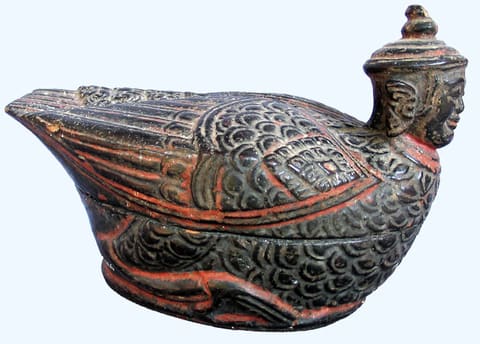
Kinnari Box
N° 861·VIII · The Restless Century
Kinnari Box
Unknown
19th - 20th century · Carved wood with black and red lacquer
Khmer · Post-Angkorian

A small 19th-20th-century lacquered-wood box in the form of a duck with a human head - identified by its mitre as a Kinnari, a celestial dancer - carved and painted red. The museum suggests it may have held betel nut and leaves.

“This box is in the form of duck with human head.” In the museum’s words — cambodiamuseum.info ↗ · quotation verified against the live page

Meanwhile — Dancing on a Shore Europe · 1900

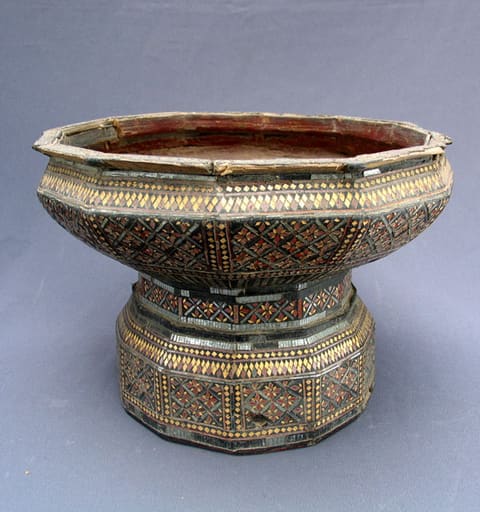
Pedestal
N° 862·VIII · The Restless Century
Pedestal
Unknown
19th - 20th century · Woven bamboo with black lacquer
Khmer · Post-Angkorian

A tall footed pedestal of woven bamboo coated with black lacquer, from Phnom Penh, used to support offerings such as fruit, cakes or sweets. The museum shows it among the ethnographic objects of daily life in its north gallery, its lacquer decorated with floral motifs and inlaid reflective glass.

“The north gallery of the National Museum exhibits ethno-graphic objects used in daily life.” In the museum’s words — cambodiamuseum.info ↗ · quotation verified against the live page

Meanwhile — Dancing on a Shore Europe · 1900