The Atlas·KE

KE

National Museums of Kenya, Nairobi — 8 works · museum site ↗ · 1100–1650 60000 BCE2020

Seen from Nairobi, history is above all architecture & ornament, then writing & invention — a collection opened wide onto other worlds — a window more than a mirror (5 of 8 works are from other civilisations).

Architecture 3 Invention 1 Power 1 Sculpture 1 Sacred 1 Observation 1
Gede Ruins
N° 476·III · Faith and Empire
Gede Ruins
Unknown
Swahili town, 12th–17th century · coral-stone masonry (ruined town: mosques, palace and houses)
Swahili

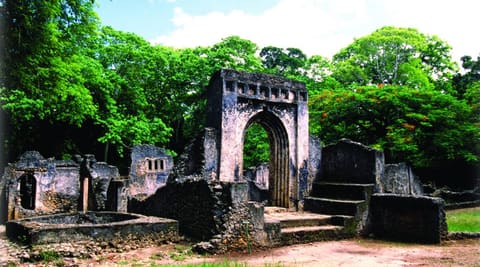
The Gede Ruins in Kilifi (about 16 km south of Malindi) are the remains of a Swahili town that traces its origin to the twelfth century and was rebuilt with new town walls in the fifteenth and sixteenth centuries. At its peak in the fifteenth century the wealthy town held a conglomeration of mosques, a magnificent palace and houses nestled in some 45 acres of forest; the last families left in the first half of the seventeenth century. First excavated under James Kirkman, Gede was re-gazetted as the Gede National Monument in 1970 and is under the care of the National Museums of Kenya, its indigenous forest also a sacred site for the surrounding community.

“Gede ruins are the remains of a Swahili town, typical of most towns along the East African Coast.” In the museum’s words — museums.or.ke ↗ · quotation verified against the live page

Meanwhile — Bronze Shiva (Sukhothai) South Asia · Sukhothai art, early 20th Buddhist century (c. mid-14th century CE)
The Portuguese Chapel, Malindi
N° 602·IV · Toward the Renaissance
The Portuguese Chapel, Malindi
Unknown
built in the 1490s (Portuguese)
Portuguese

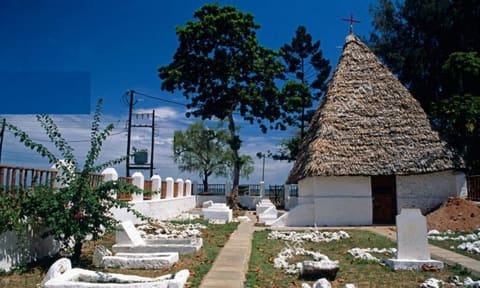
The Portuguese Chapel at Malindi, said by the National Museums of Kenya to be the oldest Christian church in East Africa, dates from the Portuguese presence that began with Vasco da Gama's arrival in 1498; it was built in the style of the Navigator's chapel at Sagres in Portugal and endured until the Portuguese withdrew to Mombasa in 1593. In 1542 the Catholic missionary Francis Xavier (later St Francis Xavier), en route to Goa, landed at Malindi to bury a seaman in the chapel graveyard, and his name is still associated with the chapel. It was declared a gazetted monument in 1935 and is cared for by the National Museums of Kenya.

“This Chapel is said to be the oldest Christian church in East Africa and was declared a gazetted monument in 1935.” In the museum’s words — museums.or.ke ↗ · quotation verified against the live page

Meanwhile — Decorated glazed dish Islamic world · 1400–1599 CE

Vasco da Gama Pillar (Padrão)
N° 611·IV · Toward the Renaissance
Vasco da Gama Pillar (Padrão)
Unknown
erected 1499 (Portuguese) · limestone (Lisbon limestone from Portugal)
Portuguese

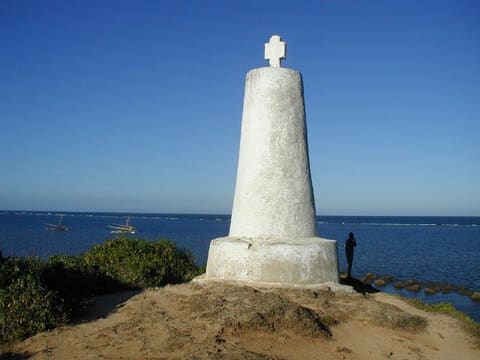
Standing on a headland above the sea at Malindi, the Vasco da Gama Pillar is a Portuguese padrão — a pillar carrying a cross with Portugal's coat of arms — that Vasco da Gama's sailors were allowed to erect on his return voyage in 1499, near the then sultan's palace, possibly as a leading mark for later seafarers. The National Museums of Kenya records it as the only known original padrão out of several placed along the African coast by Portuguese seafarers; the cross is of Lisbon limestone carried from Portugal. In 1973 a protective concrete cone was built over the weathered original, which still supports the limestone cross. It was declared a gazetted National Monument in 1935 and is under the National Museums of Kenya.

“This Pillar is the only known original Padrao out of several placed at various points at the African coastline by various Portuguese seafarers.” In the museum’s words — museums.or.ke ↗ · quotation verified against the live page

Meanwhile — Decorated glazed dish Islamic world · 1400–1599 CE

Thimlich Ohinga
N° 621·V · The Renaissance
Thimlich Ohinga
Unknown
built 16th century CE · undressed dry-stone walls
Lake Victoria Basin pastoral communities

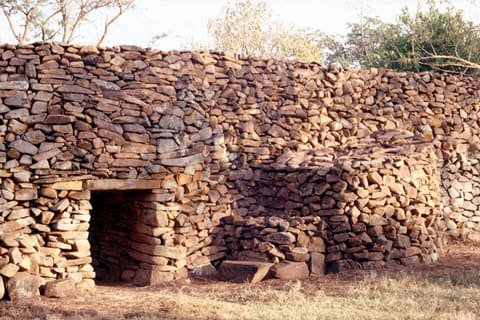
Presented by the National Museums of Kenya, Thimlich Ohinga — 46 km north-west of Migori in the Lake Victoria region — is a dry-stone walled settlement built in the 16th century CE, and the largest and best-preserved of these massive enclosures (ohingni) in the lake basin. Its undressed stone walls, laid without mortar using a three-phase building technology of irregular stones, served as a fort for communities and livestock while also defining social units linked to lineage; such enclosures persisted in the region from the 16th to the mid-20th century.

“Thimlich Ohinga is the largest and best preserved of these traditional enclosures found in the Lake Victoria region.” In the museum’s words — museums.or.ke ↗ · quotation verified against the live page

Meanwhile — Painting of a Dog and Puppies East Asia · 16th century (Joseon)

Fort Jesus
N° 703·V · The Renaissance
Fort Jesus
Batista Cairato
built 1593 (Portuguese) · masonry (Portuguese military fortification on a coral ridge)
Portuguese

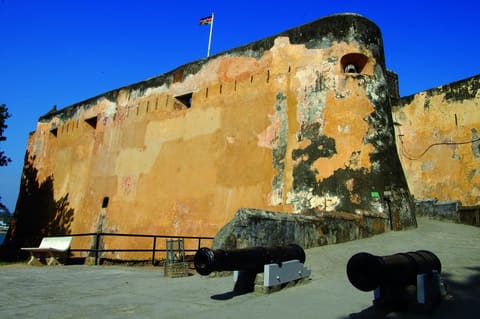
The Portuguese built Fort Jesus in 1593 on a coral ridge at the entrance to Mombasa harbour, to a design by the Italian architect and engineer Batista Cairato; it has kept its basic shape for nearly 400 years. Fought over repeatedly — including an Omani Arab siege of 1696–1698 — it later served as barracks and, under the British protectorate, as a prison, before becoming a museum in 1962 (built with a grant from the Gulbenkian Foundation) whose exhibits come from excavations at Fort Jesus, Gede, Manda, Ungwana and other sites. In 2011 UNESCO declared it a World Heritage Site, highlighted as one of the most outstanding and well-preserved examples of 16th-century Portuguese military fortifications. It is a museum of the National Museums of Kenya on Mombasa Island.

“In 2011, it was declared a World Heritage Site by UNESCO and highlighted as one of the most outstanding and well-preserved examples of 16th-century Portuguese military fortifications.” In the museum’s words — museums.or.ke ↗ · quotation verified against the live page

Meanwhile — Cypress Trees East Asia · Azuchi-Momoyama period, 1590

Murumbi African Heritage Collection
N° 1184·Undated
Murumbi African Heritage Collection
Unknown
Murumbi collection (Joseph and Sheila Murumbi) · artifacts, art pieces, books, jewellery, postal stamps, textiles and furniture
African (various)

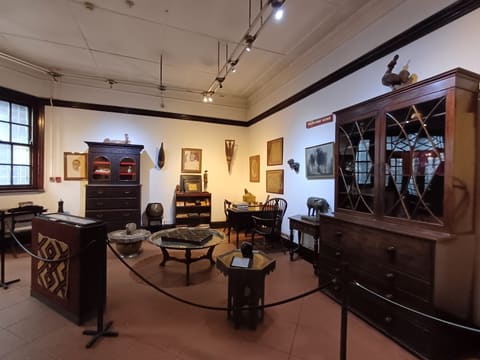
The Nairobi Gallery — housed in Nairobi's 1913 former colonial building at the city's 'point zero,' from where distances across Kenya were measured — is the home of the collections of Joseph and Sheila Murumbi, described by the National Museums of Kenya as Africa's greatest private collectors of artifacts, art pieces, books, jewellery, postal stamps, textiles and furniture. The Murumbi African Heritage Collection is shown across themed galleries, and the pan-African postage-stamp collection is said to be next to the Queen of England's in importance. Joseph Murumbi was Kenya's second vice president. (No image of the collection is published on the museum's website; this record is imageless.)

“Joseph and Sheila Murumbi were Africa’s greatest private collectors of artifacts, art pieces, books, jewelry, postal stamps, textiles and furniture which are today on display at the Nairobi Gallery.” In the museum’s words — museums.or.ke ↗ · quotation verified against the live page
Pate Ivory Siwa
N° 1191·Undated
Pate Ivory Siwa
Unknown
Swahili, Lamu archipelago · ivory
Swahili

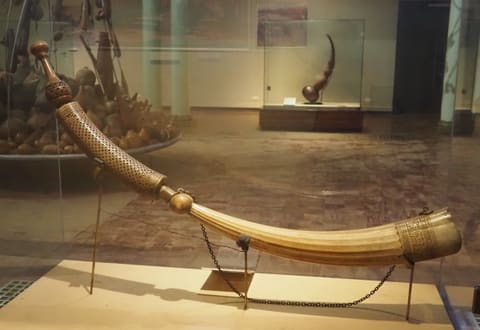
Displayed on the first floor of the Lamu Museum, the Pate Ivory Siwa is presented by the National Museums of Kenya as one of the finest African treasures in Swahili governance. It is housed among the Lamu Museum's Swahili ethnographic collection — described by the museum as one of the largest and most authentic Swahili collections on the East African coast, assembled from the traditional settlements of the Lamu archipelago. (No image of the Siwa is published on the museum's website; this record is imageless.)

“This floor displays one of the finest African treasures in Swahili governance the Pate Ivory Siwa.” In the museum’s words — museums.or.ke ↗ · quotation verified against the live page
Turkana Boy (Homo erectus skeleton)
N° 1226·Undated
Turkana Boy (Homo erectus skeleton)
Unknown
Homo erectus, lived over 1.6 million years ago; discovered 1984 · fossilised bone (skeleton)

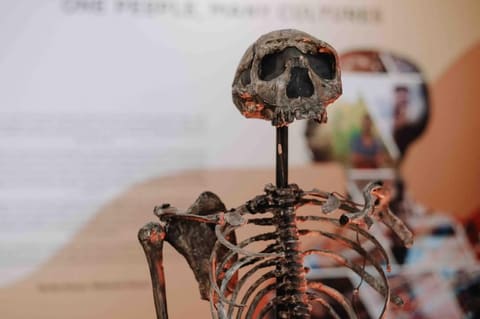
Held by the National Museums of Kenya, the original skeleton of Turkana Boy — which the National Museums of Kenya calls one of Kenya's greatest treasures — is kept in a strong room built to withstand even a bomb blast, while the cast on display (which looks exactly like the original) is what most visitors see. Discovered in 1984 near Lake Turkana by the late Kamoya Kimeu, Turkana Boy is the most complete Homo erectus skeleton ever found; he was about 8 to 12 years old and stood 5'3", and lived over 1.6 million years ago. His remarkably preserved bones have given scientists unparalleled insights into early human life, and the skeleton has travelled to Paris, Tokyo and New York.

“Discovered on July 1984, near Lake Turkana by the late Kamoya Kimeu, Turkana Boy is the most complete Homo erectus skeleton ever found.” In the museum’s words — museums.or.ke ↗ · quotation verified against the live page