The Atlas·IE

IE

National Museum of Ireland, Dublin — 10 works · museum site ↗ · 100 BCE – 1123 60000 BCE2020

Seen from Dublin, history is above all faith & ritual objects, then treasure & power — a collection kept wholly in its own tradition — a mirror.

Ritual 4 Power 2 Sculpture 2 Invention 1 Craft 1
Loughnashade Horn
N° 239·II · The Classical World
Loughnashade Horn
Unknown
1st century BC · Riveted sheets of hammered bronze
Iron Age Ireland (Celtic) · Iron Age

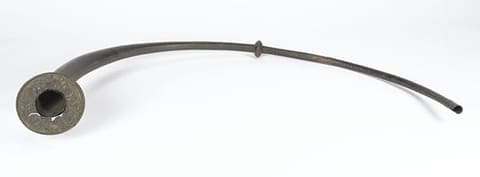
A curved Iron Age bronze horn or trumpet, the only survivor of four found in 1794 in the former lake of Loughnashade, beside the royal complex of Emain Macha (Navan Fort), Co. Armagh; an early description records it as part of a votive deposit that also contained human skulls and other bones.

“This important Iron Age artefact is possibly linked to the Ulster Kings at Emain Macha.” In the museum’s words — museum.ie ↗ · quotation verified against the live page

Meanwhile — Dotaku (Bronze Bell) with Flowing-Water Pattern East Asia · Japan, Yayoi period, circa 1st century BC
The Broighter Collar
N° 240·II · The Classical World
The Broighter Collar
Unknown
1st century BC · Gold (tubular neck-ring with buffer terminals, raised and incised La Tène ornament)
Iron Age Ireland (Celtic) · Iron Age

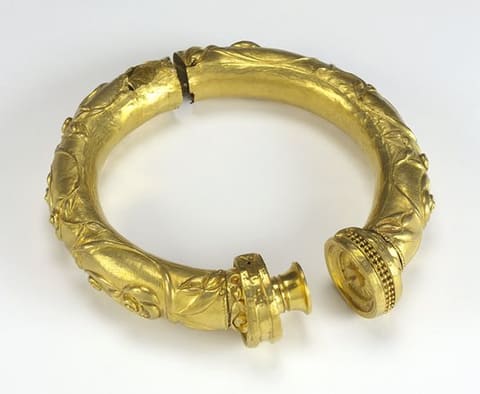
The Broighter gold collar — described by the museum as the most sumptuous Irish Iron Age gold collar — a tubular buffer-terminal neck ornament with raised and incised La Tène ornament, found in a hoard of gold objects near the ancient shore of Lough Foyle at Broighter, Co. Derry. Collars like it are associated with Celtic kings and gods.

“The most sumptuous Irish Iron Age gold collar was found in a hoard of gold objects close to the ancient shore of Lough Foyle at Broighter, Co. Derry.” In the museum’s words — museum.ie ↗ · quotation verified against the live page

Meanwhile — Dotaku (Bronze Bell) with Flowing-Water Pattern East Asia · Japan, Yayoi period, circa 1st century BC
The 'Tara' Brooch
N° 370·III · Faith and Empire
The 'Tara' Brooch
Unknown
8th century AD · Cast gilt silver with fine gold filigree panels and studs of glass, enamel and amber; a plaited silver-wire chain
Early Medieval Irish (Insular) · Early Medieval (Insular art)

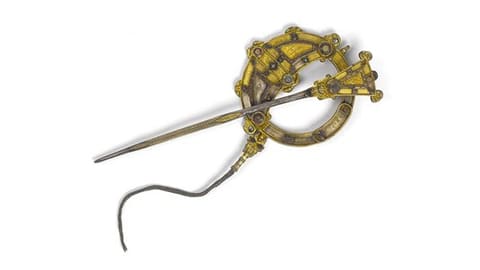
The so-called "Tara" Brooch — found not at Tara but near the seashore at Bettystown, Co. Meath, in 1850, the Tara attribution being a dealer’s invention to raise its value. The museum places it, with the Ardagh Chalice and Derrynaflan Paten, at the pinnacle of early medieval Irish metalworking; it is cast gilt silver with exceptionally fine gold filigree on the front and cast La Tène-style spirals on the back.

“This brooch was found not in Tara but near the seashore at Bettystown, Co. Meath, in 1850. Its provenance was attributed to Tara by a dealer in order to increase its value.” In the museum’s words — museum.ie ↗ · quotation verified against the live page

Meanwhile — Stone Standing Amitabha Buddha from Gamsansa Temple Site East Asia · 719 (Unified Silla)

Derrynaflan Silver Paten
N° 373·III · Faith and Empire
Derrynaflan Silver Paten
Unknown
8th century AD · Beaten silver dish soldered and wire-stitched to a bronze rim, with gilt-bronze frames, gold filigree, glass and enamel studs; assembled from more than 300 pieces
Early Medieval Irish (Insular) · Early Medieval (Insular art)

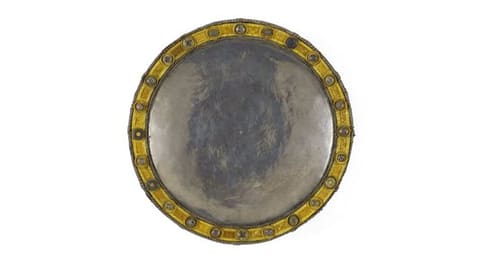
A paten (the dish used at Mass to hold the Eucharist) from the Derrynaflan hoard, of very complex construction assembled from more than 300 pieces. The museum notes patens were common in the later Roman world but few examples survive from early medieval Ireland.

“This silver paten, like the Derrynaflan Chalice, is part of a hoard of altar vessels found at Derrynaflan, Lurgoe, Co. Tipperary.” In the museum’s words — museum.ie ↗ · quotation verified against the live page

Meanwhile — Maya Cylindrical Vase Americas & Oceania · Late Classic (c. 600–900 CE)

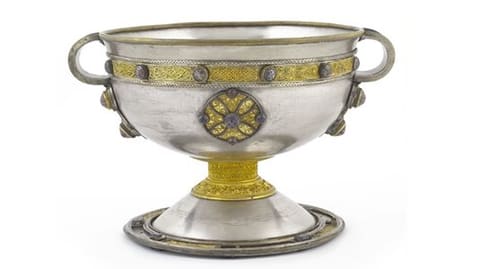
The Ardagh Chalice
N° 374·III · Faith and Empire
The Ardagh Chalice
Unknown
8th century AD · Spun silver bowl and foot with applied gold, silver, glass, amber and enamel ornament, gold filigree, and a rock crystal
Early Medieval Irish (Insular) · Early Medieval (Insular art)

An 8th-century silver communion chalice found at Reerasta, Ardagh, Co. Limerick, used for dispensing Eucharistic wine at Mass; the museum calls it one of the greatest treasures of the early Irish Church. Its form recalls late Roman tableware but its construction is Irish, and the names of the eleven apostles and St Paul are inscribed beneath a band of gold filigree.

“The Ardagh Chalice is one of the greatest treasures of the early Irish Church.” In the museum’s words — museum.ie ↗ · quotation verified against the live page

Meanwhile — Maya Cylindrical Vase Americas & Oceania · Late Classic (c. 600–900 CE)

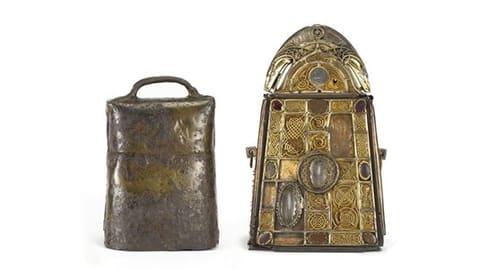
The Bell of St Patrick and its Shrine
N° 377·III · Faith and Empire
The Bell of St Patrick and its Shrine
Unknown
Bell 8th–9th century AD; shrine circa AD 1100 · Iron bell of two riveted sheets coated with bronze; shrine of bronze plates with a silver-gilt frame and gold filigree panels
Early Medieval Irish (Insular) · Early Medieval (Insular art)

An iron hand-bell reputed to have belonged to St Patrick — frequently named in written sources as one of the principal relics of Ireland — together with the elaborate bronze, silver-gilt and gold-filigree shrine made around AD 1100 to enclose it.

“This bell is reputed to have belonged to St. Patrick. It is made of two sheets of iron which are riveted together and coated with bronze.” In the museum’s words — museum.ie ↗ · quotation verified against the live page

Meanwhile — Cusped bowl Islamic world · 9th-10th century

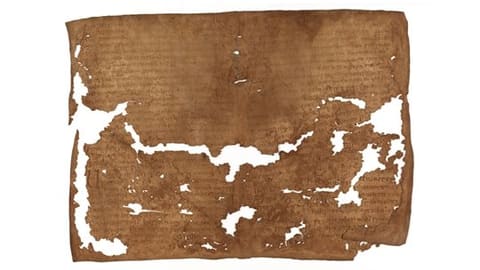
The Faddan More Psalter
N° 386·III · Faith and Empire
The Faddan More Psalter
Unknown
Circa AD 800 · Vellum manuscript with a leather cover lined with papyrus
Early Medieval Irish (Insular) · Early Medieval (Insular art)

An early medieval Book of Psalms, a chance find made in a Co. Tipperary bog in 2006 and conserved in the National Museum’s laboratory at Collins Barracks; its papyrus-lined cover is direct evidence for contact between Ireland and the Mediterranean world over a thousand years ago. The museum describes it as the first discovery of its kind in Ireland or anywhere in the world.

“The Book of Psalms known as the Faddan More Psalter, dates from approximately AD 800.” In the museum’s words — museum.ie ↗ · quotation verified against the live page

Meanwhile — Bodhisattva Avalokiteshvara (Padmapani), upper torso South Asia · Srivijaya art, 14th Buddhist century (c. 8th century CE)

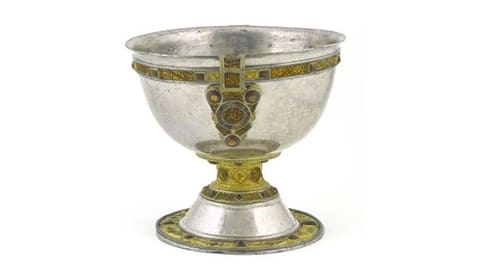
Derrynaflan Chalice
N° 388·III · Faith and Empire
Derrynaflan Chalice
Unknown
Early 9th century AD · Beaten and lathe-polished silver with gold filigree panels and amber studs
Early Medieval Irish (Insular) · Early Medieval (Insular art)

A silver communion chalice from a hoard of altar vessels found in 1980 at the monastic site of Derrynaflan, Co. Tipperary; the museum compares it to the Ardagh Chalice, noting it is generally considered less elegant and slightly later, with simpler decoration and less finely executed filigree.

“This chalice dates from the early 9th century AD and was found in 1980 on a monastic site at Derrynaflan, Co. Tipperary.” In the museum’s words — museum.ie ↗ · quotation verified against the live page

Meanwhile — Wooden snuff tablet with kneeling figure Americas & Oceania · 700–950 CE

The Lismore Crozier
N° 464·III · Faith and Empire
The Lismore Crozier
Neachtain
Circa AD 1100 · Wooden staff sheathed in sheet bronze with spacer knops and a cast copper-alloy crook, decorated with blue glass studs and millefiori insets
Early Medieval Irish (Insular) · Early Medieval (Insular art)

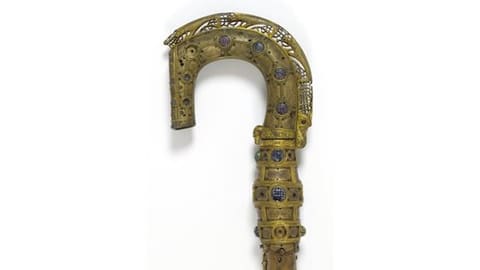
A bishop’s crozier of about AD 1100, found in a blocked-up doorway at Lismore Castle, Co. Waterford; an inscription records both Neachtain, the craftsman who made it, and the Bishop of Lismore who commissioned it. The museum frames such croziers as symbols of power and authority during a period of Church reform.

“The Lismore Crozier was discovered in a blocked-up doorway at Lismore Castle, in the early years of the 19th century.” In the museum’s words — museum.ie ↗ · quotation verified against the live page

Meanwhile — Hoa Hakananai'a Americas & Oceania · c. 1000–1200 AD

Cross of Cong
N° 480·III · Faith and Empire
Cross of Cong
Unknown
AD 1123 · Cast bronze plates over an oak core, with gold filigree, niello, rock crystal and glass bosses
Early Medieval Irish (Insular) · Early Medieval (Insular art)

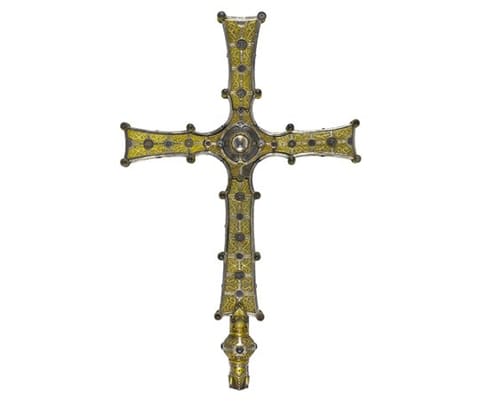
A processional cross made in 1123 for Toirrdelbach Ua Conchobair (Turlough O’Conor), High King of Ireland, to enshrine a relic of the True Cross; the museum presents it as the culmination of a long tradition of distinctively Irish church metalwork and "one of the greatest treasures of the era." Kept for centuries at the Augustinian friary at Cong, Co. Mayo.

“The Cross of Cong was made in 1123 to encase a fragment of the True Cross that was brought to Ireland and displayed in different places around the country.” In the museum’s words — museum.ie ↗ · quotation verified against the live page

Meanwhile — Whispering Pines in Myriad Valleys East Asia · 1124, Northern Song dynasty