The Atlas·PT

Portugal

Museu Nacional de Arte Antiga, Lisbon — 20 works · museum site ↗ · 1213–1731 60000 BCE2020

Seen from Lisbon, history is above all sacred images, then faith & ritual objects — a collection split between its own tradition and other worlds (4 of 20 works are from other civilisations).

Sacred 6 Ritual 4 Power 2 Sculpture 2 Invention 1 Architecture 1 Craft 1 Portraits 1 Stories 1 Observation 1
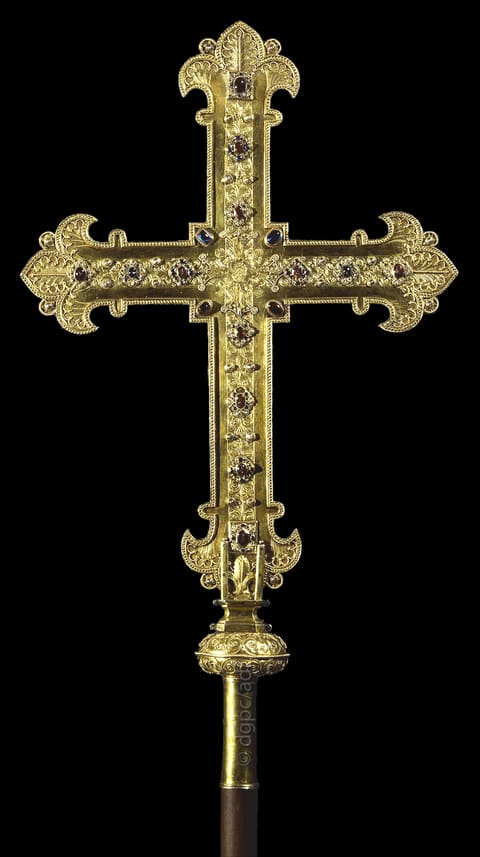
Cross of Dom Sancho I
N° 510·III · Faith and Empire
Cross of Dom Sancho I
Unknown
1213 · gold, sapphires, garnets, pearls and seed-pearls
Portuguese

A solid gold processional cross commissioned by King Sancho I for the monastery of Santa Cruz in Coimbra to house a relic of the True Cross, its reverse engraved with the Lamb of God and the symbols of the four evangelists. One of the earliest surviving works tied to Portuguese royal patronage.

“This remarkable piece, made of solid gold, precious stones and pearls set in the obverse, once housed a relic of the Holy Cross, since the founder of the Portuguese nation, Dom Afonso Henriques, had dedicated the cult of the Canons Regular of St. Augustine to the invocation of the Cross of Christ.” In the museum’s words — museudearteantiga.pt ↗

Meanwhile — Huastec Effigy Vessel Americas & Oceania · Postclassic (c. 900–1521 CE)
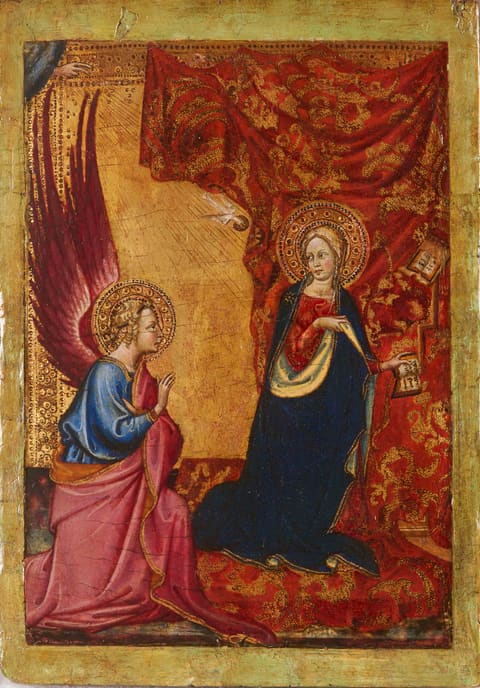
The Annunciation
N° 573·IV · Toward the Renaissance
The Annunciation
Álvaro Pires de Évora (active 1410–1434)
1430–1434 · tempera and gold ground on panel
Portuguese

Acquired in 2018, this small Annunciation is the museum's only work by Álvaro Pires de Évora, the earliest Portuguese-born painter with a securely identified body of work - though his entire documented career was spent in Tuscany, not Portugal. It is prized for the decorative grace of its red fabrics and gold-punched background.

“But Pires still remains the first painter born in Portugal to whom we can safely attribute an artistic oeuvre of some significance. For this reason, he must be considered among the “founding fathers” of Portuguese painting, while, at the same time, in his own historical right, he was part of one of the identifying currents of Italian painting in the Quattrocento.” In the museum’s words — museudearteantiga.pt ↗

Meanwhile — Inkstone Box with Poetry-Inspired Seashore Design in Maki'e and Silver Inlay East Asia · Japan, Muromachi period, early 15th century

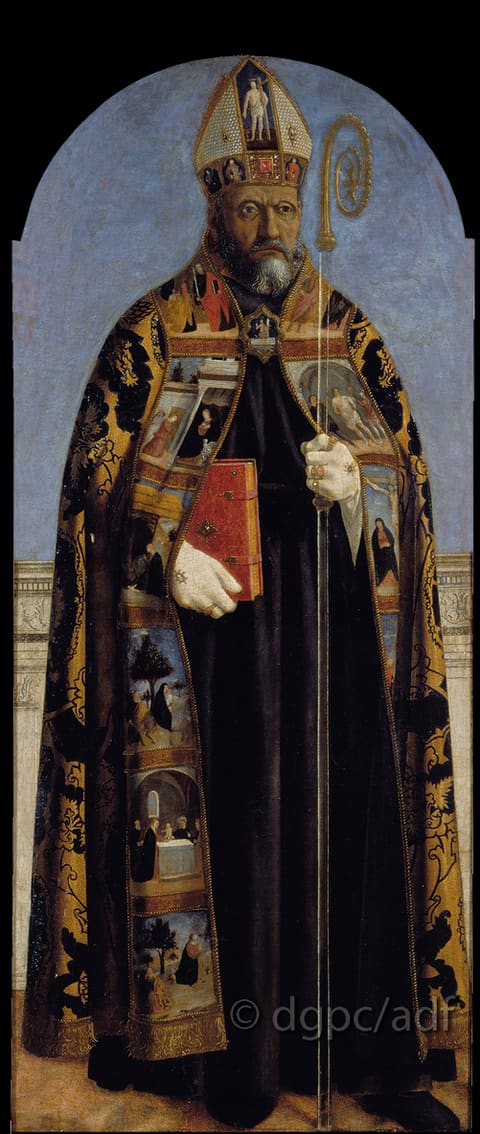
St. Augustine
N° 586·IV · Toward the Renaissance
St. Augustine
Piero della Francesca (c. 1415–1492)
c. 1465 · tempera on poplar
Italian · Italian Renaissance

A panel from a dismembered altarpiece Piero della Francesca painted for the Augustinian church in his native Sansepolcro, its central panel now lost. The bishop-saint holds a crystal crosier and wears a cope embroidered with scenes from the life of Christ, prized for the calm monumentality typical of the artist.

“This painting was part of a polyptych painted by Piero della Francesca for the Church of the Hermits of St. Augustine, at Borgo Sansepolcro, in Italy.” In the museum’s words — museudearteantiga.pt ↗

Meanwhile — Quipu (knotted-cord recording device), Inka Americas & Oceania · 1400–1532 CE

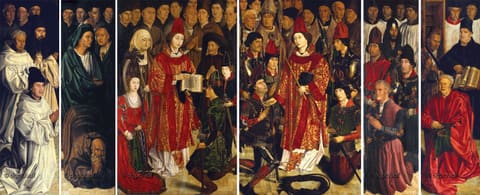
St. Vincent Panels
N° 589·IV · Toward the Renaissance
St. Vincent Panels
Attributed to Nuno Gonçalves (active 1450–1491)
c. 1470 · oil (?) and tempera on oak
Portuguese

Six oak panels depicting around sixty members of Portuguese society - from the royal court to fishermen and clergy - gathered in solemn veneration around a double image of St. Vincent, patron saint of Lisbon. Traditionally attributed to Nuno Gonçalves, court painter to King Afonso V, it is considered one of the founding works of Portuguese painting and an unusually early collective portrait in European art.

“The six paintings attributed to Nuno Gonçalves present a group of 58 people gathered together around the double figuration of St. Vincent. A solemn and monumental assembly, representing the Court and various groups of Portuguese society at that time, engaged in an act of veneration directed towards the patron and inspiration of the 15th-century military expansion into the Maghreb.” In the museum’s words — museudearteantiga.pt ↗

Meanwhile — Quipu (knotted-cord recording device), Inka Americas & Oceania · 1400–1532 CE

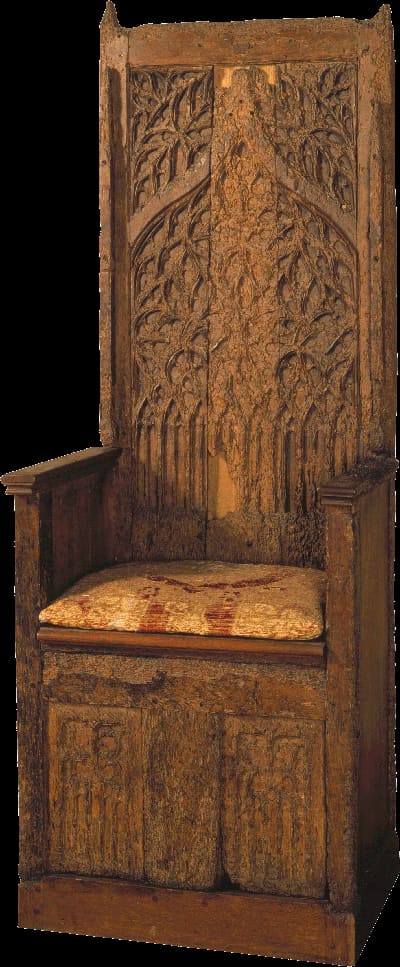
Ceremonial Armchair (said to be of King Afonso V)
N° 590·IV · Toward the Renaissance
Ceremonial Armchair (said to be of King Afonso V)
Unknown
c. 1470–1475 · oak
Portuguese

An austere oak armchair from the Franciscan monastery of Santo António do Varatojo, founded by King Afonso V in 1470. Traditionally associated with the king by the friars' own chroniclers and preserved for generations as a relic of the monastery's royal founding, it is one of the oldest known pieces of Portuguese furniture.

“Associated with the king by the Order’s chroniclers, this armchair is one of the oldest known examples of Portuguese furniture.” In the museum’s words — museudearteantiga.pt ↗

Meanwhile — Blue-and-White Vase with Swan Design South Asia · Mid-to-late 15th century, Lê sơ dynasty

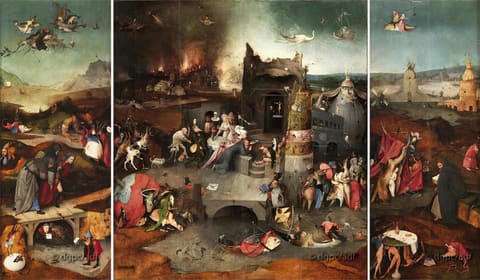
Temptations of St. Anthony
N° 615·V · The Renaissance
Temptations of St. Anthony
Hieronymus Bosch (c. 1450–1516)
c. 1500 · oil on oak
Netherlandish · Northern Renaissance

A signed triptych on the temptations endured by St. Anthony the hermit, the theme Bosch returned to more than any other: demonic, hybrid creatures and false beauties assail the saint on the inner panels, while the closed exterior shows Christ's journey to Calvary harassed by ordinary townspeople, rendered in an eerie moonlit grisaille.

“This triptych displays the most recurrent and central theme of Bosch’s work: the temptation and loneliness of the just man when faced with evil and the diabolical which dominates the earthly world either expressly, in the form of the monstrous and the hybrid, or under the guise of a false and provocative beauty.” In the museum’s words — museudearteantiga.pt ↗

Meanwhile — Adorned Buddha South Asia · 15th - 16th century

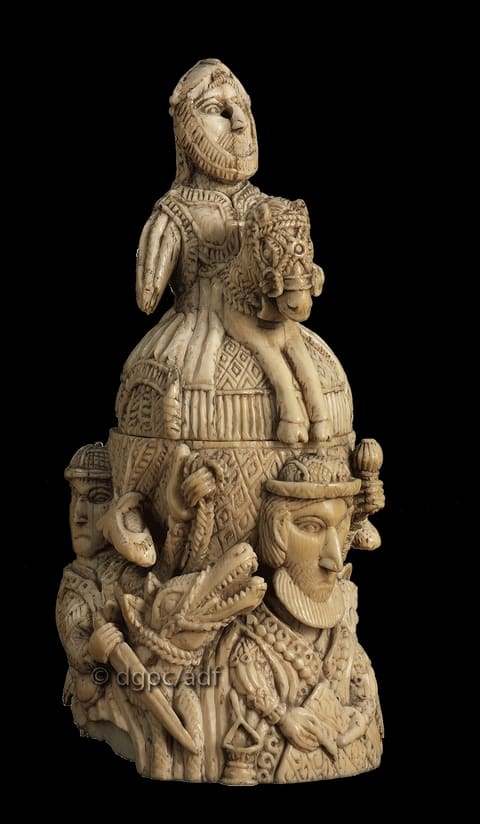
Salt Cellar
N° 617·V · The Renaissance
Salt Cellar
Unknown Edo (Benin) ivory carver
first quarter of the 16th century · ivory
Edo (Benin) · Benin Kingdom

An ivory salt cellar carved in the Kingdom of Benin for the Portuguese export trade, combining European figure types - Portuguese men rendered with careful attention to their beards, hair, and long noses - with West African textile patterns and craftsmanship. An early and rare artifact of Afro-Portuguese cultural exchange.

“Using European prototypes, the ivory pieces from Benin are distinguished by their careful depiction of the Portuguese, with the artists detailing their physiognomical features (long hair, variously styled beards and slender, pointed noses).” In the museum’s words — museudearteantiga.pt ↗

Meanwhile — Portrait of the Venetian Painter Giovanni Bellini Europe · 1511–1512

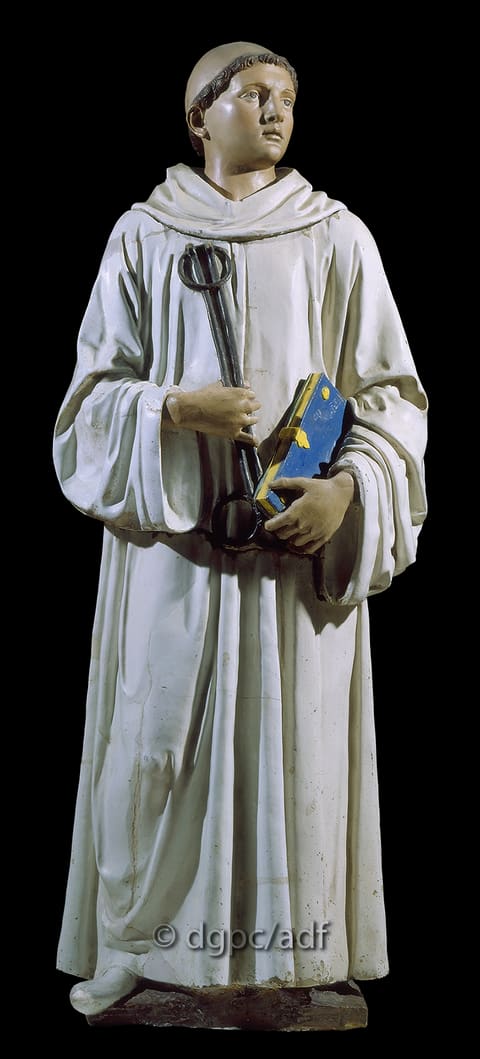
St. Leonard
N° 627·V · The Renaissance
St. Leonard
Attributed to Andrea della Robbia and Girolamo della Robbia (attrib.) (Andrea, 1435–1525)
1501–1513 · modelled, polychrome and glazed terracotta
Italian · Italian Renaissance

A glazed terracotta sculpture from the della Robbia workshop in Florence, part of a group of at least six such pieces sent to the monastery at Belém before 1514 - tradition holds they were a gift from Pope Julius II to King Manuel I. Depicts St. Leonard, protector of women in childbirth.

“Demonstrating the prestige attained throughout Europe by the della Robbia workshop, this sculpture arrived in Portugal before 1514, forming part of a group of at least six sculptures originating from Florence, some of which are still conserved today.” In the museum’s words — museudearteantiga.pt ↗

Meanwhile — Phra Hai Sok (Lanna Buddha) South Asia · Lanna art (base inscription records its arrival in Bangkok in 1856 CE)

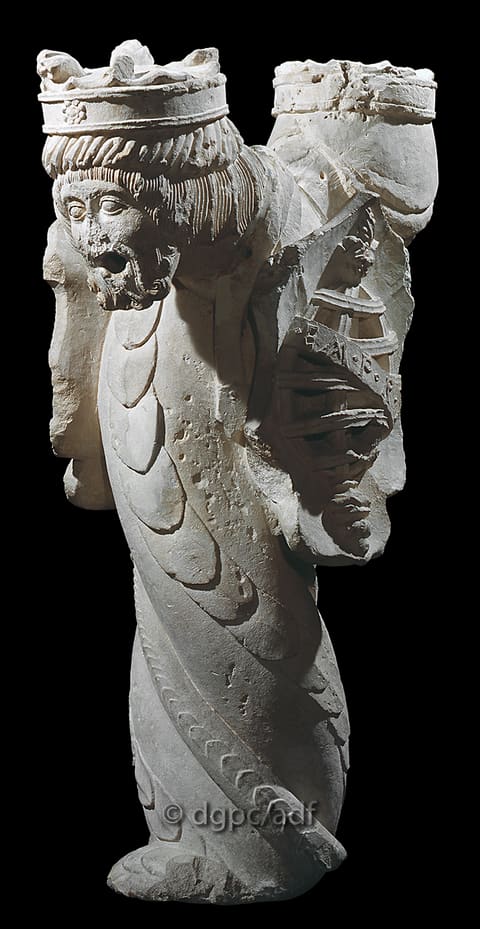
Two-Headed Fountain
N° 628·V · The Renaissance
Two-Headed Fountain
Unknown
1501–1515 · limestone
Portuguese · Manueline

An enigmatic carved fountain spout combining the crowned heads of a man and a woman with the royal emblems of King Manuel I and Queen Leonor - the armillary sphere and the shrimping net - a rare instance of the two rulers' devices appearing together on the same Manueline-period monument.

“The first has the high-relief armillary sphere, with an ecliptic around which there runs the inscription E.M.P.R.P – Emanuel Primus Rex Portugaliae, corresponding to the name of Dom Manuel I (1495-1521) – in Roman capitals.” In the museum’s words — museudearteantiga.pt ↗

Meanwhile — Phra Hai Sok (Lanna Buddha) South Asia · Lanna art (base inscription records its arrival in Bangkok in 1856 CE)

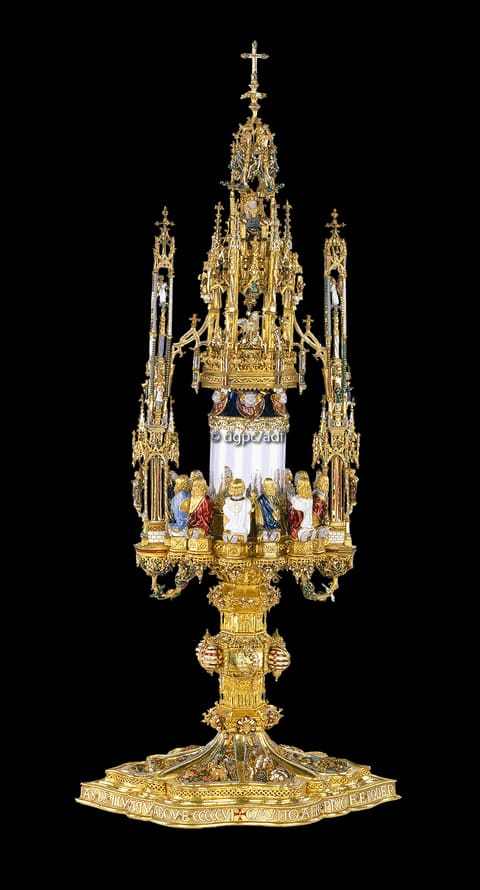
Belém Monstrance
N° 635·V · The Renaissance
Belém Monstrance
Attributed to Gil Vicente (c. 1465–c. 1536)
1506 · gold and polychrome enamels
Portuguese · Manueline

A towering gold monstrance made for the monastery at Belém from gold brought back by Vasco da Gama, showing the twelve apostles beneath the dove of the Holy Spirit and God the Father above. Widely regarded as the most celebrated surviving work of Portuguese goldsmithing.

“It was made with the gold paid as a tribute by the king of Kilwa (in present-day Tanzania), as a sign of vassalage to the crown of Portugal, and was brought to this country by Vasco da Gama on his return from his second voyage to India, in 1503.” In the museum’s words — museudearteantiga.pt ↗

Meanwhile — Gold ewer with dragon and phoenix design East Asia · Ming Dynasty (1368–1644)

Reliquary
N° 639·V · The Renaissance
Reliquary
Mestre João (active c. 1510)
c. 1510 · gold, enamels, pearls, diamond, rock crystals and cabochons of emeralds and rubies
Portuguese · Manueline

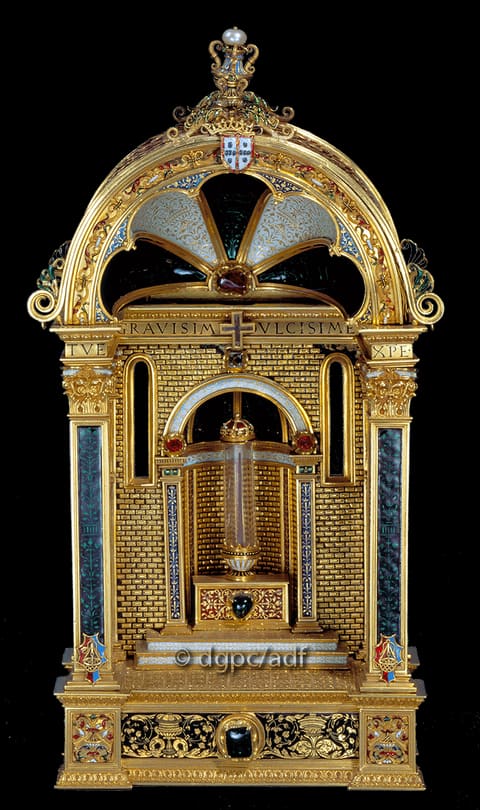
Known as the Reliquary of Queen Leonor, this gold reliquary was made to house a relic of Christ's Crown of Thorns and later fitted with a small cross for a relic of the True Cross - a singular object whose architectural form deliberately evokes the classical orders being rediscovered in the Italian Renaissance.

“What makes this piece exceptional is its singular form, displaying the taste for Antiquity: a direct reflection of the attempts made to recover the ancient classical orders during the Italian Renaissance.” In the museum’s words — museudearteantiga.pt ↗

Meanwhile — Phra Hai Sok (Lanna Buddha) South Asia · Lanna art (base inscription records its arrival in Bangkok in 1856 CE)

Salome with the Head of St. John the Baptist
N° 640·V · The Renaissance
Salome with the Head of St. John the Baptist
Lucas Cranach the Elder (1472–1553)
c. 1510 · oil on oak
German · Northern Renaissance

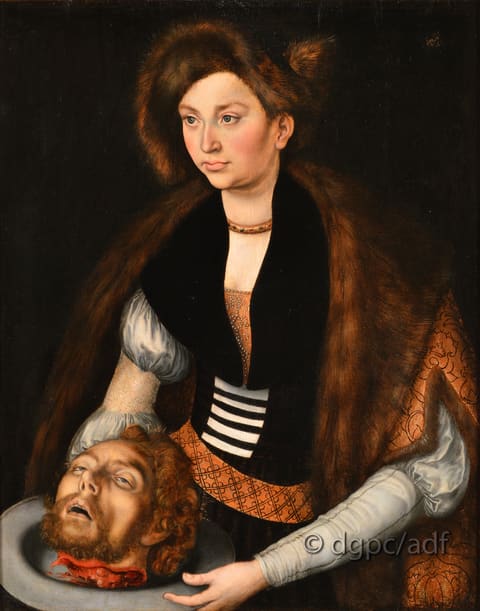
Cranach's Salome holds the head of John the Baptist with cool composure, one of a long series of paintings the artist devoted to alluring, dangerous women set against dark backgrounds - a signature theme that helped define his enormous success.

“Depicting Salome with the head of St. John the Baptist, this painting marked the beginning of a series of works by the painter devoted to the theme of female power and women’s wiles.” In the museum’s words — museudearteantiga.pt ↗

Meanwhile — Phra Hai Sok (Lanna Buddha) South Asia · Lanna art (base inscription records its arrival in Bangkok in 1856 CE)

Hell
N° 644·V · The Renaissance
Hell
Unknown Portuguese master
c. 1510–1520 · oil on oak
Portuguese

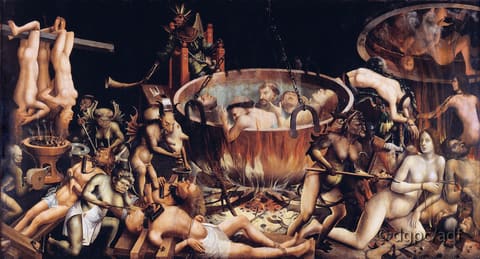
A crowded, phantasmagorical vision of Hell and the torments awaiting the deadly sins, notable for casting the demonic world in the guise of the non-European peoples just encountered through the Portuguese voyages: Lucifer wears an Amerindian feather headdress and sits on an African-style chair.

“This diversity can also be seen in the linking of the demonic world to the universe outside Europe: Lucifer has a headdress of Amerindian feathers, and is depicted sitting on an African chair, holding an African-looking ivory horn; another demon is also clad in feathers.” In the museum’s words — museudearteantiga.pt ↗

Meanwhile — Salt Cellar Africa · first quarter of the 16th century

Book of Hours, said to be of King Dom Manuel I
N° 650·V · The Renaissance
Book of Hours, said to be of King Dom Manuel I
Attributed to António de Holanda (1480–1557)
1517–c. 1551 · tempera and gold on parchment
Portuguese · Manueline

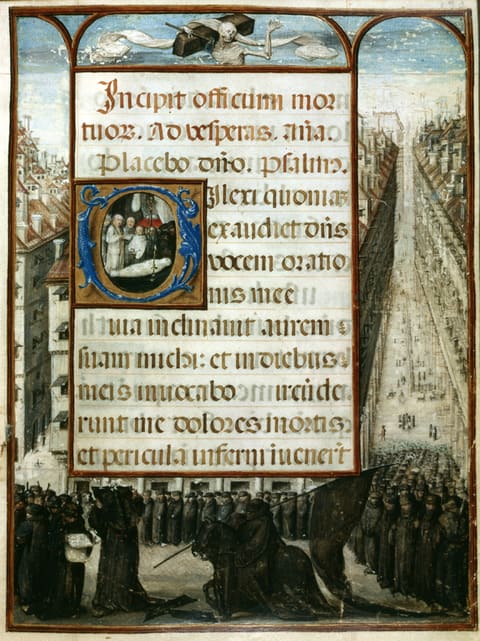
An illuminated Book of Hours whose depiction of a funeral procession is thought to allude to the 1551 transfer of King Manuel I's remains to the Jerónimos Monastery, meaning the manuscript was likely completed under his son João III. One folio vividly depicts Rua Nova dos Mercadores, Lisbon's bustling merchants' street during the age of the Discoveries.

“This folio takes us back to the Lisbon of 1521 (the year of Dom Manuel I’s death), showing us a typical district of the city during the time of Portugal’s Overseas Discoveries: Rua Nova dos Mercadores, the hub of trade and commerce and the place where one would find the workshops of engravers, gold and silversmiths, jewellers and gilders” In the museum’s words — museudearteantiga.pt ↗

Meanwhile — Manuscript Page from the Golestan of Sa’di Islamic world · 1526–1530

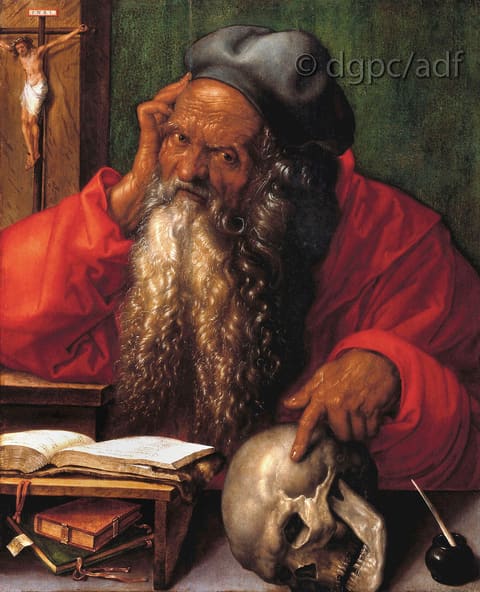
St. Jerome
N° 652·V · The Renaissance
St. Jerome
Albrecht Dürer (1471–1528)
1521 · oil on oak
German · Northern Renaissance

An old, meditative St. Jerome gazes out at the viewer in this innovative, psychologically direct portrayal of the scholar-saint, painted by Dürer as a gift during his 1520-21 journey through the Netherlands for a Portuguese merchant official based in Antwerp.

“This masterpiece of the extremely gifted German Renaissance painter, created during his trip to the Low Countries in 1520-1521, was a gift from Dürer to Rui Fernandes de Almada, the secretary of the Portuguese factory house in Antwerp.” In the museum’s words — museudearteantiga.pt ↗

Meanwhile — Padrão of Sunda Kalapa South Asia · 16th century (treaty dated 21 August 1522)

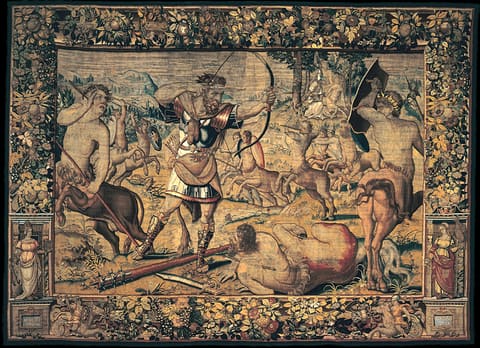
Hercules' Fight with the Centaurs
N° 672·V · The Renaissance
Hercules' Fight with the Centaurs
Unknown
c. 1550 · wool and silk
Flemish

A large Brussels tapestry depicting one of Hercules's mythological battles, from a now-dispersed set that once shared a common border and workshop. Regarded by the museum as one of its most significant tapestries for its compositional arrangement, technique and iconography.

“Showing great mastery of the Renaissance language brought by Italian and Flemish influences, this tapestry is one of the most significant examples from the MNAA collection, not only from the point of view of its compositional arrangement, but also from the point of view of the technique and iconography that it displays” In the museum’s words — museudearteantiga.pt ↗

Meanwhile — Tep Pranam South Asia · 16th century

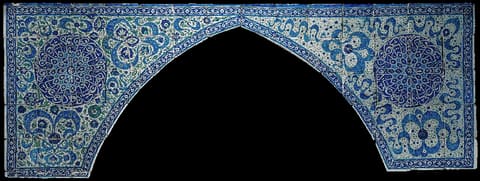
Tile Panel, Alfiz
N° 694·V · The Renaissance
Tile Panel, Alfiz
Unknown
1570–1580 · glazed stone paste with polychromy
Syrian · Ottoman period

A monumental glazed ceramic tile panel from a Damascus mosque built under Suleyman the Magnificent, its alfiz frame decorated with vegetal motifs and Koranic calligraphy. Acquired by the collector Calouste Gulbenkian in 1923 and later donated to the museum.

“This example, dating from between 1570 and 1580, comes from the Damascus Mosque, built by Suleyman I, the Magnificent. It was acquired by Calouste Gulbenkian, in 1923, and later donated to the MNAA, becoming part of its collection thereafter.” In the museum’s words — museudearteantiga.pt ↗

Meanwhile — Debus Implements South Asia · Late 16th century

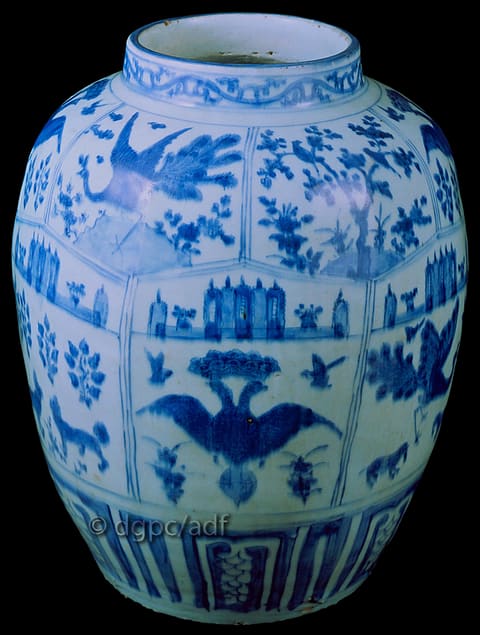
Pot
N° 695·V · The Renaissance
Pot
Unknown
c. 1575–1600 · moulded and painted porcelain
Chinese · Ming Dynasty, Wanli period

A rare Chinese export porcelain jar bearing the coat of arms of the Augustinian religious order, one of only a handful of surviving 16th-century Chinese pieces decorated to special commission with European ecclesiastical heraldry, likely destined for an Augustinian monastery in Macau.

“The porcelain pot with the insignia of the Augustinian Order is a rare and fundamental piece in the small group of objects identified as 16th-century Chinese export pottery decorated with coats of arms. Only a very small number of similar pieces are known to exist.” In the museum’s words — museudearteantiga.pt ↗

Meanwhile — The Fall of the Titans Europe · 1588–1590

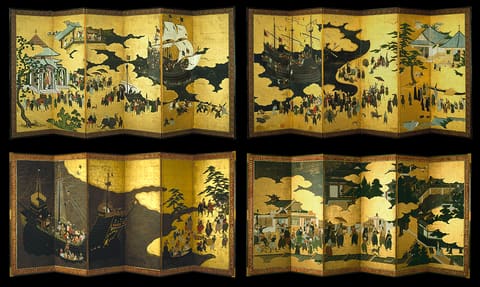
Namban Folding Screens
N° 730·VI · The Baroque Age
Namban Folding Screens
Attributed to Kanō Naizen (1st pair, seal) and Kanō Domi (2nd pair, attrib.) (Naizen, 1570–1616)
c. 1606 · wooden lattice covered with paper, gold leaf, polychrome tempera painting, silk, lacquer, copper gilt
Japanese · Momoyama–Edo periods

Two pairs of folding screens recording the arrival of Portuguese traders and Jesuit missionaries at Nagasaki in the 16th century, a rare and detailed Japanese visual record of the earliest encounters between Japan and Europe.

“The arrival of the Portuguese in Japan in 1543 gave rise to commercial and cultural exchanges that were recorded in these two pairs of screens: the curiosity and festive atmosphere aroused by the arrival of the black ship of the namban jin (the barbarians from the south, as the Portuguese were called) in the port of Nagasaki.” In the museum’s words — museudearteantiga.pt ↗

Meanwhile — Trotting Horse Europe · signed 1607

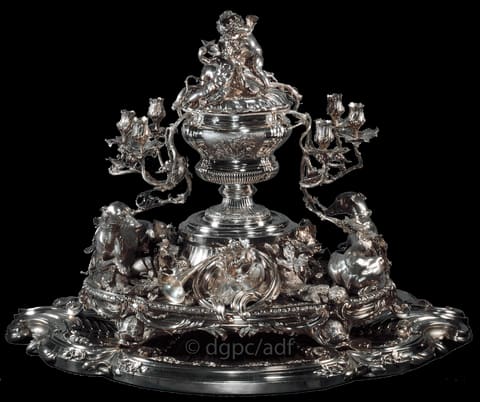
Table Centrepiece
N° 813·VII · The Age of Reason
Table Centrepiece
Thomas Germain and François-Thomas Germain (Thomas, active 1720–1748)
1729–1731 · cast, spun, engraved and finely-chiselled silver
French

A silver centrepiece made for the elaborate multi-course dining ritual of the French court, produced by Thomas Germain, the most celebrated silversmith of his age, for the Duke of Aveiro - whose estate was confiscated after his 1758 conviction in the conspiracy against King José I. A rare survival from the height of Parisian silverwork.

“This work is paradigmatic of its time, undoubtedly confirming the talent and the status of the Germains as sculptors. Through the perfection of its chiselling, and the fantasy and originality of its composition, it represents one of the high points of 18th-century Parisian production.” In the museum’s words — museudearteantiga.pt ↗

Meanwhile — Famille-rose Vase with Bats and Peaches East Asia · Qing dynasty, Yongzheng reign (1723–1735)