National Museum of China, Beijing — 14 works · museum site ↗·Shaanxi History Museum, Xi'an — 17 works · museum site ↗·Shanghai Museum, Shanghai — 15 works · museum site ↗ · 5000 BCE – 1799
Seen from Beijing and Xi'an and Shanghai, history is above all craft & design, then faith & ritual objects — a collection opened wide onto other worlds — a window more than a mirror (46 of 46 works are from other civilisations).
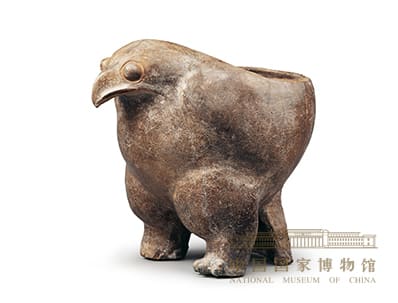
A Yangshao pottery tripod cauldron (ding) modelled as a standing eagle, its two legs and drooping tail forming three stable supports and the vessel mouth set on its back. The museum calls it a rare Neolithic sculptural treasure, found in the tomb of an adult woman alongside ritual stone and bone implements, which it suggests points to a sacrificial use.
“The eagle-shaped pottery ding is an example of the perfect combination of primitive art and practical functions, and is a rare sculpture art treasure in ancient times.”
In the museum’s words — en.chnmuseum.cn ↗ · quotation verified against the live page
Painted Pottery Basin with Fish and Human Face Design
Unknown
Neolithic, Yangshao Culture · painted pottery
Yangshao culture · Neolithic
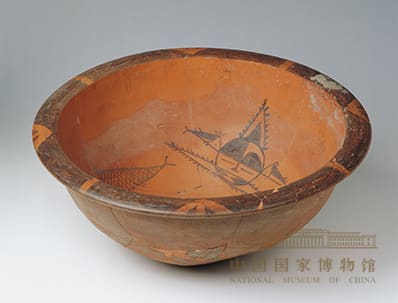
A red Yangshao painted pottery basin from the Banpo settlement, its interior painted in black with two symmetrical human-mask-and-fish designs — round faces flanked by fish, their mouths overlapping so each face seems to hold two fish. The museum links the fish motifs to Banpo totem worship and fishing life. Excavated at Banpo, Xian, Shaanxi, in 1955.
“The ancient Banpo people painted fish patterns and net patterns on many pots. This should be related to totem worship and economic life at that time.”
In the museum’s words — en.chnmuseum.cn ↗
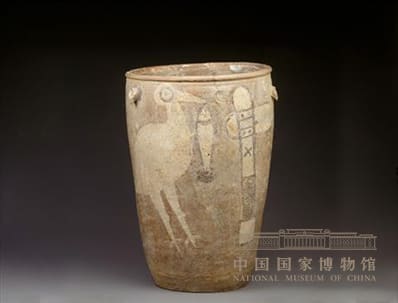
A large Yangshao painted pottery burial jar whose panel shows a long-legged stork holding a fish beside an upright stone axe. The museum explains that such jars held human remains and that the totem-and-weapon composition marked the burial of a clan leader. Unearthed at Yancun, Linru (now Ruzhou), Henan, in 1978.
“Painted pottery jars were used for holding human remains in Yangshao culture. They are also known as "Yichuan jars" because most of them were unearthed near Yichuan County, Henan Province, and were mainly used for the burial of adults.”
In the museum’s words — en.chnmuseum.cn ↗ · quotation verified against the live page
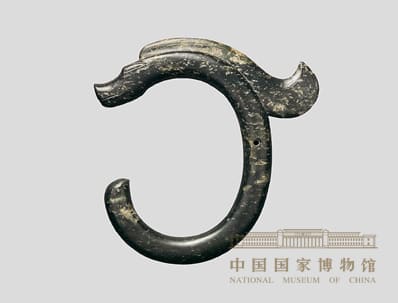
A curled Neolithic jade dragon of the Hongshan culture, carved from dark green Xiuyan jade with a long snout, floating mane and hooked body; the museum notes its reputation as 'China's No. 1 Dragon' and counts it among the earlier dragon images found in China. (Page states only 'Neolithic, Hongshan Culture'; the year range shown is the standard span of the Hongshan culture.)
“The jade dragon is carved from dark green Xiuyan jade. The body is smooth and clean. On its head are long snout and thin eyes.”
In the museum’s words — en.chnmuseum.cn ↗ · quotation verified against the live page
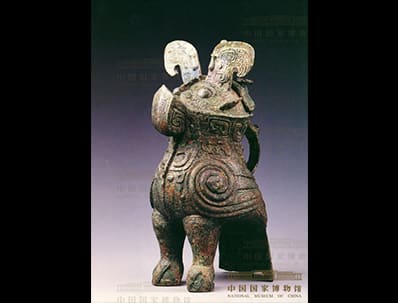
A late Shang bronze wine vessel (zun) cast in the form of a standing owl balanced on its tail and two feet, which the museum calls the pinnacle of late Shang bronze art. From the tomb of Fu Hao — consort of King Wu Ding — at Yinxu, Anyang, Henan, excavated in 1976.
“This marvelous artifact can be regarded as the pinnacle of bronze art in the late Shang period. The shape of this zun is a standing owl, balanced with a tail and two feet, arranged both functionally and aesthetically.”
In the museum’s words — en.chnmuseum.cn ↗
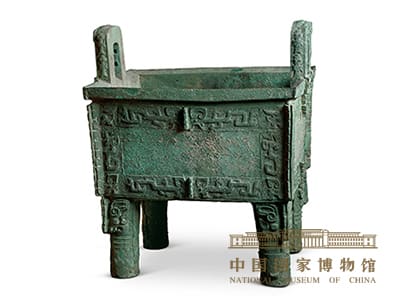
The largest and heaviest known ancient Chinese bronze: a rectangular ritual food cauldron (ding) of the late Shang, decorated with cloud-and-thunder grounds, taotie and double-tiger-devouring-human motifs. The museum records its weight as 832.84 kg and reads its interior inscription 'Hou Mu Wu' (formerly Si Mu Wu) as the temple title of a Shang king's mother. Said to have been unearthed at Wuguancun, Anyang, Henan, in 1939.
“The Hou Mu Wu bronze square ding (formerly known as Si Mu Wu ding) is huge, majestic, and weighs 832.84 kg. It is currently known as the heaviest bronze ware in ancient China.”
In the museum’s words — en.chnmuseum.cn ↗
Western Zhou Dynasty (c. 11th century–771 BC), King Xuan's Reign · bronze
Chinese · Western Zhou
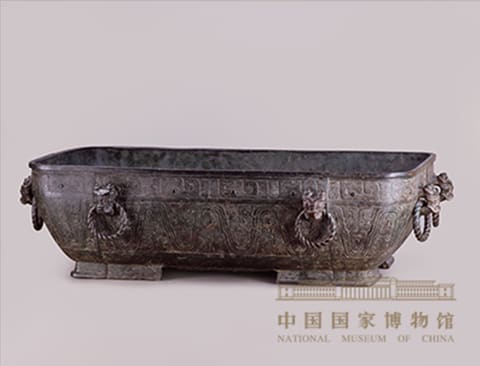
A very large Western Zhou bronze water basin (pan) famed for the long inscription cast inside it, which records how Guoji Zibai led an army against the Xian Yun, took 500 heads and 50 captives, and was rewarded by King Xuan of Zhou. The museum notes the text can be matched against poems in the Book of Poetry. Unearthed at Baoji, Shaanxi, between 1821 and 1850.
“A long inscription is cast on the inner base of this bronze pan. It describes how GuojiZibai led an army to battle against the Xian Yun nation, decapitated 500 enemies and captured 50 foes.”
In the museum’s words — en.chnmuseum.cn ↗ · quotation verified against the live page
Western Zhou Dynasty (c. 11th century–771 BCE), King Kang's reign · bronze
Chinese · Western Zhou
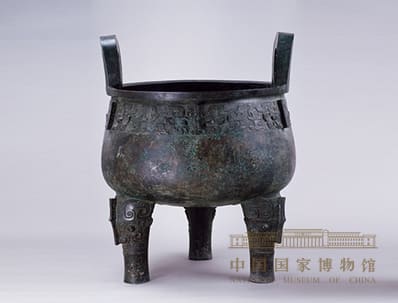
The Da Yu ding, a monumental early Western Zhou bronze food cauldron of King Kang's reign, ranked by the museum among the famous treasures of the early Western Zhou for its imposing, dignified form and long inscription. Excavated at Meixian, Shaanxi, during the Qing Daoguang reign (1821–50) and acquired by the museum's predecessor in 1959.
“It is a famous treasure of the early Western Zhou Dynasty, known for its imposing and dignified modeling.”
In the museum’s words — en.chnmuseum.cn ↗ · quotation verified against the live page
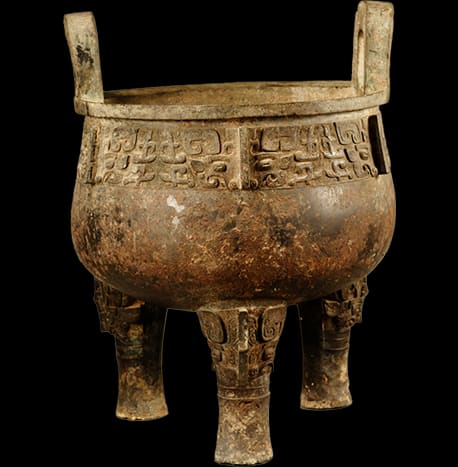
Translated from Chinese: A deep, hemispherical late Western Zhou bronze ding on hoof-shaped feet, decorated only with two raised bands. Its inscription of more than 270 characters records four victories led by Duoyou against the Xianyun during the reign of King Li and the royal bronze awarded for casting this commemorative vessel.
“多友鼎,半球形体,器腹较深,蹄足。装饰花纹简单,仅在器腹上部装饰两道弦纹。”
In the museum’s words — sxhm.com ↗ · quotation verified against the live page
Middle Western Zhou dynasty, 1046–771 BCE · bronze
Chinese · Western Zhou dynasty
Translated from Chinese: A Western Zhou bronze ding whose 19-line, 207-character inscription records a land exchange in the fifth year of King Gong. The transaction required approval by senior officials and a formal survey by the royal administration, making the vessel an important dated standard for middle Western Zhou bronzes.
“该鼎造型简单大方,内壁铸有铭文19行共207个字,讲述了西周中期一件土地交易事件。”
In the museum’s words — sxhm.com ↗ · quotation verified against the live page
Translated from Chinese: A heavy early Western Zhou bronze ding with animal-mask ornament over a thunder-pattern ground. Its four-line, 28-character inscription records that Wang Jiang reclaimed land formerly granted to Shi Lu, transferred it to Yu, and that Yu made the vessel to commemorate the grant; the museum identifies it as a dating standard for King Kang's reign.
“该鼎内壁共铸铭文四行28字,大意是说:某年八月初,王姜将原赐予师栌的土地收回,转赐给旟,旟便做此鼎纪念。”
In the museum’s words — sxhm.com ↗ · quotation verified against the live page
Western Zhou dynasty, late 10th century BCE · bronze
Chinese · Western Zhou
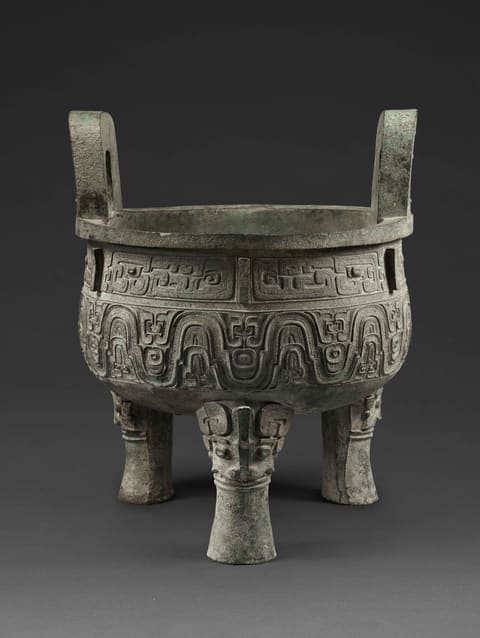
Translated from Chinese: A monumental Western Zhou bronze ritual food vessel (ding), cast in the late 10th century BCE. Its majestic, heavy body is decorated below the rim with stylized animal-mask (taotie) bands and, on the belly, broad rhythmic wave-band ornament, with relief masks on the upper legs. A 290-character inscription cast inside the belly records that it was made by an official named Ke, who managed the Zhou king's food service and transmitted the king's commands. Excavated at Rencun, Famen town, Fufeng county, Shaanxi in the mid-Guangxu era and donated to the museum by Ms. Pan Dayu in 1951; a flagship treasure of the bronze gallery.
“大克鼎铸造于公元前 10 世纪末的西周时期。整器威严厚重,口沿下装饰变形兽面纹,腹部宽大的纹饰波澜起伏而富有节奏感,蹄足上部饰有浮雕兽面。”
In the museum’s words — shanghaimuseum.net ↗ · quotation verified against the live page
Chime Bells of Marquis Su of Jin (Jin Hou Su Zhong)
Unknown
Western Zhou dynasty (late), 9th century BCE · bronze
Chinese · Western Zhou
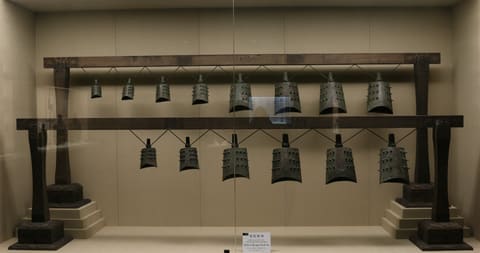
Translated from Chinese: A set of 16 late Western Zhou chime bells (yongzhong), the largest 52 cm and the smallest 22 cm high, excavated in 1992 from Tomb 8 of the Jin Marquises' cemetery at Beizhao village, Quwo county, Shanxi, and arranged in two graduated rows tuned to a harmonious scale. They carry a 355-character inscription — the first known Western Zhou bronze bell inscribed with a sharp tool — recording Marquis Su of Jin accompanying King Li of Zhou on a campaign against the Yi peoples in the east, an event absent from received histories.
“该组编钟,大者高52厘米,小者高22厘米,皆为甬钟。 1992年山西省曲沃县北赵村晋侯墓地出土,共16件,可分为两组,每组8件,大小相次,排编成两列音阶与音律相和谐的编钟。”
In the museum’s words — shanghaimuseum.net ↗ · quotation verified against the live page
Spring and Autumn period (early), 8th–7th century BCE · bronze
Chinese · Spring and Autumn
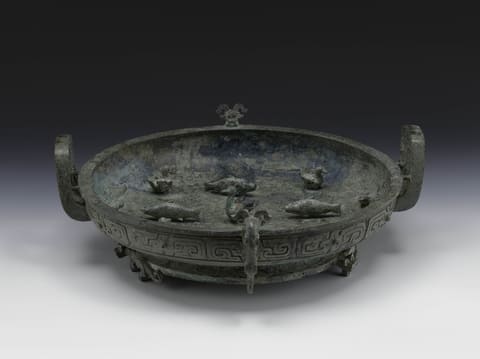
Translated from Chinese: An early Spring and Autumn bronze water basin (pan) whose interior teems with sculptural aquatic creatures — a central male water-bird ringed by concentric circles of frogs, turtles, fish and female water-birds — every three-dimensional animal able to rotate a full 360 degrees, a technique previously unknown that displays the advance of early Spring and Autumn casting. A 32-character inscription on the interior bottom states that a Grand Master made this washing basin for his wife Zi Zhong Jiang, praying for long life. Donated by Ye Zhaofu in 1997.
“方唇、折沿、浅腹,底接圈足,下附三卷尾虎支足。双附耳,附耳高出盘沿甚多;与附耳呈对角的位置另有双兽形鋬,曲角圆眼、四肢攀附器腹,口啣盘沿,作探水状。”
In the museum’s words — shanghaimuseum.net ↗ · quotation verified against the live page
Spring and Autumn Period (770–403 BC), Wu State · bronze
Chinese · Spring and Autumn Period
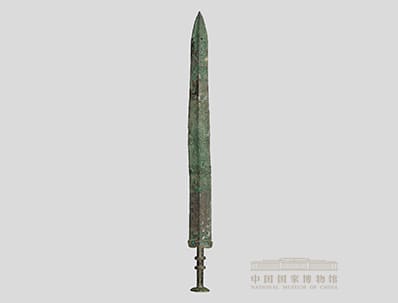
A Spring and Autumn bronze sword bearing the name of King Fuchai of the state of Wu — the fief of the descendants of Taibo, son of the King of Zhou. The museum notes that nine such inscribed 'Wu Wang Fuchai' swords are recorded. Unearthed at Huixian, Henan, in 1976.
“The State of Wu was the fief of the descendants of Taibo, the son of the King of Zhou.”
In the museum’s words — en.chnmuseum.cn ↗ · quotation verified against the live page
Spring and Autumn period (late), 6th–5th century BCE · bronze
Chinese · Spring and Autumn
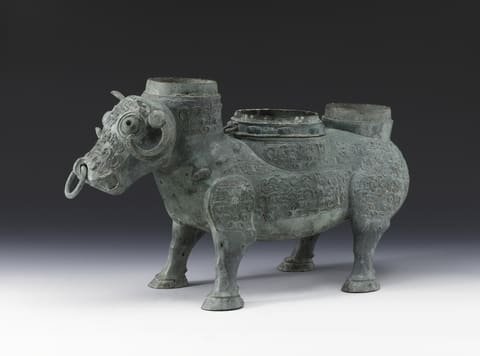
Translated from Chinese: A late Spring and Autumn bronze wine vessel (zun) in the form of a water buffalo. The hollow body has three openings on the neck and back; a removable pot-shaped vessel set into the central opening held wine, warmed by water poured into the belly. The tense curved horns and round staring eyes keep the animal lifelike, and a ring through the nose shows that nose-ringing was already used to tame cattle in the Spring and Autumn period. Excavated at Liyu village, Hunyuan county, Datong, Shanxi. This ox-shaped zun is the object the museum's English 'Museum Treasures' page currently features.
“尊作水牛形,牛腹中空,牛颈和背脊上有三孔,中间一孔套有一个锅形器,可以取出。从其结构看,这是一件温酒器,牛背上的锅形器可以盛酒,空穴注水装于尊腹用来温酒。”
In the museum’s words — shanghaimuseum.net ↗ · quotation verified against the live page
Spring and Autumn period (late), reign of King Fuchai of Wu (r. 495–473 BCE) · bronze
Chinese · Spring and Autumn
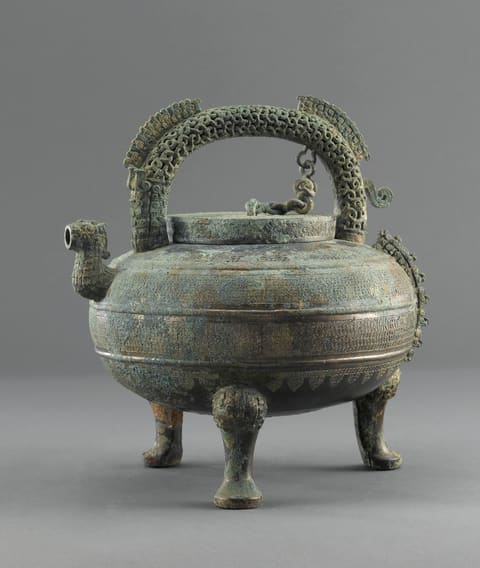
Translated from Chinese: A late Spring and Autumn bronze pouring vessel (he) with a flattened round body on three animal-headed hoof feet, a dragon-headed spout, and a lid joined to the mouth by a figure-8 cast chain linking to an openwork dragon-form handle; the surface is covered with extremely fine interlaced serpent (panchi) ornament. A 12-character inscription on the shoulder records that King Fuchai of Wu cast the vessel from Wu bronze for a woman. As Fuchai reigned only 23 years and most surviving objects of his are weapons and jian basins, this he is especially rare. Donated by Ho Hung-chang in 1996.
“扁圆形腹,器底下接三兽首蹄形足,曲颈龙首流,与流相对一侧饰有扉棱,直口平盖,与器口相合成子母口,盖上有环钮,套铸 8 字形链条与提梁内侧小环相连。”
In the museum’s words — shanghaimuseum.net ↗ · quotation verified against the live page
Meanwhile — Vače SitulaEurope · Early 5th century BC
N° 207·II · The Classical World
Shang Yang Fangsheng (Shang Yang square measure)
Unknown
Qin, 18th year of Duke Xiao (344 BCE) · bronze
Chinese · Qin
Translated from Chinese: The Shang Yang square measure, a bronze volume standard. A 32-character inscription on its left wall records that in the 18th year of Duke Xiao of Qin (344 BCE) the Grand Governor Shang Yang cast a standard sheng equal to 16 1/5 cubic cun; a further inscription on the base is the 26th-year edict of the First Emperor of Qin (221 BCE) standardizing weights and measures. It is an exceptionally important physical document in the history of Chinese metrology.
“商鞅方升是量器。左壁刻有铭文三十二字,记秦孝公十八年(公元前344年)大良造商鞅铸造了容量为十六又五分之一立方寸为一升的标准升。底部铭文为秦始皇廿六年诏书。”
In the museum’s words — shanghaimuseum.net ↗ · quotation verified against the live page
Meanwhile — Zagreb MummyEgypt & Nubia · 4th century BCE, Egyptian Late Period; C14-dated to c. 390 BCE
Western Han dynasty, before 136 BCE · gilt-and-silvered bronze
Chinese · Western Han dynasty
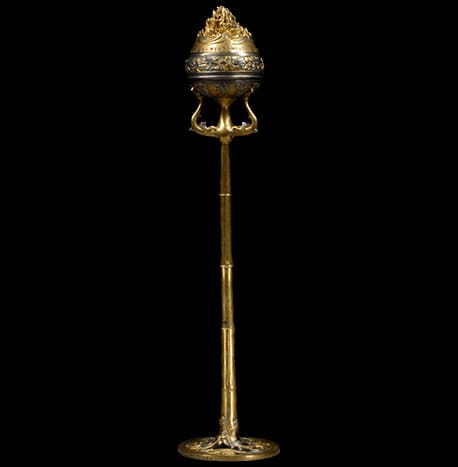
Translated from Chinese: A Western Han bronze incense burner gilded and silvered throughout, with nine dragons distributed across its pierced base, five-section bamboo-form stem, and mountain-shaped bowl. The lid inscription connects it to Weiyang Palace, and the museum states that Emperor Wu presented it to his sister, Princess Yangxin, in 136 BCE.
“该熏炉为青铜质地,通体鎏金鎏银。熏炉的底座上透雕着两条蟠龙,两条龙昂首张口咬住竹柄,竹节形柄分为五节,节上刻着竹叶,柄的上端有三条蟠龙将熏炉托起。”
In the museum’s words — sxhm.com ↗ · quotation verified against the live page
Bronze Rhino-shaped Zun (wine vessel) Inlaid with Gold and Silver Cloud Designs
Unknown
Western Han (206 BC – AD 8) · bronze
Chinese · Western Han
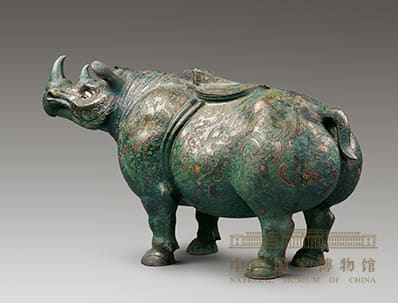
A Western Han bronze wine vessel (zun) in the naturalistic form of a Sumatran rhinoceros standing with head raised, its hollow belly holding wine and its whole body inlaid with fine gold and silver cloud designs. Excavated at Doumacun, Xingping, Shaanxi, in 1963.
“This bronze Zun adopts the shape of a rhinoceros. The rhinoceros stands with its head up. It is muscular, with accurate proportions, in a strong posture. It represents the image of the Dicerorhinus sumatrensis that lived in ancient China.”
In the museum’s words — en.chnmuseum.cn ↗ · quotation verified against the live page
Western Han dynasty, 206 BCE–9 CE · white Hetian jade
Chinese · Western Han dynasty
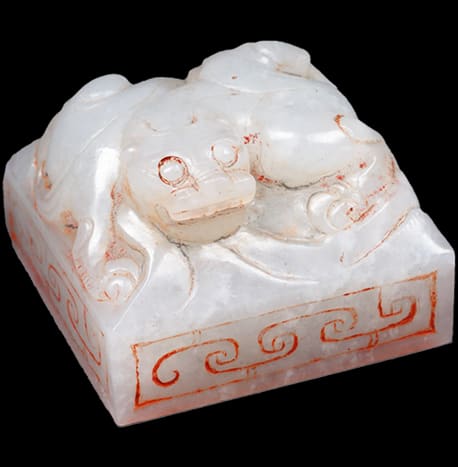
Translated from Chinese: A square Western Han white-jade seal with a hornless-dragon-shaped knob, cloud ornament on four sides, and the seal-script inscription 'Empress's Seal.' Because it was found near the joint mausoleum of Emperor Gaozu and Empress Lü, the museum cautiously suggests that it may have belonged to Empress Lü.
“玉玺印面为正方形,上雕一只螭(chī)虎形象做纽,四面刻有云纹,印面篆书“皇后之玺”四个字”
In the museum’s words — sxhm.com ↗ · quotation verified against the live page
Painted Bronze Lamp in the shape of Goose Carrying Fish
Unknown
Western Han · bronze
Chinese · Western Han
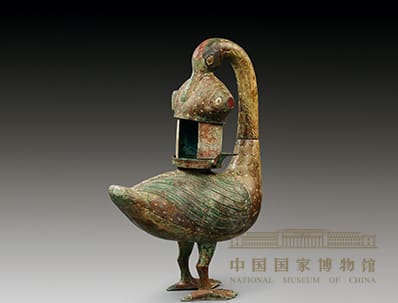
A Western Han painted bronze lamp shaped as a standing wild goose that turns its head back to hold a fish in its beak. Made in four dismountable parts with adjustable shade-plates, its hollow neck and fish channelled smoke down into the body to keep the room clean — the museum calls it a rare marriage of function and form.
“Lamps made in the Han Dynasty are diverse in form, for example, wild goose foot, the Vermillion Bird, ox and sheep and other auspicious patterns.”
In the museum’s words — en.chnmuseum.cn ↗ · quotation verified against the live page
White Jade Belt Buckle (Xianbeitou) with Dragon Design
Unknown
Jin dynasty (attributed) · jade
Chinese · Jin
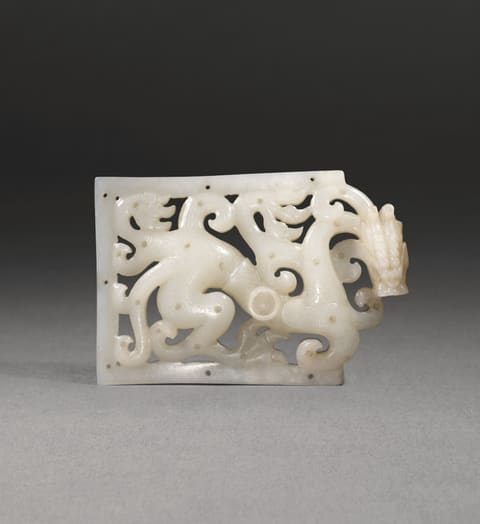
Translated from Chinese: A white-jade belt buckle (the self-named term 'xianbeitou' means a belt clasp), its face carved in openwork with a crouching, scale-covered dragon. Two columns of inscription on the reverse record the object's name, its date, the imperial workshop that made it, the labour expended and the supervising officials; scholars judge that the clasp may have been used by an emperor of the Jin dynasty. The museum's own record leaves the precise date open; the Jin attribution rests on the inscription.
“此器正面透雕一躬身盘曲、满饰鳞纹的龙,背面两侧各有一列铭文,记载了该器的名称、制作年代、制作机构、制作工时、监造官姓名等。”
In the museum’s words — shanghaimuseum.net ↗ · quotation verified against the live page
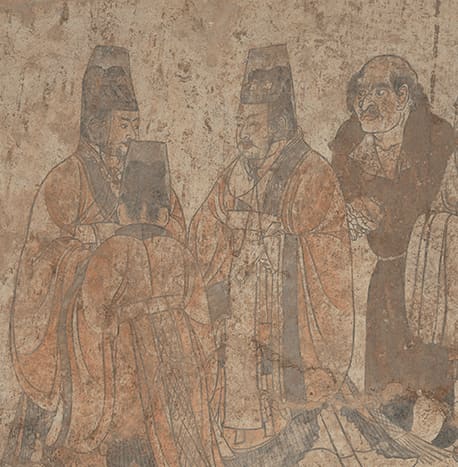
Translated from Chinese: Located on the east wall of Crown Prince Zhanghuai's tomb passage, this mural presents three solemn Tang Court of State Ceremonial officials facing three visitors. The museum interprets the visitors as envoys from the Eastern Roman Empire, Silla on the Korean peninsula, and the Mohe people of northeast China.
“《客使图》位于章怀太子墓道东壁,画面中共有六位人物”
In the museum’s words — sxhm.com ↗ · quotation verified against the live page
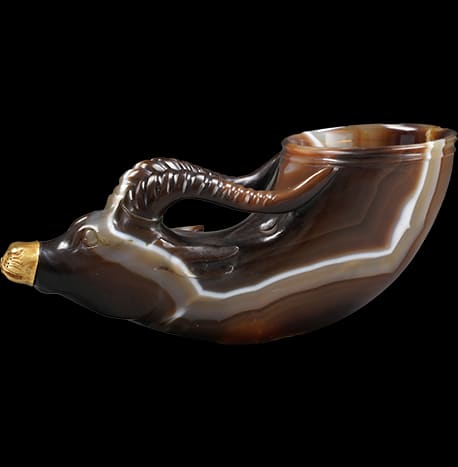
Translated from Chinese: Carved from rare multicolored banded agate, this horn-shaped drinking vessel terminates in a vividly modeled bovine head. A removable gold fitting at the muzzle serves as the outlet, while spiral antelope horns curve back to join the cup body; the museum notes that the object's place of manufacture remains disputed.
“这件玛瑙杯是用一块罕见的五彩缠丝玛瑙雕刻而成,造型写实生动。杯体模仿兽角的形状,杯子的前部雕刻为牛形兽首,双眼圆睁,炯炯有神,刻画的神形皆肖。”
In the museum’s words — sxhm.com ↗ · quotation verified against the live page
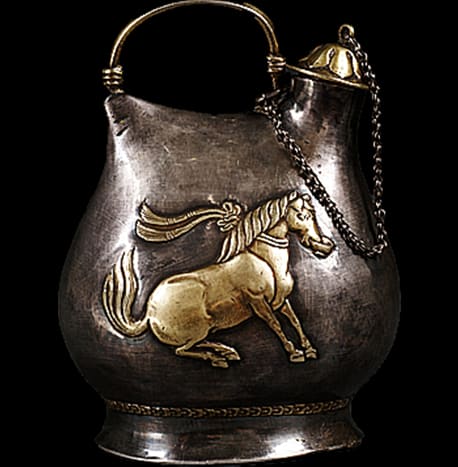
Gilt Silver Flask with Dancing Horse Holding a Cup
Unknown
Tang dynasty, 618–907 · silver with gilding
Chinese · Tang dynasty
Translated from Chinese: A flattened silver flask modeled after a northern nomadic leather bag, with a chain-linked lid and arched handle. Each side was hammered and molded with a corresponding gilded horse kneeling and holding a cup in its mouth, recalling the dancing horses that performed at Emperor Xuanzong's birthday celebrations.
“从外形上看,壶身呈扁圆形,是模仿我国北方游牧民族契丹族使用的皮囊壶制作而成。”
In the museum’s words — sxhm.com ↗ · quotation verified against the live page
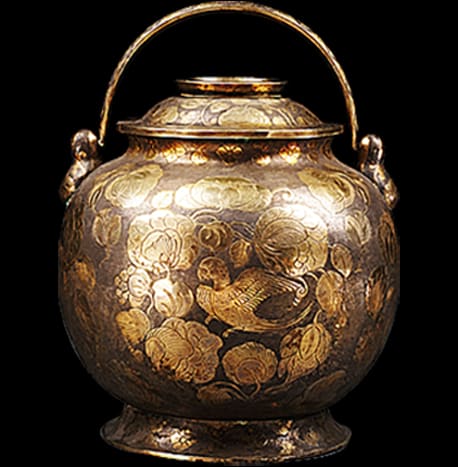
Translated from Chinese: A lidded silver jar centered on a gilded parrot with raised head, spread wings, and lifted tail, encircled by flowering sprays over a ring-mat ground. An ink inscription inside the lid records purple and white quartz, indicating that the tightly closed jar stored mineral ingredients used in alchemy.
“鎏金鹦鹉纹提梁银盖罐罐体中心以鹦鹉纹作为主体纹饰,鹦鹉抬首,展翅,翘尾”
In the museum’s words — sxhm.com ↗ · quotation verified against the live page
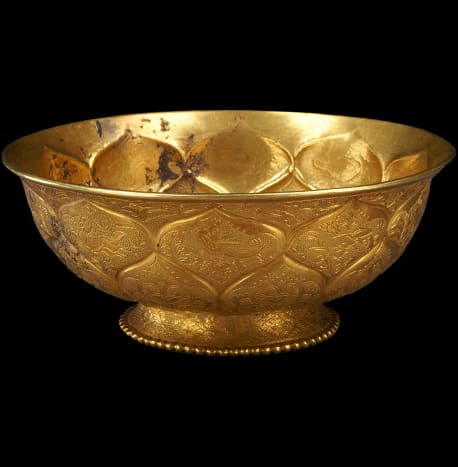
Gold Bowls with Mandarin Duck and Lotus-petal Designs (Pair)
Unknown
Tang dynasty, 618–907 · gold
Chinese · Tang dynasty
Translated from Chinese: Two matching hammered-gold bowls with flaring rims, rounded bodies, and trumpet-shaped feet. Their walls carry two tiers of repoussé lotus petals engraved with mandarin ducks, other birds and animals, honeysuckle, flying birds, clouds, and ring-mat grounds.
“两碗造型、纹饰均相同,纯金质,捶揲制作,造型饱满庄重。侈口,弧腹,圜底,喇叭形圈足。”
In the museum’s words — sxhm.com ↗ · quotation verified against the live page
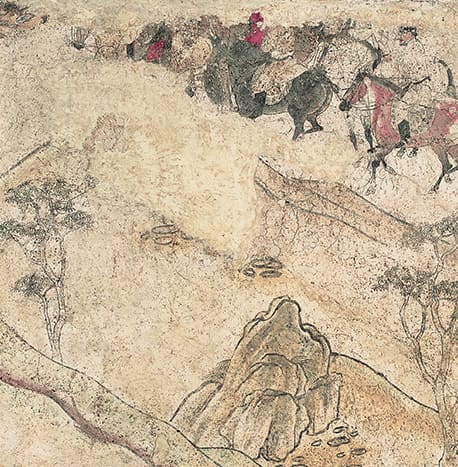
Translated from Chinese: Painted on the east wall of the passage to Crown Prince Zhanghuai's tomb, this expansive hunting procession includes more than forty mounted figures, two camels, ancient trees, and rocky landscape. Riders carry bows, falcons, hounds, a cheetah, and a lynx around a central figure on a white horse.
“该图绘于章怀太子墓墓道东壁。由40多个骑马人物、2只骆驼、5株古树和山石所组成,场景壮阔,构图别致。”
In the museum’s words — sxhm.com ↗ · quotation verified against the live page
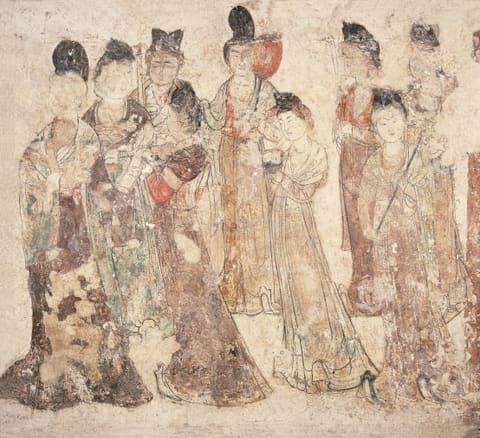
Translated from Chinese: Painted on the south section of the east wall in the antechamber of Princess Yongtai's tomb, this mural shows nine palace women walking behind a senior attendant. They carry a box, drinking cup, fly-whisk, ruyi scepter, round fan, and candle, while turning, conversing, and looking back.
“这幅绘制在永泰公主墓前室东壁南侧的《宫女图》保存最完整,也最为动人,是唐墓壁画中反映女性形象最完美的一幅。”
In the museum’s words — sxhm.com ↗ · quotation verified against the live page
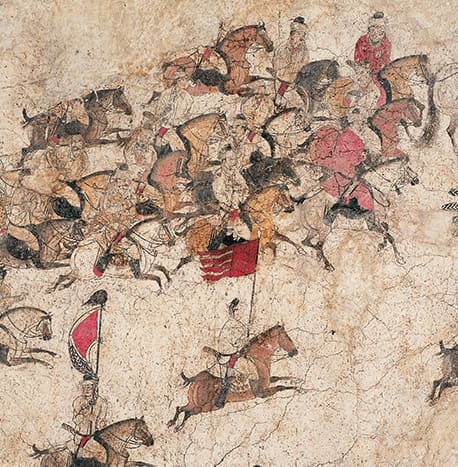
Translated from Chinese: Painted on the west wall of the passage to Crown Prince Zhanghuai's tomb, the mural contains more than twenty mounted figures. Five riders wield crescent-headed polo sticks and contest the ball amid galloping horses, while mountains and five scattered old trees open the surrounding space.
“该图绘制于唐章怀太子墓墓道西壁,共绘二十余骑马人物,均着深浅两色窄袖长袍,戴幞头,穿黑靴。”
In the museum’s words — sxhm.com ↗ · quotation verified against the live page
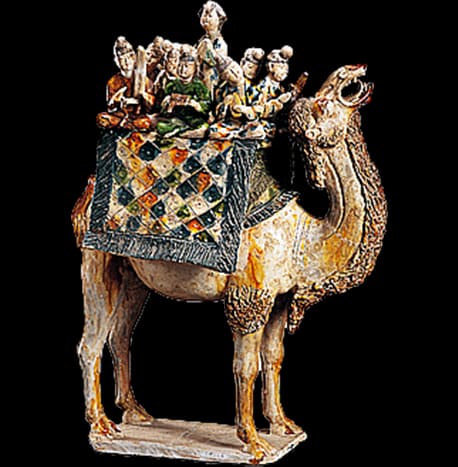
Translated from Chinese: A Tang sancai ensemble comprising a camel and eight performers. Seven seated male musicians in Chinese dress play instruments associated with Central Asian peoples around the platform, while a woman stands at the center singing, creating an imaginative traveling stage on the camel's back.
“该文物由一骆驼和八个人俑组成,骆驼站在长方形底座上,引颈长嘶,驼背上的驮架为一平台,铺有色彩斑斓的毛毯,共有八名乐手在其上。”
In the museum’s words — sxhm.com ↗ · quotation verified against the live page
Shangyu Tie (letter in cursive script), handscroll
After Wang Xizhi (303–361)
Tang-dynasty tracing copy after Wang Xizhi (303–361) · ink on paper
Chinese · Tang
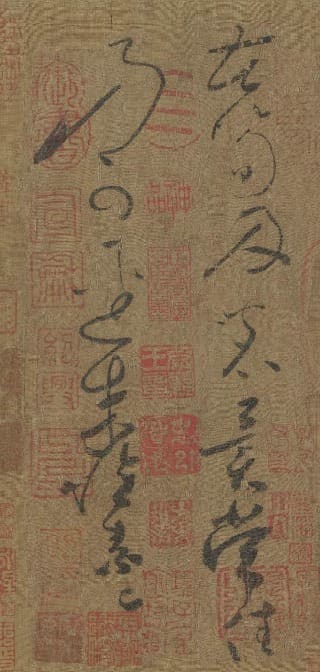
Translated from Chinese: Wang Xizhi (303–361), courtesy name Yishao, of Langya Linyi and later Shaoxing, served as General of the Right (hence 'Wang of the Right Army') and created new running- and cursive-script styles. This is a letter he wrote to a friend, surviving as a Tang-dynasty tracing copy, its brushwork clear and vigorous with a lingering flavour of draft-cursive script. The museum dates the work to the Eastern Jin after Wang Xizhi while identifying the extant scroll as a Tang copy.
“王羲之( 303-361 ),字逸少,琅琊临沂人,后移居绍兴。”
In the museum’s words — shanghaimuseum.net ↗ · quotation verified against the live page
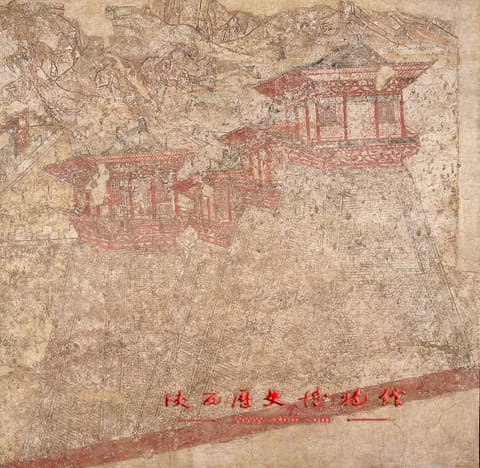
Translated from Chinese: A pair of watchtower murals from the tomb of Crown Prince Yide. Each depicts a three-tier imperial gate tower followed by a corner tower and rammed-earth city wall, using vermilion as the dominant color with green, red, yellow, and blue accents.
“阙楼图绘制于懿德太子墓。懿德太子李重润是唐中宗长子(公元682年—公元701年),也是中宗李显与韦皇后所生的唯一的儿子。”
In the museum’s words — sxhm.com ↗ · quotation verified against the live page
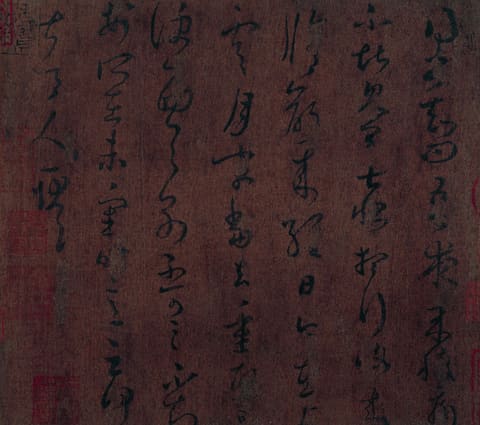
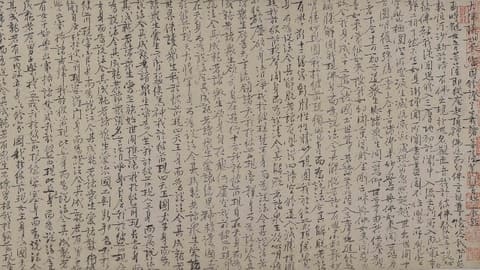
Translated from Chinese: Huaisu (737–799), lay surname Qian, dharma name Cangzhen, of Changsha, excelled at wild-cursive script and, with Zhang Xu, created the 'wild cursive' style — the two known as 'Wild Zhang and Drunk Su.' This short letter to a friend, round and lively yet naturally understated in its brushwork, is to this day the only undisputed authentic surviving work by Huaisu.
“怀素( 737-799 ),俗姓钱,法名藏真。长沙人。”
In the museum’s words — shanghaimuseum.net ↗ · quotation verified against the live page
Attributed to Sun Wei (active c. 9th–10th century)
Tang dynasty (9th century) · ink and colour on silk
Chinese · Tang
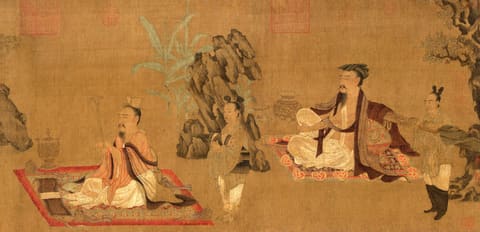
Translated from Chinese: Sun Wei (active c. 9th–10th century), a native of Kuaiji (present-day Shaoxing, Zhejiang), was a late-Tang painter who fled to Shu and settled in Chengdu, celebrated above all for his painting of water. Scholars regard this handscroll as a surviving portion of a 'Seven Sages of the Bamboo Grove,' depicting four of the sages — Shan Tao, Wang Rong, Liu Ling and Ruan Ji. The mounting before the painting bears the title 'Sun Wei's Gao Yi Tu' inscribed by Emperor Huizong of Song.
“孙位(约九至十世纪),会稽(今浙江绍兴)人,晚唐画家。唐末避地入蜀,遂居成都。擅画人物、鬼神、龙水,松石、墨竹、鹰犬亦妙,尤以画水著名。”
In the museum’s words — shanghaimuseum.net ↗ · quotation verified against the live page
Celadon Ewer with Phoenix-shaped Handle and Inverted Filling
Unknown
Five Dynasties period, 907–960 · celadon-glazed ceramic
Chinese · Five Dynasties period
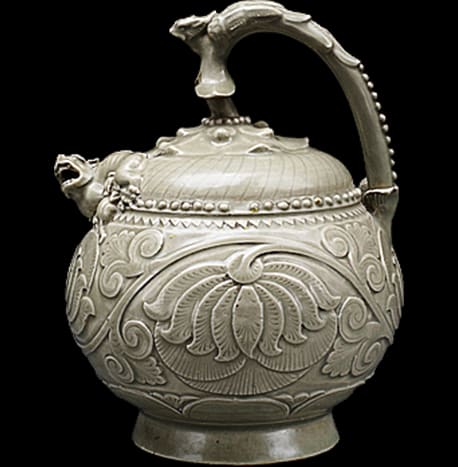
Translated from Chinese: A Five Dynasties celadon ewer with a recumbent phoenix forming the overhead handle and a flower calyx suggesting the lid. A nursing lion and cub are modeled where lid and body meet, the mother lion's open mouth forms the spout, and water enters through a plum-blossom-shaped aperture in the base.
“该文物为伏凤式提梁,以花蒂象征壶盖。盖、壶衔接处堆塑哺乳母子狮,母狮张口为流。”
In the museum’s words — sxhm.com ↗ · quotation verified against the live page
Transcription of Key Passages of the Surangama Sutra, handscroll
Wang Anshi (1021–1086)
Northern Song dynasty, 8th year of Yuanfeng era (1085) · ink on paper
Chinese · Northern Song
Translated from Chinese: Wang Anshi (1021–1086), courtesy name Jiefu, styled Banshan, of Linchuan in Jiangxi, was a jinshi of 1042 who rose to chief councillor and was skilled in running-cursive script. This scroll transcribes the 'Wonderful Ear-Gate of Guanshiyin' section of the Surangama Sutra, written swiftly in pale ink with a relaxed, unfettered touch; brushed in the 8th year of the Yuanfeng era (1085), when the author was 65.
“王安石( 1021 - 1086 ),字介甫,号半山,江西临川人。”
In the museum’s words — shanghaimuseum.net ↗ · quotation verified against the live page
Meanwhile — Reclining VisnuSouth Asia · Second half of the 11th century
N° 482·III · Faith and Empire
Kesi Tapestry: Ducks in a Lotus Pond
Zhu Kerou (active mid-12th century)
Southern Song dynasty (12th century) · silk kesi (cut-silk tapestry)
Chinese · Southern Song
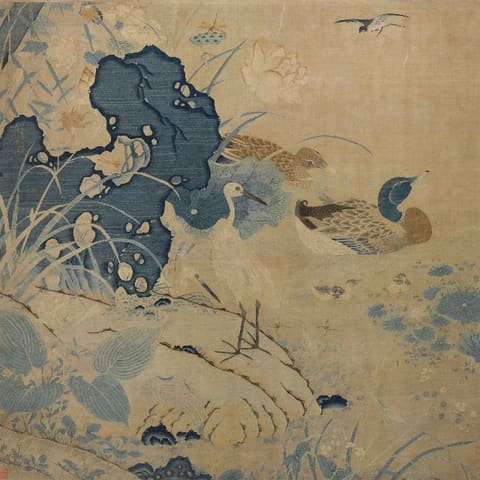
Translated from Chinese: A very large Southern Song kesi (cut-silk) tapestry picture, woven with the signature 'made by Zhu Gang, styled Kerou, of Jiangdong' and a 'Kerou' seal. Zhu Gang (courtesy name Kerou) of Yunjian (present-day Songjiang, Shanghai) was active under Emperor Gaozong of the Southern Song and excelled at kesi so fine it was hard to tell from painting. Influenced by academy painting, it shows green-headed ducks with ducklings among duckweed, a pair of egrets, kingfishers, red dragonflies and water-striders amid lotus, hibiscus, lily and reeds. Donated by the Pang family in 1952.
“本幅缂丝画尺幅极大,受院体画派影响,以春夏间生趣盎然的莲 塘实景绘成缂丝底稿。图中绿头双鸭浮游于萍草间,尾有乳鸭相随,旁有白鹭一对。”
In the museum’s words — shanghaimuseum.net ↗ · quotation verified against the live page
Southern Song dynasty (1127–1279) · Ge ware stoneware
Chinese · Southern Song
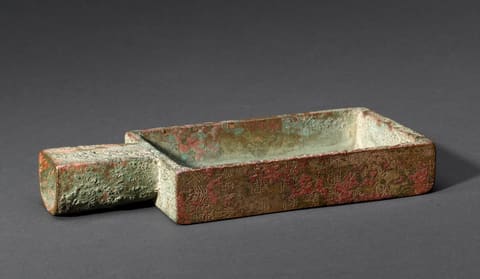
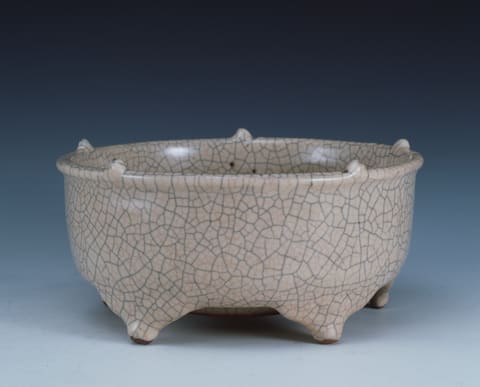
Translated from Chinese: A Southern Song Ge-ware brush washer with five nipple studs on the rim and five feet, covered in a lustrous millet-yellow glaze crazed all over with large and small dark-brown and pale-yellow crackle — the effect known as 'golden thread and iron wire.' Six spur marks on the interior base and the unglazed feet reveal the dark body. A classic heirloom Ge ware; Ge is one of the Five Great Kilns of the Song and the only one whose kiln site has never been found, a standing riddle of Chinese ceramic history.
“这件五足洗口沿有五枚乳钉。足底和圈足均无釉,应是在烧成的时候作为支撑点,防止受力不均而导致器物变形。”
In the museum’s words — shanghaimuseum.net ↗ · quotation verified against the live page
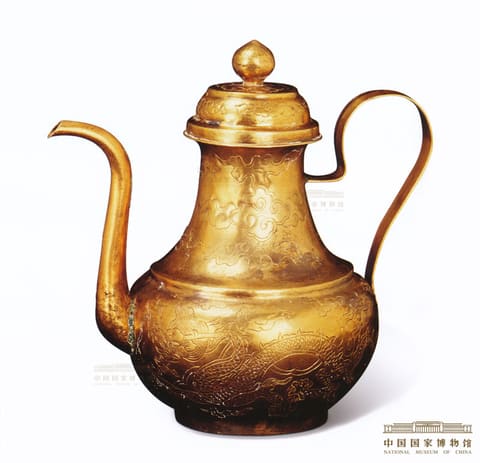
A Ming gold ewer with dragon-and-phoenix design, excavated in 1958 from the Dingling imperial mausoleum at Changping, Beijing. (The object page gives only the name, Ming date, dimensions/weight and findspot — no descriptive text.)
“Excavated in 1958 in the Dingling imperial mausoleum, Changping, Beijing”
In the museum’s words — en.chnmuseum.cn ↗ · quotation verified against the live page
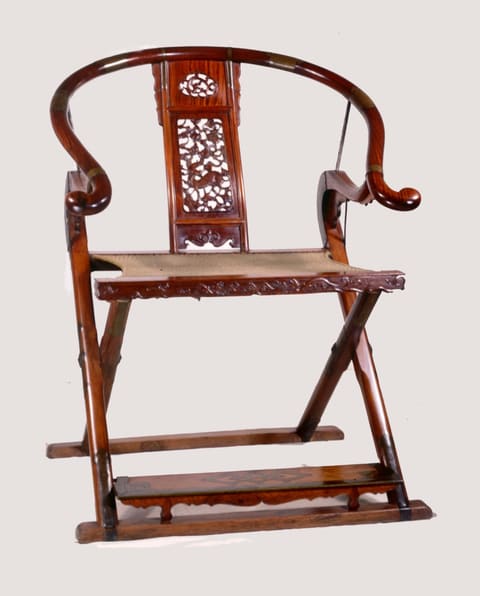
Translated from Chinese: A well-proportioned, flowing folding chair (jiaoyi) of huanghuali wood, its softly toned figured grain neither dull nor loud. The curved back-rest ring is jointed from five sections held by wedge-tenon joints; crest-rail and arms sweep down in one gentle line, and the joints carry paktong (white-copper) mounts that both strengthen and decorate. The openwork splat shows a chi-dragon above and a qilin below over a humen apron-foot. Such folding chairs stood in the most prominent position of a hall, commanding the other seats — emblems of rank and status.
“这把交椅比例匀称,造型流畅。取材黄花梨木,色泽不静不喧,恰到好处;纹理或隐或现,灵动变幻。”
In the museum’s words — shanghaimuseum.net ↗ · quotation verified against the live page
Silver Bowl with Design in Relief, Depicting the Tale of a Golden Deer
Unknown
Qing Dynasty, 18th century · silver
Cambodian · Qing Dynasty
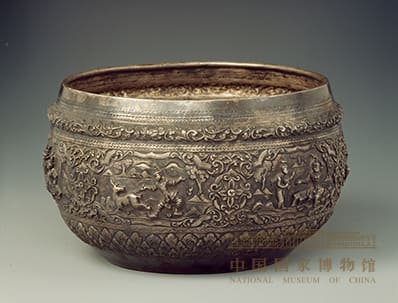
An 18th-century silver bowl worked in relief with 'The Tale of a Golden Deer,' recorded by the museum as a gift from Cambodia to the Qing court and listed among Cambodia's best-known legends. Held in the museum's 'Artifacts Handed Down from Ancient Times' highlights.
“This is a gift from Cambodia to the Qing government in the 18th century. Cambodia abounds in historical tales, legends and myths.”
In the museum’s words — en.chnmuseum.cn ↗ · quotation verified against the live page
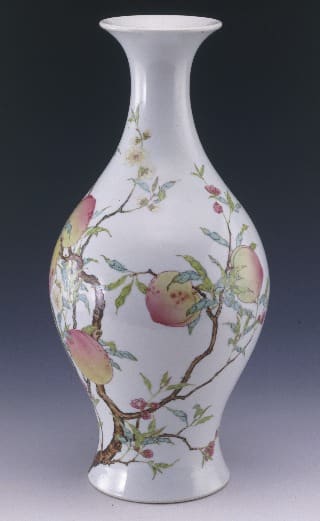
Translated from Chinese: A Yongzheng-reign Jingdezhen olive-shaped vase with flaring mouth, slender neck and swelling belly, finely potted with a lustrous glaze and a six-character underglaze-blue Yongzheng reign mark. The white exterior is painted in famille-rose (fencai) enamels with a pair of vigorous peach branches bearing eight plump longevity peaches, blossoms, and a pair of bats — the bat-and-peach motif signifying 'good fortune and long life.' Donated by Zhang Yongzhen in 2004.
“侈口,细颈,溜肩,鼓腹,胫部内收,底部略外撇,形同橄榄,端庄秀美。胎质细腻,釉色莹润,制作极为精良。”
In the museum’s words — shanghaimuseum.net ↗ · quotation verified against the live page
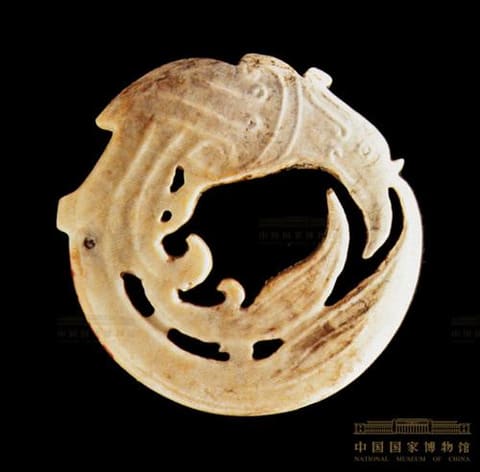
A Neolithic jade phoenix ornament excavated in 1955 from the Luojiaboling site at Tianmen, Hubei Province, shown among the museum's archaeological highlights. (The object page gives only the name, period 'Neolithic Age', dimensions and findspot — no descriptive text or culture.)
“Excavated in 1955 from Luojiaboling site, Tianmen, Hubei Province”
In the museum’s words — en.chnmuseum.cn ↗ · quotation verified against the live page
N° 1160·Undated
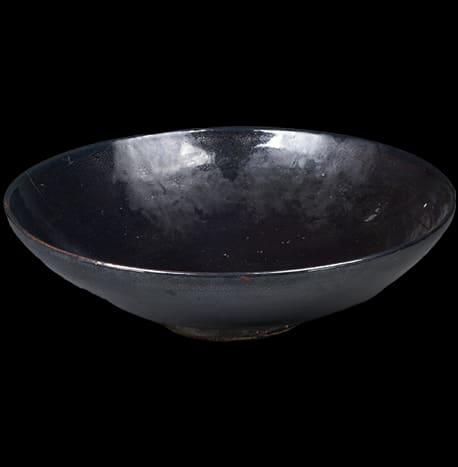
Jin-dynasty Black-glazed Oil-spot Bowl
Unknown
Jin dynasty in the title; Song dynasty in the museum period field · porcelain with black oil-spot glaze
Chinese · Jin or Song dynasty (museum page conflict)
Translated from Chinese: A large bowl with a gray-white body, black glaze, flaring mouth, tapering sides, and ring foot. Oil-drop-like crystals formed inside the bowl through kiln transformation. The museum page titles the object as Jin dynasty but labels its period as Song, so the structured years are left unresolved.
“灰白胎,黑釉。敞口,腹由口至底渐收,圈足。碗内有因窑变形成的油滴状结晶体。”
In the museum’s words — sxhm.com ↗ · quotation verified against the live page