The Atlas·HR

HR

Arheološki muzej u Zagrebu, Zagreb — 20 works · museum site ↗ · 6000 BCE – 1200 60000 BCE2020

Seen from Zagreb, history is above all sculpture, then craft & design — a collection split between its own tradition and other worlds (11 of 20 works are from other civilisations).

Sculpture 7 Craft 5 Invention 4 Ritual 2 Power 1 Sacred 1
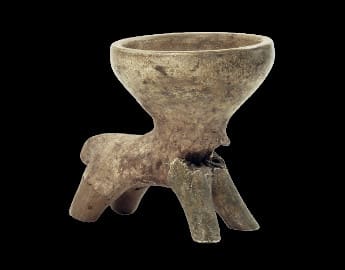
Zoomorphic ceramic altar from Gradac (Vučedol)
N° 012·I · The First Makers
Zoomorphic ceramic altar from Gradac (Vučedol)
Unknown
Neolithic, Starčevo culture (c. 6000–5300 BCE) · Fired clay (ceramic)
Starčevo culture · Neolithic

Translated and condensed from the museum’s Croatian text. A four-legged zoomorphic ceramic altar with a hemispherical bowl, found at the Gradac site at Vučedol in 1938. Although recovered at the Vučedol site, the museum assigns it to the Neolithic Starčevo culture. Such small portable altars are interpreted as household cult objects — variously as lamps, incense burners, or vessels for symbolic offerings — and belong to a group of unusually shaped ritual ceramics bearing animal features.

“Tijekom istraživanja položaja Gradac na Vučedolu, 1938. godine pronađen je zoomorfni keramički žrtvenik na četiri noge s poluloptastim recipijentom.” In the museum’s words — amz.hr ↗ · quotation verified against the live page
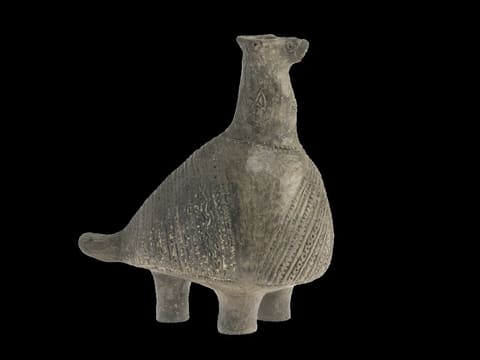
Vučedol Dove (bird-shaped vessel from Vučedol)
N° 040·I · The First Makers
Vučedol Dove (bird-shaped vessel from Vučedol)
Unknown
Vučedol culture, Eneolithic (c. 3000–2200 BCE) · Fired clay (ceramic) with white incrustation
Vučedol culture · Eneolithic (Copper Age)

Translated and condensed from the museum’s Croatian text. A hollow ceramic vessel modelled as a stylised bird on three stump feet, richly decorated with incised ornament filled with white incrustation. Excavated at the Gradac site at Vučedol in 1938 under the supervision of the museum, it is the best-known find of those excavations and the symbol of the Vučedol culture; the museum presents it both as an example of refined potters’ craft and as an important religious symbol (a cult vessel thought to have held liquid during rituals). Scholars dispute whether it depicts a dove or a partridge.

“Posuda u obliku ptice, tzv. Vučedolska golubica, nedvojbeno je primjer zanatske vještine keramičara istančanog umjetničkog dara, ali i važan religijski simbol.” In the museum’s words — amz.hr ↗ · quotation verified against the live page
Meanwhile — Cycladic Female Figure of Amorgos Greek world · 2800-2300 BC (Early Cycladic II)

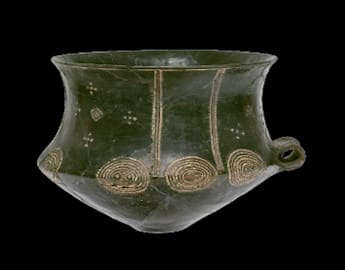
Vučedol terrine with astral decoration
N° 041·I · The First Makers
Vučedol terrine with astral decoration
Unknown
Vučedol culture, Eneolithic (c. 3000–2200 BCE) · Fired clay (ceramic) with white and red incrustation
Vučedol culture · Eneolithic (Copper Age)

Translated and condensed from the museum’s Croatian text. A large terrine that covered the head of a woman in the so-called “grave of the married couple” excavated at Vučedol in 1938. On its biconical carination it bears representations of nine suns, above which four fields are, in recent interpretations, read as the constellation of Orion — the dominant constellation of the winter sky. The deep incised (kerbschnitt) ornament is filled with white, and occasionally red, incrustation.

“Terina je posuda koja na bikoničnom prijelomu ima prikaze 9 sunaca, a iznad njih su četiri polja, za koja se u novim tumačenjima tvrdi da prikazuju sazviježđe Oriona.” In the museum’s words — amz.hr ↗ · quotation verified against the live page
Meanwhile — Cycladic Female Figure of Amorgos Greek world · 2800-2300 BC (Early Cycladic II)

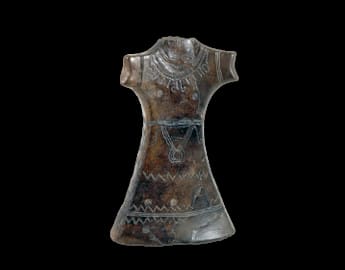
Dalj Idol (anthropomorphic figurine)
N° 087·I · The First Makers
Dalj Idol (anthropomorphic figurine)
Unknown
Middle Bronze Age (c. 1700–1300 BCE) · Fired clay (ceramic) with incrusted ornament
Dalj–Bijelo Brdo group (Middle Bronze Age) · Bronze Age

Translated and condensed from the museum’s Croatian text. An anthropomorphic ceramic figurine, known as the Dalj Idol, which the museum calls the best-known example of Bronze Age figural sculpture from the territory of Croatia. Donated to the museum and published by Viktor Hoffiler in 1928, it survives about 23 cm high and lacks its head; the figure wears a long robe covered with incised ornaments representing bronze dress-ornaments. It is linked to the Dalj–Bijelo Brdo group, with the closest parallels in present-day Serbia.

“Antropomorfna keramička figurina, poznata kao Daljski idol, najpoznatiji je primjerak brončanodobne figuralne plastike s područja Republike Hrvatske.” In the museum’s words — amz.hr ↗ · quotation verified against the live page
Meanwhile — Bronze standard from Brili Near East · 16th-15th century BC

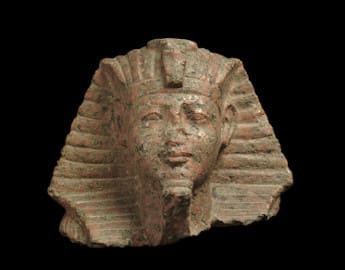
Head of a sphinx (pharaoh Amenhotep II)
N° 111·I · The First Makers
Head of a sphinx (pharaoh Amenhotep II)
Unknown
New Kingdom, 18th Dynasty, reign of Amenhotep II (1427–1400 BCE) · Pink Aswan granite
Ancient Egyptian · New Kingdom, 18th Dynasty

Translated and condensed from the museum’s Croatian text. A fragmentary head of a sphinx (a pharaonic portrait) in pink Aswan granite, which the museum describes as one of the most beautiful objects in its collection. By comparison with other 18th-Dynasty monuments it is dated to the reign of Amenhotep II, at the first flowering of the New Kingdom; the head wears the royal nemes headcloth with a uraeus at the brow and the typical pharaonic beard.

“Glava sfinge (odnosno faraonski portret) jedan je od najljepših predmeta u zbirci.” In the museum’s words — amz.hr ↗ · quotation verified against the live page
Meanwhile — Dagger with a sheath from Lchashen Near East · Late Bronze Age, 15th–14th centuries BC

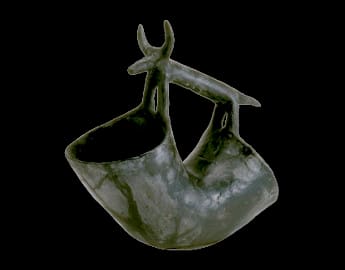
Askos with bull-shaped handle from Kaptol
N° 151·II · The Classical World
Askos with bull-shaped handle from Kaptol
Unknown
Early Iron Age, Hallstatt (Kaptol group), 9th–4th c. BCE · Fired clay (ceramic)
Hallstatt culture (Kaptol group) · Early Iron Age

Translated and condensed from the museum’s Croatian text. An Early Iron Age askos — a jug for holding and pouring alcoholic drink — from tumulus XII of the Kaptol-Čemernica cemetery, with a handle in the form of a bull. It belongs to a small group of Iron Age askoi whose distribution is limited to southern Pannonia. Such feasting vessels accompanied the richly furnished graves of Hallstatt warrior elites; the plastic bull imagery is thought to carry deeper symbolism connected with the afterlife.

“Askos iz tumula XII s groblja Kaptol-Čemernica s ručkom u obliku bika pripada maloj skupini željeznodobnih askosa čiji je prostor rasprostiranja ograničen na prostor južne Panonije.” In the museum’s words — amz.hr ↗ · quotation verified against the live page
Meanwhile — Kouros of Sounion Greek world · c. 600 BC

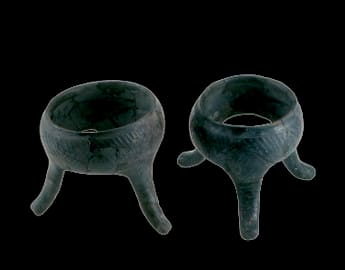
Ceramic tripod from Kaptol
N° 152·II · The Classical World
Ceramic tripod from Kaptol
Unknown
Early Iron Age, Hallstatt (Kaptol group), 9th–4th c. BCE · Fired clay (ceramic)
Hallstatt culture (Kaptol group) · Early Iron Age

Translated and condensed from the museum’s Croatian text. One of a pair of ceramic tripods from the tumulus cemetery of Kaptol-Čemernica in the Požega valley, excavated in the 1960s–1970s and part of an Iron Age feasting set. Made by local potters and decorated in the recognisable Kaptol style, the tripods are probably a local reinterpretation of the bronze tripods found in Greece and Etruria, evidencing the circulation of ideas and religious practices from Italy through the south-eastern Alpine region to Kaptol during the Early Iron Age.

“Vjerojatno je da tronošci iz Kaptola predstavljaju lokalnu reinterpretaciju brončanih tronožaca kakve nalazimo u Grčkoj i Etruriji.” In the museum’s words — amz.hr ↗ · quotation verified against the live page
Meanwhile — Kouros of Sounion Greek world · c. 600 BC

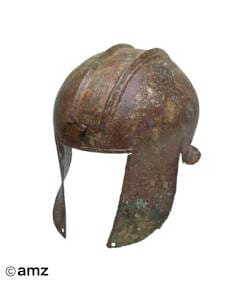
Greek-Illyrian helmet from Beli (Cres)
N° 169·II · The Classical World
Greek-Illyrian helmet from Beli (Cres)
Unknown
Second half of the 6th – beginning of the 5th century BCE
Greek-Illyrian

Translated and condensed from the museum’s Croatian text. A chance underwater find from the waters off the village of Beli on the island of Cres: a rounded helmet of Greek-Illyrian type with a neck-guard and pronounced triangular cheek-pieces pierced with round lacing holes, a frontal projection and a nape ring for hanging a crest. It weighed about 1 kg and had an 11 cm wide face opening; beads were once inset in small holes along its lower rim, and an incised equal-armed cross on the brow may be an owner’s personal mark or the spot where an ornament (boar, lions, ram’s head) was to be made. The museum’s photo caption dates it to the second half of the 6th to the beginning of the 5th century BCE.

“Zaobljena kaciga sa štitnikom za vrat i izraženim trokutastim štitnicima za obraze s kružnim otvorima za vezivanje te čeonim izdankom i zatiljnom alkom za privjes perjanice težila je oko 1 kg i imala otvor za lice širine 11 cm.” In the museum’s words — amz.hr ↗ · quotation verified against the live page
Meanwhile — Bull-headed rhyton Near East · 6th–5th centuries BC

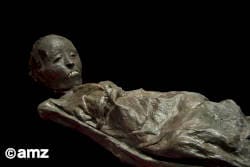
Zagreb Mummy
N° 199·II · The Classical World
Zagreb Mummy
Unknown
4th century BCE, Egyptian Late Period; C14-dated to c. 390 BCE · Mummified human remains with linen wrappings
Ancient Egyptian · Late Period

Translated and condensed from the museum’s Croatian text. One of the most famous exhibits in the museum: an Egyptian mummy that reached the National Museum in Zagreb (the museum’s predecessor) in 1862, bought in Egypt by Mihael Barić. X-rayed in Zagreb in 1986, the skeleton shows it to be a woman who died between the ages of 30 and 40; radiocarbon dating places her at about 390 BCE. Her body was wrapped in inscribed linen bandages that form a separate monument, the Liber Linteus Zagrabiensis.

“Karakteristike kostura zagrebačke mumije upućuju da je riječ o tijelu ženskog spola koja je umrla između 30. i 40. godine života.” In the museum’s words — amz.hr ↗ · quotation verified against the live page

Meanwhile — Tribune of Eshmun Greek world · Sanctuary of Eshmun, Bustan esh Sheikh (near Sidon), ca. 350 B.C.

Liber Linteus Zagrabiensis (Zagreb Linen Book)
N° 201·II · The Classical World
Liber Linteus Zagrabiensis (Zagreb Linen Book)
Unknown
Etruscan linen book, 4th–1st century BCE · Linen with ink text
Etruscan

Translated and condensed from the museum’s Croatian text. The linen bandages that wrapped the Zagreb Mummy, inscribed in Etruscan, form a separate monument the museum calls the longest surviving manuscript in the Etruscan language, with about 1,130 words. It is at once the only remaining Etruscan text with literary features and the only preserved example of a linen book from antiquity. Unrolled it measures 340 cm; its text is set in twelve columns and is thought to be a kind of liturgical calendar or ritual book. Its Etruscan character was first established by the Viennese Egyptologist Jakob Krall in 1892.

“Laneni povoji Zagrebačke lanene knjige najduži su sačuvani rukopis etruščanskog jezika s oko 1130 riječi.” In the museum’s words — amz.hr ↗ · quotation verified against the live page
Meanwhile — Cameo: Portraits of Ptolemy II and Arsinoe II (The Gonzaga Cameo) Greek world · 3rd century BC (setting - later work)

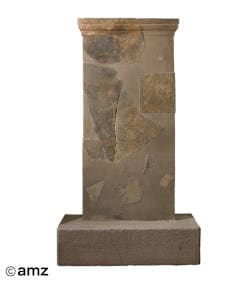
Lumbarda Psephisma
N° 213·II · The Classical World
Lumbarda Psephisma
Unknown
Early 3rd century BCE (Hellenistic) · Stone
Greek (Issaean-Doric) · Hellenistic

Translated and condensed from the museum’s Croatian text. Stone fragments of a unique Greek inscription — a decree (lex coloniae) that, in the museum’s words, codifies the procedures to be observed when founding a Greek (Issaean) settlement on the island of Korčula (Korkyra Melaina). Discovered in several finds from 1877 onward on the Koludrt hill at Lumbarda and first published by J. Brunšmid, the inscription — probably of the 3rd century BCE — prescribed the obligations and land allotments of the first colonists; about 180 names survive (of perhaps some 300 originally recorded), arranged in the three Doric phylai (Dymanes, Hylleis, Pamphyloi), and among the founders appear two Illyrians, father and son Pyllos and Dazos.

“Lumbardska psefizma kodificira, u osnovi, postupke kojih se bilo nužno pridržavati prigodom osnivanja anonimne grčke, isejske, naseobine na otoku Korčuli.” In the museum’s words — amz.hr ↗ · quotation verified against the live page
Meanwhile — Silver calyx-cup from Varbitsa Europe · Late 4th - first half of the 3rd c. BC

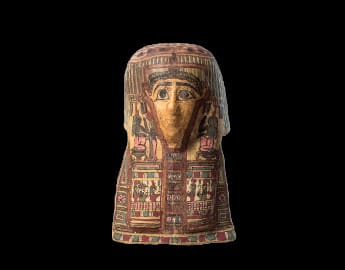
Egyptian funerary mask
N° 217·II · The Classical World
Egyptian funerary mask
Unknown
Ptolemaic period (3rd–1st c. BCE) · Painted and partly gilded cartonnage
Ancient Egyptian (Ptolemaic) · Ptolemaic period

Translated and condensed from the museum’s Croatian text. A funerary mask of painted and partly gilded cartonnage from the Ptolemaic period, most probably a child’s mask typical of the Hellenistic era in Egypt. The face is gilded, the head wears a headcloth, and several deities are shown on the chest; on the headcloth, level with the jaw, the resurrection goddesses Isis and Nephthys face one another.

“Najvjerojatnije je riječ je o dječjoj pogrebnoj masci tipično za razdoblje helenizma u Egiptu.” In the museum’s words — amz.hr ↗ · quotation verified against the live page
Meanwhile — Mosaic with Alexandrine Parakeet Greek world · 160–150 BC

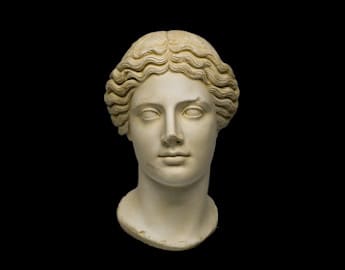
Marble portrait of a woman (Empress Livia?) from Salona
N° 248·II · The Classical World
Marble portrait of a woman (Empress Livia?) from Salona
Unknown
First half of the 1st century CE · White marble
Roman · Julio-Claudian

Translated and condensed from the museum’s Croatian text. An exceptionally fine white-marble portrait of a woman found near Roman Salona (present-day Solin), carved in the manner of classical Greek statues, which may represent the empress Livia — wife of Augustus and grandmother of Claudius, who declared her a deity. It is distinguished by luxuriant wavy hair with deep channels between the strands, gathered into a bun at the nape, and is dated to the first half of the 1st century.

“Portret bi mogao prikazivati caricu Liviju, ženu cara Augusta te baku cara Klaudija, koji ju je proglasio božanstvom.” In the museum’s words — amz.hr ↗ · quotation verified against the live page
Meanwhile — Mummified Child in Gilded Cartonnage Egypt & Nubia · Graeco-Roman

Torso of a Roman emperor from Issa (Vis)
N° 253·II · The Classical World
Torso of a Roman emperor from Issa (Vis)
Unknown
1st century CE (Julio-Claudian dynasty) · Marble
Roman · Julio-Claudian

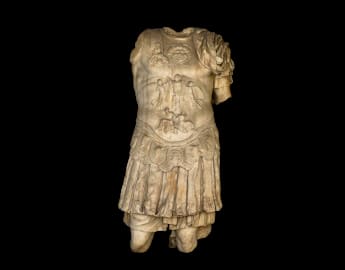
Translated and condensed from the museum’s Croatian text. A fragmentary marble statue of an emperor in a breastplate decorated with pteryges, wearing a military tunic and a paludamentum cloak, discovered on the island of Vis (ancient Issa) and once part of the Vicko Solitro collection. The cuirass is richly carved with a gorgoneion above a trophy flanked by two Victories, with two bound captives below. On iconographic and stylistic grounds the statue is dated to the 1st century and probably represents one of the emperors of the Julio-Claudian dynasty.

“Ikonografski i stilski ovaj se kip može datirati u 1. stoljeće te vjerojatno predstavlja nekog od careva julijevsko-klaudijevske dinastije.” In the museum’s words — amz.hr ↗ · quotation verified against the live page
Meanwhile — Whistling bottle: feline and mouse (Vicús) Americas & Oceania · 400 BCE – 500 CE

Bronze head of Mithras from Siscia
N° 281·II · The Classical World
Bronze head of Mithras from Siscia
Unknown
2nd century CE · Bronze with silver and copper inlay
Roman · Roman Imperial

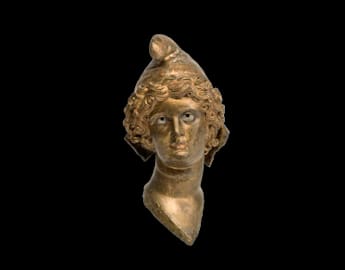
Translated and condensed from the museum’s Croatian text. A finely modelled bronze head of a youthful deity, a chance find from Sisak dated to the 2nd century. It has almond eyes with silver eyeballs, copper-inlaid lips, and a Phrygian cap inlaid with copper spirals and silver ornament. The stars set into the cap, giving a brilliant colour effect, point to the astral character that identifies the figure as Mithras.

“Zvijezde umetnute u kapi, koje daju sjajan koloristički efekt, upućuju na astralni karakter što jasno upozorava da je riječ o Mitri.” In the museum’s words — amz.hr ↗ · quotation verified against the live page
Meanwhile — Seated Kubera South Asia · 2nd Century AD

Marble portrait of a woman (Crispina?) from Siscia
N° 292·II · The Classical World
Marble portrait of a woman (Crispina?) from Siscia
Unknown
Second half of the 2nd century CE · Marble
Roman · Antonine

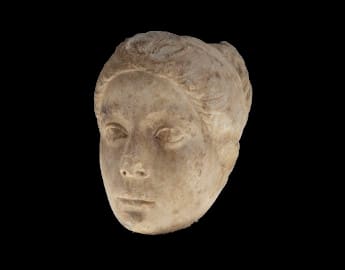
Translated and condensed from the museum’s Croatian text. A marble portrait of a woman found in Sisak (ancient Siscia) whose style and technique place it in the second half of the 2nd century, when stone sculpture was strongly influenced by portraits of empresses such as Faustina the Younger, Lucilla and Crispina. Slightly under life size, it has a hairstyle divided by a narrow plait into two segments; lacking archaeological context it cannot be securely identified, but it closely resembles known portraits of Bruttia Crispina, wife of the emperor Commodus.

“Arheološki muzej u Zagrebu čuva mramorni portret žene pronađen u Sisku koji svojim stilskim i tehnološkim karakteristikama odgovara drugoj polovini 2. st.” In the museum’s words — amz.hr ↗ · quotation verified against the live page
Meanwhile — Agate amphoriskoi and dish from Mtskheta Near East · 2nd-3rd century AD

Portrait of a young woman, the “Solinjanka” (Plautilla?)
N° 293·II · The Classical World
Portrait of a young woman, the “Solinjanka” (Plautilla?)
Unknown
Early 3rd century CE (Severan period) · White marble
Roman · Severan

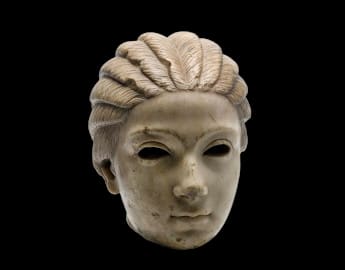
Translated and condensed from the museum’s Croatian text. A white-marble portrait of a young woman that the museum has kept since 1869, with hair dressed in twelve melon-slice strands gathered into a detailed bun and eye sockets once filled with coloured glass paste. From the colony of Salona (Solin), it is nicknamed the “Solinjanka.” Its very high quality suggests a member of the imperial family, possibly the empress Fulvia Plautilla, wife of Caracalla, though this cannot be confirmed; it is regarded as a peak achievement of early-3rd-century portrait art.

“Arheološki muzej u Zagrebu od 1869. godine čuva portret djevojke izveden u bijelom mramoru.” In the museum’s words — amz.hr ↗ · quotation verified against the live page
Meanwhile — Agate amphoriskoi and dish from Mtskheta Near East · 2nd-3rd century AD

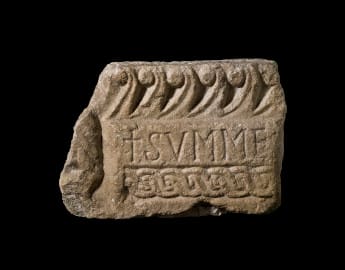
Altar-screen beam with the +SVMME inscription from Lobor
N° 387·III · Faith and Empire
Altar-screen beam with the +SVMME inscription from Lobor
Unknown
First third of the 9th century (Pre-Romanesque) · Stone
Croatian (early medieval) · Pre-Romanesque

Translated and condensed from the museum’s Croatian text. A fragment of a stone altar-screen beam (architrave) found at Lobor in 1946, decorated in three bands — hooks above, a two-strand plait below, and in the centre a carved inscription +SVMME, read as an abbreviated invocation “In nomine summe Trinitatis.” It belonged to a pre-Romanesque church built in the first third of the 9th century in the Hrvatsko zagorje region. The museum keeps it and displays it within the permanent exhibition of its Medieval Collection.

“Čuva se u Arheološkom muzeju u Zagrebu gdje je izložen u okviru stalnog postava Srednjovjekovne zbirke.” In the museum’s words — amz.hr ↗ · quotation verified against the live page
Meanwhile — Wooden snuff tablet with kneeling figure Americas & Oceania · 700–950 CE

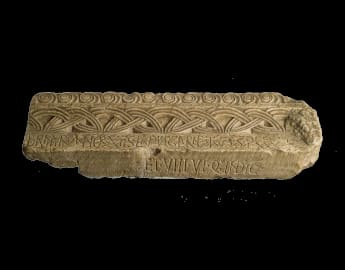
Altar-screen beam with the inscription of Duke Branimir
N° 404·III · Faith and Empire
Altar-screen beam with the inscription of Duke Branimir
Unknown
888 CE (Pre-Romanesque) · Limestone
Croatian (early medieval) · Pre-Romanesque

Translated and condensed from the museum’s Croatian text. A limestone fragment of an altar-screen beam (architrave) from the pre-Romanesque church of St Peter at Gornji Muć, found in 1871 and given to the museum’s predecessor in 1872; the museum still holds and exhibits it and counts it among its most valuable and best-known exhibits. Its Latin dedicatory inscription is double-dated — by the reign of Duke Branimir and by the Christian year 888. At the time of its discovery it was the first excavated monument to bear the carved name of a Croatian ruler, and it is regarded as a cornerstone of Croatian national archaeology.

“U vrijeme pronalaska to je bio prvi iskopani arheološki spomenik koji je na sebi nosio uklesano ime hrvatskog vladara.” In the museum’s words — amz.hr ↗ · quotation verified against the live page
Meanwhile — Cusped bowl Islamic world · 9th-10th century

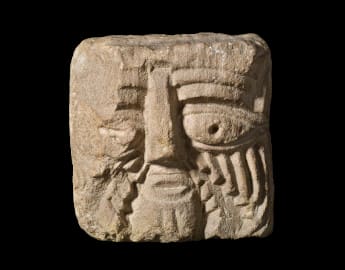
Romanesque relief head from Rudina
N° 487·III · Faith and Empire
Romanesque relief head from Rudina
Unknown
Second half of the 12th century (Romanesque) · Stone
Croatian (Romanesque) · Romanesque

Translated and condensed from the museum’s Croatian text. A square stone console carved with a furrowed face, one of the celebrated “Rudina heads” from the Romanesque Benedictine abbey of St Michael at Rudina in Slavonia. The reliefs are considered a supreme work of Romanesque stylisation, and eighteen have been found; of these only a single head is kept in the Archaeological Museum in Zagreb (one is in a private collection and the rest in the Požega Town Museum). Originally painted, these consoles decorated the eaves cornice of the church apses.

“Samo se jedna glava čuva u Arheološkom muzeju u Zagrebu, jedna je u privatnoj zbirci, a ostale u Gradskom muzeju Požega.” In the museum’s words — amz.hr ↗ · quotation verified against the live page

Meanwhile — Pre-Columbian musical instruments of the Diquís (ocarinas) Americas & Oceania · c. 800–1550 CE