History Museum of Armenia, Yerevan — 20 works · museum site ↗ · 3600 BCE – 1333
Seen from Yerevan, history is above all treasure & power, then sculpture — a collection opened wide onto other worlds — a window more than a mirror (16 of 20 works are from other civilisations).
Power 8Sculpture 7Ritual 2Craft 2Architecture 1
N° 034·I · The First Makers
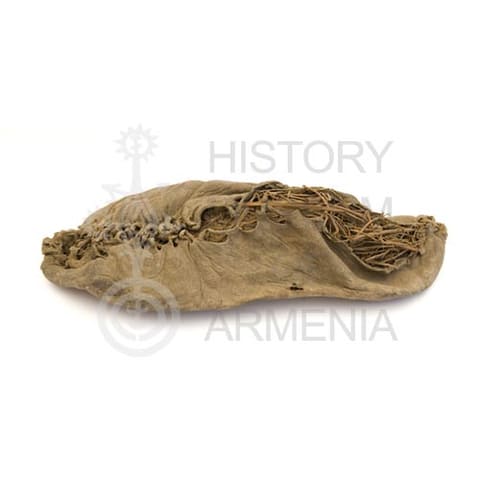
Leather shoe from Areni-1 (world's oldest shoe)
Unknown
Copper Age, c. 3600–3500 BC · Leather
Chalcolithic · Copper Age (Chalcolithic)
A single-piece cowhide shoe recovered in 2008 from the Areni-1 cave complex in Vayots Dzor and radiocarbon-dated to about 3500 BC in laboratories at the Universities of California and Oxford; the museum presents it as "the world's oldest shoe", preserved in near-complete condition.
“The leather shoe was discovered in 2008. As evidenced by the excavating archeologists, the shoe was dated from 3500 BC by the radio-carbon analysis in Spectrometry Laboratories at the Universities of California and Oxford. This permits considering the unique find that came down to us in a state of stunning preservation “the world’s oldest shoe”.”
In the museum’s words — historymuseum.am ↗ · quotation verified against the live page
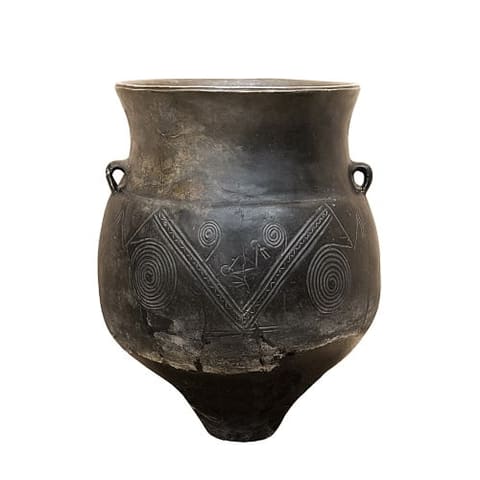
A large Early Bronze Age storage vessel (karas) from the Shengavit settlement whose incised decoration of wavy water-bands, spiral bird-headed dragons and a central stork is read by the museum as protective iconography.
“The main angle-shaped ornamental pattern is formed by wavy bands symbolizing water, which stretch upwards on the vessel body. Numerous twisting spirals at the ends of the bands embody bird-headed dragons as guardians of water and the contents of the karas vessel.”
In the museum’s words — historymuseum.am ↗ · quotation verified against the live page
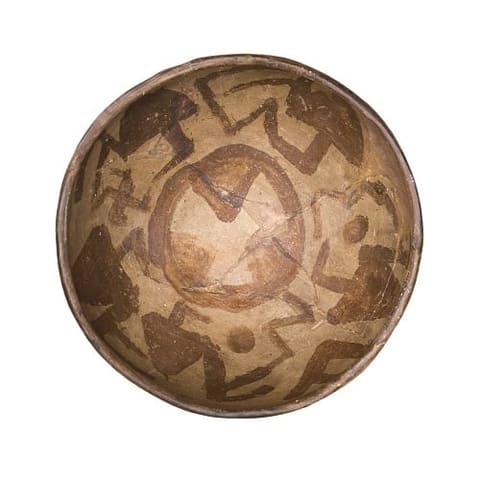
An Early Bronze Age ritual clay bowl from Shengavit ornamented with a central hearth ringed by bird-and-serpent creatures, a swastika and a lunar bowl-circle, which the museum interprets as fertility symbolism.
“The Shengavit bowl is an object of ritual significance, in the ornamental design of which images connected with the elements of nature necessary for fertility are manifested. In the centre of the composition is the round ritual hearth with three- winged protuberances, while surrounding it are birds combined with serpent-like bodies, a swastika and a bowl-circle symbolizing the Moon.”
In the museum’s words — historymuseum.am ↗ · quotation verified against the live page
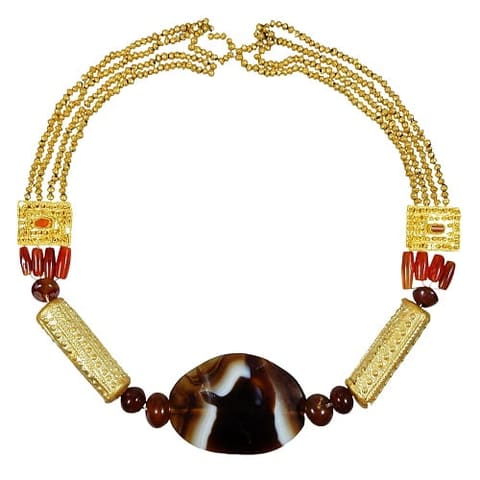
Middle Bronze Age, 22nd–21st centuries BC · Gold, agate, cornelian
Ancient Armenia · Middle Bronze Age
A composite necklace from the rich Middle Bronze Age tomb at Karashamb, built around a large reddish-brown agate pendant flanked by symmetrically arranged gold and cornelian beads, including granulated cylindrical beads and unusual bead-separators.
“In the centre of the necklace is a reddish-brown agate pendant (7 x 5 cm) of an irregular oval shape with a longitudinal hole for the thread. Biconical beads of cornelian are threaded on both sides of the ornament, then gold and cornelian beads of various forms are arranged in a symmetric sequence.”
In the museum’s words — historymuseum.am ↗ · quotation verified against the live page
Middle Bronze Age, 17th–16th centuries BC · Bronze
Ancient Armenia · Middle Bronze Age
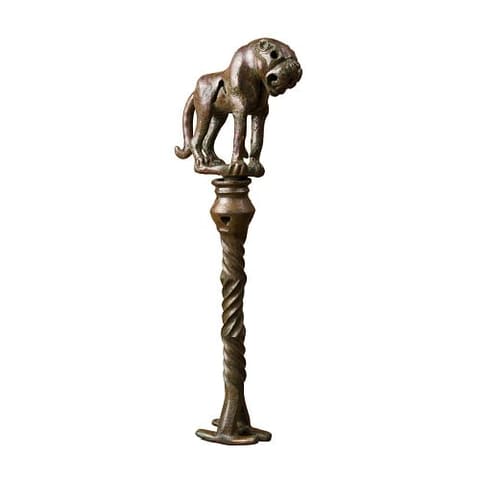
A hollow cast-bronze lion from Oshakan on a tall columnar stand with an anchor-shaped base, its wide muzzle, open mouth and fangs emphasized and its torso pierced with wedge-shaped openings.
“A hollow figure of the lion is shown standing on a quadrangular platform on a high stand. The animal has a large head on a small body.”
In the museum’s words — historymuseum.am ↗ · quotation verified against the live page
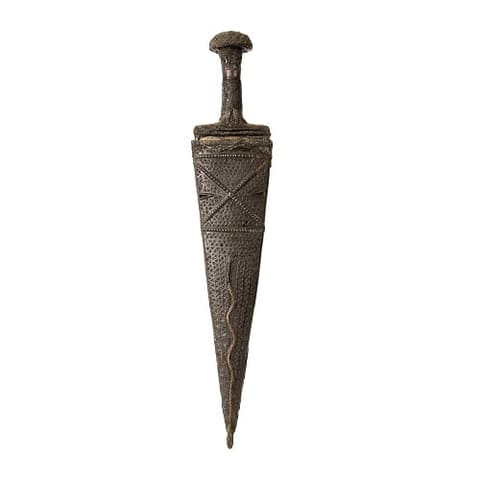
A Late Bronze Age bronze dagger from Lchashen with a hollow wood-inlaid handle, its sheath decorated with wedge-shaped cuts and an embossed serpent crawling upwards.
“The handle is cylindrical, hollow, with a hemispherical head, inlayed with wood. The sheath is decorated with wedge-shaped cuts and the embossed image of a serpent crawling upwards.”
In the museum’s words — historymuseum.am ↗ · quotation verified against the live page
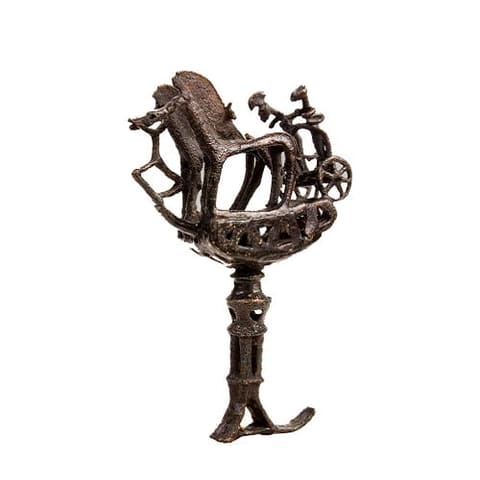
A cast bronze group from Lori Berd showing a two-wheeled spoked chariot drawn by a pair of horses in motion, with two dagger-armed figures on the chariot body, mounted on a hollow openwork platform that held bronze jingling globules.
“A two-wheeled chariot with a pair of horses in dynamic motion is on a quadrangular platform. The horses are slender-waisted with longish muzzles, high manes and long tails.”
In the museum’s words — historymuseum.am ↗ · quotation verified against the live page
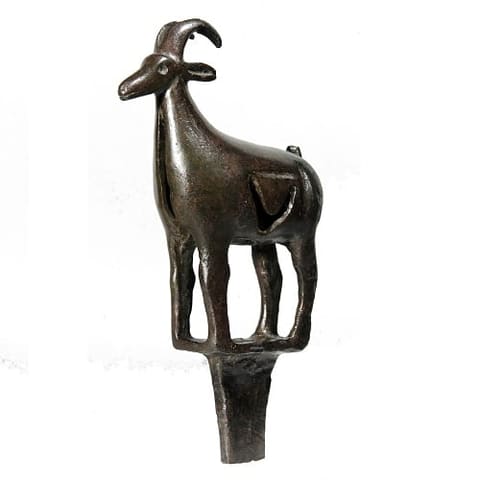
A hollow cast-bronze figure of a goat from Nerkin Getashen standing on a square platform, its head raised with backward-hooked horns; the body has angular openings and contains bronze balls that jingle.
“The cast sculpture shows a goat standing in a tranquil posture on a square platform, rod-shaped at the base. Its head is raised high and decorated with horns hooked backwards.”
In the museum’s words — historymuseum.am ↗ · quotation verified against the live page
Late Bronze–Early Iron Age, 13th–12th centuries BC · Clay
Ancient Armenia · Late Bronze–Early Iron Age
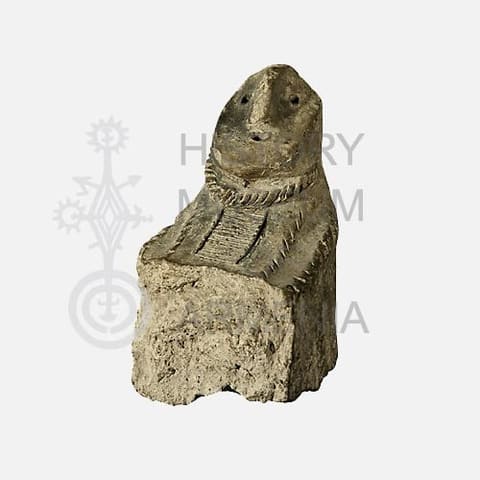
A seated clay figurine from Metsamor representing a fertility goddess, her shoulders draped in a cloak edged with grain-and-water patterns and her chest bearing a moulded bead ornament; the museum notes such statuettes were used in rituals.
“The statuette represents a deity patronizing fertility. She is shown sitting with her gaze fixed upwards. Her head is small, her face is oval-shaped and flat.”
In the museum’s words — historymuseum.am ↗ · quotation verified against the live page
Meanwhile — Two appliquésEurope · 13th or 12th century BC
N° 143·I · The First Makers
Miniature sculpture of a chariot
Unknown
Early Iron Age, 9th century BC · Bronze
Ancient Armenia · Early Iron Age
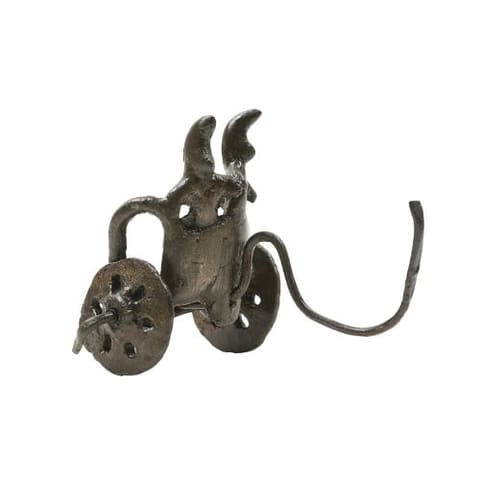
A miniature bronze two-wheeled chariot from Paravakar with six-spoked wheels, a curved pole and arched open sides, carrying two helmeted warriors.
“This is a miniature sculpture of a two-wheeled chariot. The body of the chariot is wide and open at the back; it has a semi-circular, arched sides and spoked wheels (six spokes in each). The pole is curved. Two warriors wearing helmets are on the body of the chariot.”
In the museum’s words — historymuseum.am ↗ · quotation verified against the live page
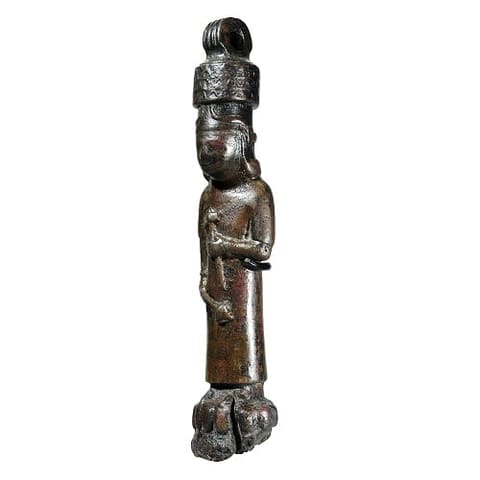
A cast bronze figure of Teisheba, the Urartian god of war, thunder and winds and second of the three supreme deities of the Urartian pantheon, from the fortress of Teishebaini (Karmir Blur); he wears a horned headdress and a fringed garment with the characteristic Urartian rosette ornament.
“Teisheba, the god of war, thunder and winds, was the second of the three supreme deities in the Urartian pantheon. The statuette represents a young man standing on a foliate base.”
In the museum’s words — historymuseum.am ↗ · quotation verified against the live page
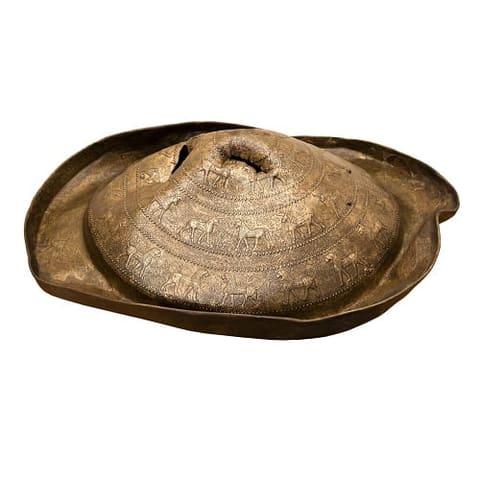
A round embossed bronze shield from the Urartian fortress of Teishebaini (Karmir Blur), decorated with concentric bands of lions and bulls and carrying a cuneiform dedication of King Rusa I, son of Sarduri, to the god Khaldi.
“It is a round shield, conical in the centre. Images of lions and bulls are chased on three concentric ornamental bands of the surface. Handles are nailed to the opposite side of the shield. On the brim edge of the shield is one line of cuneiform inscription, which is partially damaged.”
In the museum’s words — historymuseum.am ↗ · quotation verified against the live page
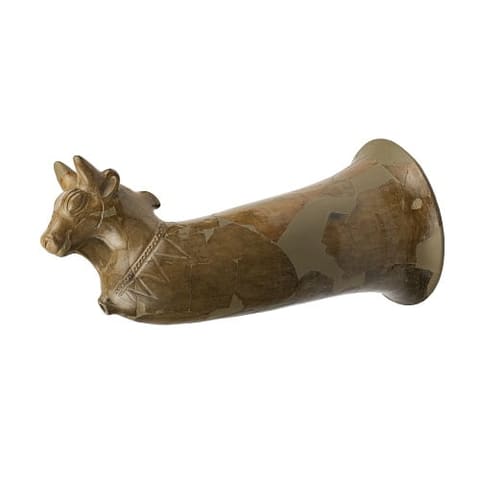
A polished ceramic drinking-horn (rhyton) from Armavir whose front is modelled as a realistic bull's head with thick horns and a half-open mouth, its cylindrical body flaring to a trumpet-shaped rim.
“The rhyton with the sculpture of a bull’s head, made of fine-grained clay, is coated with a cinnamon slip and has a well-polished surface. The body is cylindrical with a trumpet- like widening rim.”
In the museum’s words — historymuseum.am ↗ · quotation verified against the live page
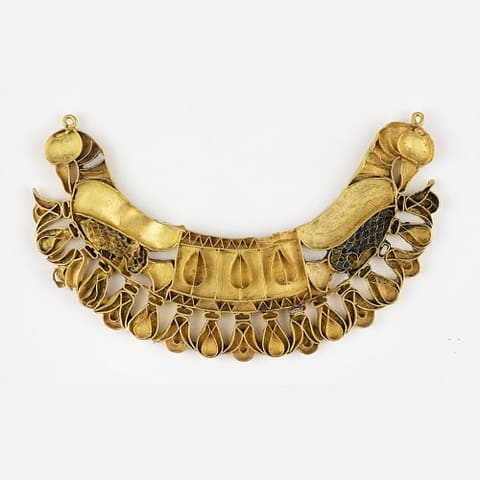
A crescent-shaped gold breast ornament from Armavir bearing stylized birds at the ends and three trees of life at the centre above a band of lotus flowers and buds; the museum notes the motifs derive from Urartian art and have parallels in the Persepolis reliefs.
“The pectoral is crescent-shaped with the single images of stylized birds at the ends. Schematic images of three trees of life are between the birds, in the centre of the ornament.”
In the museum’s words — historymuseum.am ↗ · quotation verified against the live page
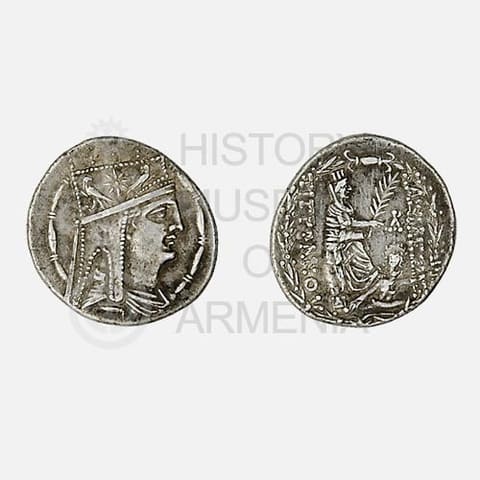
A silver tetradrachm of King Tigranes II the Great, struck 83–69 BC, showing the diademed and crowned bust of the king on the obverse and the seated Tyche on the reverse.
“Armenia, Tigranes the Great (95-55 BC), tetradrachm issued in 83-69 BC, weight: 15.33 gm, HMA 18981/4; a. The bust of the King with a crown and a diadem, b. Tyche seated on a rock.”
In the museum’s words — historymuseum.am ↗ · quotation verified against the live page
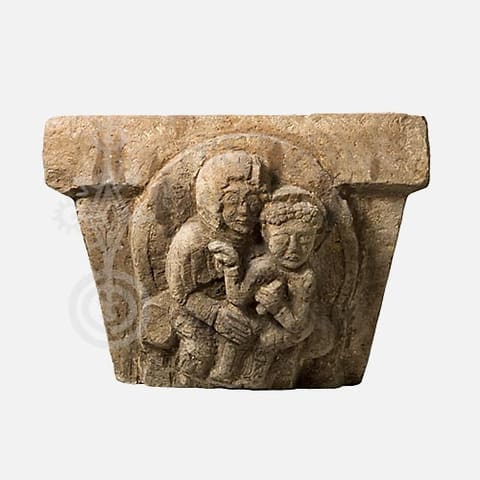
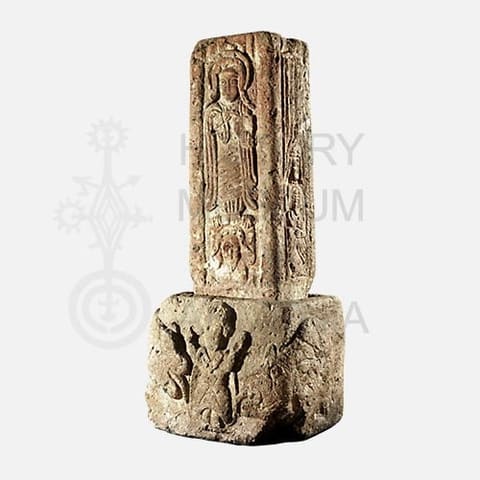
An early medieval carved stone capital from Dvin showing the Virgin and Child in the Hodegetria type on its west face; its centre has an opening that held the winged cross once raised on the memorial column.
“The Virgin and Child are presented in frontal view on the west face, in the iconographic principle of Hodegetria.”
In the museum’s words — historymuseum.am ↗ · quotation verified against the live page
An early medieval carved stone stela from Harichavank whose faces and base depict the Old Testament scenes of the Three Youths in the Fiery Furnace and Daniel in the lions' den, with a relief cross on the reverse.
“The narrative scenes of the “Three Adolescents in the Fiery Furnace” and “Daniel in the Den of Lions” are respectively depicted on the four faces and the base of the stela.”
In the museum’s words — historymuseum.am ↗ · quotation verified against the live page
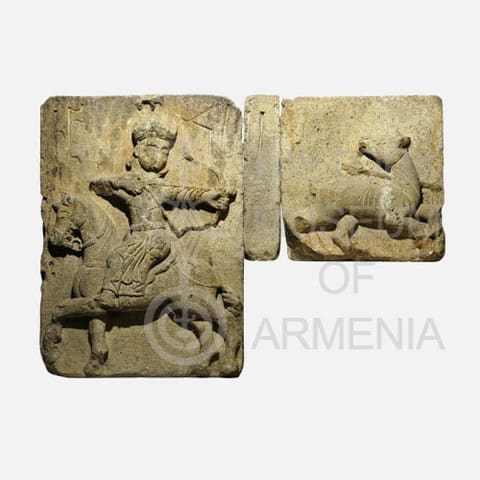
An early 14th-century relief from the south façade of Spitakavor (White Virgin) church in Vayots Dzor, carved on three slabs with a princely rider in jewelled attire hunting a deer with bow and arrow.
“The scene is carved on three separate slabs of the south façade of the church of Spitakavor (White Virgin).”
In the museum’s words — historymuseum.am ↗ · quotation verified against the live page
Middle Bronze Age (more than forty centuries old, museum dating) · Silver
Armenian (Middle Bronze Age) · Middle Bronze Age
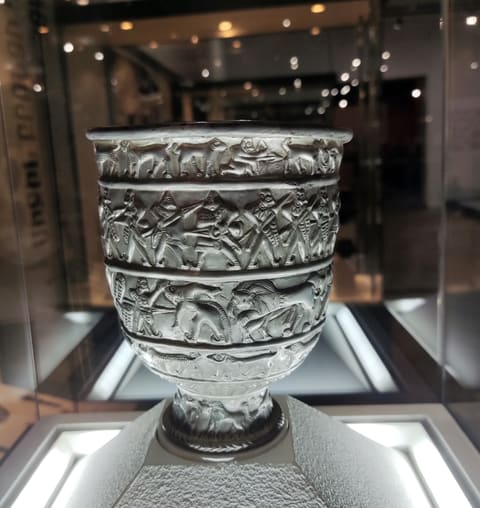
Translated from Armenian: A silver repoussé goblet discovered in 1987 by archaeologist Vahan Hovhannisyan in a 'royal' tomb at Karashamb village, Kotayk Province, together with many other precious objects. The museum's account presents it as a unique example of ancient Eastern iconography and of exceptional significance for understanding the spiritual and material culture of Middle Bronze Age Armenia: across six horizontal embossed friezes it depicts an ancient Indo-European mythological narrative, and its presence attests that the region was a serious productive and cultural centre with close ties to the Hittite world and the centres of Mesopotamia.
“արծաթե դրվագազարդ գավաթը հայտնաբերվել է «արքայական» դամբարանում բազմաթիվ այլ թանկարժեք իրերի հետ միասին”
In the museum’s words — historymuseum.am ↗ · quotation verified against the live page
N° 1231·Undated
Winged cross from Sevan
Unknown
Middle Ages · Stone
Medieval Armenia · Middle Ages
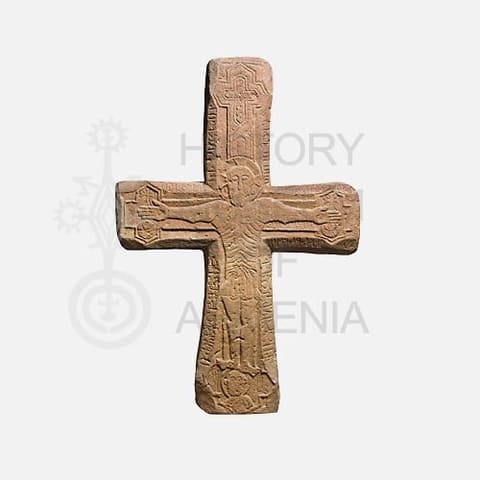
A carved stone winged cross from Sevan sculpted with the Crucifixion, showing Christ upright and open-eyed above Adam's symbolic tomb — features the museum associates with the early Amenaprkich ("Saviour of All") cross-stone type.
“The three-dimensional sculpture of the cross presents the Crucifixion of Jesus Christ. Christ, nude and standing upright, is nailed on the logs.”
In the museum’s words — historymuseum.am ↗ · quotation verified against the live page