National Museum of Lithuania, Vilnius — 12 works · museum site ↗ · 11145 BCE – 1989
Seen from Vilnius, history is above all faith & ritual objects, then sculpture — a collection kept wholly in its own tradition — a mirror.
Ritual 3Sculpture 3Craft 3Power 2Invention 1
N° 005·I · The First Makers
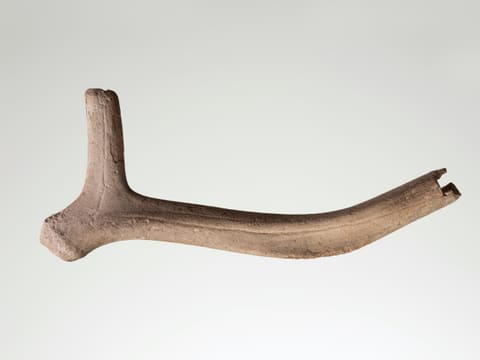
Lyngby-Type Reindeer-Antler Axe — oldest antler artefact in the East Baltic
Unknown
11145–11045 BCE · Reindeer antler
Late Palaeolithic
Translated from Lithuanian: A Lyngby-type axe of reindeer antler, found by chance in 2014 at Parupė (Biržai district) and, in the museum’s words, to this day the oldest antler artefact in the East Baltic region. Dated to c. 11,145–11,045 BCE (Late Palaeolithic); inventory EM 2780. Donated by Vilius Venckūnas, owner of the plot where it was found.
“Parupės kaime, Nemunėlio Radviliškio seniūnijoje, Biržų rajone 2014 m. atsitiktinai rastas raginis kirvis, šiai dienai, yra seniausias raginis dirbinys Rytų Baltijos regione.”
In the museum’s words — lnm.lt ↗ · quotation verified against the live page
N° 009·I · The First Makers
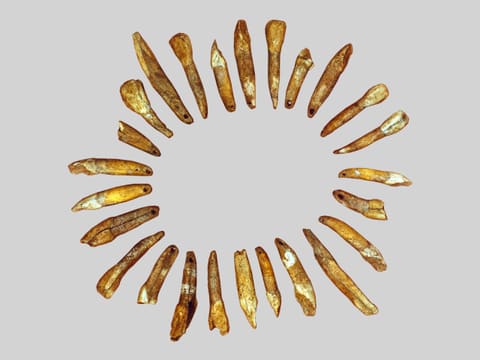
Necklace of Animal-Tooth Pendants from the Donkalnis Shaman’s Grave
Unknown
6377–6221 BCE · Elk and wild boar teeth
Mesolithic
Translated from Lithuanian: A necklace of 25 elk and 2 wild-boar teeth that adorned the head of a shaman buried at Donkalnis (grave no. 2). In all, 57 tooth-amulets were found in the grave, laid symmetrically over the dead — placed on the eyes and inserted into the ears, nose and mouth — beside a symbolic hearth of split stones strewn with red ochre. Mesolithic, c. 6377–6221 BCE; excavated by archaeologist Adomas Butrimas in 1982; inventory EM 2248:343.
“Vėriniu, sudarytu iš 25 briedžio ir 2 šerno dantų, buvo papuošta žynio galva. Kape iš viso rasti 57 dantys-amuletai.”
In the museum’s words — lnm.lt ↗ · quotation verified against the live page
Meanwhile — Idol (pebble)Near East · Byblos, Neolithic Period (9,000–4,000 B.C.)
N° 035·I · The First Makers
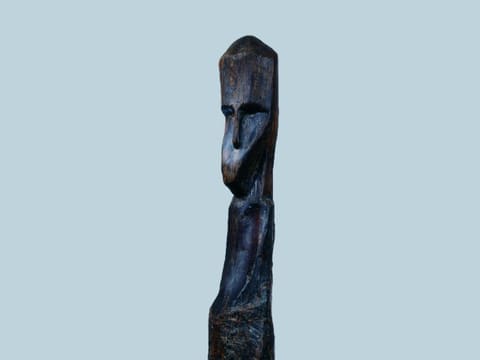
Neolithic Post Sculpture with a Carved Human Head
Unknown
3500 BCE · Black alder wood
Neolithic
Translated from Lithuanian: A two-metre wooden post of black alder with a human head carved at its top — a rare piece of Neolithic figurative art. From the Šventoji 2 ancient settlement; dated c. 3500 BCE, excavated by archaeologist Rimutė Rimantienė in 1969; inventory EM 2135:167.
“Viršutinėje stulpo dalyje išskaptuota žmogaus galva.”
In the museum’s words — lnm.lt ↗ · quotation verified against the live page
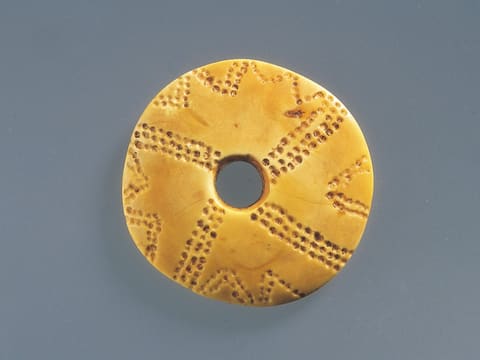
Translated from Lithuanian: A round amber disc amulet decorated with a cross, which the museum describes as the oldest sun symbol. From the Daktariškė 5 ancient settlement; dated c. 3100–2900 BCE, excavated by archaeologist Adomas Butrimas in 1987; inventory EM 2245:2804.
“Skridinys puoštas kryžma. Tai seniausias saulės simbolis.”
In the museum’s words — lnm.lt ↗ · quotation verified against the live page
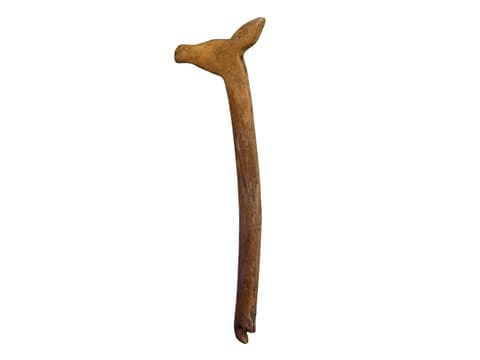
Translated from Lithuanian: A bone ceremonial staff carved with the head of a young elk — one of the celebrated Stone Age finds from the Šventoji settlements. From Šventoji settlement 4; dated c. 3000 BCE, made of bone; excavated by archaeologist Rimutė Rimantienė in 1989; inventory EM 2136:160. The museum presents it among the most important Stone Age finds in its Old Arsenal archaeology exhibition.
“Tyrinėjo archeologė Rimutė Rimantienė 1989 m.”
In the museum’s words — lnm.lt ↗ · quotation verified against the live page
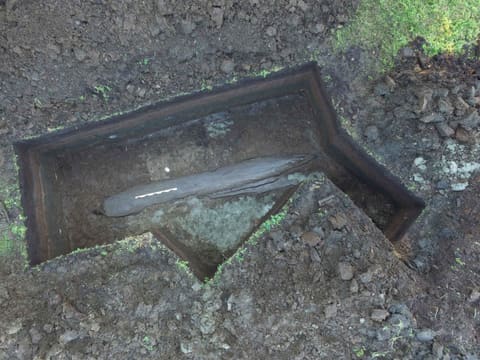
Translated from Lithuanian: A six-metre oak dugout canoe; both of its ends are pointed and one side was repaired by drilling holes to reinforce it. From the Šventoji 58 ancient settlement; dated c. 2800–2700 BCE, investigated by archaeologists in 2015.
“Abu luoto galai smailūs, vienas bortas taisytas gręžiant skyles jam sutvirtinti.”
In the museum’s words — lnm.lt ↗ · quotation verified against the live page
Meanwhile — Ninevite Clay VaseNear East · First half of the 3rd millennium BC
N° 056·I · The First Makers
The Norūnai Hoard — flint and stone battle-axes
Unknown
2600–2400 BCE · Flint and stone
Neolithic
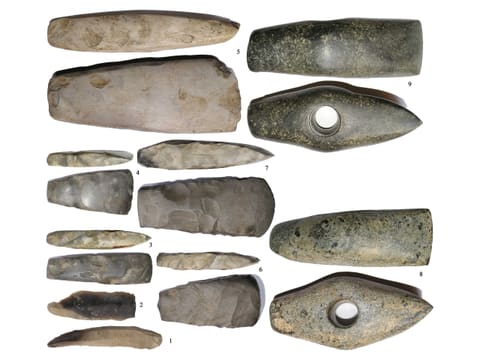
Translated from Lithuanian: A hoard of flint and boat-shaped stone battle-axes and blades, found at Norūnai (Alytus district) in 1961 while digging a sand quarry, at a depth of 2 metres, by Stasys Kriukonis. Dated c. 2600–2400 BCE; inventory EM 1990:1–9.
“Lobį sudaro titnaginiai ir laiviniai kovos kirviai, skeltės, rasti Norūnuose, Alytaus r. 1961 m., kasant smėlio karjerą, 2 metrų gylyje. Rado Stasys Kriukonis.”
In the museum’s words — lnm.lt ↗ · quotation verified against the live page
“Varpas”, no. 6 (1898) — first printing of the Lithuanian national anthem
Vincas Kudirka
1898 · Paper (printed newspaper)
Lithuanian
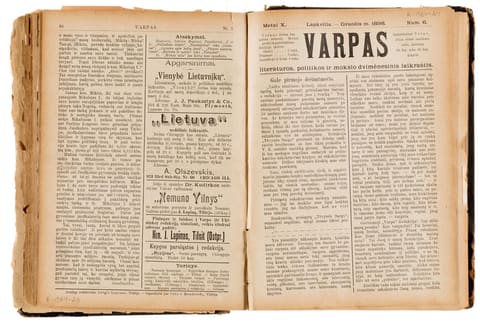
Translated from Lithuanian: A bound set of newspapers that includes issue no. 6 of “Varpas” for 1898, in which Vincas Kudirka’s poem “Tautiška giesmė” — later the national anthem of Lithuania — was printed for the first time. “Varpas” appeared during the years of the Lithuanian press ban under the Russian Empire; the monthly of literature, politics and science was published in Tilsit and smuggled across the border into Lithuania. Held at the Vincas Kudirka Museum, an LNM branch in Kudirkos Naumiestis.
“Šiame laikraščių komplekte įrištas ir 1898 metų „Varpo“ šeštas numeris, kuriame pirmą kartą buvo išspausdintas Vinco Kudirkos eilėraštis „Tautiška giesmė“, vėliau tapęs Lietuvos himnu.”
In the museum’s words — lnm.lt ↗ · quotation verified against the live page
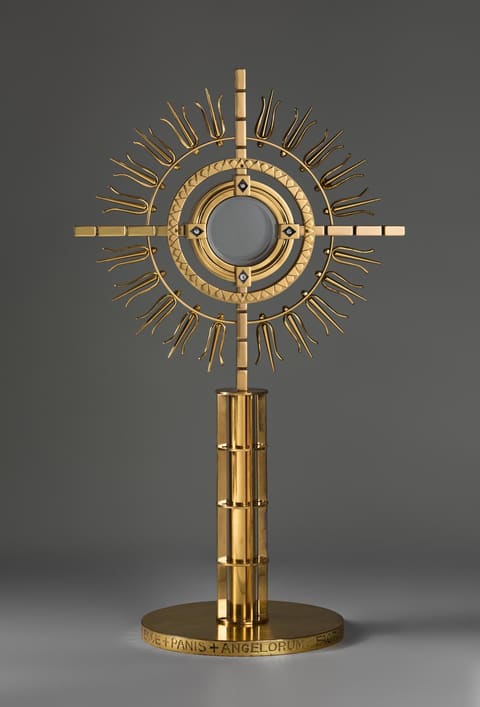
Translated from Lithuanian: A nearly 70-cm-tall monstrance designed by Kazys Varnelis, better known as a master of Op art than as a maker of church art; the museum calls it perhaps the only such work in Lithuania from Varnelis’s studio of ecclesiastical art. It was created in 1957 for the chapel of the Sisters of the Immaculate Conception of the Blessed Virgin Mary in Putnam, Connecticut (USA), whose interior Varnelis designed. The newest acquisition of the Kazys Varnelis House-Museum (an LNM branch), it arrived from the United States in 2024.
“Naujausias Kazio Varnelio namų-muziejaus rinkinio eksponatas – ypatingas Kazio Varnelio suprojektuotas bažnytinės dailės kūrinys – beveik 70 cm aukščio monstrancija, 2024 m. atkeliavusi iš Jungtinių Amerikos Valstijų.”
In the museum’s words — lnm.lt ↗ · quotation verified against the live page
Lithuanian Tricolour Flag from the Gediminas Castle Tower (1989)
Unknown
1989 · Textile
Lithuanian
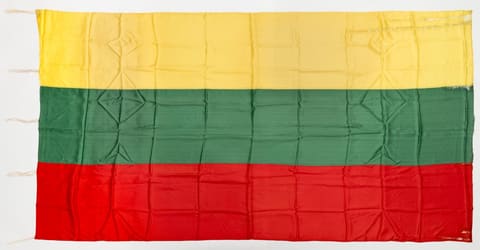
Translated from Lithuanian: The tricolour flag that flew on the Gediminas Castle Tower in 1989, displayed there for the National Museum of Lithuania’s 170th anniversary. The museum’s text recounts the tower’s flag history from its beginning: on the cold evening of 1 January 1919 a party of ten volunteers reached Gediminas Hill and three of them raised the Lithuanian tricolour on the tower; the flag was destroyed days later when the Red Army took Vilnius. Since 1988 the tricolour has flown permanently on the hill, replaced each 1 January in a ceremony on Lithuanian Flag Day.
“Minint Lietuvos nacionalinio muziejaus įkūrimo 170 metų sukaktį, Gedimino pilies bokšte eksponuojama 1989 m. ant bokšto plevėsavusi trispalvė.”
In the museum’s words — lnm.lt ↗ · quotation verified against the live page
“Perkūnas” Statuette from Kernavė — exhibit no. 1 of the Vilnius Museum of Antiquities
Unknown
Entered as no. 1 in the 1858 catalogue of the Vilnius Museum of Antiquities
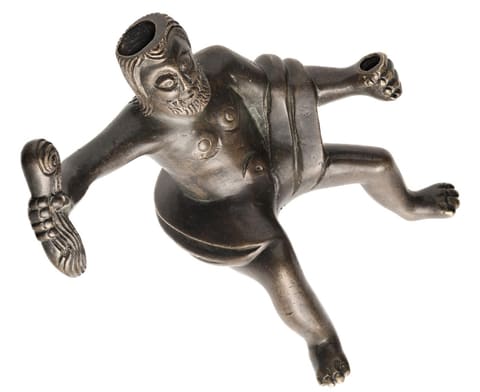
Translated from Lithuanian: The object with which the collection of the Vilnius Museum of Antiquities — the first public museum in Lithuania, founded on Count Eustachy Tyszkiewicz’s private collection — begins. In the museum’s 1858 catalogue, compiled by Adomas Honoris Kirkoras, it is entered as no. 1 and named the ‘Perkūnas statuette from Kernavė’. Long imagined as an image of the pre-Christian thunder-god Perkūnas and a symbol of pagan Lithuania, the museum now considers it a practical fitting, most likely part of a light. Presented at the Old Arsenal as the museum’s founding exhibit for its 170th anniversary.
“Senienų muziejaus 1858 m. eksponatų kataloge, kurį sudarė Adomas Honoris Kirkoras, šis eksponatas įrašytas pirmu numeriu ir įvardytas kaip „Perkūno statulėlė iš Kernavės“.”
In the museum’s words — lnm.lt ↗ · quotation verified against the live page
N° 1198·Undated
Renaissance Ring from the Castellan’s House, Vilnius
Unknown
Form and decoration typical of 16th-century jewellery (found 2021) · Metal, decorated with enamel and niello
Renaissance
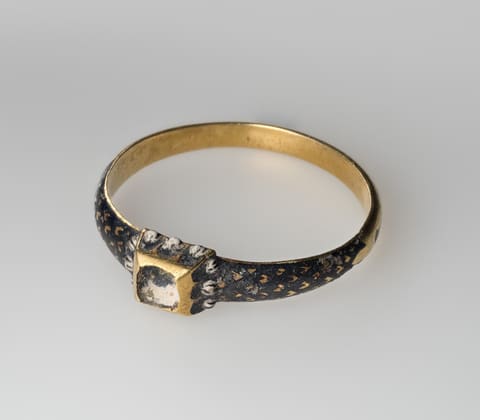
Translated from Lithuanian: A ring unearthed in 2021 while excavating the first cellar of the Castellan’s House, which had been buried during an 18th-century fire. Its form and decoration resemble the enamelled and nielloed jewellery favoured by nobles and wealthy townsfolk in the 16th century. Presented as the signature exhibit of the Castellan’s House (Pilininko namas), an LNM branch in the Vilnius Castle complex, for the museum’s 170th anniversary.
“Žiedas buvo rastas 2021 m., atkasant pirmąjį namo rūsį, užverstą 18 amžiuje gaisro metu. Jo forma ir dekoras panašūs kaip 16 amžiuje bajorų ir turtingų miestiečių pamėgtų juvelyrinių dirbinių, dekoruotų emaliu ir juodinimu.”
In the museum’s words — lnm.lt ↗ · quotation verified against the live page