The Atlas·EG

EG

Grand Egyptian Museum, Giza — 18 works · museum site ↗ · 2686 BCE – 395 CE 60000 BCE2020

Seen from Giza, history is above all sculpture, then faith & ritual objects — a collection opened wide onto other worlds — a window more than a mirror (18 of 18 works are from other civilisations).

Sculpture 6 Ritual 4 Power 4 Architecture 2 Craft 2
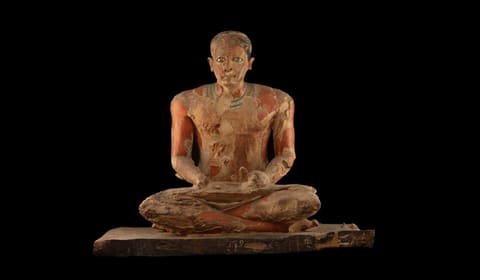
Statue of the Scribe Mitri
N° 053·I · The First Makers
Statue of the Scribe Mitri
Unknown
Old Kingdom · Painted wood
Ancient Egyptian · Old Kingdom

A painted wooden statue of Mitri, a Fifth-Dynasty official, seated in the traditional cross-legged scribe pose with inlaid-stone eyes and a papyrus roll on his lap; his names and titles are inscribed on the base. Main Galleries.

“This painted wooden statue belongs to Mitri who held many important titles” In the museum’s words — gem.eg ↗ · quotation verified against the live page

Meanwhile — Harappan Jar South Asia · 2500-2400 BCE (Middle Bronze Age)
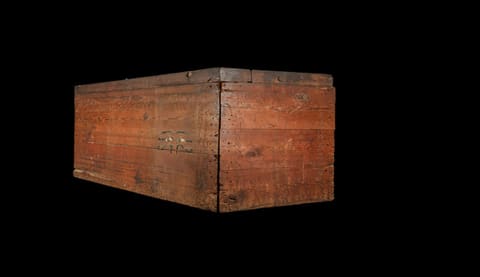
Exterior Coffin of Mesehti
N° 075·I · The First Makers
Exterior Coffin of Mesehti
Unknown
Middle Kingdom · Wood
Ancient Egyptian · Middle Kingdom

The wooden exterior coffin of Mesehti, nomarch of Asyut and overseer of priests of Wepwawet and Anubis, one of a pair from his tomb; it bears inscriptions partly derived from the Pyramid Texts. Main Galleries.

“A set of two wooden coffins were found in the tomb of Mesehti in Asyut.” In the museum’s words — gem.eg ↗ · quotation verified against the live page

Meanwhile — Clay Tablet with Case (Apil-Sin Period) Near East · 19th century BC (reign of Apil-Sin)

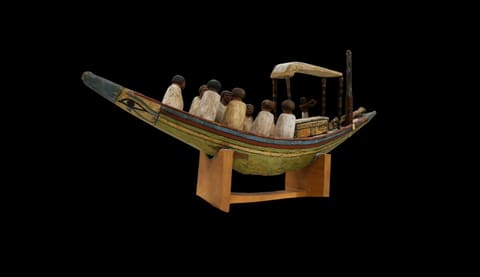
Model of Funerary Boat of Ukhhotep
N° 076·I · The First Makers
Model of Funerary Boat of Ukhhotep
Unknown
Middle Kingdom · Painted wood
Ancient Egyptian · Middle Kingdom

A Middle Kingdom painted wooden model of a funerary boat with hawk-headed rudderposts, discovered at Meir in 1885; a model sarcophagus inscribed for Ukhhotep lies under a four-post canopy among nine seated figures. Main Galleries.

“A painted wooden model of a funerary boat discovered in Meir in 1885. The two rudderposts are hawk-headed.” In the museum’s words — gem.eg ↗ · quotation verified against the live page

Meanwhile — Clay Tablet with Case (Apil-Sin Period) Near East · 19th century BC (reign of Apil-Sin)

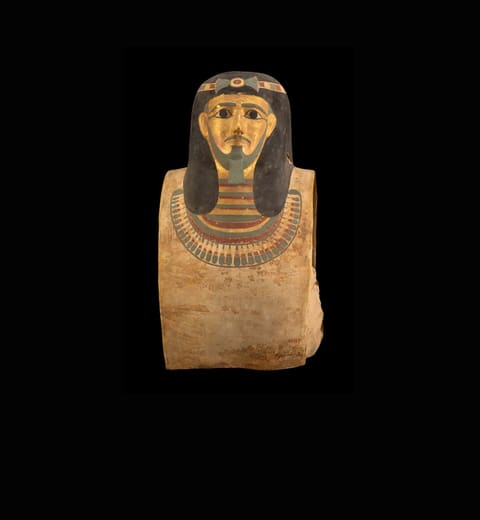
Mummy Mask of Mesehti
N° 077·I · The First Makers
Mummy Mask of Mesehti
Unknown
Middle Kingdom · Cartonnage
Ancient Egyptian · Middle Kingdom

A painted cartonnage mummy mask of Mesehti, a provincial governor of Asyut in the later 11th Dynasty; his tomb was discovered at Asyut in 1893. He is shown with a lotus fillet and a multi-coloured broad collar. Main Galleries.

“Funerary masks were used in ancient Egypt to protect the head of the deceased and to ensure that their features were perfectly portrayed. This cartonnage mummy mask belongs to Mesehti who served as a provincial governor of Asyut” In the museum’s words — gem.eg ↗ · quotation verified against the live page

Meanwhile — Clay Tablet with Case (Apil-Sin Period) Near East · 19th century BC (reign of Apil-Sin)

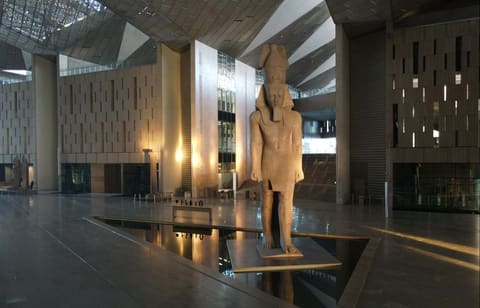
Colossal Statue of Ramesses II
N° 093·I · The First Makers
Colossal Statue of Ramesses II
Unknown
New Kingdom · Granite
Ancient Egyptian · New Kingdom

A colossal granite statue of Ramesses II that originally stood outside the main temple of the god Ptah at Memphis, guarding its sacred inner space, with Prince Khaemwaset and Princess Bintanath carved behind the king's legs. It stands in the museum's Grand Hall (the pictured image shows it in situ in the atrium).

“Then as now, this giant statue reflects the power and richness of King Ramesses II. It originally stood outside the main temple of god Ptah at Memphis, guarding its sacred inner space.” In the museum’s words — gem.eg ↗ · quotation verified against the live page

Meanwhile — Statuette of a goat Near East · Late Bronze Age, 14th–13th centuries BC

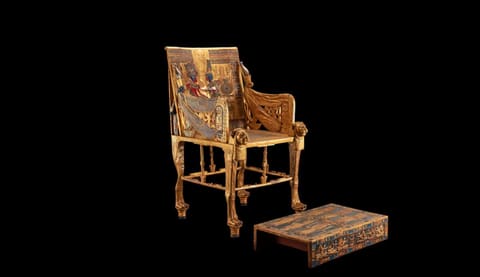
Golden Throne
N° 094·I · The First Makers
Golden Throne
Unknown
New Kingdom · Gilded wood inlaid with glass, faience and semi-precious stones
Ancient Egyptian · New Kingdom

Tutankhamun's gilded wooden armchair, found wrapped in linen in the Antechamber of his tomb; the wood is sheathed in gold that is both chased and inlaid with glass, faience and semi-precious stones. Tutankhamun Galleries.

“This beautifully decorated armchair was found wrapped in linen in the Antechamber.” In the museum’s words — gem.eg ↗ · quotation verified against the live page

Meanwhile — Statuette of a goat Near East · Late Bronze Age, 14th–13th centuries BC

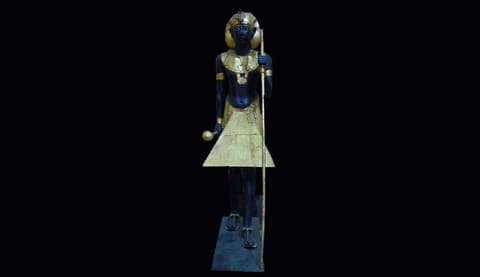
Guardian Statue with Khat Headdress
N° 095·I · The First Makers
Guardian Statue with Khat Headdress
Unknown
New Kingdom · Gilded wood
Ancient Egyptian · New Kingdom

One of two almost identical life-size 'guardian' portrait statues of Tutankhamun that flanked the sealed entrance to his Burial Chamber; this figure wears the khat headdress. Tutankhamun Galleries.

“Two almost identical portrait statues of King Tutankhamun flanked the sealed entrance to his Burial Chamber.” In the museum’s words — gem.eg ↗ · quotation verified against the live page

Meanwhile — Statuette of a goat Near East · Late Bronze Age, 14th–13th centuries BC

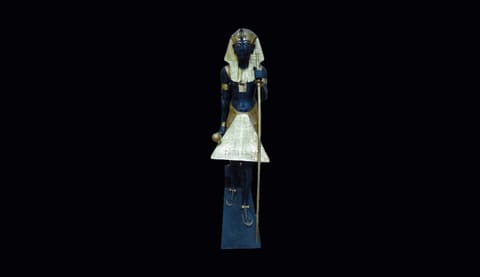
Guardian Statue with Nemes Headcloth
N° 096·I · The First Makers
Guardian Statue with Nemes Headcloth
Unknown
New Kingdom · Wood, gold, bronze and gesso
Ancient Egyptian · New Kingdom

The companion life-size guardian statue of Tutankhamun, wearing the nemes headcloth, one of the pair that stood face to face before the sealed doorway to his Burial Chamber. Tutankhamun Galleries.

“This life-sized statue of King Tutankhamun is one of a pair that stood face to face before the sealed doorway to his Burial Chamber.” In the museum’s words — gem.eg ↗ · quotation verified against the live page

Meanwhile — Statuette of a goat Near East · Late Bronze Age, 14th–13th centuries BC

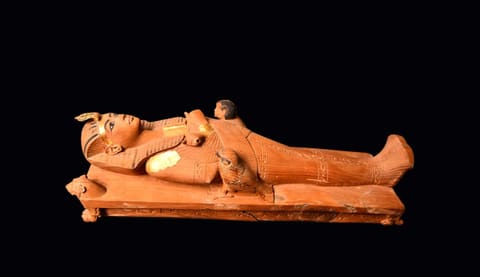
Model of Tutankhamun on a Funerary Bed
N° 097·I · The First Makers
Model of Tutankhamun on a Funerary Bed
Unknown
New Kingdom · Wood
Ancient Egyptian · New Kingdom

A wooden model of Tutankhamun shown as a mummy lying on a funerary bed, found wrapped in a linen cloth inside a sarcophagus-shaped box that also held shabti tools. Tutankhamun Galleries.

“This wooden model was found wrapped in a linen cloth inside a sarcophagus-shaped box” In the museum’s words — gem.eg ↗ · quotation verified against the live page

Meanwhile — Statuette of a goat Near East · Late Bronze Age, 14th–13th centuries BC

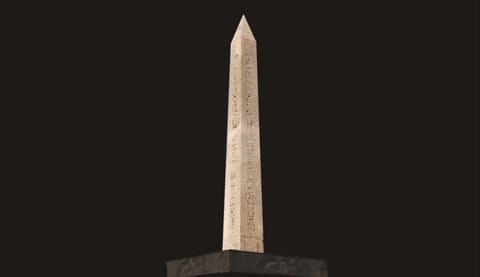
Obelisk of King Ramesses II
N° 098·I · The First Makers
Obelisk of King Ramesses II
Unknown
New Kingdom · Granite
Ancient Egyptian · New Kingdom

A 16-metre, 87-ton granite obelisk of Ramesses II from Tanis (San el-Hagar), the tallest that ever stood there, inscribed on all four sides with the king's names. At the Grand Egyptian Museum it is raised on a platform above four pillars, the 'Hanging Obelisk', so visitors can view the cartouches on its base; the museum presents it as the first artefact welcoming visitors.

“Ramesses II raised over ten obelisks at Tanis (San el-Hagar) in the Eastern Delta. With a total height of 16 meters, this granite obelisk is the highest that ever stood at Tanis.” In the museum’s words — gem.eg ↗ · quotation verified against the live page

Meanwhile — Statuette of a goat Near East · Late Bronze Age, 14th–13th centuries BC

Pyramidion of an Obelisk of Queen Hatshepsut
N° 099·I · The First Makers
Pyramidion of an Obelisk of Queen Hatshepsut
Unknown
New Kingdom · Red granite
Ancient Egyptian · New Kingdom

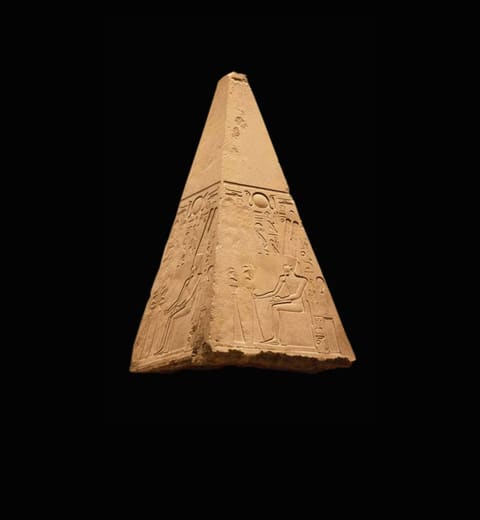
The red granite pyramidion (capstone) of an obelisk erected by Queen Hatshepsut at the Temple of Amun-Re at Karnak, discovered in 1861; its reliefs of the kneeling queen before Amun-Re were later altered, probably under Thutmose III. Grand Staircase.

“This red granite pyramidion originally belonged to an obelisk erected by Queen Hatshepsut at the Temple of Amun-Re at Karnak.” In the museum’s words — gem.eg ↗ · quotation verified against the live page

Meanwhile — Statuette of a goat Near East · Late Bronze Age, 14th–13th centuries BC

Royal Diadem
N° 100·I · The First Makers
Royal Diadem
Unknown
New Kingdom · Gold
Ancient Egyptian · New Kingdom

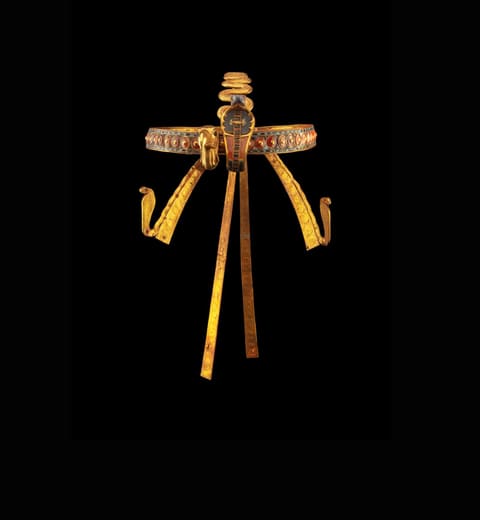
Tutankhamun's royal diadem, a solid-gold fillet decorated with red carnelian roundels and blue glass squares, found concealed under the golden funerary mask on the king's head. Tutankhamun Galleries.

“Concealed under the golden funerary mask, this elaborate diadem encircled the king’s head.” In the museum’s words — gem.eg ↗ · quotation verified against the live page

Meanwhile — Statuette of a goat Near East · Late Bronze Age, 14th–13th centuries BC

Statue of God Ptah, King Ramesses II & Goddess Sekhmet
N° 101·I · The First Makers
Statue of God Ptah, King Ramesses II & Goddess Sekhmet
Unknown
New Kingdom · Red granite
Ancient Egyptian · New Kingdom

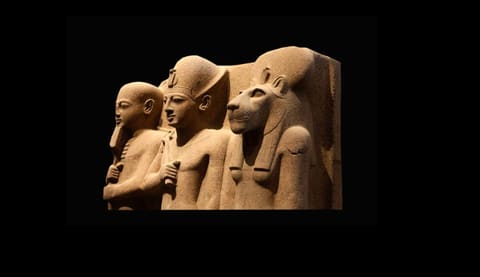
A red granite triad discovered in 1904 near the courtyard of the Temple of Heryshef at Herakleopolis Magna (Ihnasya el-Medina), showing King Ramesses II standing between the god Ptah and the lioness-headed goddess Sekhmet. Displayed on the Grand Staircase.

“Discovered in 1904 near the courtyard of the Temple of Heryshef at Herakleopolis Magna (Ihnasya el-Medina), this red granite colossal represents King Ramesses II standing between god Ptah and goddess Sekhmet.” In the museum’s words — gem.eg ↗ · quotation verified against the live page

Meanwhile — Statuette of a goat Near East · Late Bronze Age, 14th–13th centuries BC

Statue of Queen Hatshepsut
N° 102·I · The First Makers
Statue of Queen Hatshepsut
Unknown
New Kingdom · Red granite
Ancient Egyptian · New Kingdom

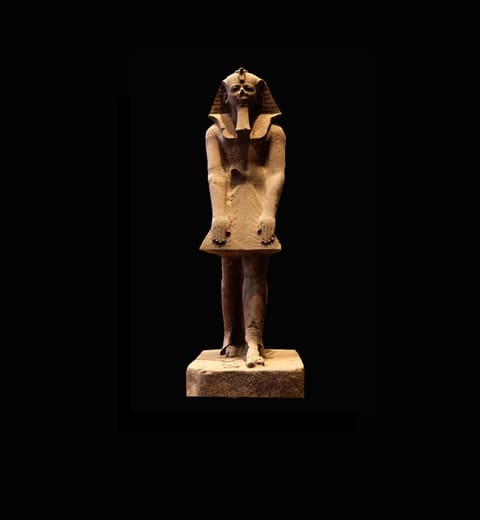
A red granite statue of Queen Hatshepsut, daughter of King Thutmose I, who ruled as king; the museum notes her statuary combines feminine traits with masculine royal symbols such as the false beard. Grand Staircase.

“Queen Hatshepsut was a daughter of King Thutmose I and chief royal wife of King Thutmose II.” In the museum’s words — gem.eg ↗ · quotation verified against the live page

Meanwhile — Statuette of a goat Near East · Late Bronze Age, 14th–13th centuries BC

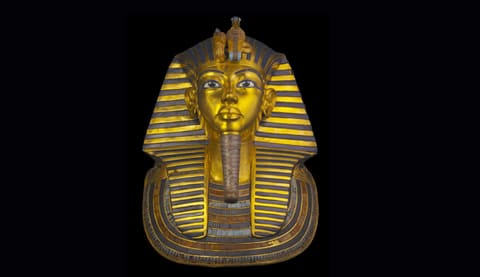
The Golden Burial Mask of Tutankhamun
N° 103·I · The First Makers
The Golden Burial Mask of Tutankhamun
Unknown
New Kingdom · Gold, glass, lapis lazuli, obsidian, carnelian, faience, quartzite
Ancient Egyptian · New Kingdom

The gold funerary mask of Tutankhamun, found placed over the head and shoulders of the king's mummified remains; the museum calls it one of the most famous objects in the world. The face idealises Tutankhamun as the gods Osiris and Re, and an inscription on the back identifies parts of the mask with individual deities. Displayed in the Tutankhamun Galleries.

“This mask of solid gold is one of the most famous objects in the world. It was found placed over the head and shoulders of Tutankhamun’s mummified remains.” In the museum’s words — gem.eg ↗ · quotation verified against the live page

Meanwhile — Statuette of a goat Near East · Late Bronze Age, 14th–13th centuries BC

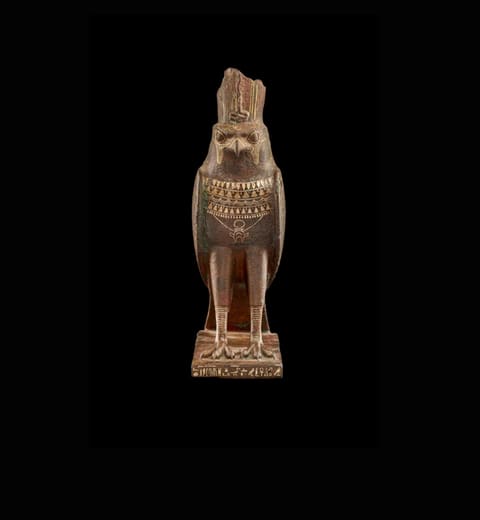
Statuette of a Falcon
N° 158·II · The Classical World
Statuette of a Falcon
Unknown
Late Period · Gilt bronze
Ancient Egyptian · Late Period

A gilt bronze votive statuette of a hawk, the avian form of the god Horus, discovered in 1893 at Sais (Sa el-Hagar) in the western Nile Delta and dated by the museum to Dynasty 26 (Late Period). It was cast by the lost-wax technique, with gold highlighting the head, plumage and collar. Main Galleries.

“This gilt bronze votive statuette of a hawk was discovered in 1893 at Sais (Sa-al-Hagar) in the western Delta” In the museum’s words — gem.eg ↗ · quotation verified against the live page

Meanwhile — Bull-headed rhyton Near East · 6th–5th centuries BC

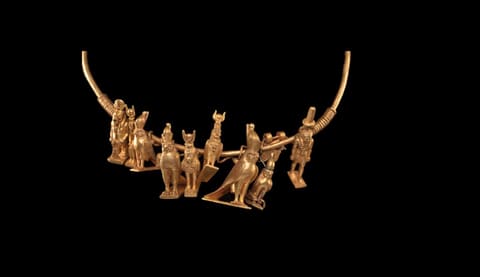
Golden Necklace (Dendera Treasure Hoards)
N° 209·II · The Classical World
Golden Necklace (Dendera Treasure Hoards)
Unknown
Graeco-Roman · Gold
Ancient Egyptian · Graeco-Roman

A Ptolemaic gold necklace from the 'Dendera Treasure Hoards', caches found between the Dendera temple and its enclosure wall; ten symbolic figures hang from the gold wire, including Taweret, a seated Isis and falcons. Part of a hoard confiscated in 1914. Main Galleries.

“The so-called ‘Dendera Treasure Hoards’ were caches of spectacular objects of great art-historical value that were discovered in the area between the Dendera temple and its enclosure wall.” In the museum’s words — gem.eg ↗ · quotation verified against the live page

Meanwhile — Marble portrait of a woman (Empress Livia?) from Salona Rome · First half of the 1st century CE

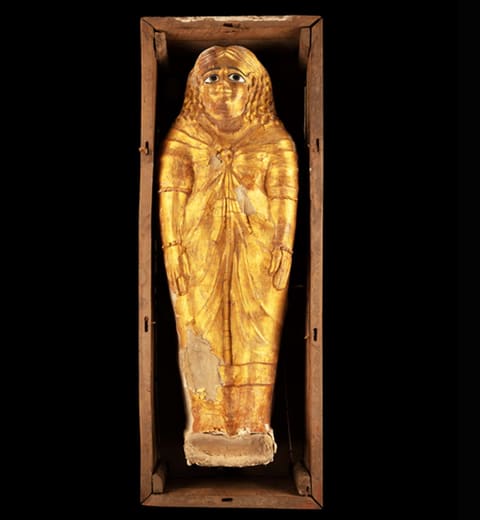
Mummified Child in Gilded Cartonnage
N° 210·II · The Classical World
Mummified Child in Gilded Cartonnage
Unknown
Graeco-Roman · Gilded cartonnage
Ancient Egyptian · Graeco-Roman

A Graeco-Roman mummified child in a gilded cartonnage placed inside a wooden coffin, from Beni Suef; the museum notes the artistry and amount of gold speak to the wealth of the young girl's family. Main Galleries.

“Mummified child in a gilded cartonnage placed inside a wooden coffin.” In the museum’s words — gem.eg ↗ · quotation verified against the live page

Meanwhile — Marble portrait of a woman (Empress Livia?) from Salona Rome · First half of the 1st century CE