The Atlas·FI

FI

National Museum of Finland (Suomen kansallismuseo), Helsinki — 20 works · museum site ↗ · 6800 BCE – 1994 60000 BCE2020

Seen from Helsinki, history is above all treasure & power, then sculpture — a collection kept wholly in its own tradition — a mirror.

Power 6 Sculpture 5 Sacred 3 Craft 2 Observation 2 Ritual 1 Stories 1
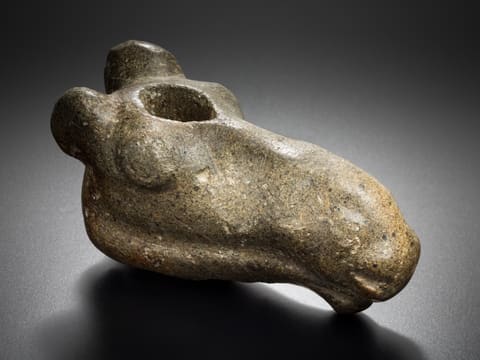
Elk’s Head of Huittinen
N° 007·I · The First Makers
Elk’s Head of Huittinen
Unknown
Late Mesolithic Stone Age, c. 6800–5200 BCE · soapstone
Finnish Stone Age · Late Mesolithic

An artfully carved soapstone elk’s head (14.5 cm long), one of the most famous Stone Age animal-head weapons found in Finland; the museum dates the sculpture to the late Mesolithic, around 6800–5200 BCE, and the Palojoki, Huittinen settlement where it was found to approximately 6100 BCE by radiocarbon. Probably modelled on a killed young elk and too soft to serve as a weapon or tool, it was likely a valuable ceremonial item (KM6292:1).

“In the Stone Age, the elk was an important animal that was depicted in both rock art paintings and objects. Objects decorated with elks’ heads had a special significance for people of the Stone Age. One of the most famous animal head weapons found in Finland is the Elk’s Head of Huittinen, which dates back to the Mesolithic Stone Age.” In the museum’s words — kansallismuseo.fi ↗ · quotation verified against the live page

Meanwhile — Idol (pebble) Near East · Byblos, Neolithic Period (9,000–4,000 B.C.)
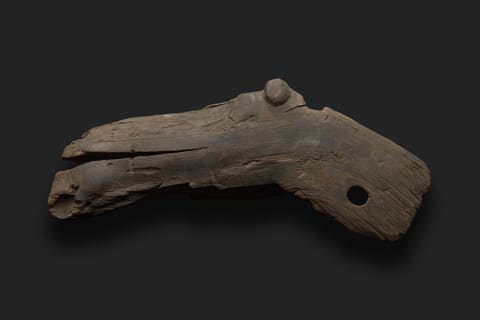
Wooden elk head sculpture
N° 010·I · The First Makers
Wooden elk head sculpture
Unknown
Mesolithic Stone Age, c. 6000 BCE · wood
Finnish Stone Age · Mesolithic

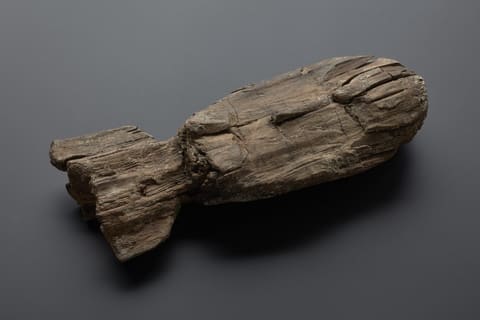
A c. 8,000-year-old wooden elk head painted with red ochre, found in a bog at Lehtojärvi, Rovaniemi in 1955; carved joints suggest it was a boat figurehead, making it the only physical evidence of the elk-head boats known from rock art. It weighs 748 g and is about 37 cm long.

“This wooden elk head was found in a bog in Lehtojärvi, Rovaniemi, when digging a ditch in 1955. Based on the joints carved into the elk’s head, the object was probably a boat figurehead.” In the museum’s words — kansallismuseo.fi ↗ · quotation verified against the live page

Meanwhile — Idol (pebble) Near East · Byblos, Neolithic Period (9,000–4,000 B.C.)
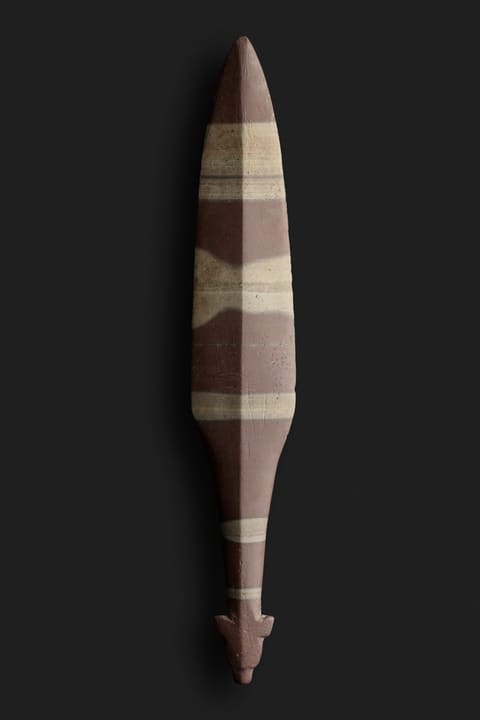
Animal head dagger from Pyhäjoki
N° 016·I · The First Makers
Animal head dagger from Pyhäjoki
Unknown
Neolithic Stone Age (5200–1900/1700 BCE) · red slate
Finnish Stone Age · Neolithic

A skilfully ground dagger of light-striped Scandinavian (Köli) red slate whose handle ends in a bear’s head seen from above, found during gravel extraction beside a Stone Age settlement at Pyhäjoki (KM13438:1). The museum dates it to the Neolithic Stone Age (5200–1900/1700 BCE); 16 cm long and with no signs of use, it is linked to ritual valuables reflecting the bear’s power as a spirit animal.

“This skilfully crafted dagger with a bear’s head handle was found in Pyhäjoki when extracting gravel right next to a Stone Age settlement. The object is made of light-striped Scandinavian (Köli) red slate.” In the museum’s words — kansallismuseo.fi ↗ · quotation verified against the live page

Meanwhile — Leather shoe from Areni-1 (world's oldest shoe) Near East · Copper Age, c. 3600–3500 BC

Wooden god
N° 033·I · The First Makers
Wooden god
Unknown
Neolithic Stone Age, c. 4000–2000 BCE · wood
Finnish Stone Age · Neolithic

A narrow, flat wooden sculpture of a human head, 24.5 cm high and broken off below the shoulders, found during shore excavations at Pohjankuru (present-day Raasepori) in 1897 and dated to the Neolithic Stone Age, c. 4000–2000 BCE (KM 3481:1). The museum has also published a 3D model of it.

“This wooden sculpture of a human head was found during shore excavations in Pohjankuru, present-day Raasepori, in 1897. The object has been dated to the Neolithic Stone Age circa 4000–2000 BCE.” In the museum’s words — kansallismuseo.fi ↗ · quotation verified against the live page

Meanwhile — Brick Bearing the Handprint of its Original Builder Near East · c. 3000 BCE (Early Bronze Age)

Bronze axes from Tapaninkylä
N° 107·I · The First Makers
Bronze axes from Tapaninkylä
Unknown
c. 1500–1300 BCE · bronze
Nordic Bronze Age · Bronze Age

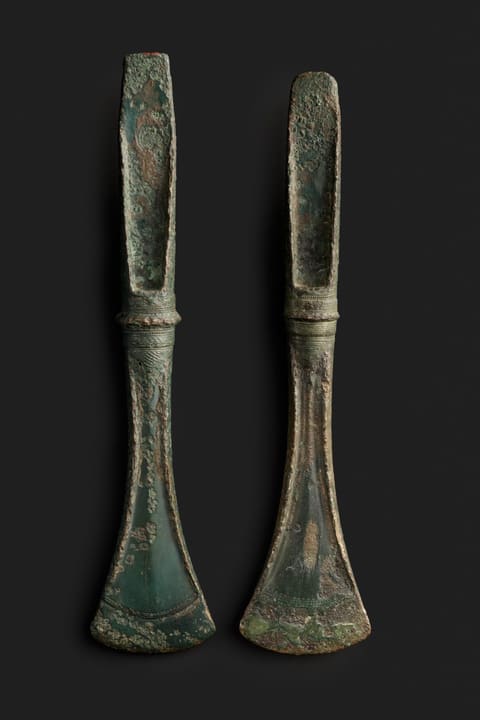
A pair of narrow-headed palstave axes of Danish type, decorated with line, dot and spiral patterns, found in the 1840s near the Bronze Age shoreline at Tapaninkylä, Helsinki; the museum counts them among the finest bronze objects in Finland and notes the (uncertain) association of paired bronze sacrifices with the Bronze Age cult of divine twins (KM72:1a-b).

“Two narrow-headed bronze axes were found in Tapaninkylä, Helsinki, in the 1840s. The axes are among the finest bronze objects in Finland. They are decorated with various line, dot and spiral patterns.” In the museum’s words — kansallismuseo.fi ↗ · quotation verified against the live page

Meanwhile — Dagger with a sheath from Lchashen Near East · Late Bronze Age, 15th–14th centuries BC

Snake buckle
N° 342·III · Faith and Empire
Snake buckle
Unknown
Vendel Period, c. 550–800 CE · bronze
Finnish Iron Age · Vendel Period

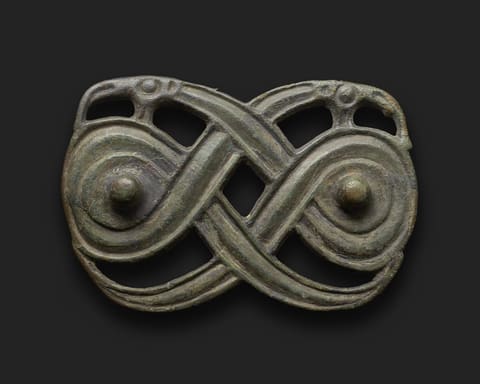
A bronze buckle formed of two intertwined snakes, 8.1 cm long, found at Hattelmala, Hämeenlinna, in 1925 as part of a hoard hidden at the base of a rock; the museum dates it to the Vendel Period (c. 550–800s) and suggests the hoard may have belonged to a bronze caster or been looted from cemeteries (KM8615:1).

“This bronze snake buckle was found in Hattelmala, Hämeenlinna, in 1925. The object was part of a hoard hidden at the base of a rock along with some other bronze jewellery and fragments.” In the museum’s words — kansallismuseo.fi ↗ · quotation verified against the live page

Meanwhile — Plaque with Buddhas and attendants East Asia · dated 664-665 (Tang dynasty)

Sword from Pappilanmäki, Eura
N° 349·III · Faith and Empire
Sword from Pappilanmäki, Eura
Unknown
7th century CE · Damascus steel, gold-plated bronze handle, wooden scabbard
Finnish Iron Age · Vendel Period

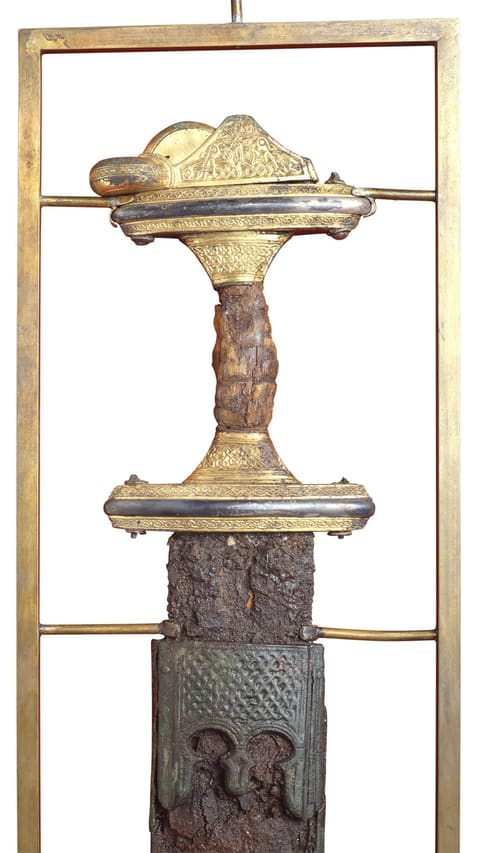
A 7th-century ring-sword — the only complete one found in Finland, still rusted into its partly preserved wooden scabbard — found in 1939 when a boiler room was being dug at a farm in Pappilanmäki, Eura, and deposited in the National Museum’s collection that spring (KM11002:5). X-ray photography has revealed Damascus steel, the handle is gold-plated bronze, and the large notch in the scabbard’s middle came from a workman’s shovel; the museum presents it as a prestige object from a destroyed grave in the prosperous late Iron Age Eura region.

“One of Finland’s most famous Iron Age swords is the ring-sword found in Pappilanmäki, Eura in 1939, dating back to the 7th century.” In the museum’s words — kansallismuseo.fi ↗ · quotation verified against the live page

Meanwhile — Gold Crown (Altan Titem) East Asia · 6th–8th century

Brooch from Laitila
N° 391·III · Faith and Empire
Brooch from Laitila
Unknown
Viking Age · silver
Viking Age · Viking Age

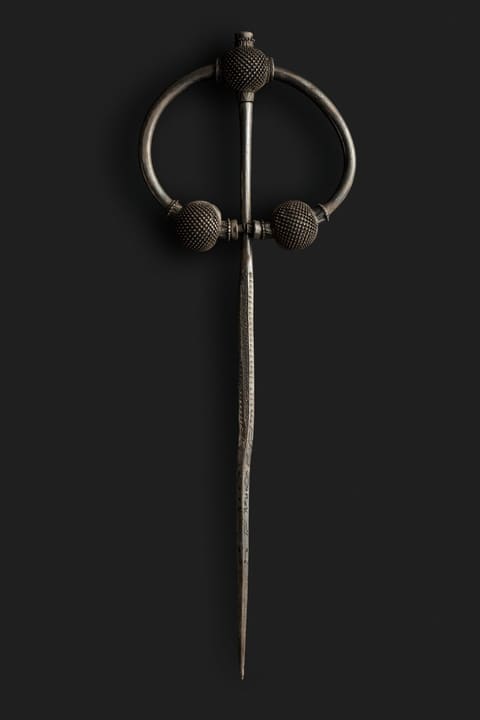
A large silver “thistle brooch” of Irish type — the only one of its kind known in Finland — found in a field at Laitila in 1940; its finder thought it had fallen from a Russian aircraft and hung it on a fence pole for months before it reached the National Museum’s collections (KM11243:1). Such large brooches fastened cloaks and displayed the owner’s wealth and position.

“This silver brooch dating from the Viking Age was found in a field in Laitila in 1940. The person who found the large brooch thought it had come from a Russian plane during the war and put it on a fence pole.” In the museum’s words — kansallismuseo.fi ↗ · quotation verified against the live page

Meanwhile — Manjusri Sikhadara South Asia · Early 10th century

Cross pendant from Taskula
N° 439·III · Faith and Empire
Cross pendant from Taskula
Unknown
Era of the crusades, 11th century onwards · silver
Finnish Iron Age · Crusade period

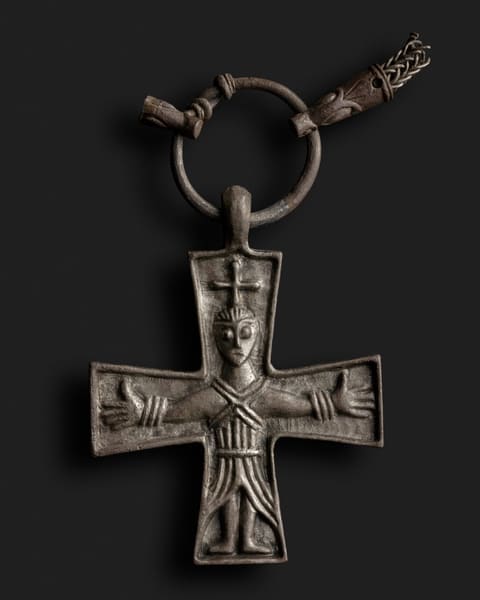
A silver crucifix pendant from a man’s grave at Taskula (Maaria), Turku, found in 1938: one side bears the crucified Christ — exceptionally with a small cross on his head — and the other probably the Virgin Mary with wrists tied to the cross’s arms; the braided chain ends in delicate animal-head tubes (KM11275:29). The museum sees Eastern Church influence in the treatment and leaves open what the pendant meant to its wearer.

“The cross pendant of Taskula is made of silver and has the image of the crucified Christ on one side, and the other side probably depicts the Virgin Mary, whose wrists are tied to the arms of the cross.” In the museum’s words — kansallismuseo.fi ↗ · quotation verified against the live page

Meanwhile — Mother and Child South Asia · 10th-11th Century AD

Grave number 56 from Luistari, Eura
N° 456·III · Faith and Empire
Grave number 56 from Luistari, Eura
Unknown
Viking Age; buried after 1018, early 11th century
Finnish Iron Age · Viking Age

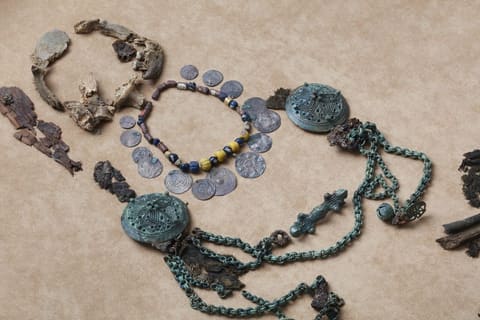
The richly furnished grave of a woman dubbed the “Eura Queen” by excavation director Pirkko-Liisa Lehtosalo-Hilander, found in 1969 in the Luistari cemetery at Eura, which was in use for almost 800 years and held more than 1,300 burials. The newest coin in her necklace (struck under Cnut the Great, 1018–1024) and radiocarbon dating place the burial in the early 11th century, after 1018; her jewellery and grave goods are among the signature Iron Age finds the museum presents from its Prehistory exhibition.

“The woman buried in grave number 56 in Luistari was named the “Eura Queen” by the director of the excavation, Pirkko-Liisa Lehtosalo-Hilander. The grave was found during the first summer of digging in 1969.” In the museum’s words — kansallismuseo.fi ↗ · quotation verified against the live page

Meanwhile — Coyote Warrior (Guerrero Coyote) Americas & Oceania · Early Postclassic (c. 900–1150 CE)

Treasure of Halikko
N° 470·III · Faith and Empire
Treasure of Halikko
Unknown
1100s (hidden mid- to late 1100s) · gold-plated silver and silver
Romanesque · Crusade period

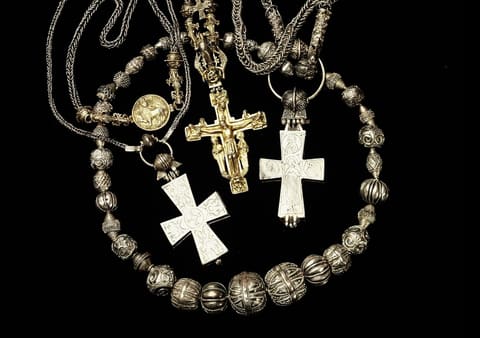
A silver hoard found in 1887 on the grounds of Joensuu Manor in Halikko, hidden in a clay pot in the mid-to-late 1100s: its unique gold-plated silver crucifix — a masterpiece of Romanesque craftsmanship likely made by a German goldsmith, with no parallel anywhere in Europe — comes with two cross pendants, 36 filigree beads and a filigree pendant. The museum presents it as property of a high-ranking priest or rich aristocrat from one of the most important transitional periods in Finnish history.

“The most unique item in the Halikko treasure is the three-dimensional crucifix, made of gold-plated silver. It is a masterpiece of the Romanesque craftsmanship of the 1100s. The Halikko crucifix was likely made by a German goldsmith.” In the museum’s words — kansallismuseo.fi ↗ · quotation verified against the live page

Meanwhile — Male human figure (Manta culture) Americas & Oceania · 800–1500 CE

Kalanti altarpiece
N° 574·IV · Toward the Renaissance
Kalanti altarpiece
Master Francke
1430s · oak, oil paint
Northern Gothic · Late Middle Ages

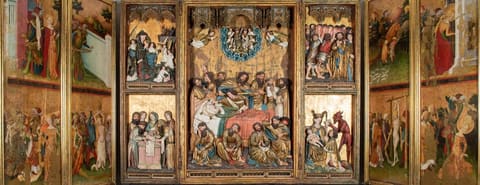
A winged oak altarpiece from Kalanti Church: relief sculptures of the life of the Virgin Mary by an unknown workshop, and door panels of the martyrdom of Saint Barbara painted in Hamburg in the 1430s by the painter known as Master Francke. Purchased for the National Museum’s collections from the Kalanti/Uusikirkko parish in 1903 (H4329:6); the painted and sculpted parts have been kept separately since 1920s conservation, and the whole measures roughly 200 × 260 cm opened.

“The panel paintings on the doors depict the martyrdom story of Saint Barbara. They were painted by a painter known as Master Francke, who carried out the painting work in Hamburg in the 1430s.” In the museum’s words — kansallismuseo.fi ↗ · quotation verified against the live page

Meanwhile — Inkstone Box with Poetry-Inspired Seashore Design in Maki'e and Silver Inlay East Asia · Japan, Muromachi period, early 15th century

Holy Communion
N° 810·VII · The Age of Reason
Holy Communion
Margareta Capsia (1682–1759)
1725
Finnish

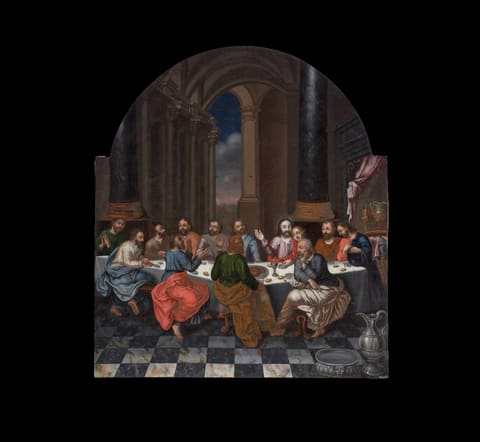
The earliest known painting by Margareta Capsia, the earliest known Finnish female artist: a Last Supper altarpiece painted in 1725 for the church of Pedersöre and donated to the Finnish Antiquarian Society in 1898. Based on a Bible engraving by Matthäus Merian, it singles out Judas by his purse of silver coins, darker complexion and direct gaze at the viewer; Capsia’s signature sits on a floor tile at bottom right.

“The 1725 painting of the Holy Communion, which she painted for the church of the Pedersöre rural municipality and which is now in the collection of the National Museum of Finland, is her earliest known painting.” In the museum’s words — kansallismuseo.fi ↗ · quotation verified against the live page

Meanwhile — A Hundred Steeds East Asia · 1728, Qing dynasty

Emperor’s throne
N° 848·VII · The Age of Reason
Emperor’s throne
Christian Meyer
1797–1799 · gilded wood (linden)
Russian Imperial · Russian Empire

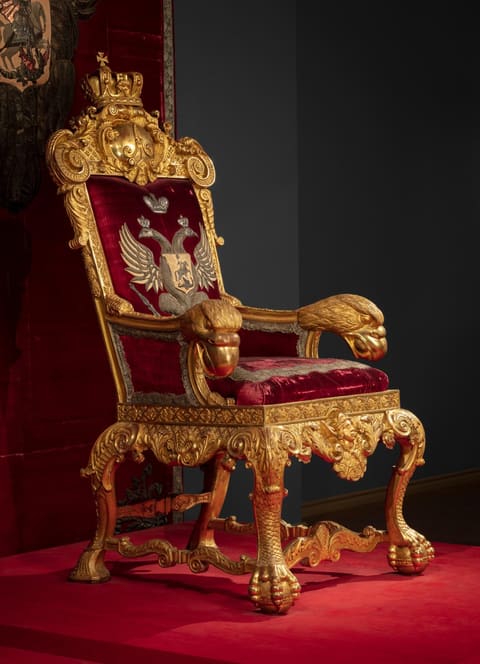
Made by Christian Meyer in St Petersburg in 1797–1799, of gilded linden wood upholstered in red velvet with silver cording: one of six copies of Nicholas Clausen’s 1731 silver throne of Empress Anna Ivanovna that Emperor Paul I commissioned as symbols of the Emperor’s power across the empire. This is the throne brought to the Diet of Porvoo in 1809, afterwards kept in Porvoo Cathedral, the Administrative Council in Turku and the Imperial Finnish Senate in Helsinki (H7266:1); two of its sibling thrones are in the Kremlin and one in the Hermitage.

“Made by Christian Meyer in St Petersburg in 1797–1799, the throne is made of gilded wood (linden) and upholstered with red velvet, lined with silver cording on the back and the seat.” In the museum’s words — kansallismuseo.fi ↗ · quotation verified against the live page

Meanwhile — The Buddhist Protector Mahakala East Asia · 18th–19th century

Bridal trinket crown
N° 896·VIII · The Restless Century
Bridal trinket crown
Unknown
Second half of the 19th century
Finnish folk culture

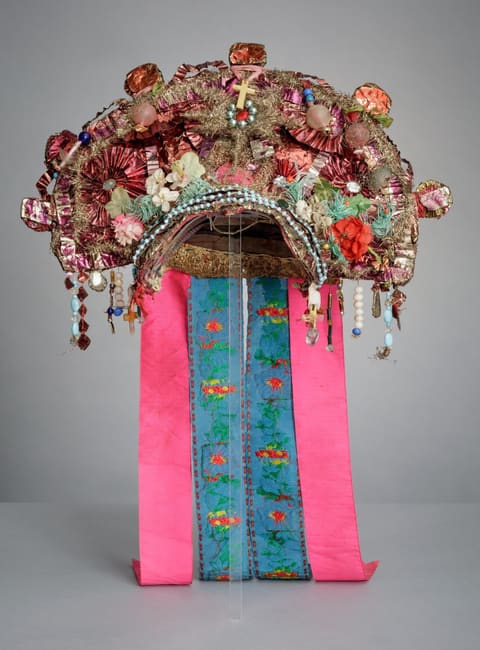
A half-moon-shaped bridal trinket crown from Vehkalahti in Kymenlaakso, the easternmost region where bridal crowns were traditionally used, of the staniol-paper-decorated type that developed there in the second half of the 19th century (K6816:146). Dressing a peasant bride in borrowed finery — crowned by the bridal crown as its most important symbol — is a custom the museum traces back to at least the 17th century.

“In Kymenlaakso, the easternmost region where bridal crowns were traditionally used, trinket crowns developed into a half-moon shape in the second half of the 19th century and were decorated with staniol paper.” In the museum’s words — kansallismuseo.fi ↗ · quotation verified against the live page

Meanwhile — Kahu kiwi (kiwi feather cloak) Americas & Oceania · Māori, 1850–1900

The Attack
N° 979·VIII · The Restless Century
The Attack
Eetu Isto
1899
Finnish · Russification era

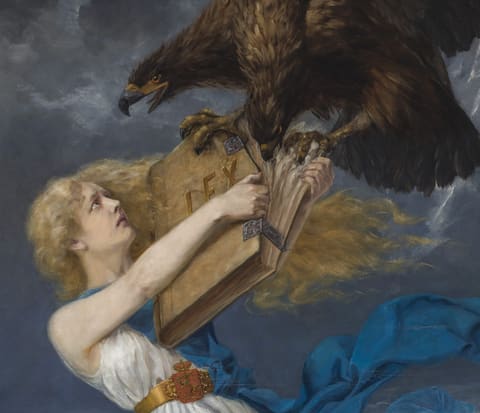
Eetu Isto’s 1899 allegory of the Russification years: the Finnish Maiden, the coat of arms of Finland on her belt, clutches the law book against the attacking two-headed eagle of Russia. Painted in Helsinki in late 1899 and transported to Sweden for fear of confiscation, it became the symbol of constitutional resistance, its banned copies distributed by a network of agents to Finns as far away as Sweden, the US and Hungary (H30058).

“Painted by Eetu Isto in 1899, The Attack is a painting that gained a huge reputation for its political resistance during the Russification of Finland (1899–1905 and 1908–1917). In the painting, the maiden bearing the coat of arms of Finland on her belt defends herself against the attacking two-headed eagle of Russia, who tries to steal a law book from her, just like Russia threatened Finland’s autonomy and law during the years of oppression.” In the museum’s words — kansallismuseo.fi ↗ · quotation verified against the live page

Meanwhile — Retrato del Sr. Juan Carlos Muñoz Americas & Oceania · 1899

Eugen Schauman’s (1875–1904) shirt
N° 993·IX · Into Our Time
Eugen Schauman’s (1875–1904) shirt
Unknown
1904
Finnish

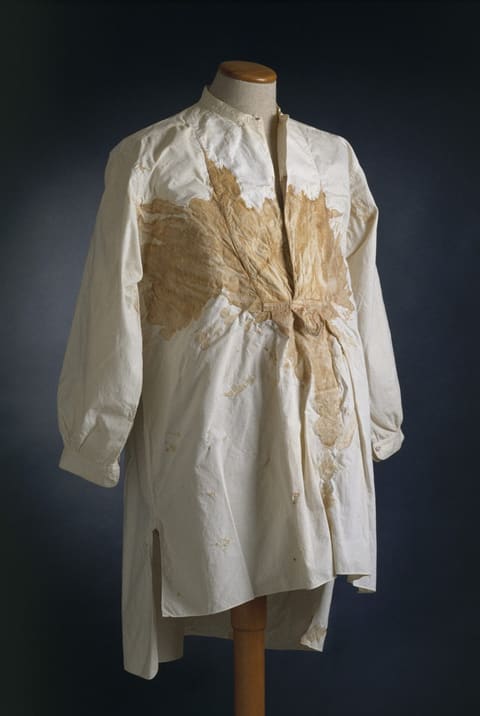
The blood-stained shirt worn by civil servant Eugen Schauman when he shot Governor-General Nikolay Bobrikov on the Senate staircase in Helsinki on 16 June 1904 and then himself — Finland’s best-known political murder, which the museum frames as interpretable both as terrorism and as a patriot’s desperate act. Hidden first in Porvoo and then in Sweden from the Gendarmes, the clothes were handed to the National Museum in 1924 at his father’s request (H8365:4).

“Schauman became a national hero and a patriotic martyr. The blood-stained clothes worn by Schauman were first taken to the Porvoo Museum. In fear of the Gendarmes, the clothes were moved to Sweden, but eventually, at Schauman’s father’s request, they were handed over to the National Museum in 1924.” In the museum’s words — kansallismuseo.fi ↗ · quotation verified against the live page

Meanwhile — El Asesinato del Gobernador Bustamante (The Assassination of Governor Bustamante) South Asia · Circa 1904

President’s chain
N° 1024·IX · Into Our Time
President’s chain
Akseli Gallen-Kallela
1919 (collar symbols renewed 1963)
Finnish

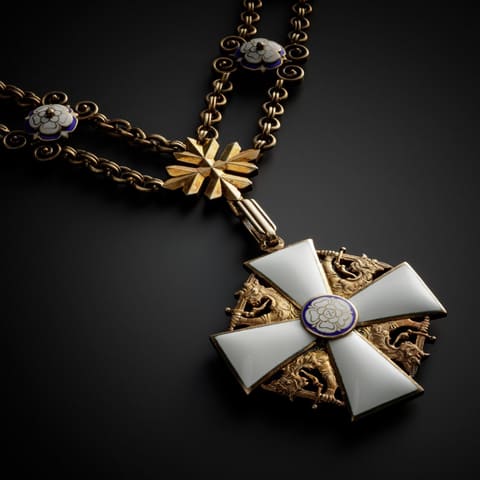
The Grand Cross of the White Rose of Finland with Collar — Finland’s highest decoration, worn only by the President of the Republic as Grand Master of the Order — this example having belonged to President Urho Kaleva Kekkonen. Akseli Gallen-Kallela designed the Order’s decorations in 1919, drawing the rose from Finland’s coat of arms; his original swastika symbols were replaced in 1963 with spruce twigs designed by Gustaf von Numers, and Kekkonen first wore the new collar on Independence Day 1963.

“The Grand Cross of the White Rose of Finland with Collar is Finland’s highest decoration and is only awarded to the President of the Republic, who is the Grand Master of the Order. It has also been awarded to some foreign heads of state in connection with state visits. This Grand Cross belonged to President Urho Kaleva Kekkonen.” In the museum’s words — kansallismuseo.fi ↗ · quotation verified against the live page

Meanwhile — La calle (The Street) Americas & Oceania · c. 1942

Atelier Fauni’s Moomin characters
N° 1064·IX · Into Our Time
Atelier Fauni’s Moomin characters
Workshop of Atelier Fauni
1950s
Finnish

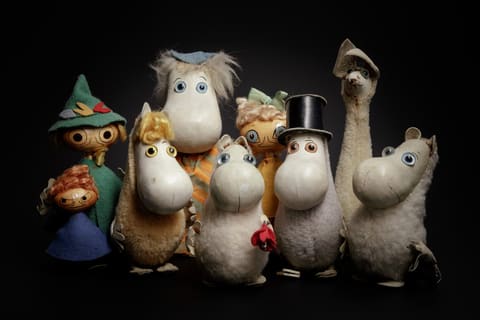
Handmade dolls of Tove Jansson’s Moomin world — Moomintroll, Moominmamma and Moominpappa surrounded by Snufkin, Little My, Snork Maiden, Mymble and Hemulen — made by the Finnish Atelier Fauni in the 1950s (H2002056). The museum notes Jansson wrote the first Moomin books during the war years, and that Atelier Fauni had produced over a million original dolls by 1971, identifiable by the maker’s mark on a paw or tail.

“The Moomins and their friends have inspired a number of products. The Moomin family is surrounded by characters made by the Finnish Atelier Fauni in the 1950s: Snufkin, Little My, Snork Maiden, Mymble and Hemulen.” In the museum’s words — kansallismuseo.fi ↗ · quotation verified against the live page

Meanwhile — Landscape in the Nude Africa · 1953

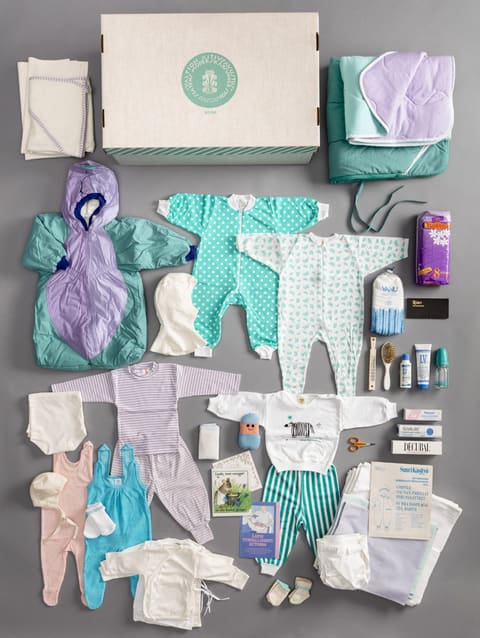
Maternity grant – protection for mothers and children
N° 1095·IX · Into Our Time
Maternity grant – protection for mothers and children
Unknown
Maternity package, 1993–1994
Finnish

A maternity package — the goods form of the Finnish maternity grant introduced by the 1937 Maternity Grants Act and extended to all mothers attending early-pregnancy medical examination from 1949 — with the 1993–1994 contents of bold colours, soft cotton fabrics and reusable nappies (H2002024). The museum presents it as an emblem of the welfare state: about 70% of those entitled still choose the package.

“The social situation and fashion trends of the time have been reflected in the maternity package. In 1993–1994, the contents were characterised by bold colours, soft cotton fabrics and reusable nappies.” In the museum’s words — kansallismuseo.fi ↗ · quotation verified against the live page

Meanwhile — Morning Star (Gambeh Then') Americas & Oceania · 1993