The Atlas·PH

PH

National Museum of the Philippines, Manila — 13 works · museum site ↗ · 900 CE–1979 60000 BCE2020

Seen from Manila, history is above all craft & design, then treasure & power — a collection opened wide onto other worlds — a window more than a mirror (12 of 13 works are from other civilisations).

Craft 3 Power 2 Sculpture 2 Stories 2 Invention 1 Ritual 1 Observation 1 New vision 1
Laguna Copperplate Inscription
N° 405·III · Faith and Empire
Laguna Copperplate Inscription
Unknown
900 CE · copper
Philippine (Hindu-Buddhist period)

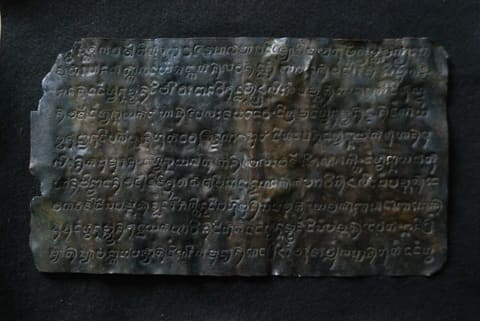
The Laguna Copperplate Inscription, a thin copper strip incised with an Early Kawi-form script and dated by a Saka year corresponding to 900 CE, is presented by the National Museum as Hindu-Buddhist evidence of the archipelago's early Southeast Asian maritime contacts; a National Cultural Treasure displayed in the Baybayin Gallery of the National Museum of Anthropology, Manila.

“The Laguna Copperplate Inscription (LCI) is another piece of evidence of the Hindu-Buddhist material found in the country. The LCI is a thin copper strip with etchings similar to the Early Kawi script” In the museum’s words — nationalmuseum.gov.ph ↗ · quotation verified against the live page

Meanwhile — The Bell of St Patrick and its Shrine Europe · Bell 8th–9th century AD; shrine circa AD 1100
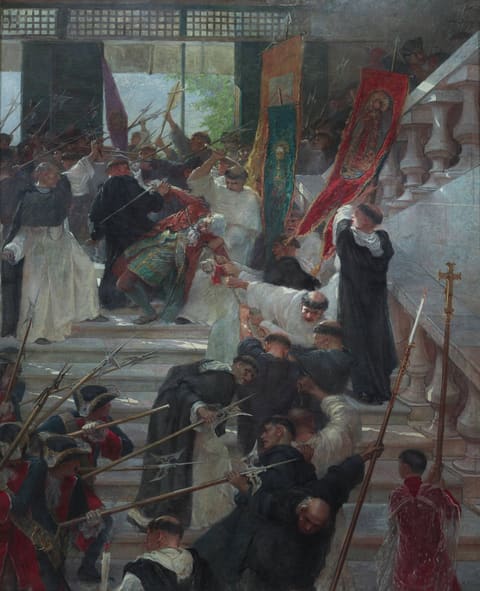
Spoliarium
N° 933·VIII · The Restless Century
Spoliarium
Juan Luna y Novicio (1857-1899)
1884 · Oil on canvas
Filipino

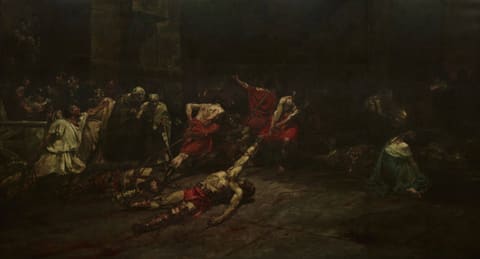
Juan Luna's Spoliarium, which the National Museum presents as one of the country's best-known paintings, is displayed in the Spoliarium Hall of the National Museum of Fine Arts in Manila, across from Hidalgo's El Asesinato del Gobernador Bustamante.

“the Spoliarium by Juan Luna y Novicio (1857-1899). Displayed across it is El Asesinato del Gobernador Bustamante (The Assassination of Governor Bustamante)” In the museum’s words — nationalmuseum.gov.ph ↗ · quotation verified against the live page

Meanwhile — Bringing Home the Body of King Karl XII of Sweden Europe · signed 1884

El Asesinato del Gobernador Bustamante (The Assassination of Governor Bustamante)
N° 992·IX · Into Our Time
El Asesinato del Gobernador Bustamante (The Assassination of Governor Bustamante)
Felix Resurreccion Hidalgo (1855-1913)
Circa 1904
Filipino

Felix Resurreccion Hidalgo's El Asesinato del Gobernador Bustamante, which the National Museum describes as the largest known work by the master painter, hangs in the Spoliarium Hall of the National Museum of Fine Arts in Manila, opposite Luna's Spoliarium.

“El Asesinato del Gobernador Bustamante (The Assassination of Governor Bustamante), the largest known work by another Filipino master painter” In the museum’s words — nationalmuseum.gov.ph ↗ · quotation verified against the live page

Meanwhile — Eugen Schauman’s (1875–1904) shirt Europe · 1904

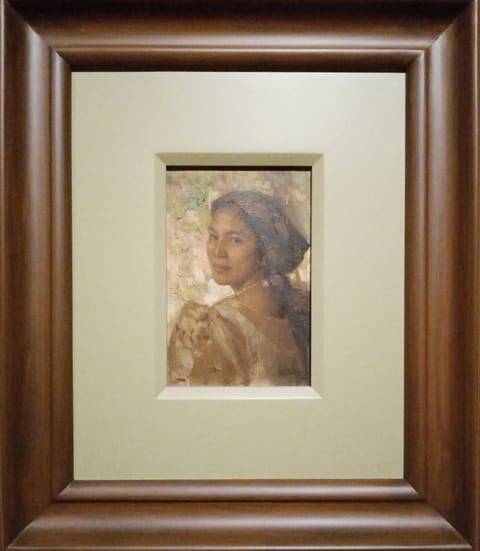
Dalagang Bukid (The Country Lass)
N° 1037·IX · Into Our Time
Dalagang Bukid (The Country Lass)
Fernando Amorsolo (1892-1972)
1928 · oil on canvas
Filipino

Dalagang Bukid (The Country Lass) is a 1928 oil painting by National Artist Fernando Amorsolo in the National Fine Arts Collection, shown at the National Museum of Fine Arts in Manila; Amorsolo cast the smiling country girl in a baro't saya as his image of ideal Filipina beauty.

“a 1928 oil painting from the National Fine Arts Collection (NFAC).” In the museum’s words — nationalmuseum.gov.ph ↗ · quotation verified against the live page

Meanwhile — Phar Lap's Skeleton (Horse, Equus caballus) Americas & Oceania · Phar Lap 1926–1932

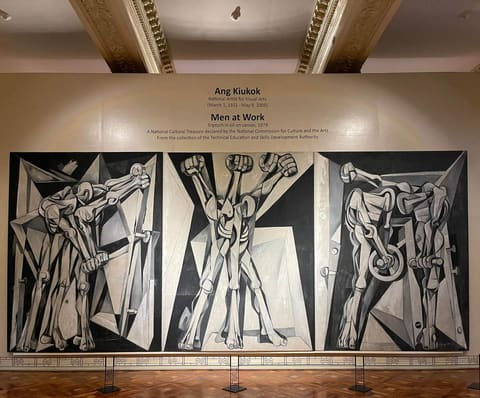
Men at Work
N° 1088·IX · Into Our Time
Men at Work
Ang Kiukok (1931-2005)
1979 · oil on canvas
Filipino

A large-scale 1979 triptych in oil on canvas by National Artist Ang Kiukok, Men at Work renders solid, muscular limbs and torsos in black and white to represent the strength of the labour force; it is held in the National Fine Arts Collection at the National Museum of Fine Arts, Manila.

“is a large-scale triptych oil on canvas painting created in 1979 by Ang Kiukok (1931-2005). This semiabstract painting depicting solid, heavy, and muscular human limbs and torso in tones of black and white and engaged in physical work represents the strength of the labor force.” In the museum’s words — nationalmuseum.gov.ph ↗ · quotation verified against the live page

Meanwhile — War Requiem Europe · 1982

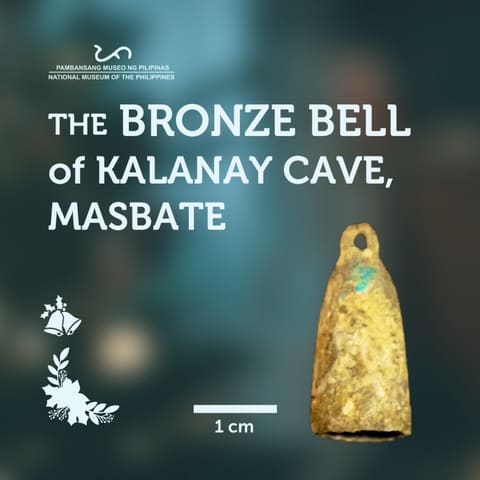
Bronze bell from Kalanay Cave
N° 1120·Undated
Bronze bell from Kalanay Cave
Unknown
Metal Age · bronze
Philippine

A small bronze bell about 27 mm long with a loop top and a free-swinging clapper, excavated from the burial site of Kalanay Cave in Aroroy, Masbate; it belongs to the National Archaeological Collection curated by the National Museum's Archaeology Division in Manila.

“The small, thinly encrusted bell is made of bronze and measures 27 mm in length and 12.5 mm in diameter. It has a loop top (with a 2-mm opening) and a free-swinging clapper inside, attached to a bar from the bottom of the bell.” In the museum’s words — nationalmuseum.gov.ph ↗ · quotation verified against the live page
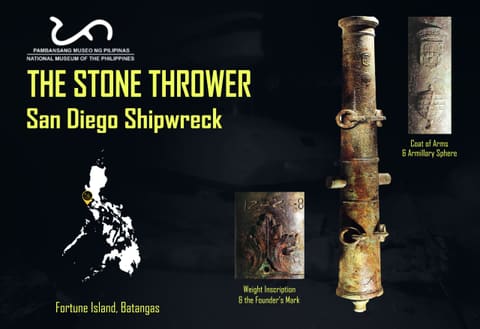
Bronze pedrero cannon from the San Diego shipwreck
N° 1122·Undated
Bronze pedrero cannon from the San Diego shipwreck
Unknown
16th century CE · bronze
Portuguese

A large bronze muzzle-loading Portuguese pedrero (stone-throwing) cannon about 2.57 m long, recovered from the San Diego shipwreck off Fortune Island, Batangas; designed to fire stone balls, it carries the Portuguese royal coat of arms and armillary sphere and is held by the National Museum of Anthropology, Manila.

“This cannon has a typical slightly conical body type that is divided approximately in half by a central molding, short molded collar, and a relatively elaborate tailpiece. It measures about 2.57 m in length and has a bore diameter of 173 mm corresponding to a 5.5-kg stone ball.” In the museum’s words — nationalmuseum.gov.ph ↗ · quotation verified against the live page
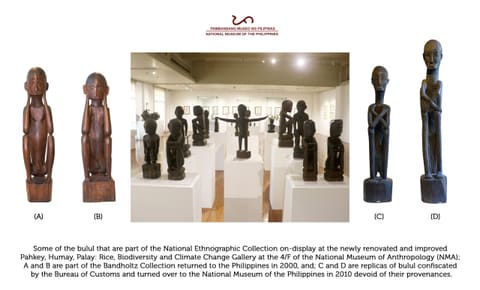
Bulul (Ifugao granary figure)
N° 1123·Undated
Bulul (Ifugao granary figure)
Unknown
Traditional Ifugao · wood
Ifugao

A bulul, the carved anthropomorphic granary figure of the Ifugao of the Cordillera believed to guard the rice harvest and to embody ancestral and guardian spirits; the form features in the ethnology holdings of the National Museum of Anthropology, Manila.

“are carved anthropomorphic figures serving as granary idols believed to protect against pests and assure good harvest for the Ifugaos in the Cordillera.” In the museum’s words — nationalmuseum.gov.ph ↗ · quotation verified against the live page
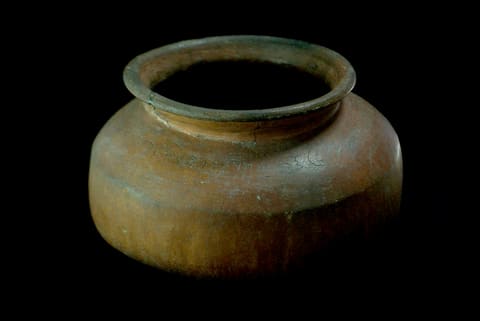
Calatagan Ritual Pot
N° 1128·Undated
Calatagan Ritual Pot
Unknown
c. 15th century · earthenware
Philippine

An earthenware pot from Calatagan, Batangas, declared a National Cultural Treasure and displayed among the evidence of ancient Philippine writing in the Baybayin Gallery of the National Museum of Anthropology, Manila.

“Notable artifacts displayed in the Baybayin Gallery include the Laguna Copperplate Inscription, Calatagan Ritual Pot, and Butuan Metal Paleograph” In the museum’s words — nationalmuseum.gov.ph ↗ · quotation verified against the live page
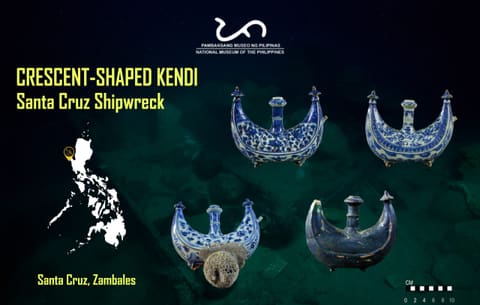
Crescent-shaped kendi from the Santa Cruz shipwreck
N° 1138·Undated
Crescent-shaped kendi from the Santa Cruz shipwreck
Unknown
Late 15th to early 16th century CE · blue-and-white porcelain
Chinese

A crescent-shaped Chinese blue-and-white porcelain kendi, an unusual pouring vessel with a central cylindrical neck standing on four small feet, recovered from the Santa Cruz shipwreck off Zambales (late 15th to early 16th century); part of the maritime collection of the National Museum of Anthropology, Manila.

“There are unusual forms in limited numbers such as the crescent-shaped blue and white kendi. They are made of thick porcelain, have a central cylindrical neck and stand on four small feet.” In the museum’s words — nationalmuseum.gov.ph ↗ · quotation verified against the live page
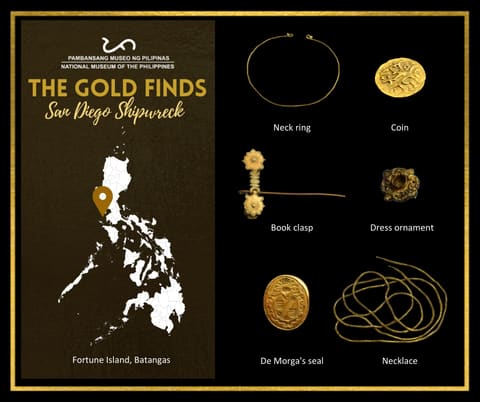
Gold finds from the San Diego shipwreck
N° 1151·Undated
Gold finds from the San Diego shipwreck
Unknown
16th century CE · gold

Gold ornaments recovered from the San Diego, which sank off Fortune Island, Batangas, on 14 December 1600 - among them a neck ring reported as the first found at any Philippine archaeological site and a bulky but light woven necklace - now in the maritime collection of the National Museum of Anthropology, Manila.

“The neck ring, a probable indication of Southeast Asian tradition, was reportedly the first to be seen in any Philippine archaeological site. The long woven necklace has a bulky appearance but light in weight.” In the museum’s words — nationalmuseum.gov.ph ↗ · quotation verified against the live page
Maitum Anthropomorphic Burial Jars
N° 1172·Undated
Maitum Anthropomorphic Burial Jars
Unknown
Metal Age · earthenware
Philippine · Metal Age

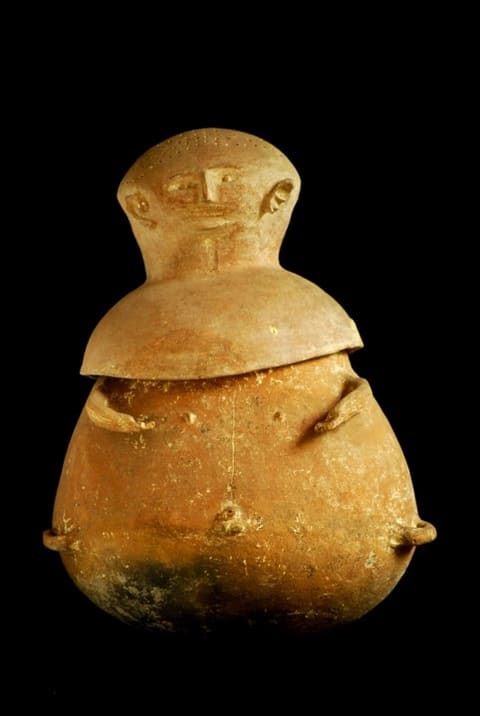
The Maitum anthropomorphic burial jars, secondary-burial vessels modelled as human figures with varied facial expressions, were recovered from Ayub Cave in Pinol, Maitum, Sarangani, and are displayed as National Cultural Treasures in the Kaban gallery of the National Museum of Anthropology, Manila.

“The Maitum anthropomorphic burial potteries, which are secondary burial vessels shaped into human figures in various facial expressions, are presented in this exhibit together with wooden dugout coffins from Banton in Romblon, limestone urns” In the museum’s words — nationalmuseum.gov.ph ↗ · quotation verified against the live page
Manunggul Jar
N° 1175·Undated
Manunggul Jar
Unknown
Metal Age · earthenware
Philippine · Metal Age

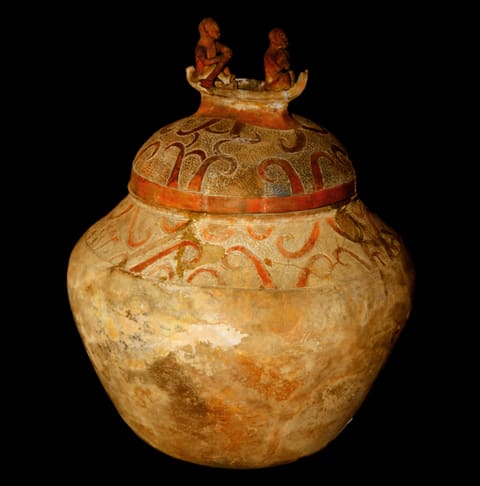
A secondary-burial vessel of the Metal Age and a declared National Cultural Treasure, the Manunggul burial jar is one of the marquee holdings of the National Museum of Anthropology in Manila.

“secondary burial and is represented by the Manunggul burial jar and the Maitum anthropomorphic burial jars, both of which are declared National Cultural Treasures.” In the museum’s words — nationalmuseum.gov.ph ↗ · quotation verified against the live page