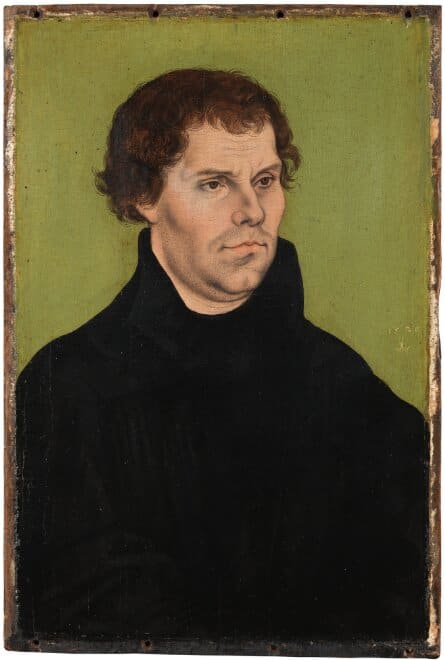
Lucas Cranach d.ä. (Lucas Cranach the Elder) (1472-1553)
signed 1526 · Oil on beech
German · Northern Renaissance
A portrait of the Protestant reformer Martin Luther by his close associate Lucas Cranach the Elder, whose copies of this image shaped later perceptions of Luther; signed with Cranach's winged-dragon mark.
“The portrait of Luther carries Cranach’s signature, a winged dragon.”
In the museum’s words — nationalmuseum.se ↗ · quotation verified against the live page
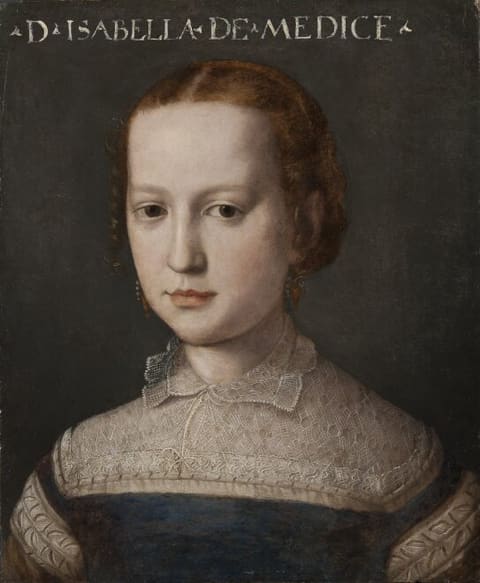
A Renaissance engagement portrait of the eleven-year-old Florentine princess Isabella de' Medici, attributed to Bronzino; the museum's Timeline commentary reads her cornucopia earrings as a fertility reference and the dark background as a foil for her pale complexion.
“This portrait shows Princess Isabella de’ Medici on her engagement, at the age of eleven, to Paolo Giordano Orsini.”
In the museum’s words — nationalmuseum.se ↗ · quotation verified against the live page
Meanwhile — Pine ForestEast Asia · Azuchi-Momoyama period, 16th century
N° 731·VI · The Baroque Age
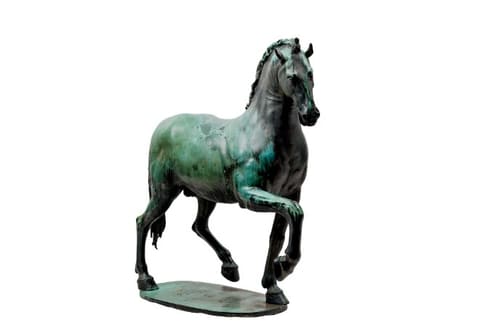
Trotting Horse
Adriaen de Vries (c. 1556-1626)
signed 1607 · Bronze
Dutch · Mannerism
A large bronze of a trotting horse by the leading Mannerist court sculptor of Prague; probably from Emperor Rudolf II's collections before it was taken as Swedish war booty in 1648 and entered Queen Kristina's collection.
“Perhaps Adriaen de Vries has depicted one of the emperor’s real horses.”
In the museum’s words — nationalmuseum.se ↗ · quotation verified against the live page
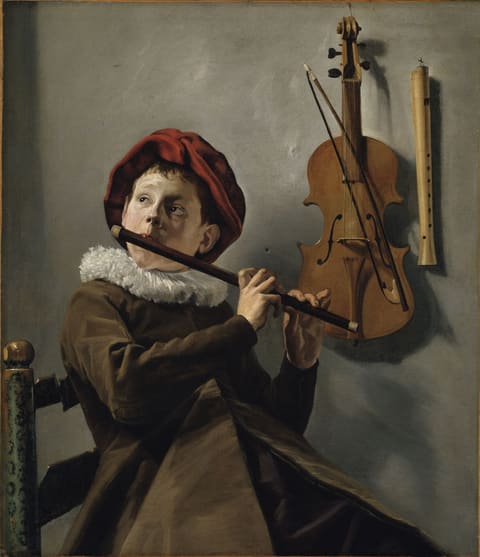
A young boy absorbed in playing a flute, by one of the few women masters of the Dutch Golden Age; Nationalmuseum's own collection database dates the work to the early 1630s and reads it as a possible allegory of Hearing, one of the Five Senses. Also presented as the museum's single hero highlight for its 17th-century galleries on the Timeline tour.
“Leyster’s bravura brushwork, and the boy’s unsteady pose as he leans against the broken chair-back, contribute to the momentary quality of the image.”
In the museum’s words — collection.nationalmuseum.se ↗ · quotation verified against the live page
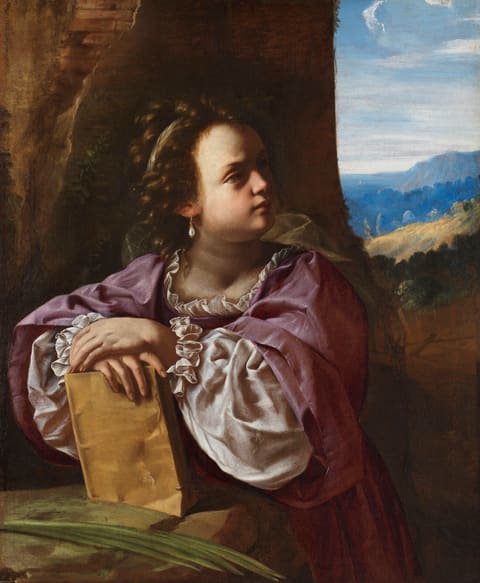
Saint Catherine of Alexandria, patron saint of philosophers and scholars, shown as an intellectual young woman leaning on a book with the martyr's palm frond at her feet; announced in 2020 as a rare acquisition of a work by one of the few women artists to achieve renown in 17th-century Europe, probably painted in Naples in the mid-1630s.
“The chiaroscuro lighting and refined colour scheme contribute to the painting’s high artistic quality.”
In the museum’s words — nationalmuseum.se ↗ · quotation verified against the live page
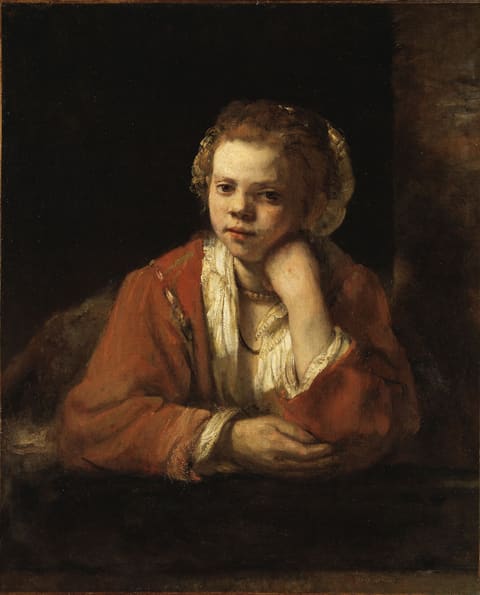
A half-length genre scene of a girl at a window, one of several similar paintings of women Rembrandt produced around 1650; Nationalmuseum's collection database notes its broad brushwork and light/dark contrast, and the museum also uses it as the single representative highlight for its 17th-century galleries on the permanent collection's chronological Timeline tour.
“His vivid image of a girl at a window is painted with broad brushstrokes and sharp contrasts between light and shadow.”
In the museum’s words — collection.nationalmuseum.se ↗ · quotation verified against the live page
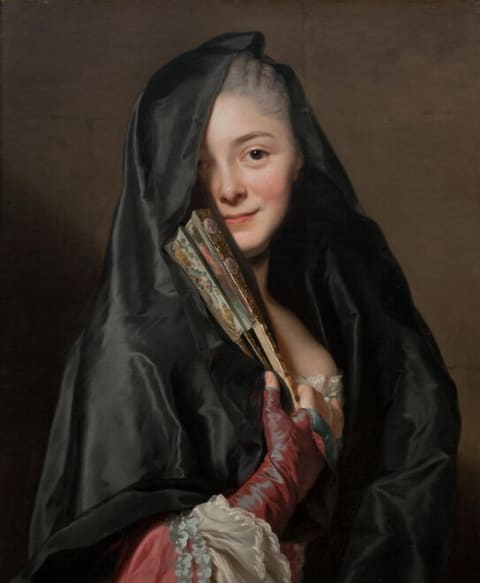
The Lady with the Veil. The Artist's Wife Marie Suzanne Giroust
Alexander Roslin (1718-1793)
1768 · Oil on canvas
Swedish · Rococo
A masquerade portrait of the artist's wife and fellow painter, Marie Suzanne Giroust, dressed for a fancy-dress ball in Bolognese style; Nationalmuseum's own Timeline commentary calls it one of its best-known paintings, and notes it was exhibited in Paris in 1769.
“The Lady with the Veil is one of the Nationalmuseum’s best-known paintings.”
In the museum’s words — nationalmuseum.se ↗ · quotation verified against the live page
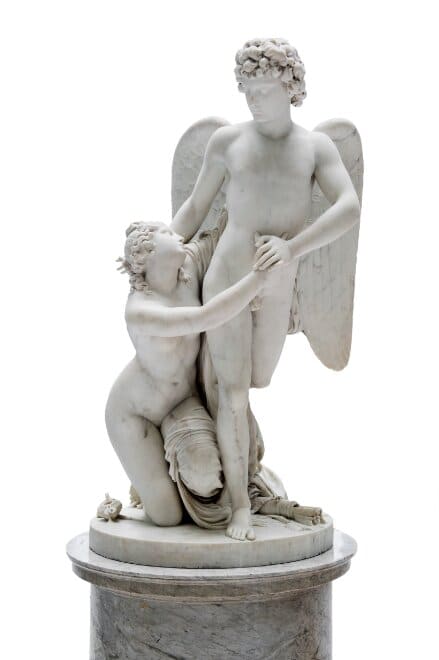
A marble group of Psyche discovering her sleeping lover Amor by lamplight, from Sergel's series of monumental mythological marbles; the museum's Timeline text frames it as the centrepiece of Sweden's shift from Rococo to Neoclassicism.
“The love goddess Venus has sent her son Amor to punish her rival Psyche, but Amor falls in love with the beautiful princess. Psyche is prevented from seeing him, however, and suspects that he is a monster. In the light of an oil lamp she discovers that her sleeping lover is a beautiful youth, but she accidentally splashes oil on him, waking him up.”
In the museum’s words — nationalmuseum.se ↗ · quotation verified against the live page
Meanwhile — HMS Bounty RelicsAmericas & Oceania · HMS Bounty, mutiny of 1789
N° 890·VIII · The Restless Century
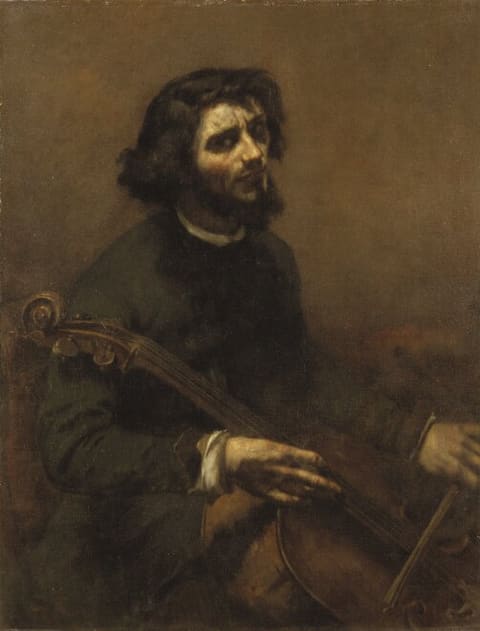
The Cellist (Self-portrait)
Gustave Courbet (1819-1877)
1847 · Oil on canvas
French · Realism
A self-portrait of Courbet posing as a cellist, part of a run of costumed self-portraits by which he drew early attention to himself outside the academic system; shown at the 1848 Paris Salon.
“The portrait was shown at the 1848 Paris Salon.”
In the museum’s words — nationalmuseum.se ↗ · quotation verified against the live page
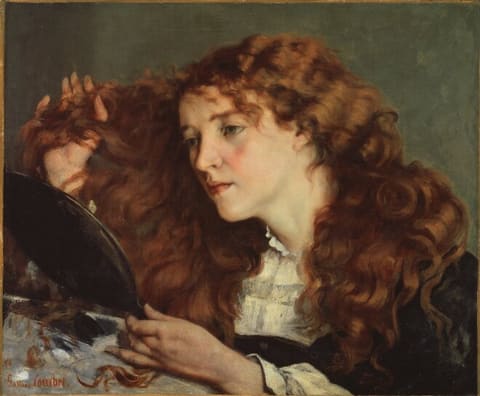
A portrait of Joanna Heffernan, Courbet's Irish model and mistress, shown absorbed in her own reflection; the museum's commentary reads the mirror motif against the era's dependence of female models on their appearance.
“This image is of Joanna Heffernan, who was Courbet’s model and mistress.”
In the museum’s words — nationalmuseum.se ↗ · quotation verified against the live page
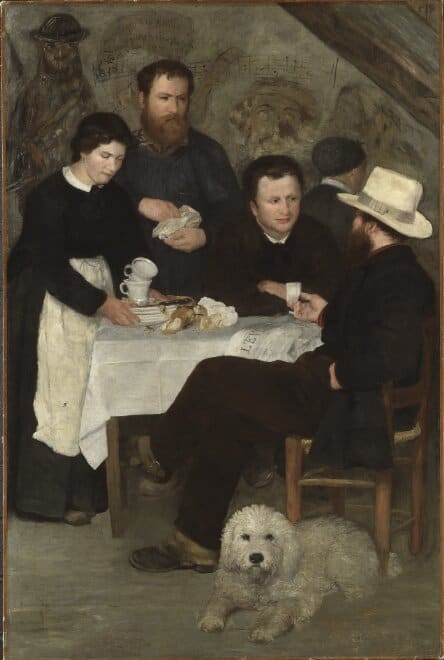
A group portrait of bohemian artist friends gathered at Mother Anthony's inn at Marlotte, in the forest of Fontainebleau; the museum's Timeline text uses it to illustrate how the Impressionists cultivated their own image.
“Auguste Renoir’s paintings of modern life, in this case the bohemian artists of Marlotte in the forest of Fontainebleau, show that the impressionists were skilled in branding and promoting themselves.”
In the museum’s words — nationalmuseum.se ↗ · quotation verified against the live page
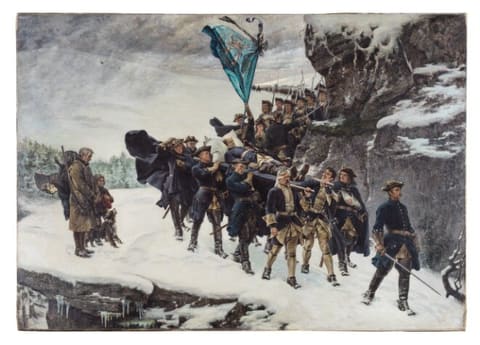
A panoramic history painting imagining the funeral cortege of Charles XII across a snowy mountain landscape; Nationalmuseum's own commentary calls the scene as a whole 'a fantasy' pieced together from separate historical episodes, and situates the painting within the National Romantic image-making of 1890s Sweden.
“The scene stretches panorama-like across a snowy mountain landscape. A column of troops winds its way to the horizon. The uniforms and arms are accurately depicted, but the scene as a whole is a fantasy. Charles XII’s body was not carried on an open bier, but in a coffin pulled on a wagon. The artist has combined the return of the body with the story of General Armfeldt’s disastrous retreat across the Jämtland mountains.”
In the museum’s words — nationalmuseum.se ↗ · quotation verified against the live page
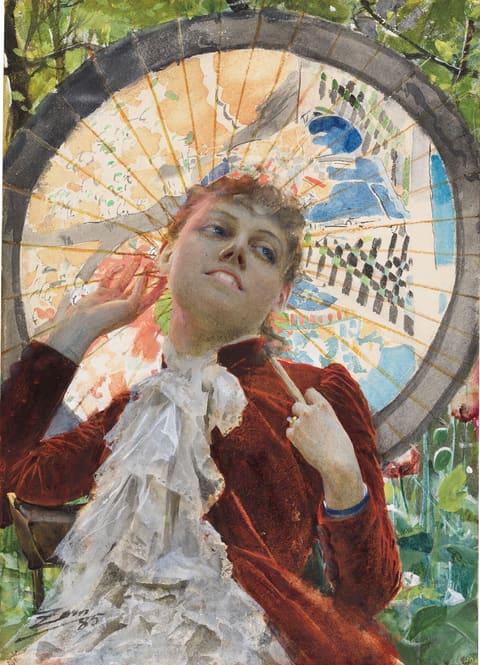
A watercolour of Zorn's new wife Emma under a parasol, painted on Dalarö in 1885 and shown that year at the pioneering "Opponents'" exhibition in Stockholm, the younger generation's first organised break from the Academy of Fine Arts.
“It shows Emma beneath a Japanese parasol, reflecting the artist’s interest in Japan’s visual culture which was substantial at the time.”
In the museum’s words — collection.nationalmuseum.se ↗ · quotation verified against the live page
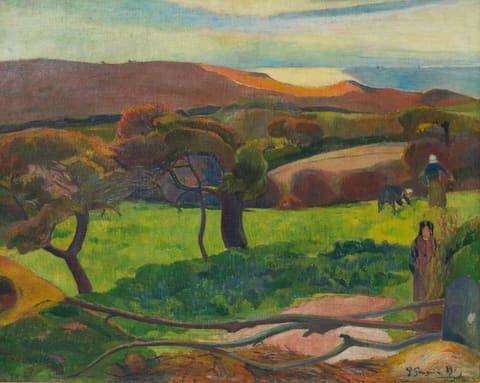
A decorative Brittany landscape from the end of the 1880s, painted in the bold, rhythmic outlines and flat colour areas Gauguin developed around Pont-Aven; bought by the Swedish painter Richard Bergh in 1892, it went on to shape Swedish national-romantic landscape painting of the 1890s.
“The painting exerted a decisive influence on the atmospheric national romanticist painting in Sweden during the 1890s.”
In the museum’s words — collection.nationalmuseum.se ↗ · quotation verified against the live page
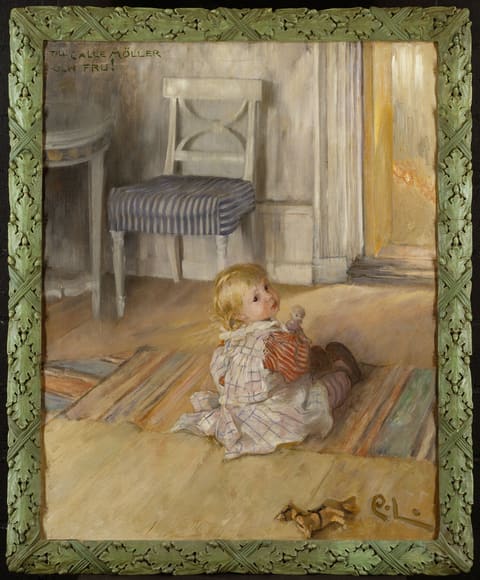
A portrait study dated 1890, presented by Nationalmuseum as its single hero highlight representing the turn of the 20th century on its Timeline tour; Larsson is one of the Swedish National Romantic painters the museum names as central to that gallery. The museum's own collection database confirms the work (inventory NM 2343) but does not carry further curatorial text.
“, 1890, oil on canvas.”
In the museum’s words — nationalmuseum.se ↗ · quotation verified against the live page
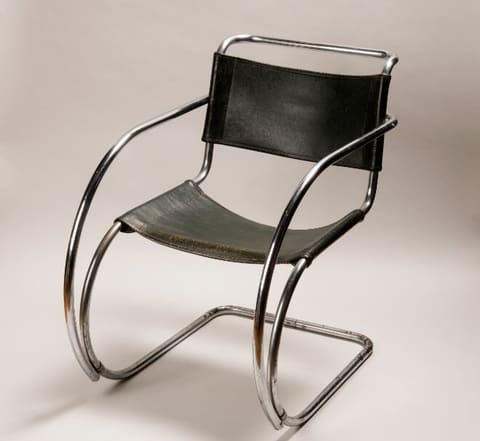
A cantilevered tubular-steel armchair from 1926, one of the first generation of steel-tube furniture designs that the museum's Timeline text credits with starting a 'design revolution' toward industrially producible, affordable modern furniture.
“The German architect Mies van der Rohe’s 1926 chair is a visionary and elegant example.”
In the museum’s words — nationalmuseum.se ↗ · quotation verified against the live page
Meanwhile — KerisSouth Asia · Early-mid 20th century
N° 1039·IX · Into Our Time
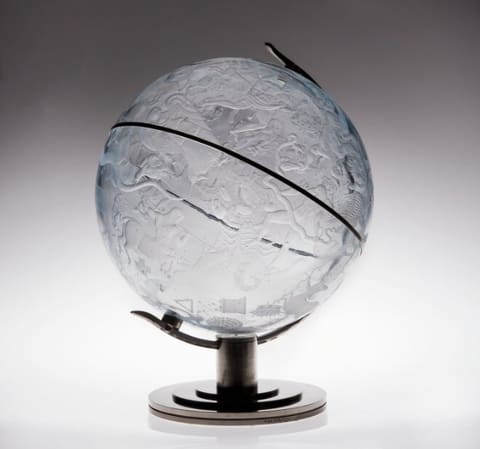
"Celestial Globe"
Edward Hald (1883-1980)
manufactured 1929-1930 · Engraved glass, pewter
Swedish
An engraved glass globe depicting the twelve signs of the zodiac, made by Edward Hald for Orrefors for the 1930 Stockholm Exhibition; the museum's Timeline text frames it as the finale of the 1920s revival of engraved Swedish glass.
“Hald’s globe was made for the Stockholm Exhibition of 1930.”
In the museum’s words — nationalmuseum.se ↗ · quotation verified against the live page
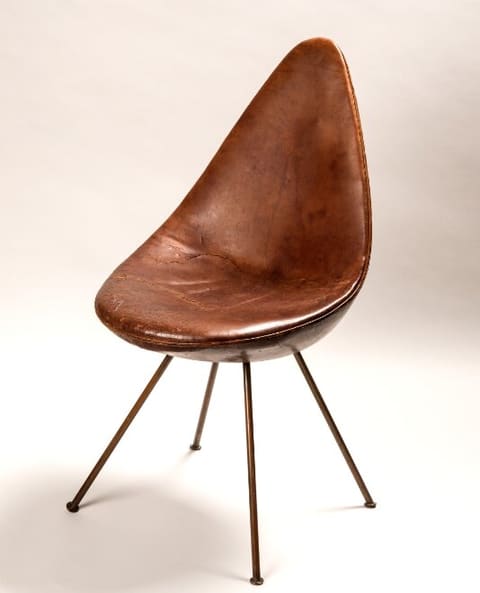
designed 1958 · Moulded polystyrene, leather upholstery, tubular copper
Danish · Scandinavian Design
A moulded chair designed by Arne Jacobsen in 1958 for Copenhagen's SAS Royal Hotel, manufactured by Fritz Hansen; the museum's Timeline text credits the touring exhibition 'Design in Scandinavia' with popularising this style of Nordic design internationally.
“Design in Scandinavia, a travelling exhibition that was seen by more than 600 000 Americans between 1954 and 1957, helped establish the term in the US.”
In the museum’s words — nationalmuseum.se ↗ · quotation verified against the live page