The Atlas·ES

Spain

Museo Nacional del Prado, Madrid — 20 works · museum site ↗ · 1438–1823 60000 BCE2020

Seen from Madrid, history is above all sacred images, then stories & histories — a collection kept wholly in its own tradition — a mirror.

Sacred 9 Stories 7 Portraits 3 Observation 1
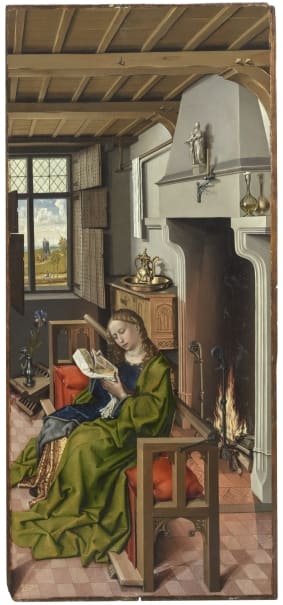
Saint Barbara
N° 578·IV · Toward the Renaissance
Saint Barbara
Master of Flémalle (active c. 1410s–1440s)
1438 · oil on panel
Netherlandish · Northern Renaissance

An early Netherlandish panel showing Saint Barbara reading beside a fireplace in a richly furnished interior, with the tower in which her father imprisoned her visible through the window; one of the finest early examples of Flemish interior painting, originally paired with a panel of Saint John the Baptist and Heinrich von Werl.

“Saint Barbara reads by the light of a fireplace in a richly appointed room. The key to her identity lies outside the window that opens onto a landscape with a tower, her customary attribute.” In the museum’s words — museodelprado.es ↗

Meanwhile — Domaru Armor Laced with Black Leather Thongs and Purple Red and White Cords East Asia · Japan, Muromachi period, 15th century
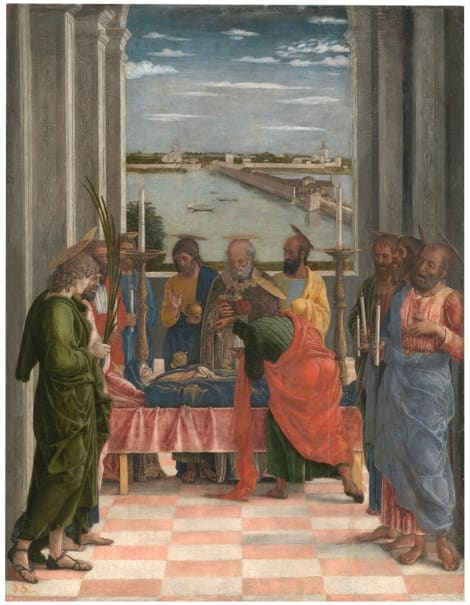
The Death of the Virgin
N° 585·IV · Toward the Renaissance
The Death of the Virgin
Andrea Mantegna (1430–1506)
ca. 1462 · mixed method on panel
Italian · Italian Renaissance

A Quattrocento panel by Andrea Mantegna depicting the death of the Virgin Mary, painted by an artist whose deep engagement with classical antiquity and connections to Paduan humanism and Venetian painting defined his early career.

“Andrea Mantegna, one of the great figures of the Quattrocento, trained in Padua with the painter and antiquarian Francesco Squarzione, who instilled an interest in antiquity in the young Mantegna.” In the museum’s words — museodelprado.es ↗

Meanwhile — Aztec Double-Headed Serpent Americas & Oceania · 1400–1521

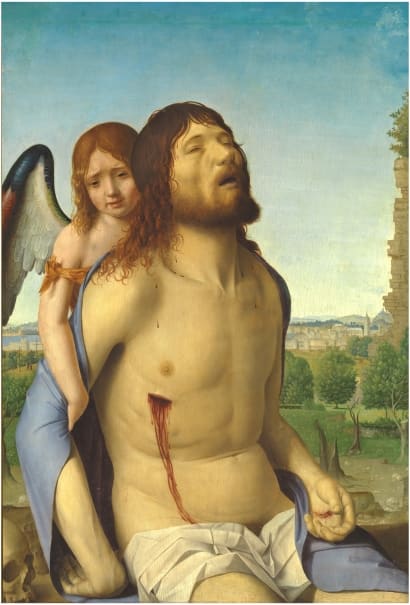
The Dead Christ supported by an Angel
N° 595·IV · Toward the Renaissance
The Dead Christ supported by an Angel
Antonello da Messina (1430–1479)
1475–1476 · mixed method on panel
Italian · Italian Renaissance

A Pietà-like devotional panel painted by the Sicilian master Antonello da Messina after his return from Venice, fusing meticulous Flemish-derived brushwork with the compositional and anatomical lessons he had absorbed from Giovanni Bellini.

“Antonello da Messina was trained in Naples, the Italian city where the influence of Flemish painting was greatest. He later worked in Sicily and mainland Italy.” In the museum’s words — museodelprado.es ↗

Meanwhile — Blue-and-White Vase with Swan Design South Asia · Mid-to-late 15th century, Lê sơ dynasty

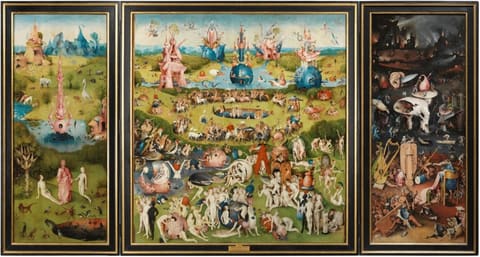
The Garden of Earthly Delights
N° 603·IV · Toward the Renaissance
The Garden of Earthly Delights
Hieronymus Bosch (c. 1450–1516)
1490–1500 · oil on oak panel (grisaille exterior)
Netherlandish · Northern Renaissance

Hieronymus Bosch's most complex and enigmatic triptych, its closed outer panels showing the Creation of the World in grisaille and its open interior unfolding a dense vision of Eden, an unrestrained garden of worldly pleasure, and a hellscape of punishment.

“On the outer faces of the triptych Bosch depicted in grisaille the Third Day of the Creation of the World, when the waters were separated from the earth and the earthly Paradise (Eden) created.” In the museum’s words — museodelprado.es ↗

Meanwhile — Decorated glazed dish Islamic world · 1400–1599 CE

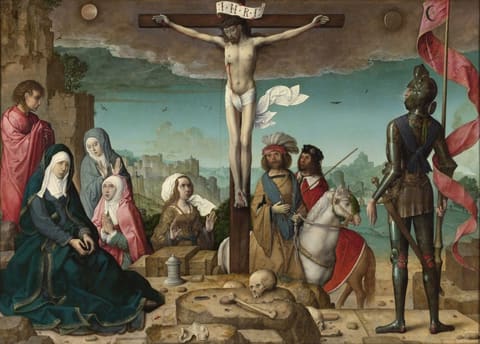
The Crucifixion
N° 638·V · The Renaissance
The Crucifixion
Juan de Flandes (documented 1496–1519)
1509–1519 · oil on panel
Flemish · Northern Renaissance

A panel of the Crucifixion painted for the main altarpiece of Palencia Cathedral by the Flemish-born painter Juan de Flandes, documented at the Spanish court between 1496 and 1519, later separated from the altarpiece before entering the Prado.

“Documents at Palencia Cathedral cast light on this Crucifixion´s original location -the central row of the main altarpiece at that cathedral- and its author: Juan de Flandes (doc. 1496-1519).” In the museum’s words — museodelprado.es ↗

Meanwhile — Salt Cellar Africa · first quarter of the 16th century

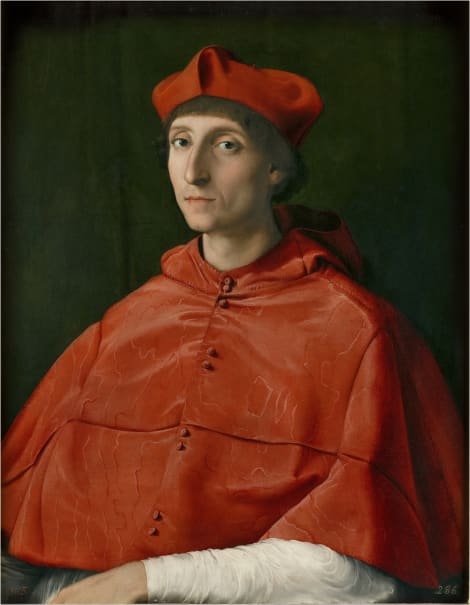
The Cardinal
N° 642·V · The Renaissance
The Cardinal
Raphael (Raffaello Sanzio) (1483–1520)
1510–1511 · oil on panel
Italian · Italian Renaissance

A portrait of an unidentified cardinal, long recognized as a work by Raphael even though the sitter's identity - once thought to be Antonio Granvela - remains debated among candidates such as Cardinal Bendinello Suardi and Cardinal Giovanni Alidosi.

“Since the moment when it was decided that the present work is by Raphael but that the sitter is not Antonio Granvela, art historians have expended considerable efforts on identifying the sitter.” In the museum’s words — museodelprado.es ↗

Meanwhile — Salt Cellar Africa · first quarter of the 16th century

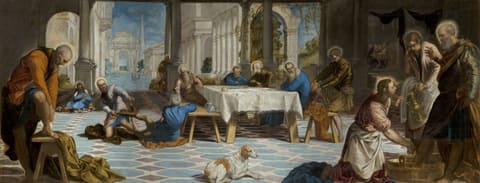
The Washing of the Feet
N° 671·V · The Renaissance
The Washing of the Feet
Jacopo Robusti Tintoretto (1518–1594)
1548–1549 · oil on canvas
Italian · Italian Renaissance

A large New Testament scene by Tintoretto showing Christ washing Saint Peter's feet before the Last Supper, originally painted for the Venetian church of San Marcuola with an off-centre composition designed to read coherently when viewed from the right-hand side of the nave.

“This scene from the New Testament (John 13, 1-20) shows the moment just before the Last Supper, when Jesus washed Saint Peter´s feet as an example of humility and service to others.” In the museum’s words — museodelprado.es ↗

Meanwhile — Painting of a Dog and Puppies East Asia · 16th century (Joseon)

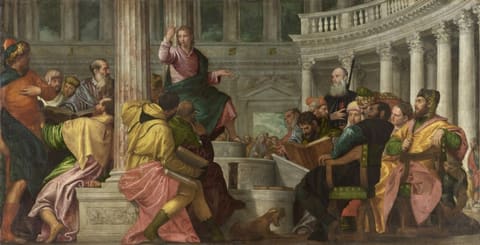
Christ among the Doctors in the Temple
N° 674·V · The Renaissance
Christ among the Doctors in the Temple
Paolo Veronese (1528–1588)
1550–1556 · oil on canvas
Italian · Italian Renaissance

Paolo Veronese's depiction of the twelve-year-old Christ debating the doctors in the Temple of Jerusalem after being found by Mary and Joseph, with a bearded onlooker in the habit of a Knight of the Holy Sepulchre believed to be the painting's patron.

“This work illustrates the final passage of Christ´s childhood (Luke 2, 41-50) when, at the age of 12, he was taken to Jerusalem by his parents to celebrate Passover.” In the museum’s words — museodelprado.es ↗

Meanwhile — Pine Forest East Asia · Azuchi-Momoyama period, 16th century

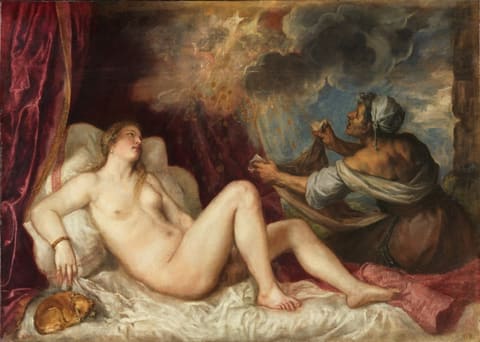
Danaë and the Shower of Gold
N° 681·V · The Renaissance
Danaë and the Shower of Gold
Titian (Tiziano Vecellio) (1490–1576)
1560–1565 · oil on canvas
Italian · Italian Renaissance

One of several versions of Titian's mythological "poesie" for the Spanish crown, showing the princess Danaë visited by Jupiter in the form of a shower of gold, developed from an earlier Danaë Titian had painted in Rome for Cardinal Alessandro Farnese.

“Danaë depicts the moment in which Jupiter possesses the princess in the form of golden rain.” In the museum’s words — museodelprado.es ↗

Meanwhile — Pine Forest East Asia · Azuchi-Momoyama period, 16th century

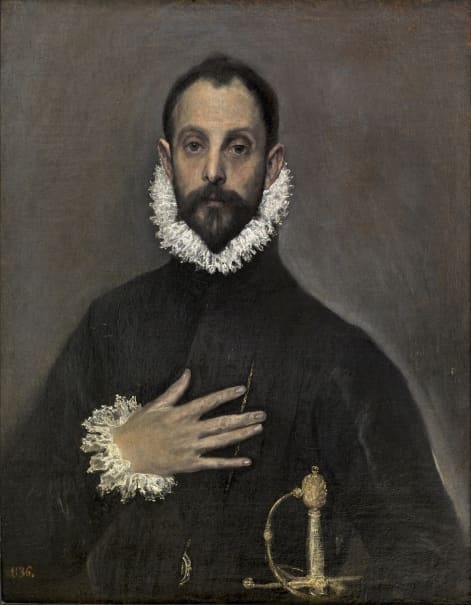
The Nobleman with his Hand on his Chest
N° 696·V · The Renaissance
The Nobleman with his Hand on his Chest
El Greco (1541–1614)
ca. 1580 · oil on canvas
Spanish · Spanish Golden Age

One of six portraits of gentlemen by El Greco that entered the royal collection as a donation from the widow of the Duke of Arco, this bust-length portrait of an unidentified nobleman of about 30 is among the artist's earliest and most distinctive works painted after his move to Spain.

“The sitter, who is aged around 30, is dressed according to Spanish fashion of the late 1570s, with a narrow, white ruff that reaches up behind his ears.” In the museum’s words — museodelprado.es ↗

Meanwhile — Tile Panel, Alfiz Islamic world · 1570–1580

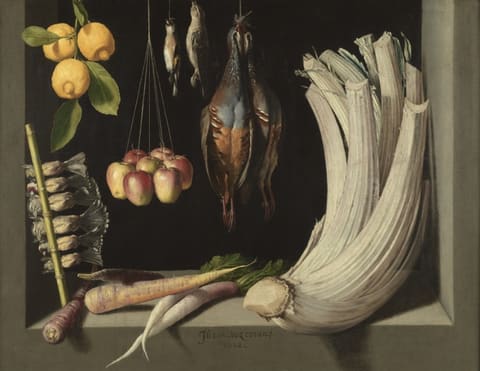
Still Life with Game, Vegetables and Fruit
N° 726·VI · The Baroque Age
Still Life with Game, Vegetables and Fruit
Juan Sánchez Cotán (1560–1627)
1602 · oil on canvas
Spanish · Spanish Golden Age

A founding work of the Spanish still-life tradition by Juan Sánchez Cotán, arranging game, vegetables and fruit with the sober, almost devotional intensity that later writers used to define the genre in early 17th-century Spain.

“Sobriety, intimacy, magical purity, mysterious intensity, elegance in simplicity or symbolic humility are the characteristics that have been used to describe the Spanish still life of the early 17th century.” In the museum’s words — museodelprado.es ↗

Meanwhile — Aleppo Room Islamic world · 1600–01 and 1603

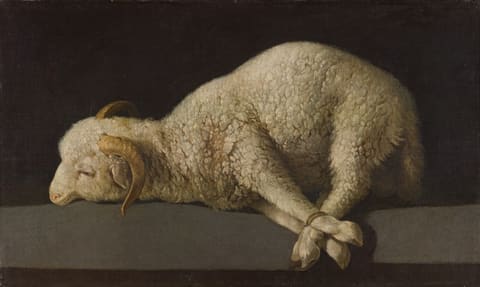
A Lamb
N° 755·VI · The Baroque Age
A Lamb
Francisco de Zurbarán (1598–1664)
1635–1640 · oil on canvas
Spanish · Spanish Golden Age

Francisco de Zurbarán's spare, single-subject painting of a bound merino lamb lying in sacrificial posture against a dark ground, its calculated lighting and meticulous rendering of texture recalling sculpted images of martyred saints.

“It lies with bound feet in an unmistakably sacrificial posture curiously reminiscent of famous images of martyred saints like Stefano Maderno´s moving sculpture of Saint Cecilia at the basilica of Santa Cecilia in Rome.” In the museum’s words — museodelprado.es ↗

Meanwhile — Water Fowl in the Lotus Pond East Asia · Japan, Edo period, early 17th century

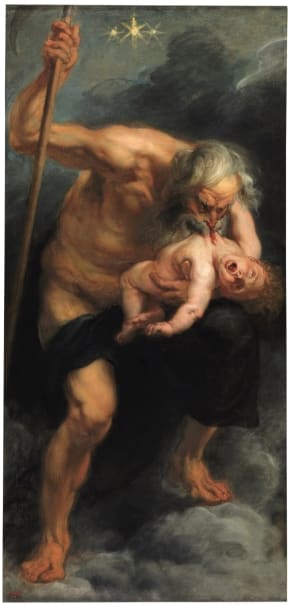
Saturn devouring a Son
N° 757·VI · The Baroque Age
Saturn devouring a Son
Peter Paul Rubens (1577–1640)
1636–1638 · oil on canvas
Flemish · Flemish Baroque

Rubens's own treatment of the god Saturn devouring a child, painted as part of the large mythological cycle he supplied for the Torre de la Parada hunting lodge, pairing the god's scythe-bearing old age with the boy's terror in characteristically intense Baroque physicality.

“With impressive bestial energy, he leans over a boy, into whom he sinks his teeth to devour him, while the defenceless creature attempts to kick himself free, writhing and screaming for help, and directs his anguished gaze at the viewer.” In the museum’s words — museodelprado.es ↗

Meanwhile — Water Fowl in the Lotus Pond East Asia · Japan, Edo period, early 17th century

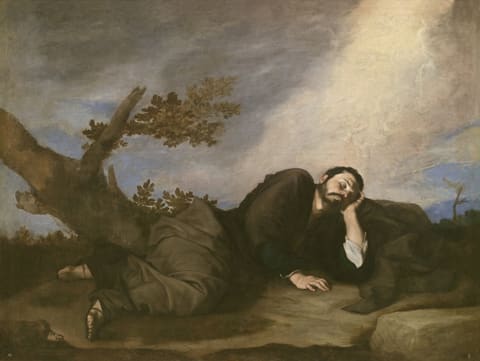
Jacob's Dream
N° 760·VI · The Baroque Age
Jacob's Dream
José de Ribera (1591–1652)
1639 · oil on canvas
Spanish · Spanish Golden Age

José de Ribera's rendering of the patriarch Jacob's dream of a ladder of angels, imagined as a sleeping shepherd in the countryside, in which the artist's naturalistic figure and calibrated light bring earthly realism to a miraculous biblical vision.

“This subject demonstrates Ribera´s skill at constructing metaphoric discourse. He uses the image of a shepherd resting in the countryside to describe one of the best-known Bible stories.” In the museum’s words — museodelprado.es ↗

Meanwhile — Writing Box, Pontoon bridge design in "maki-e" lacquer East Asia · Edo period, 17th century

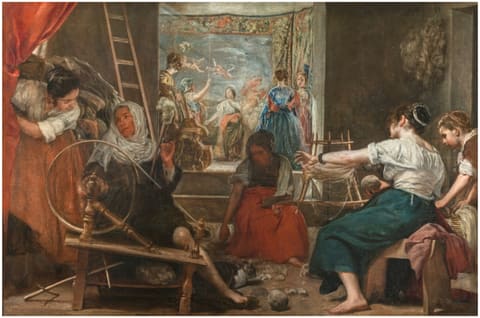
The Spinners, or the Fable of Arachne
N° 771·VI · The Baroque Age
The Spinners, or the Fable of Arachne
Diego Rodríguez de Silva y Velázquez (1599–1660)
1655–1660 · oil on canvas
Spanish · Spanish Golden Age

A late Velázquez painting long read as a genre scene of women spinning in a tapestry workshop but understood, once its 18th-century additions are set aside, as a more complex mythological scene built around Arachne's fable.

“First, Velázquez painted the surface occupied by the figures and the tapestry in the background. Later, in the 18th century, a wide strip (with the arch and oculus) was added to the top, along with narrower ones on the left, right and bottom.” In the museum’s words — museodelprado.es ↗

Meanwhile — Mere pounamu (greenstone striking weapon) "Amokura" Americas & Oceania · Māori, 1500–1820

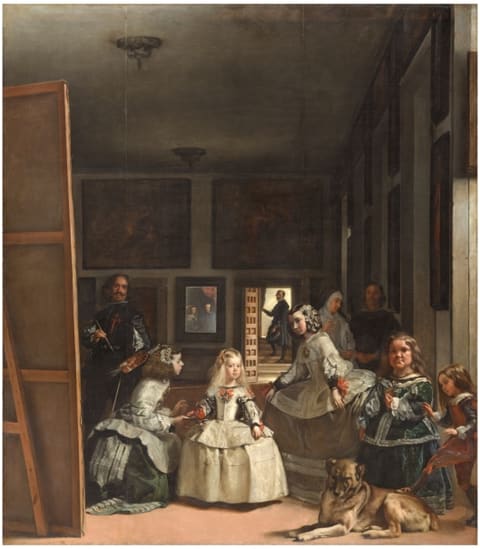
Las Meninas
N° 772·VI · The Baroque Age
Las Meninas
Diego Rodríguez de Silva y Velázquez (1599–1660)
1656 · oil on canvas
Spanish · Spanish Golden Age

Velázquez's 1656 group portrait set in the Cuarto del Príncipe of Madrid's Alcázar, singled out even in the 18th century by the writer Antonio Palomino as the artist's most illustrious work and never since out of critical regard as a summit of Spanish painting.

“This is one of Velázquez's largest paintings and among those in which he made most effort to create a complex and credible composition that would convey a sense of life and reality while enclosing a dense network of meanings.” In the museum’s words — museodelprado.es ↗

Meanwhile — Mere pounamu (greenstone striking weapon) "Amokura" Americas & Oceania · Māori, 1500–1820

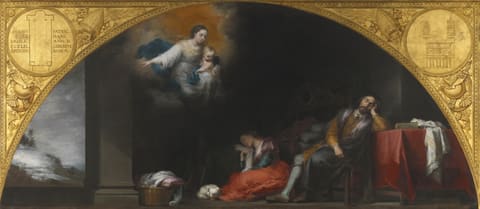
The Foundation of Santa Maria Maggiore in Rome. The Patrician's Dream
N° 779·VI · The Baroque Age
The Foundation of Santa Maria Maggiore in Rome. The Patrician's Dream
Bartolomé Esteban Murillo (1617–1682)
1664–1665 · oil on canvas
Spanish · Spanish Golden Age

One of a pair of large arched canvases Murillo painted for Seville's church of Santa María la Blanca, narrating the legendary snowfall that led a Roman patrician to found the basilica of Santa Maria Maggiore, as recorded in the Roman Breviary's account of the feast of Our Lady of the Snows.

“The two arched works were intended to hang beneath a small dome in the recently remodeled Sevillian church of Santa María la Blanca in 1665, and they narrate the story of the founding of the Roman basilica of Santa Maria Maggiore.” In the museum’s words — museodelprado.es ↗

Meanwhile — Tứ Kỳ Pagoda Stone Incense Pillar (Cây hương chùa Tứ Kỳ) South Asia · 1666, Cảnh Trị reign, Lê Huyền Tông, Lê Trung Hưng period

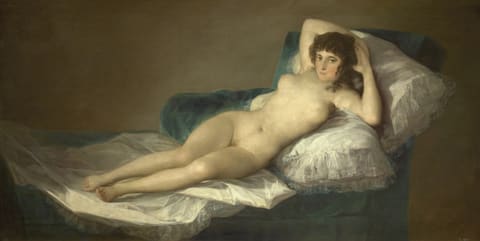
The Naked Maja
N° 846·VII · The Age of Reason
The Naked Maja
Francisco de Goya y Lucientes (1746–1828)
1795–1800 · oil on canvas
Spanish

Goya's reclining nude, first recorded in November 1800 hanging in the private cabinet of Manuel Godoy's palace alongside other paintings of Venus, adapting the traditional pose of the reclining goddess into one of Spanish painting's most famous nudes.

“This painting follows the traditional typology of the goddess Venus reclining on a bed. The first mention of this work dates from November 1800, in the description of Godoy´s palace by the engraver Pedro González de Sepúlveda.” In the museum’s words — museodelprado.es ↗

Meanwhile — The Buddhist Protector Mahakala East Asia · 18th–19th century

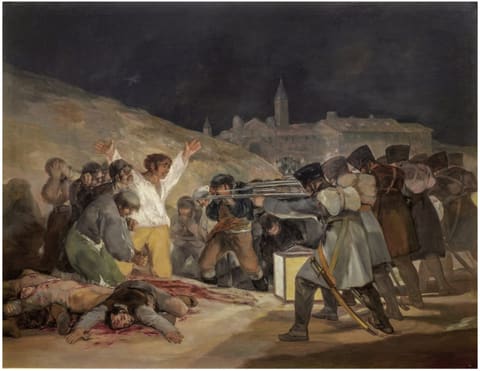
The 3rd of May 1808 in Madrid, or "The Executions"
N° 867·VIII · The Restless Century
The 3rd of May 1808 in Madrid, or "The Executions"
Francisco de Goya y Lucientes (1746–1828)
1814 · oil on canvas
Spanish

Goya's 1814 painting of the reprisal executions that followed Madrid's 2 May 1808 uprising against the French occupation, commissioned by the restored Spanish crown to commemorate the uprising's first anniversary after Ferdinand VII's return from captivity in France.

“His arrival in Madrid would coincide with the first commemoration of the uprising of the people of the city against the occupying French on the 2nd of May 1808.” In the museum’s words — museodelprado.es ↗

Meanwhile — Australia's first bank note Americas & Oceania · Issued 8 April 1817

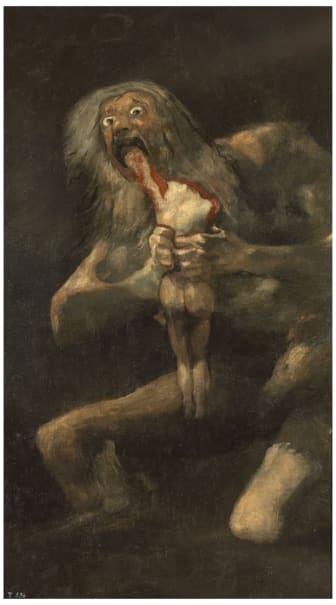
Saturn
N° 870·VIII · The Restless Century
Saturn
Francisco de Goya y Lucientes (1746–1828)
1820–1823 · mixed method on mural, transferred to canvas
Spanish

One of Goya's late Black Paintings, made directly on the walls of his house, the Quinta del Sordo, showing the god Saturn devouring one of his children; the murals were transferred to canvas after the house's new owner, Baron Émile d'Erlanger, had them removed, and were later donated to the Spanish state.

“The mural paintings that decorated the house known as "la Quinta del Sordo," where Goya lived have come to be known as the Black Paintings, because he used so many dark pigments and blacks in them, and also because of their somber subject matter.” In the museum’s words — museodelprado.es ↗

Meanwhile — Simón Bolívar Americas & Oceania · c. 1822