The Atlas·DZ

DZ

Musée National des Antiquités et des Arts Islamiques, Algiers — 22 works · museum site ↗ · 499 BCE – 1899 60000 BCE2020

Seen from Algiers, history is above all sculpture, then treasure & power — a collection opened wide onto other worlds — a window more than a mirror (22 of 22 works are from other civilisations).

Sculpture 9 Power 5 Ritual 3 Invention 2 Craft 2 Observation 1
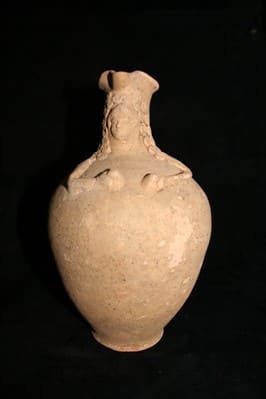
Vase of the Goddess Tanit
N° 180·II · The Classical World
Vase of the Goddess Tanit
Unknown
5th century BCE · Pottery
Punic (Carthaginian)

Translated from French: A pottery vase said to be of the goddess Tanit, found in a cemetery at Collo and dated to the 5th century BCE. On a simple round base the oval body rises to a shorter neck ending in a trefoil mouth joined to the body by a handle; on the front of the neck is carved in relief the bust of a woman with her hands on her breasts, wearing an elegant coiffure and a flower-decorated veil to the shoulders.

“Vase dit de la déesse Tanit, découvert dans un cimetière à Collo daté du 5ème Siècle av.J.-C. S’appuyant sur une simple base ronde, la panse est de forme ovale” In the museum’s words — musee-antiquites.art.dz ↗ · quotation verified against the live page

Meanwhile — Anthropoid Sarcophagus (Ford Collection) Greek world · Ayn el Helwe (near Sidon), 5th century B.C.
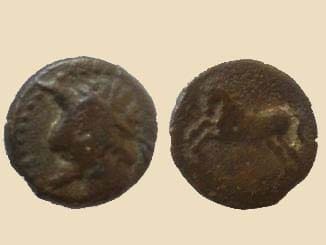
Coin of King Massinissa
N° 216·II · The Classical World
Coin of King Massinissa
Unknown
3rd–2nd century BCE · Bronze
Numidian

Translated from French: A bronze coin of the Numidian king Massinissa: the obverse bears the king's head turned to the left, the reverse a galloping horse turned to the left.

“La tête du roi Massinissa Tournée vers la gauche le revers Un cheval en galop tourné Vers la gauche” In the museum’s words — musee-antiquites.art.dz ↗ · quotation verified against the live page

Meanwhile — Ceremonial textile from the Río Loa Americas & Oceania · 500 BCE – 100 CE (Formative)

Coin of King Juba II
N° 246·II · The Classical World
Coin of King Juba II
Unknown
25 BCE – 23 CE · Silver
Numidian (Mauretanian)

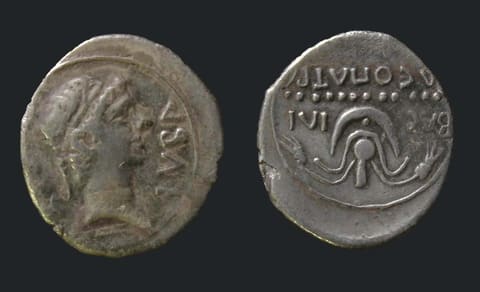
Translated from French: A silver coin of King Juba II: the obverse bears the king's head turned to the right, the reverse agrarian attributes — ears of grain and a bunch (of grapes).

“La tête du roi Juba II Tournée vers la droite le revers Attribut agraire par des épis Et une grappe” In the museum’s words — musee-antiquites.art.dz ↗ · quotation verified against the live page

Meanwhile — Sarcophagus and Cartonnage of the Priest Hor-Djehuti and the Mummy of an Unknown Woman Egypt & Nubia · 2nd half of the 1st century BC – 1st half of the 1st century AD (Roman Period)

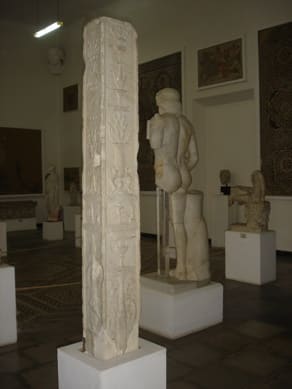
Marble Pillar with Dionysian Reliefs
N° 250·II · The Classical World
Marble Pillar with Dionysian Reliefs
Unknown
1st century CE · White marble
Roman North Africa

Translated from French: A square-section pillar of white marble dated to the 1st century CE, carved in relief across three registers on all four faces. The first register shows the bearded head of the god Dionysos set on part of a cylindrical column; the second, a youth carrying a lioness skin before a fruit-laden altar; the third, a vase on animal legs from which rises a column bearing a leaf-crowned cup — the motifs repeating, with the god replaced by a sceptre and the youth by an old man on other faces.

“pilier de coupe carrée en marbre blanc. Il remonte au premier siècle ap.J.-C,. Porte des décors en relief repartis sur trois registres qui ornent les quatre faces de ce pilier” In the museum’s words — musee-antiquites.art.dz ↗ · quotation verified against the live page

Meanwhile — Whistling bottle: feline and mouse (Vicús) Americas & Oceania · 400 BCE – 500 CE

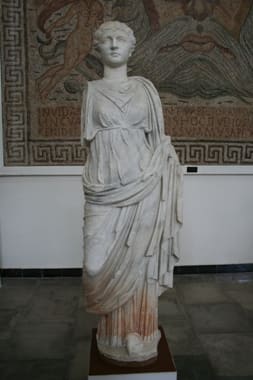
Statue of Livilla
N° 251·II · The Classical World
Statue of Livilla
Unknown
1st century CE · Marble
Roman North Africa

Translated from French: A marble statue of a standing young woman resting on her left leg, the right slightly bent; the right arm and left hand are missing. Her neck is fairly long, her hair waved at the front and gathered behind, and a fine pleated garment covers her whole body to the feet, with a toga wrapped around the torso from behind. Found at Cherchell, the ancient Caesarea.

“Cette statue représente une jeune femme debout, appuyant sur sa jambe gauche, et la droite peu inclinée. Elle est manquée du bras droit et de la main gauche. Le cou est peu long, les cheveux sont ondulés de face et rattachés en arrière. Cette femme porte un habit fin avec des plies qui couvre tout son corps” In the museum’s words — musee-antiquites.art.dz ↗ · quotation verified against the live page

Meanwhile — Whistling bottle: feline and mouse (Vicús) Americas & Oceania · 400 BCE – 500 CE

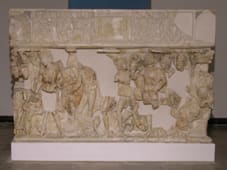
Sarcophagus of Bellerophon
N° 297·II · The Classical World
Sarcophagus of Bellerophon
Unknown
3rd century CE · White marble
Roman North Africa

Translated from French: Discovered during excavations in 1934 at the village of Azeffoun, in many white-marble fragments at the bottom of large jars, then reassembled piece by piece into a 3rd-century-CE sarcophagus of a lid and a tank carved with scenes from the legend of Bellerophon. Scientific analysis showed the marble to be of local origin (the Djebel Filfila quarries near Skikda).

“Découvert au cours des fouilles effectués en 1934, au village d’Azeffoun, en multiples fragments de marbre blanc au fond de grandes jarres. Les morceaux ont été remit chacun à sa place, reconstituant ainsi un sarcophage datant du 3ème s.ap.j.c composé d’un couvercle et d’une cuve représentant des scènes de la légende de Béllérophon” In the museum’s words — musee-antiquites.art.dz ↗ · quotation verified against the live page

Meanwhile — Varvakeion Athena Greek world · AD 200-250 (copy of a 438 BC original)

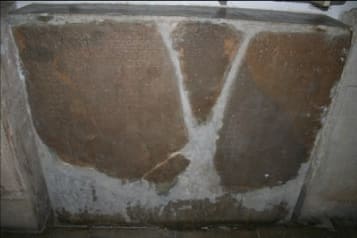
Water-Distribution Table of Lamasba
N° 304·II · The Classical World
Water-Distribution Table of Lamasba
Unknown
Roman period (records the water-law under Elagabalus, 218–222 CE) · Stone
Roman North Africa

Translated from French: A large stone panel discovered in early 1877 in the Lamasba (Merouana) region of Batna province, bearing on its front an inscription describing how irrigation water was to be distributed. The upper part records the rules adopted under the emperor Elagabalus (218–222 CE); the lower part has cells detailing each distribution — the owner's name, the plot's area, and the start, end and duration of the operation.

“gros panneau en pierre découvert au début de 1877, dans la région de Lamesba (Merouana), la wilaya de Batna, porte une inscription sur la face antérieure décrit la manière de la répartition des eaux d’irrigation. Sur la partie supérieure de l’inscription on trouve les lois adoptées sous le règne de l’empereur Elagabal (218-222 ap.J.-C)” In the museum’s words — musee-antiquites.art.dz ↗ · quotation verified against the live page

Meanwhile — Varvakeion Athena Greek world · AD 200-250 (copy of a 438 BC original)

Sarcophagus of the Seven Miracles of Christ
N° 308·II · The Classical World
Sarcophagus of the Seven Miracles of Christ
Unknown
4th century CE · White marble
Early Christian / Late Antique North Africa

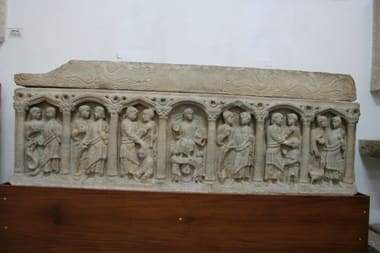
Translated from French: A white marble sarcophagus discovered in December 1857 at Dellys, dating to the 4th century CE. Rectangular and in two parts — the lid, a slab carved with three dolphins, and the tank, holding seven sculpted niches depicting the seven miracles of Christ (the multiplication of the loaves, the healing of a blind man, the miracle of Cana, and others), the scenes separated by small columns topped with capitals. The museum records it as a rare object.

“Sarcophage en marbre blanc découvert en Décembre 1857 à Dellys, datant du quatrième siècle après Jésus Christ. Il est d’une forme rectangulaire et se compose de deux parties : le couvercle est une dalle porte une sculpture de trois dauphins. Et la cuve contient sept niches sculptées, représentant les sept miracles du Christ” In the museum’s words — musee-antiquites.art.dz ↗ · quotation verified against the live page

Meanwhile — White Jade Belt Buckle (Xianbeitou) with Dragon Design East Asia · Jin dynasty (attributed)

Dowry Deed of a Married Woman (Albertini Tablet)
N° 326·II · The Classical World
Dowry Deed of a Married Woman (Albertini Tablet)
Unknown
493 CE · Cedar wood
Late Antique North Africa (Vandal period)

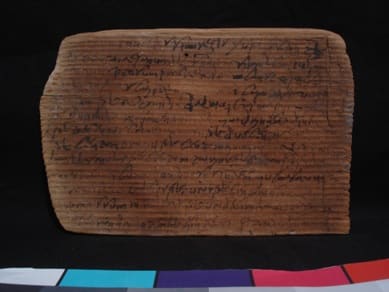
Translated from French: A cedar-wood tablet recording the dowry of a married woman named Geminia, from her betrothed Iulianus, valued at 12,000 folles to buy the bride's accessories (dress, veil, jewellery). The deed was written by the scribe Iulianus on 17 September 493 CE. It was found on Djebel Mrata, in the Tébessa region — one of the Albertini Tablets of the Vandal period.

“Geminiae, de son fiancé Iulianus. Sa valeur est 12000 folles pour acheter les accessoires de la mariée (robe, voile, bijoux, …). Cet acte a été rédigé par le scribe Iulianus, le 17 Septembre 493” In the museum’s words — musee-antiquites.art.dz ↗ · quotation verified against the live page

Meanwhile — Gold Crown from Geumnyeongchong Tomb East Asia · Silla, 5th–6th century

Minbar of the Great Mosque of Algiers
N° 465·III · Faith and Empire
Minbar of the Great Mosque of Algiers
Unknown
490 AH / 1097 CE · Cedar wood
Islamic Maghreb

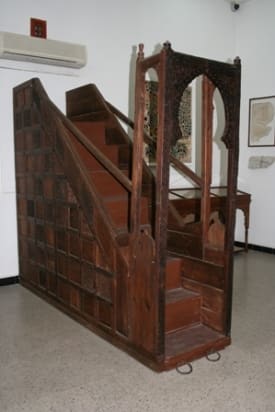
Translated from French: Counted among the oldest movable minbars, this cedar-wood pulpit has seven steps held between two lateral cheek-panels assembled by mortise-and-tenon into triangles, squares and lozenges — 120 floral and geometric panels of which only 45 survive. A broken horseshoe arch stands at the foot of the stair, and a Kufic inscription records that the pulpit was completed on the first of the month of Rajab of the year 490 (1097 CE), the work of Muhammad. It comes from the Great Mosque of Algiers.

“Ce minbar est considéré parmi les plus anciens minbars mobiles. Il comporte sept marches retenues par deux joues latérales décorées par des panneaux assemblés par la technique du tenons et mortaises en forme de triangles, de carrés et de losanges” In the museum’s words — musee-antiquites.art.dz ↗ · quotation verified against the live page

Meanwhile — Kokin Wakashu Anthology(Surviving Portion of Vol. XII) East Asia · Japan, Heian period, 11th–12th century

Marinid Alms Measure (Mudd) of Abu al-Hasan
N° 538·IV · Toward the Renaissance
Marinid Alms Measure (Mudd) of Abu al-Hasan
Unknown
731–749 AH / 1331–1348 CE · Brass
Islamic Maghreb (Marinid) · Marinid dynasty

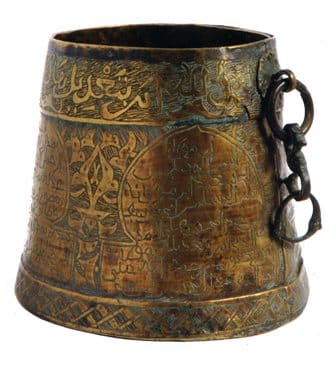
Translated from French: A truncated-conical alms measure (mudd) of brass, from Tlemcen, in the name of the Marinid sultan Abu al-Hasan al-Marini, dated 731–749 AH / 1331–1348 CE. The body bears decoration of palms and arcades, and at the centre a Naskhi inscription gives the names of the craftsman and of the sovereign who ordered its making.

“aumône de forme tronconique en cuivre jaune, portant sur la panse des décors composés de palmes et des arcatures” In the museum’s words — musee-antiquites.art.dz ↗ · quotation verified against the live page

Meanwhile — Annunciation with St. Maxima and St. Ansanus Europe · 1333

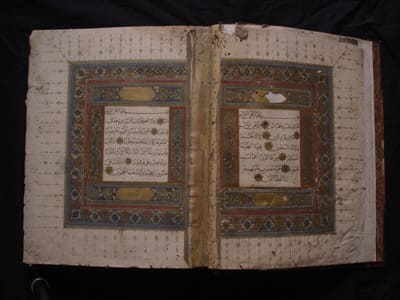
Qur'an Endowed by Abdi Pasha
N° 812·VII · The Age of Reason
Qur'an Endowed by Abdi Pasha
Unknown
1141 AH / 1729 CE · Paper and leather
Islamic Maghreb (Ottoman Algeria) · Ottoman period

Translated from French: A Qur'an given as a pious endowment by Abdi Pasha (to the Great Mosque of Algiers), dated 1141 AH / 1729 CE. It comprises 252 leaves calligraphed in Naskh and Thuluth; the opening pages are decorated with palm half-fans and gilded rosettes, with medallions of various shapes in the margins, and the binding is ornamented inside and out with floral and arabesque motifs.

“Ce coran a été doté par Abdi Pacha, il se compose de 252 feuilles, calligraphié en Naskh et Thuluth. Les premières pages sont ornées de demi- éventails de palmiers, des rosettes dorées” In the museum’s words — musee-antiquites.art.dz ↗ · quotation verified against the live page

Meanwhile — Famille-rose Vase with Bats and Peaches East Asia · Qing dynasty, Yongzheng reign (1723–1735)

Flissa Sabre
N° 853·VIII · The Restless Century
Flissa Sabre
Unknown
13th century AH / 19th century CE · Iron and copper
Kabyle (Amazigh), Algeria

Translated from French: A flissa sabre made by the tribe of Greater Kabylia, from which the weapon takes its name. The hilt is of copper shaped as an animal's head, and the iron blade bears geometric ornamentation. 13th century AH / 19th century CE, from the Kabylie region.

“Sabre faite par la tribu de la grande Kabylie d’où le nom donné à cette arme sabre de flissa. La poignée est en cuivre a la forme de la tête d’animal, et la lame en fer porte des ornementations géométriques” In the museum’s words — musee-antiquites.art.dz ↗ · quotation verified against the live page

Meanwhile — Waka 'Teremoe' (canoe hull) Americas & Oceania · Māori, 1800s

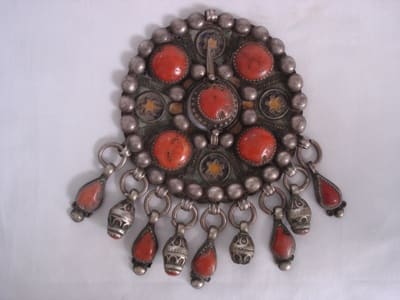
Kabyle Fibula (Ibzim / Tabzimt)
N° 854·VIII · The Restless Century
Kabyle Fibula (Ibzim / Tabzimt)
Unknown
13th century AH / 19th century CE · Silver plated with enamel and inlaid with coral
Kabyle (Amazigh), Algeria

Translated from French: A circular fibula of silver plated with enamel and inlaid with coral, with hanging pendants, known as 'Tabzimt' and worn on the chest by means of a pin. 13th century AH / 19th century CE, from the Kabylie region.

“Fibule a forme circulaire en argent plaqué d’email et incrusté de corail” In the museum’s words — musee-antiquites.art.dz ↗ · quotation verified against the live page

Meanwhile — Waka 'Teremoe' (canoe hull) Americas & Oceania · Māori, 1800s

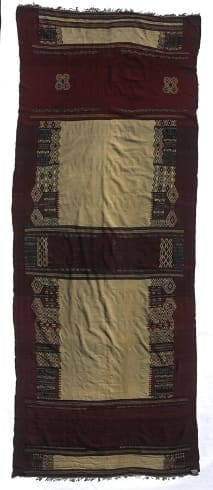
Woven Haik (Woman's Wrap)
N° 856·VIII · The Restless Century
Woven Haik (Woman's Wrap)
Unknown
13th century AH / 19th century CE · Wool
Amazigh (Algeria)

Translated from French: A woman's garment known in the region of El Milia (Jijel, Algeria) as the Haik, its decoration resembling that of Greater Kabylia. Wool, 13th century AH / 19th century CE.

“Vêtement féminin connu dans la région d’El Milia (Djidjel-Algérie) par le nom El Haik, sa décoration ressemble à celle de la grande kabylie” In the museum’s words — musee-antiquites.art.dz ↗ · quotation verified against the live page

Meanwhile — Waka 'Teremoe' (canoe hull) Americas & Oceania · Māori, 1800s

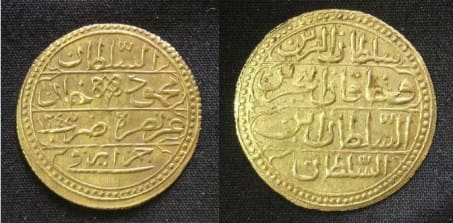
Ottoman Gold Dinar Struck at Algiers
N° 875·VIII · The Restless Century
Ottoman Gold Dinar Struck at Algiers
Unknown
Ottoman period (dated 1243 AH / 1827 CE) · Gold
Islamic Maghreb (Ottoman Algeria) · Ottoman period

Translated from French: An Ottoman-period gold dinar. The obverse gives the sultan's titles; the reverse names 'the Sultan Mahmud Khan 1243 [AH], his victory glorified, struck at Jazair (Algiers)'.

“Le sultan Mahmoud khan 1243 Sa victoire glorifiée frappé Jazair le” In the museum’s words — musee-antiquites.art.dz ↗ · quotation verified against the live page

Meanwhile — Singer Gertrud Elisabeth Mara Europe · 1828

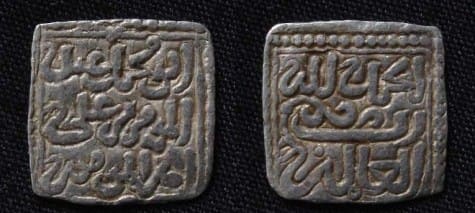
Almohad Square Dirham
N° 1108·Undated
Almohad Square Dirham
Unknown
Almohad period · Silver
Islamic Maghreb (Almohad) · Almohad dynasty

Translated from French: A square silver dirham of the Almohad period, from the Erremchi hoard (Tlemcen). The obverse reads 'Praise to God, Lord of the universe'; the reverse names 'Abou Mohamed Abd al-Mu'min ibn Ali, Commander of the Faithful' — the first Almohad caliph.

“Abou Mohamed Abd El Moumen Ben Ali Le commandeur des croyants” In the museum’s words — musee-antiquites.art.dz ↗ · quotation verified against the live page
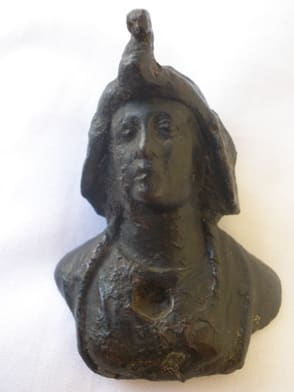
Bust of the Goddess Africa
N° 1125·Undated
Bust of the Goddess Africa
Unknown
Roman period · Bronze
Roman North Africa

Translated from French: A bronze bust of a woman found at El Berouaguia (Berrouaghia), symbolising the continent of Africa — a goddess worshipped in North Africa in pagan times. Her hair is covered with an elephant skin surmounted at the front by an elephant's trunk, the elephant being a sacred animal in North Africa. The museum notes this bust is distinguished from two near-identical specimens by facial features expressing sadness and worry.

“Buste en bronze d’une femme, découvert à El Berouaguia. Elle symbolise le continent de l’Afrique, c’était une déesse adorée en Afrique du nord à l’époque païenne. Ses cheveux sont couverts d’une peau d’éléphant surmontée en avant d’une trompe d’éléphant, ce dernier était un animal sacré en Afrique du nord” In the museum’s words — musee-antiquites.art.dz ↗ · quotation verified against the live page
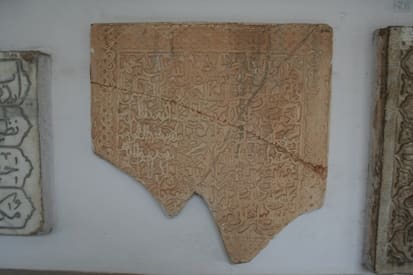
Commemorative Inscription of Abd al-Rahman al-Thaalibi
N° 1136·Undated
Commemorative Inscription of Abd al-Rahman al-Thaalibi
Unknown
Ottoman period · Stucco
Islamic Maghreb (Ottoman Algeria) · Ottoman period

Translated from French: A stucco panel carved in relief in homage to Sheikh Abd al-Rahman al-Thaalibi, glorifying his works. The text is an eight-line poem calligraphed in Naskhi script, with a lobed flower at the middle of each line and a four-lobed flower above the invocation of God. Ottoman period, from Algiers.

“Inscription gravée en relief sur un panneau en stuc, rend hommage au Cheikh Abd El –Rahmane El- Thaalibi, et glorifie ses travaux. Le texte est un poème de huit lignes calligraphié en caractères Naskhi” In the museum’s words — musee-antiquites.art.dz ↗ · quotation verified against the live page
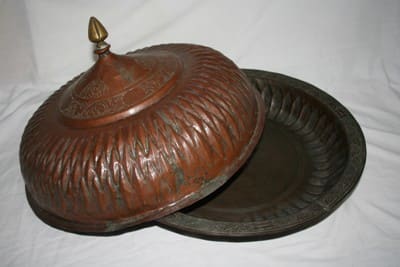
Copper Plate with Lid (Tepsi Achawet)
N° 1137·Undated
Copper Plate with Lid (Tepsi Achawet)
Unknown
Ottoman period · Red copper
Islamic Maghreb (Ottoman Algeria) · Ottoman period

Translated from French: A red-copper plate with lid bearing an inscription that gives the craftsman's name and place of making — Mahmoud Ben Keddour El Fadhil, at Algiers. The lid is decorated with a band of hammered lozenges and, between circles, palms, and a frieze alternating cypress trees with a stylised arch motif. Ottoman period, from Azeffoun (Greater Kabylia).

“Plat avec couvercle en cuivre rouge, porte une inscription représente le nom de l’artisan ainsi que le lieu” In the museum’s words — musee-antiquites.art.dz ↗ · quotation verified against the live page
Kerfala Stele
N° 1162·Undated
Kerfala Stele
Unknown
Libyc period · Sandstone
Libyco-Berber (Amazigh)

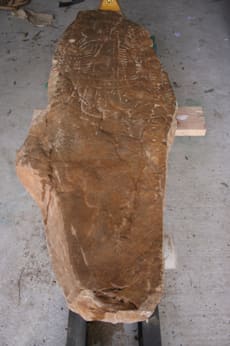
Translated from French: A Libyc-period funerary stele discovered in 1954 at the village of Kerfala (Bouira), from a tomb where a skeleton was found with a bronze bracelet on the right wrist. The figure stands frontally holding a chief's staff or sceptre; the inscription occupies both faces of the stele — 45 Libyc characters of the so-called 'eastern' alphabet on the main face (translated by the museum as 'Agellid [chief] of the Meseksen tribe, may the tomb neither decay nor age'), and 22 characters of the 'western' alphabet on the reverse.

“inscription occupe les deux faces de la stèle : la première sur la face principale, constituées de 45 caractères libyques appartiennent à l’alphabet dit oriental” In the museum’s words — musee-antiquites.art.dz ↗ · quotation verified against the live page
The Abizar Stele
N° 1215·Undated
The Abizar Stele
Unknown
Libyc period · Sedimentary rock
Libyc period (الفترة الليبية)

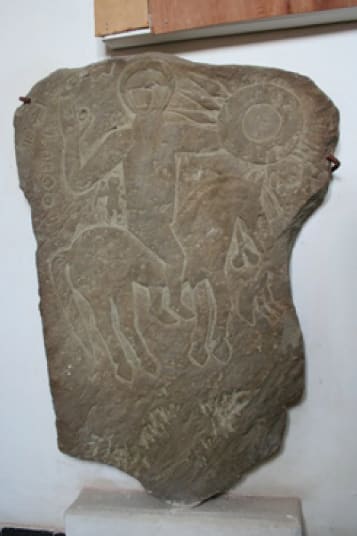
Translated from Arabic: A carved stone stele discovered in the village of Abizar, Tizi Ouzou (Greater Kabylia), in 1858. It shows a man with a round face and a long, tapering beard — somewhat resembling the portraits struck on the coins of the Numidian kings — riding an unsaddled horse in the Numidian manner, holding a shield and three spears in his left hand and raising his right hand as if in salute, a circular ring between thumb and forefinger. The stele also bears a small figure holding a staff, a dog and a bird, and, at the upper left, a three-line inscription in the Eastern Libyc script (two vertical lines of five and six characters and one horizontal line of three).

“إكتشف في قرية أبيزار، دائرة وقنون، ولاية تيزي وزو عام 1858م. يظهر عليه رجل ذو وجه دائري و لحية طويلة مدببة من الأسفل، تشبه إلى حد ما الصور المضروبة على نقود الملوك النوميديين، يمتطي جوادا بلا سرج على عادة أهل نوميديا، كما يحمل بيده اليسرى درعا و ثلاثة رماح، ويرفع يده اليمنى كأنه يؤدي تحية” In the museum’s words — musee-antiquites.art.dz ↗ · quotation verified against the live page