The Atlas·AT

Austria

Kunsthistorisches Museum, Vienna — 17 works · museum site ↗ · 2000 BCE – 1668 60000 BCE2020

Seen from Vienna, history is above all faces & portraits, then stories & histories — a collection kept mostly in its own tradition, with a few glances abroad (3 of 17 works are from other civilisations).

Portraits 6 Stories 3 Power 2 Invention 1 Ritual 1 Sculpture 1 Craft 1 Sacred 1 Observation 1
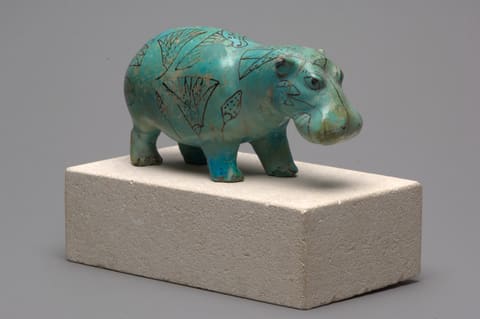
Statuette of a Hippopotamus
N° 078·I · The First Makers
Statuette of a Hippopotamus
Unknown
11th–12th Dynasty, ca. 2000 BC · faience with blue-green glaze, painted
Ancient Egyptian · Middle Kingdom (11th–12th Dynasty)

A faience hippopotamus statuette of a type placed near mummies as a grave good symbolizing regeneration in the afterlife, its body painted with the marsh plants and animals of its habitat; the king's ritual hippopotamus hunt symbolized victory over the chaos the animal represented.

“Statuettes depicting hippopotami, symbolic of regeneration in the hereafter, were popular grave goods that were placed close to the mummy in the coffin. Plants and animals characteristic of the marshes where the hippo lived are depicted on its body. The king’s ritual hippopotamus hunt symbolized his victory over the forces of chaos with which the animal had been associated since primeval times.” In the museum’s words — khm.at ↗

Meanwhile — Disk-calendar of the Middle Dnipro culture Europe · Late 3rd – early 2nd millennium BCE
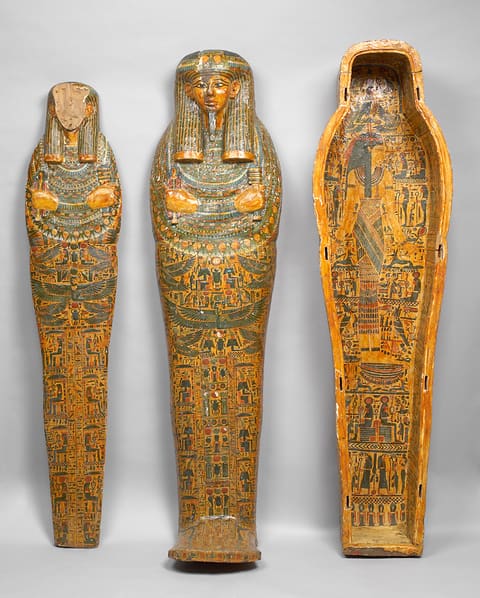
Mumienbrett und Innerer Sarg des Nes-pauti-taui
N° 127·I · The First Makers
Mumienbrett und Innerer Sarg des Nes-pauti-taui
Unknown
21st Dynasty, before 969 BC · wood and cartonnage, stuccoed, painted and varnished
Ancient Egyptian · Third Intermediate Period (21st Dynasty)

The mummy board and inner coffin of the priest Nes-pauti-taui, part of a coffin ensemble that also includes an outer coffin held by the same museum, discovered in 1891 together with 152 other burials in the so-called second cache north of the Hatshepsut Temple at Deir el-Bahari.

“Das Sargensemble des Nes-pauti-taui, zu dem neben dem Mumienbrett und dem Innensarg auch ein äußerer Sarg gehört (der sich ebenfalls im Kunsthistorischen Museum befindet), wurde 1891 zusammen mit 152 weiteren Bestattungen in der so genannten zweiten Cachette nördlich des Hatschepsut-Tempels entdeckt.” In the museum’s words — khm.at ↗

Meanwhile — Mask of Duality (Tlatilco) Americas & Oceania · Middle Preclassic (c. 1200–800 BCE)

Gemma Augustea
N° 269·II · The Classical World
Gemma Augustea
Unknown
9–12 AD · two-layered onyx (sardonyx), gold mount (mount 17th century)
Roman · Early Imperial Period (Julio-Claudian)

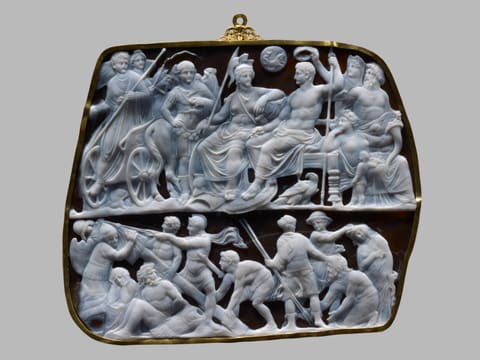
The most significant ancient cameo held in Vienna's Antiquities Collection, the Gemma Augustea glorifies the deeds of Emperor Augustus and his successor Tiberius; cut from a two-layered Arabian sardonyx, it is a masterpiece of the imperial gem-cutting workshop in Rome.

“Der Verherrlichung der Taten des Kaisers Augustus und seines Nachfolgers Tiberius diente der bedeutendste heute in der Wiener Antikensammlung verwahrte antike Kameo, die Gemma Augustea. Er ist aus einem zweischichtigen arabischen Sardonyx geschnitten und ein Meisterwerk der kaiserlichen Gemmenwerkstatt in Rom.” In the museum’s words — khm.at ↗

Meanwhile — Sarcophagus and Cartonnage of the Priest Hor-Djehuti and the Mummy of an Unknown Woman Egypt & Nubia · 2nd half of the 1st century BC – 1st half of the 1st century AD (Roman Period)

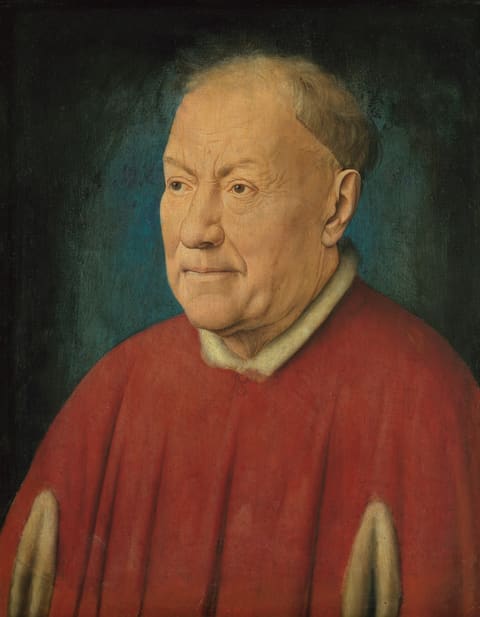
Cardinal Niccolò Albergati
N° 576·IV · Toward the Renaissance
Cardinal Niccolò Albergati
Jan van Eyck (c. 1390–1441)
c. 1435 · oil on oak panel
Flemish · Early Netherlandish Painting

The museum's own title carries a scholarly “(?)” qualifying the sitter's identity as Cardinal Niccolò Albergati; van Eyck first sketched him from life at the 1435 Arras peace congress, noting paint-colour details on the drawing itself, then produced this panel soon after - transferring, per the museum's text, techniques perfected in manuscript painting to the larger scale of panel portraiture (van Eyck did not, contrary to legend, invent oil painting itself).

“During a peace congress in Arras in 1435, van Eyck produced a silverpoint drawing (Dresden) in which he not only caught the physiognomy of the elderly cardinal and papal envoy, but already noted details concerning paint colours. The portrait shown here was produced soon after. Contrary to art history myth, oil painting, i.e. the use of oil resins as a bonding agent, was not invented by van Eyck. Yet he did transfer the delicate art of painting, which had already reached its highest point in book painting, to the larger format of panel painting, using new, highly refined techniques” In the museum’s words — khm.at ↗

Meanwhile — Inkstone Box with Poetry-Inspired Seashore Design in Maki'e and Silver Inlay East Asia · Japan, Muromachi period, early 15th century

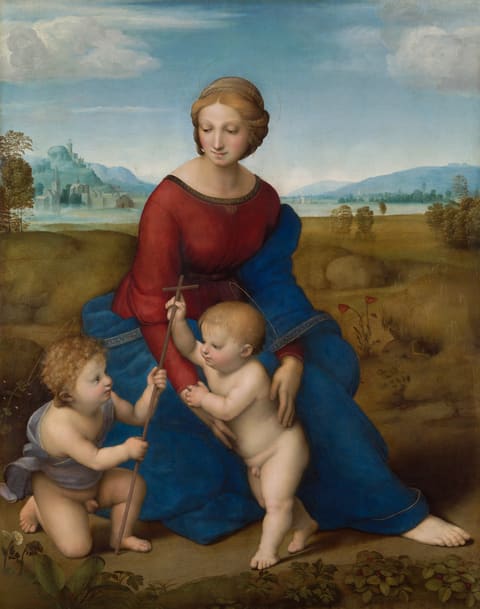
The Madonna of the Meadow
N° 634·V · The Renaissance
The Madonna of the Meadow
Raphael (1483–1520)
1505 or 1506 · oil on poplar panel
Italian · Italian Renaissance

Raphael arranges the Madonna, Christ Child and infant St John into a pyramidal group set in a pasture landscape that fades into a distant horizon, a composition the museum's own text credits with becoming an “icon” of Renaissance spiritual thought.

“The group formed into a pyramid is embedded in a delightful pasture landscape which on the one hand emphasises the world of humans; yet in the way it fades out into the far-off horizon, it appears to accentuate what is eternally valid. Thus The Madonna in the Meadow became the “icon” of the new spiritual thinking of the Renaissance.” In the museum’s words — khm.at ↗

Meanwhile — Gold ewer with dragon and phoenix design East Asia · Ming Dynasty (1368–1644)

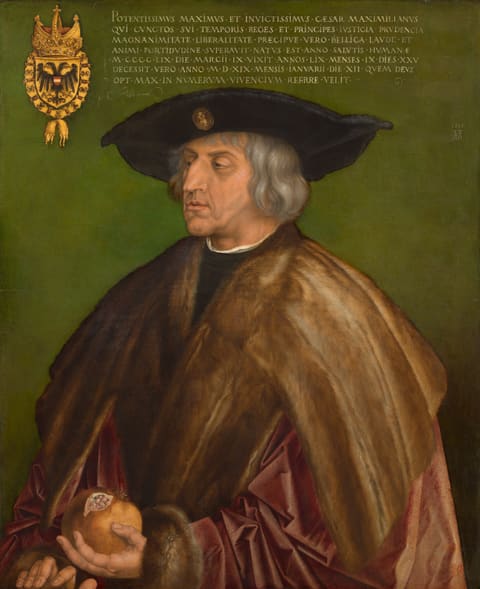
Emperor Maximilian I
N° 651·V · The Renaissance
Emperor Maximilian I
Albrecht Dürer (1471–1528)
1519 · oil on limewood panel
German · Northern Renaissance

Dürer's 1519 portrait shows Emperor Maximilian I (1459–1519) as an elegant private gentleman rather than in state regalia, his dignity conveyed through scale and a brilliantly rendered fur collar; the museum's text notes the pomegranate in his hand has been read as a stand-in for the imperial orb, an allusion to the myth of Persephone, or a reference to the 1492 conquest of Granada.

“The emperor is depicted here as an elegant private gentleman. The desired effect of dignity and power is achieved by the manner in which the emperor fills the frame and the brilliant execution of the fur collar. Several different interpretation have been suggested for the pomegranate in the emperor’s hand: as a private proxy for the imperial orb; as a reference to the myth of Persephone and thus a reference to death; and as an allusion to the conquest of Granada by the Christian armies in 1492.” In the museum’s words — khm.at ↗

Meanwhile — Padrão of Sunda Kalapa South Asia · 16th century (treaty dated 21 August 1522)

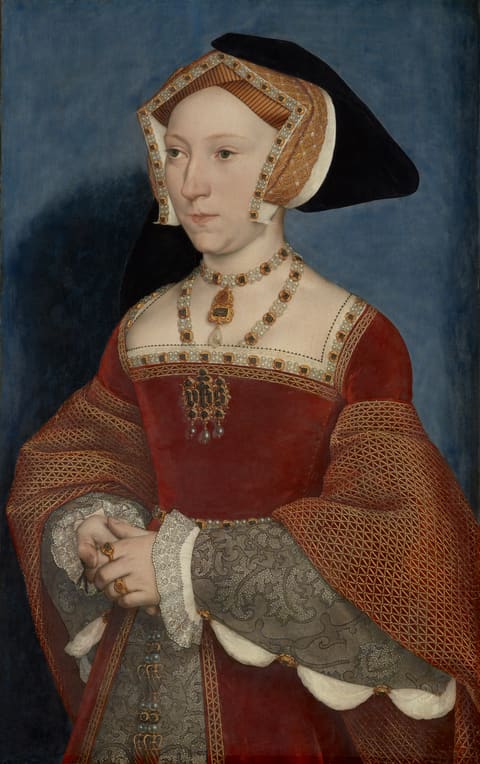
Jane Seymour
N° 665·V · The Renaissance
Jane Seymour
Hans Holbein the Younger (1497–1543)
c. 1536–1537 · oil on oak panel
German · Northern Renaissance

Among Holbein's first paintings after becoming Henry VIII's court painter in 1536, this portrait depicts Jane Seymour, who had served as lady-in-waiting to Henry's two previous queens before becoming his third wife immediately after Anne Boleyn's execution, and who died the following year after giving birth to the future Edward VI.

“Holbein became court painter to Henry VIII of England in 1536. Among the first of his paintings in the service of the King was this portrait of Jane Seymour (1509–1537). As lady-in-waiting she had served two Queens consecutively, Catherine of Aragon and Anne Boleyn, until she herself became the third wife of the English King immediately after the execution of Anne in 1536. Jane died the following year after the birth of the couple’s son and heir to the throne, Edward.” In the museum’s words — khm.at ↗

Meanwhile — Manuscript Page from the Golestan of Sa’di Islamic world · 1526–1530

Saliera
N° 667·V · The Renaissance
Saliera
Benvenuto Cellini (1500–1571)
1540–1543 · gold, enamel, ebony, ivory
Italian · Mannerism

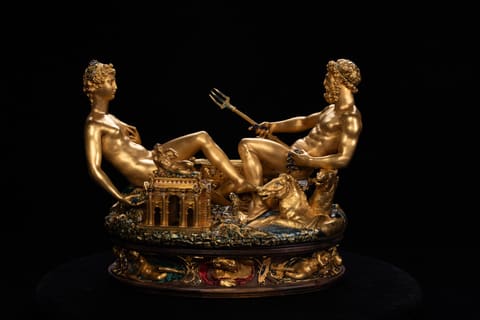
The only surviving gold work by Benvenuto Cellini, this table centrepiece for salt and pepper is really an allegory of the Cosmos, personifying sea and earth as Neptune and Tellus above a base depicting the times of day and four winds, all under the arms of its patron, King Francis I of France.

“The only extant work in gold by this Florentine artist already famous during his lifetime, Cellini’s masterpiece is far more than a precious salt and pepper cellar. Its decorative program turns it into an allegory of the Cosmos, represented here by the deities Neptune (sea) and Tellus (earth) as well as by the depictions of the times of day and the four winds on the base. This cosmos is being ruled by the man who had commissioned the work, here represented by his arms and emblems: King Francis I of France.” In the museum’s words — khm.at ↗

Meanwhile — Haikata Arabic Well (Kisima cha Asili cha Haikataa) Africa · attributed to Arab settlers, 1545

Summer
N° 684·V · The Renaissance
Summer
Giuseppe Arcimboldo (1526–1593)
1563 · oil on limewood panel
Italian · Mannerism

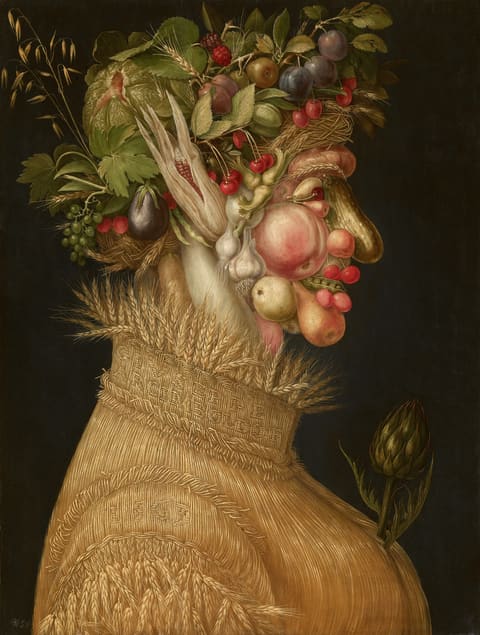
Painted in 1563 by the Habsburg court painter Arcimboldo, this composite portrait built entirely from fruit and plants - with no natural face ever showing through - is part of the series of Seasons that made his later reputation; he even wove his signature and the date into the straw of the collar.

“Arcimboldo had been imperial court painter in Vienna and Prague since 1562. As well as a portraitist, he was mainly renowned for his work as a producer and designer of courtly tournaments and wedding celebrations. In 1563, however, he created a series of paintings of the seasons, the uniqueness of which was the basis of the painter’s later fame. Made up of plant pieces and fruit, at no point does “Summer” show the surface of a natural face. The signature and date are subtly woven into the straw.” In the museum’s words — khm.at ↗

Meanwhile — Tile Panel, Alfiz Islamic world · 1570–1580

The Tower of Babel
N° 685·V · The Renaissance
The Tower of Babel
Pieter Bruegel the Elder (c. 1525–1569)
1563 · oil on oak panel
Flemish · Northern Renaissance

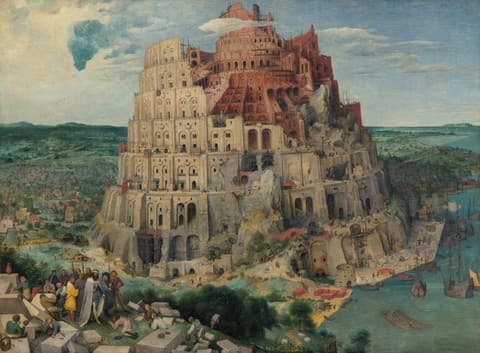
Bruegel's celebrated, encyclopaedically detailed depiction of the Tower of Babel, painted in 1563, became the most famous and most frequently copied classical treatment of the subject, its scale emphasized by a Flemish port rendered tiny beside it.

“Bruegel’s monumental composition became the most famous, most often copied and varied classic depiction of the tower. Perspective is provided by the seemingly Flemish port which seems tiny in comparison with the tower. Painstakingly, and in encyclopaedic detail, Bruegel depicts countless technical and craftsmanship processes. He blends elements from antique and Romanesque architecture in the stone structure around the building’s exterior.” In the museum’s words — khm.at ↗

Meanwhile — Tile Panel, Alfiz Islamic world · 1570–1580

Hunters in the Snow (Winter)
N° 686·V · The Renaissance
Hunters in the Snow (Winter)
Pieter Bruegel the Elder (c. 1525–1569)
1565 · oil on oak panel
Flemish · Northern Renaissance

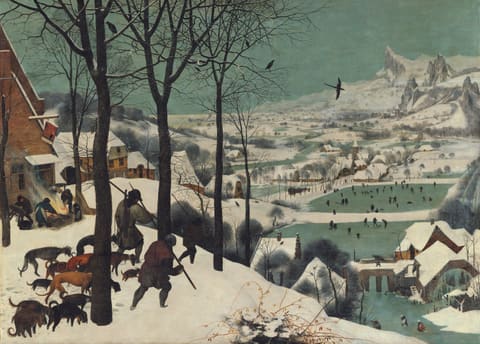
A hunting party trudges home to a snow-bound Flemish village with an exhausted pack of dogs, in what the museum's own text calls the first and most prominent winter landscape of European painting, prized less for its many small details than for its unified evocation of cold.

“The group of hunters returns to the low–lying village, accompanied by an exhausted pack of dogs. Only a single fox hangs on one of the spears slung over the men’s shoulders. To the left preparations are afoot to singe a pig over an open fire. Delightful details such as skaters on frozen ponds have added to the picture’s enormous popularity. Yet it is not the sum total of details that make the picture important, rather its overall effect. In a manner both virtuosic and consistent, Bruegel evokes the impression of permanent cold in this first and most prominent winterlandscape of european painting.” In the museum’s words — khm.at ↗

Meanwhile — Tile Panel, Alfiz Islamic world · 1570–1580

Peasant Wedding
N° 691·V · The Renaissance
Peasant Wedding
Pieter Bruegel the Elder (c. 1525–1569)
1568 · oil on oak panel
Flemish · Northern Renaissance

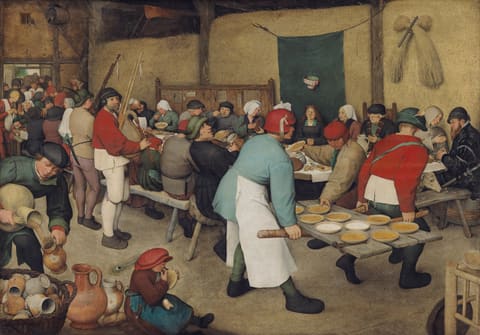
A carefully staged yet naturalistic record of a Flemish peasant wedding feast, the bride seated before a green tapestry with a paper crown above her, porridge carried in on an unhinged door, and no allegorical program beyond the realism of the scene itself.

“The apparent “snapshot” of this picture is in fact carefully composed. Dispensing with allegorical meaning the painting is a realistic record of a Flemish peasants’ wedding. The bride sits in front of a green tapestry, a paper crown hangs over her. The bridegroom was not present at the wedding feast in accordance with Flemish custom. A lawyer with a mortar–board, a Franciscan monk and the lord of the manor with his dog (to the far right) are all visible; the porridge dishes carried in on an unhinged door are utterly simple, and the posture and gait of the carriers are similarly striking.” In the museum’s words — khm.at ↗

Meanwhile — Tile Panel, Alfiz Islamic world · 1570–1580

Automaton in the Form of a Ship
N° 698·V · The Renaissance
Automaton in the Form of a Ship
Hans Schlottheim (c. 1545–1625)
dated 1585 · gilt and painted silver, copper alloy, iron
German · Northern Mannerism

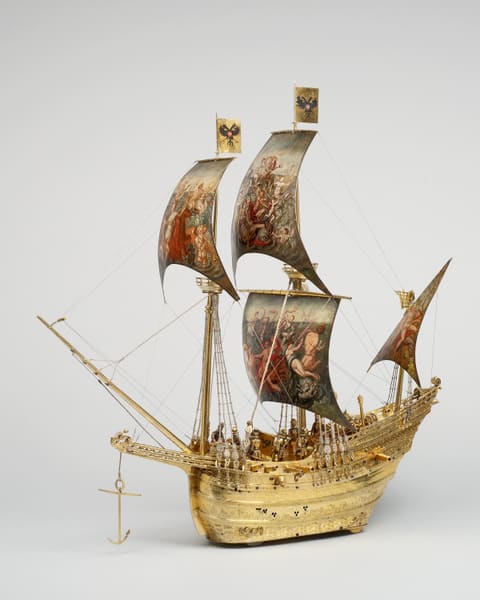
A mechanical table centrepiece in the long tradition of ship-form nefs, its decorative figures and coats of arms glorifying its ruler; a clockwork mechanism once propelled it across the table while its crew moved to hidden music and its cannons fired a salvo.

“Centrepieces in the shape of a ship have a long tradition. Here the decorative figures and coats of arms glorify the ruler and his empire. A complex mechanism propels the ship across the table while the crew moves to music from inside the ship. As a highlight, cannons fire a salvo.” In the museum’s words — khm.at ↗

Meanwhile — Pot East Asia · c. 1575–1600

Decorative Ewer with Seychelles Nut
N° 725·VI · The Baroque Age
Decorative Ewer with Seychelles Nut
Anton Schweinberger
1602 · coco de mer (Seychelles nut), silver, partly gilt
Rudolfine Mannerism

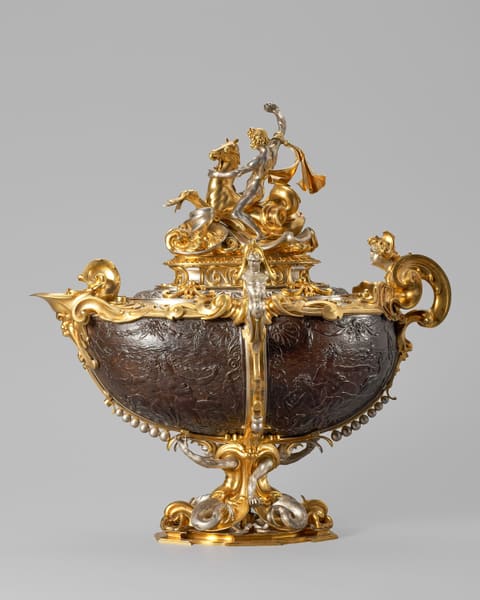
Made for Emperor Rudolf II by two of his court artists, this ewer mounts half of a giant coco de mer seed - washed up on Indian Ocean shores and long believed to be a fruit of the sea - in gilt silver whose imagery plays on that very belief, a prototypical Kunstkammer fusion of natural wonder and artifice.

“The ewer created by two court artists for Emperor Rudolph II displays half of a Seychelles nut. This giant seed from a type of palm was found washed up on beaches of the Indian Ocean, and was hence believed to be a sea fruit. The depictions on both the nut and its mount refer to this fact. The interplay of nature and art is prototypical.” In the museum’s words — khm.at ↗

Meanwhile — Aleppo Room Islamic world · 1600–01 and 1603

Self-Portrait
N° 759·VI · The Baroque Age
Self-Portrait
Peter Paul Rubens (1577–1640)
1638–1640 · oil on canvas
Flemish · Baroque

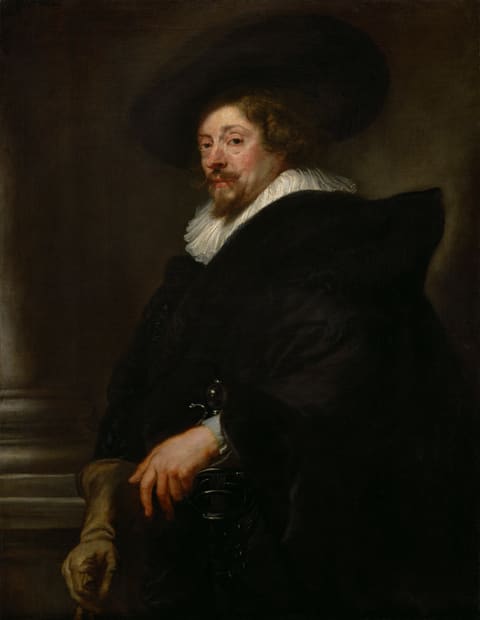
Painted in his final years, this self-portrait gives Rubens the column, sword and glove of a conventional courtly portrait, yet lavishes far more attention on his individual, aging features than that genre typically allowed - fitting for a painter who, despite great success at court, remained ambivalent about courtly life.

“Despite his great success at court, Rubens always remained ambivalent about courtly life. In the final phase of his life he sought to be released from most of his diplomatic responsibilities. While he provided this portrait of his later years with the attributes of a courtly portrait, (the column, sword and glove), he paid more attention to individual facial features than was otherwise customary in a portrait of this type.” In the museum’s words — khm.at ↗

Meanwhile — Writing Box, Pontoon bridge design in "maki-e" lacquer East Asia · Edo period, 17th century

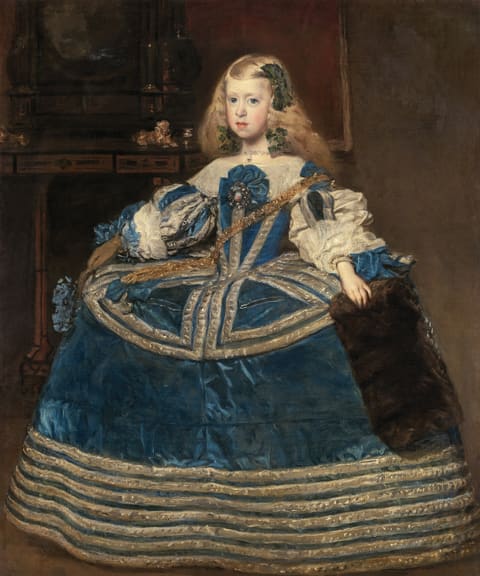
Infanta Margarita in a Blue Dress
N° 775·VI · The Baroque Age
Infanta Margarita in a Blue Dress
Diego Velázquez (1599–1660)
1659 · oil on canvas
Spanish · Spanish Golden Age

One of Velázquez's last completed works, this 1659 portrait of the eight-year-old Infanta Margarita was sent to the Viennese court as part of her betrothal to Emperor Leopold I, its shimmering, almost impressionistic brushwork resolving into full spatial depth only when viewed from a distance.

“One year before his death Velázquez created this portrait of the eight-year old Infanta as well as that of her little brother Philip Prosper (Inv.-No. 319); they were to be his last completed works. That year the pictures went to Emperor Leopold I, who married the Infanta in 1666. The painter’s personal style reached its highpoint here: shimmering spots of colour on wide painting surfaces produce an almost impressionistic effect – the viewer must stand at a suitable distance to get the impression of complete, three-dimensional spatiality.” In the museum’s words — khm.at ↗

Meanwhile — Mere pounamu (greenstone striking weapon) "Amokura" Americas & Oceania · Māori, 1500–1820

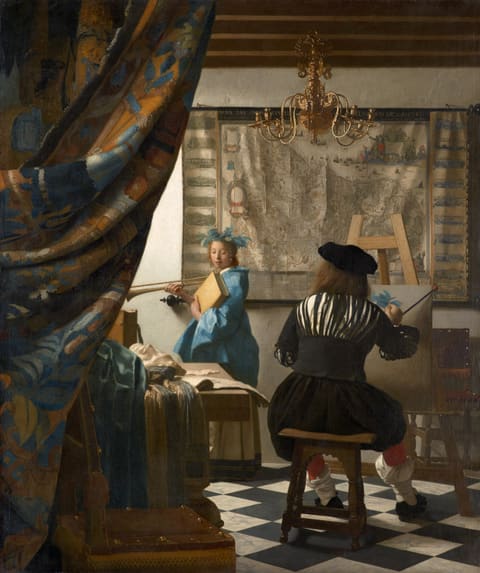
The Art of Painting
N° 782·VI · The Baroque Age
The Art of Painting
Johannes Vermeer (1632–1675)
c. 1666–1668 · oil on canvas
Dutch · Dutch Golden Age

Vermeer turns a simple studio scene into an allegory of painting itself: his model poses as Clio, muse of history, while a map of the seventeen historical Netherlandish provinces behind them nods to a land whose fame Vermeer ties to its painters.

“With his depiction of the painter in his studio, Vermeer turns this genre painting into an allegory of the art of painting. His model is posing as Clio, the Muse of history, who inspires the painter and proclaims the glory of painting in the old Netherlands, which she has immortalised in the book of history. The unity of the arts is reflected in the sculpture model, sketchbook and the work in progress on the easel. The map with the 17 provinces of the Netherlands before they were divided into north and south is a reference to a land that had always owed its fame to the art of painting.” In the museum’s words — khm.at ↗

Meanwhile — Tứ Kỳ Pagoda Stone Incense Pillar (Cây hương chùa Tứ Kỳ) South Asia · 1666, Cảnh Trị reign, Lê Huyền Tông, Lê Trung Hưng period