The Atlas·BE

Belgium

Royal Museums of Fine Arts of Belgium, Brussels — 20 works · museum site ↗ · 1415–1954 60000 BCE2020

Seen from Brussels, history is above all sacred images, then the world observed — a collection kept wholly in its own tradition — a mirror.

Sacred 7 Observation 6 Stories 3 Portraits 2 Sculpture 1 New vision 1
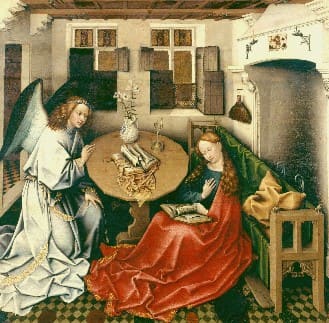
The Annunciation
N° 570·IV · Toward the Renaissance
The Annunciation
Attributed to Master of Flémalle (Robert Campin?) (c. 1375–1444)
c. 1415–1425 · oil on oak panel
Netherlandish · Flemish Primitives

The Virgin Mary sits reading as the Archangel Gabriel appears to announce the Incarnation, painted with the meticulous attention to domestic detail and the pioneering use of oil glazes associated with the anonymous 'Master of Flémalle' - an identity many scholars, though not all, equate with the documented Tournai painter Robert Campin; the museum's own catalog page itself lists the attribution with a question mark. The museum's own record (translated from French) notes the panel was given by the Société des Amis des Musées royaux (Friends of the Royal Museums) in 1910, having been acquired on the London art market from Percy More Turner.

“Don de la société Les amis des Musées royaux, Bruxelles, 1910 (acquis sur le marché de l'art de Percy More Turner, Londres, 1910)” In the museum’s words — fine-arts-museum.be ↗ · quotation verified against the live page

Meanwhile — Chimú bimetallic ceremonial bowl (Cuenco Bimetálico Chimú) Americas & Oceania · Chimú, Imperial Era (1300 – 1532 CE)
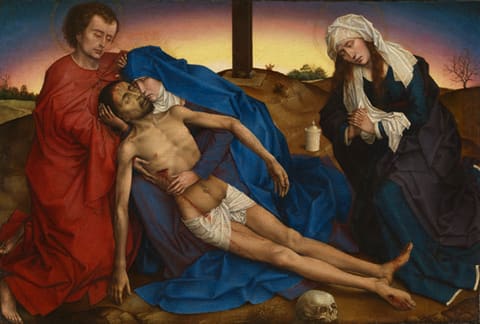
Pietà
N° 577·IV · Toward the Renaissance
Pietà
Rogier van der Weyden (1399/1400–1464)
c. 1441 · oil on oak panel
Netherlandish · Flemish Primitives

A small, intimate panel showing the dead Christ supported by the Virgin Mary and Saint John after the Deposition, painted with the restrained emotional intensity and precisely sculptural drapery characteristic of van der Weyden, the leading painter of 15th-century Brussels. The museum's own catalog record (translated from French) traces its provenance to the 1899 Pallavicino-Grimaldi sale in Genoa.

“Acquis à la vente Pallavicino-Grimaldi Gênes, galerie Sangiorgi, 29 novembre 1899 et j.s., n° 197” In the museum’s words — fine-arts-museum.be ↗ · quotation verified against the live page

Meanwhile — Domaru Armor Laced with Black Leather Thongs and Purple Red and White Cords East Asia · Japan, Muromachi period, 15th century

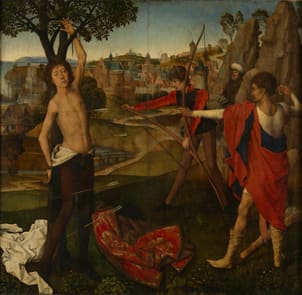
The Martyrdom of Saint Sebastian
N° 591·IV · Toward the Renaissance
The Martyrdom of Saint Sebastian
Hans Memling (c. 1440–1494)
c. 1475 · oil on oak panel
Netherlandish · Flemish Primitives

Saint Sebastian stands bound to a tree, pierced by arrows fired by four archers in contemporary 15th-century dress, painted by Memling with the calm, luminous restraint typical of his Bruges workshop, in contrast to the violence of the subject. The museum's own catalog record (translated from French) traces its acquisition to the Paris dealer Léon Gauchez in 1884.

“Acquis de Léon Gauchez, marchand, Paris, 1884” In the museum’s words — fine-arts-museum.be ↗ · quotation verified against the live page

Meanwhile — Blue-and-White Vase with Swan Design South Asia · Mid-to-late 15th century, Lê sơ dynasty

Calvary with a Donor
N° 608·IV · Toward the Renaissance
Calvary with a Donor
Hieronymus Bosch (c. 1450–1516)
c. 1495–1505 · oil on oak panel
Netherlandish · Flemish Primitives

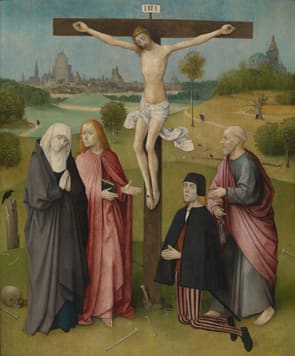
A small panel showing the Crucifixion with a kneeling donor portrait at the foot of the cross, its eerie, elongated figures and turbulent sky characteristic of Bosch's singular, unsettling religious imagery. The museum's own catalog record (translated from French) states it was acquired from Mrs F. Franchomme-Van Halteren of Brussels in 1952.

“Acquis de Mme F. Franchomme-Van Halteren, Bruxelles, 1952” In the museum’s words — fine-arts-museum.be ↗ · quotation verified against the live page

Meanwhile — Adorned Buddha South Asia · 15th - 16th century

The Adoration of the Magi
N° 679·V · The Renaissance
The Adoration of the Magi
Pieter Bruegel the Elder (c. 1527/30–1569)
c. 1556 · tempera (glue-size) on canvas
Flemish · Flemish Renaissance

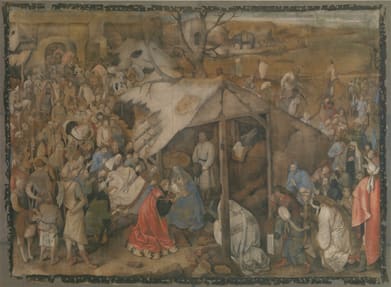
An early Bruegel painting of the Three Kings presenting their gifts to the infant Christ, executed in tempera (glue-size) on canvas rather than the artist's more usual oil on panel - a fragile distemper technique that survives in relatively few of his works. The museum's own catalog record (translated from French) notes it was acquired at the 1909 Edouard Fétis sale in Brussels and given to the museum by the Société des Amis des Musées royaux (Friends of the Royal Museums).

“Acquis à la vente Edouard Fétis, Bruxelles, galerie J. et A. Le Roy, 8-12 novembre 1909, n° 10. Don de la société Les amis des Musées royaux” In the museum’s words — fine-arts-museum.be ↗ · quotation verified against the live page

Meanwhile — Pine Forest East Asia · Azuchi-Momoyama period, 16th century

Landscape with the Fall of Icarus
N° 682·V · The Renaissance
Landscape with the Fall of Icarus
After Pieter Bruegel the Elder (c. 1527/30–1569)
c. 1560s (early copy after a lost original) · oil on canvas
Flemish · Flemish Renaissance

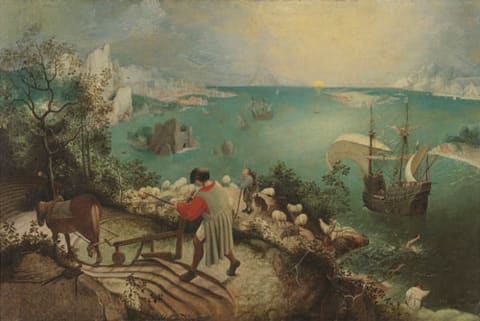
A ploughman, a shepherd, and a fisherman go about their work on a coastal landscape, seemingly oblivious to a small pair of legs splashing into the sea in the lower right corner - the mythological Icarus, fallen after flying too close to the sun. Long attributed to Bruegel himself, technical examination has cast doubt on that attribution, and the museum's own catalog page itself lists the artist only as 'Pieter I Bruegel (?)' with a question mark; it is now generally regarded as a good early copy of a lost Bruegel original. The museum's own record (translated from French) states it was acquired from the Sackville Gallery in London in 1912.

“Acquis de The Sackville Gallery, Londres, 1912” In the museum’s words — fine-arts-museum.be ↗ · quotation verified against the live page

Meanwhile — Tile Panel, Alfiz Islamic world · 1570–1580

The Fall of the Rebel Angels
N° 683·V · The Renaissance
The Fall of the Rebel Angels
Pieter Bruegel the Elder (c. 1527/30–1569)
1562 · oil on oak panel
Flemish · Flemish Renaissance

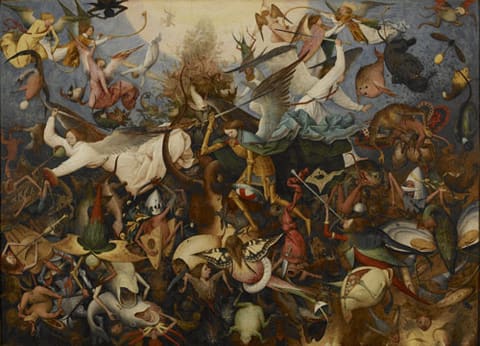
A swirling, densely packed battle scene showing the Archangel Michael and the forces of heaven driving Lucifer's rebel angels out of paradise, the fallen angels mutating into grotesque hybrid creatures, insects, and fish-like monsters as they plunge into darkness below. Bruegel signed and dated the panel in the lower left corner, 'M.D.LXII / BRVEGEL' (1562), per the museum's own catalog record (translated from French); it hangs today in the Old Masters Museum's dedicated Bruegel room, one of the museum's best-known Old Masters paintings.

“Date et signature dans de bas à gauche : M.D.LXII / BRVEGEL” In the museum’s words — fine-arts-museum.be ↗ · quotation verified against the live page

Meanwhile — Pine Forest East Asia · Azuchi-Momoyama period, 16th century

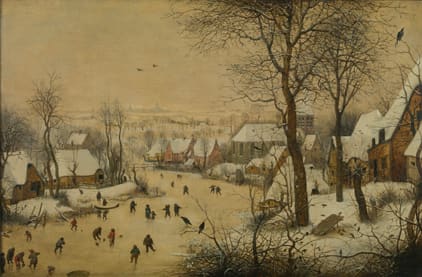
Winter Landscape with Skaters and a Bird Trap
N° 687·V · The Renaissance
Winter Landscape with Skaters and a Bird Trap
Pieter Bruegel the Elder (c. 1527/30–1569)
1565 · oil on oak panel
Flemish · Flemish Renaissance

A small panel depicting villagers skating and playing on a frozen pond beside a snow-covered church, with a baited bird trap set on the ice in the foreground - a quiet, everyday winter scene that Bruegel's own workshop and descendants would go on to copy many times over. Signed and dated in the lower right, 'BRVEGEL / M.D.LXV' (1565), per the museum's own catalog record (translated from French).

“Signature et date dans le bas à droite : BRVEGEL / M.D.LXV” In the museum’s words — fine-arts-museum.be ↗ · quotation verified against the live page

Meanwhile — Tile Panel, Alfiz Islamic world · 1570–1580

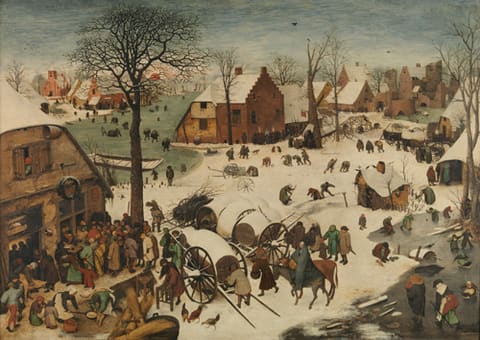
The Census at Bethlehem
N° 688·V · The Renaissance
The Census at Bethlehem
Pieter Bruegel the Elder (c. 1527/30–1569)
1566 · oil on oak panel
Flemish · Flemish Renaissance

A vast snow-covered Flemish village crowded with villagers registering for the Roman census, Bruegel transposing the biblical journey of Joseph and Mary to Bethlehem into the everyday bustle of a 16th-century Netherlandish winter, with Mary on a donkey barely visible amid the crowd. Signed and dated in the lower right, 'BREVGEL / 1566', per the museum's own catalog record (translated from French); one of the museum's two great dated Bruegel village panels alongside The Fall of the Rebel Angels.

“Signature et date dans le bas à droite : BREVGEL / 1566” In the museum’s words — fine-arts-museum.be ↗ · quotation verified against the live page

Meanwhile — Tile Panel, Alfiz Islamic world · 1570–1580

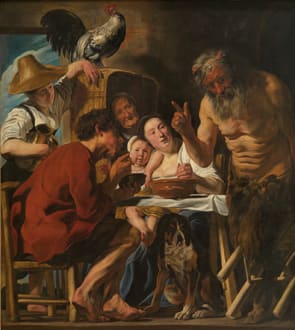
The Satyr and the Peasant
N° 742·VI · The Baroque Age
The Satyr and the Peasant
Jacob Jordaens (1593–1678)
c. 1620–1621 · oil on canvas
Flemish · Flemish Baroque

Illustrating Aesop's fable of the satyr who breaks off his friendship with a peasant who blows hot breath on his hands to warm them and cold breath on his soup to cool it, taking it as a sign of duplicity - a popular subject for Jordaens, painted here with the robust, warmly lit figures typical of his Antwerp workshop in the years after Rubens's return from Italy. The museum's own catalog record (translated from French) traces the canvas's acquisition to the London dealers Roland & Delbanco in 1940.

“Acquis de Roland & Delbanco, marchands, Londres, 1940” In the museum’s words — fine-arts-museum.be ↗ · quotation verified against the live page

Meanwhile — Water Fowl in the Lotus Pond East Asia · Japan, Edo period, early 17th century

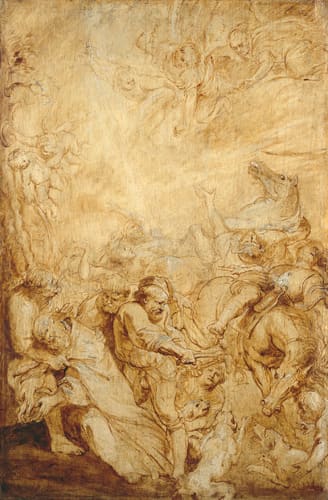
The Martyrdom of Saint Livinus
N° 750·VI · The Baroque Age
The Martyrdom of Saint Livinus
Peter Paul Rubens (1577–1640)
c. 1633 · oil on panel
Flemish · Flemish Baroque

A small, vigorously brushed oil sketch for one of Rubens's most gruesome altarpieces: the seventh-century Irish missionary bishop Livinus, his tongue torn out by hostile pagans in Flanders, held down as a dog carries off the severed member. Rubens made this modello, generally dated to around 1633, as the working design for the monumental altarpiece he painted for a Ghent church; the museum's own catalog record (translated from French) notes it was acquired through the Paris collector-dealer Fritz Lugt in 1952.

“Acquis par l'entremise de Mr Fritz Lugt, Paris, 1952” In the museum’s words — fine-arts-museum.be ↗ · quotation verified against the live page

Meanwhile — Water Fowl in the Lotus Pond East Asia · Japan, Edo period, early 17th century

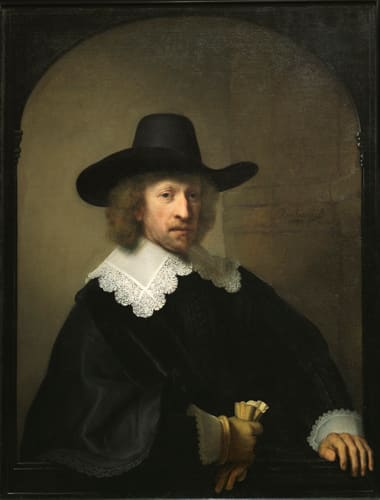
Portrait of Nicolaes van Bambeeck
N° 761·VI · The Baroque Age
Portrait of Nicolaes van Bambeeck
Rembrandt van Rijn (1606–1669)
1641 · oil on canvas
Dutch · Dutch Golden Age

A half-length portrait of the wealthy Amsterdam cloth merchant Nicolaes van Bambeeck, aged 44 according to the inscription at the top of the canvas, painted as one of a pair with the companion portrait of his wife, Agatha Bas. The museum's own catalog record (translated from French) transcribes Rembrandt's own signature and date, 'Rembrandt f. / 1641', with the sitter's age inscribed 'AE 44' above.

“Signature et date vers le milieu à droite : Rembrandt f. / 1641 ; inscription dans le haut au milieu : AE 44” In the museum’s words — fine-arts-museum.be ↗ · quotation verified against the live page

Meanwhile — Writing Box, Pontoon bridge design in "maki-e" lacquer East Asia · Edo period, 17th century

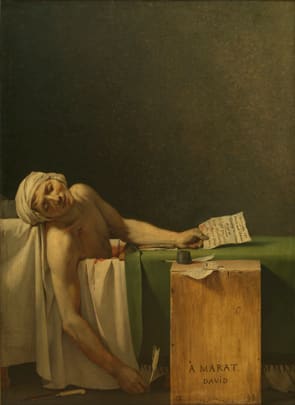
The Death of Marat
N° 842·VII · The Age of Reason
The Death of Marat
Jacques-Louis David (1748–1825)
1793 · oil on canvas
French · Neoclassicism

The revolutionary journalist Jean-Paul Marat lies dead in his medicinal bath, stabbed by his assassin Charlotte Corday, her letter of introduction still in his hand and a quill fallen from the other - painted by David, a friend and fellow revolutionary, within months of Marat's 1793 murder, as an image of secular martyrdom for the Revolution. The wooden crate beside the bath is inscribed with David's dedication, transcribed on the museum's own catalog record (translated from French) as 'A MARAT, / DAVID / L'AN-DEUX' ('To Marat, David, Year Two' of the French Republican calendar). Widely regarded as the single most famous painting in the museum's collection.

“Dédicace, signature et date en bas vers la droite sur la caisse : A MARAT, / DAVID / L'AN-DEUX” In the museum’s words — fine-arts-museum.be ↗ · quotation verified against the live page

Meanwhile — Segawa Kikunojō III as Oshizu, wife of Tanabe Bunzō East Asia · 1794

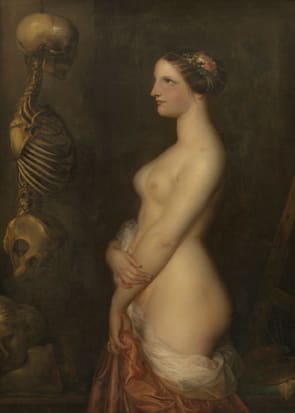
The Beautiful Rosine
N° 889·VIII · The Restless Century
The Beautiful Rosine
Antoine Wiertz (1806–1865)
1847 · oil on canvas
Belgian · Belgian Romanticism

A young nude woman recoils as she comes face to face with a standing skeleton labelled with her own name, 'La belle Rosine', on a tag glued to its skull - Wiertz's grim memento mori equating the model's living body with the death's-head she will become. The museum's own catalog record (translated from French) transcribes both inscriptions on the canvas, including Wiertz's own note that the sketch-like handling was deliberate ('doing it well is only a matter of time'); the work entered the collection as part of the artist's 1865-1868 bequest, which also founded the Wiertz Museum in his former studio.

“Titre dans le haut à gauche sur une étiquette collée sur le crâne du squelette : La belle / Rosine ; inscription à mi-hauteur à droite : Ebauche / faire bien n'est / qu'une question de temps” In the museum’s words — fine-arts-museum.be ↗ · quotation verified against the live page

Meanwhile — Jade Seal 'Đại Nam Thụ Thiên Vĩnh Mệnh Truyền Quốc Tỷ' South Asia · 1847, reign of Emperor Thiệu Trị, Nguyễn dynasty

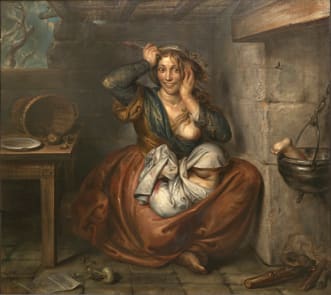
Hunger, Madness and Crime
N° 902·VIII · The Restless Century
Hunger, Madness and Crime
Antoine Wiertz (1806–1865)
1853 · oil on canvas
Belgian · Belgian Romanticism

A destitute mother, driven out of her mind by hunger, has just killed her own child and begun to cook its leg over the fire - one of Wiertz's most deliberately shocking social-protest paintings, its title naming hunger, madness, and crime as a single causal chain. The museum's own catalog record (translated from French) transcribes a scrap of paper marked 'CONTRIBUTIONS' visible within the scene, the artist's pointed indictment of public indifference to poverty; like The Beautiful Rosine, the canvas entered the collection through the artist's 1865-1868 bequest that established the Wiertz Museum.

“Inscription dans le bas à gauche : CONTRIBUTIONS” In the museum’s words — fine-arts-museum.be ↗ · quotation verified against the live page

Meanwhile — Retrato de Manuelita Rosas Americas & Oceania · 1851

Scandalized Masks
N° 929·VIII · The Restless Century
Scandalized Masks
James Ensor (1860–1949)
1883 · oil on canvas
Belgian · Belgian Fin-de-Siècle

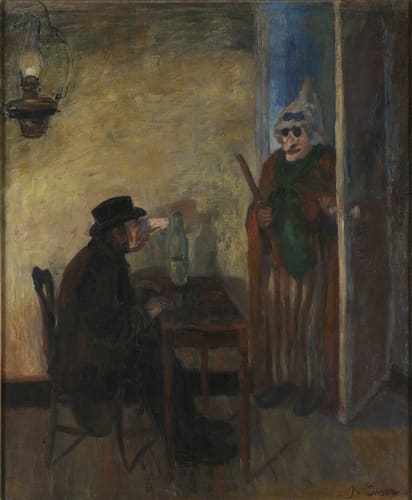
Two masked figures confront each other in a cramped, shabby interior above the Ensor family's souvenir and mask shop in Ostend, one brandishing a poker - an early instance of the carnival masks Ensor returned to across his career as vehicles for unease and hypocrisy rather than festivity. Signed and dated 1883 in the lower right, per the museum's own catalog record (translated from French), which also credits reproduction rights to SABAM Belgium; the museum acquired the canvas directly from the artist in Ostend in 1920.

“Signature et date dans le bas à droite : J. Ensor 1883” In the museum’s words — fine-arts-museum.be ↗ · quotation verified against the live page

Meanwhile — Madame X (Virginie Amélie Avegno Gautreau) Americas & Oceania · 1883–84

The Hammerman
N° 959·VIII · The Restless Century
The Hammerman
Constantin Meunier (1831–1905)
1890 · bronze
Belgian · Belgian Realism

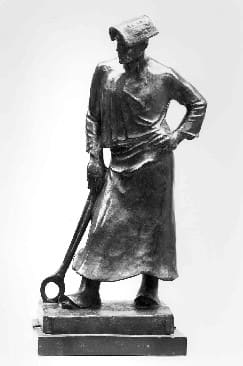
A bare-chested ironworker braces to swing his hammer, his weight thrown onto one leg in a moment of coiled physical effort - one of Meunier's best-known bronzes of industrial labor, part of a body of work that cast Belgium's steelworkers, miners, and dockers in the heroic mold more traditionally reserved for saints and soldiers. The museum's own catalog record (translated from French) records the founder's mark cast into the base, 'B. VERBEYST FONDEUR / BRUXELLES' (B. Verbeyst, founder, Brussels), alongside Meunier's own signature.

“Signature sur la terrasse : C Meunier ; inscription : B. VERBEYST FONDEUR / BRUXELLES” In the museum’s words — fine-arts-museum.be ↗ · quotation verified against the live page

Meanwhile — Mangaaka Power Figure (Nkisi N’Kondi) Africa · ca. 1880–1900

The Caresses
N° 971·VIII · The Restless Century
The Caresses
Fernand Khnopff (1858–1921)
1896 · oil on canvas
Belgian · Belgian Symbolism

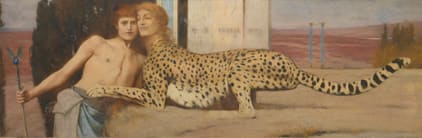
A leopard-bodied sphinx with a woman's face nuzzles against a passive, androgynous youth in front of a shallow Egyptianizing column - one of the defining images of Belgian Symbolism, also known as 'The Sphinx' or 'Art, or The Caresses'. Signed and dated 1896 in the lower right; the museum's own catalog record (translated from French) notes it was acquired from the L.T. Neumann Gallery in Vienna in 1956.

“Acquis de la Galerie L.T. Neumann, Vienne, 1956” In the museum’s words — fine-arts-museum.be ↗ · quotation verified against the live page

Meanwhile — Sleigh by the McLaughlin Carriage Company Americas & Oceania · Around 1896

The Dyke
N° 1002·IX · Into Our Time
The Dyke
Léon Spilliaert (1881–1946)
1909 · Chinese ink wash, brush, watercolor, and colored pencil on paper laid down on card
Belgian · Belgian Symbolism

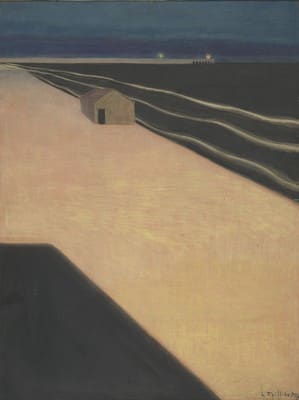
A solitary, sharply raking view of Ostend's empty sea-front promenade at night, rendered in Spilliaert's characteristic wash-and-watercolor technique, its stark diagonal perspective and near-total absence of figures typical of the brooding nocturnal scenes he made of his native seaside town. Signed and dated 1909, the work was given to the museum by the artist's daughter, Madeleine Spilliaert, in 1984; the museum's own catalog record (translated from French) explicitly lists it as being in the public domain.

“Don de Mme Madeleine Spilliaert, fille de l'artiste, Bruxelles, 1984” In the museum’s words — fine-arts-museum.be ↗ · quotation verified against the live page

Meanwhile — The hilltop Americas & Oceania · circa 1908

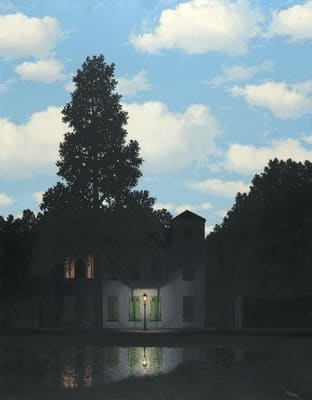
The Empire of Light
N° 1069·IX · Into Our Time
The Empire of Light
René Magritte (1898–1967)
1954 · oil on canvas
Belgian · Surrealism

A quiet suburban street glows under lamplight in the dead of night, its lit windows and streetlamp naturalistically rendered - while directly above, the sky is a bright, cloud-scattered blue, exactly as it would appear at midday: Magritte's best-known device for making night and day coexist within a single, otherwise perfectly ordinary image. This is one of more than two dozen versions Magritte painted of the composition across two decades; the museum's own catalog record (translated from French) states this canvas was acquired directly from the artist in Brussels in 1954, the same year it was painted.

“Acquis de l'artiste, Bruxelles, 1954” In the museum’s words — fine-arts-museum.be ↗ · quotation verified against the live page

Meanwhile — Landscape in the Nude Africa · 1953